From Discounts to Rebates: what the 340B pilot changes about cash flow
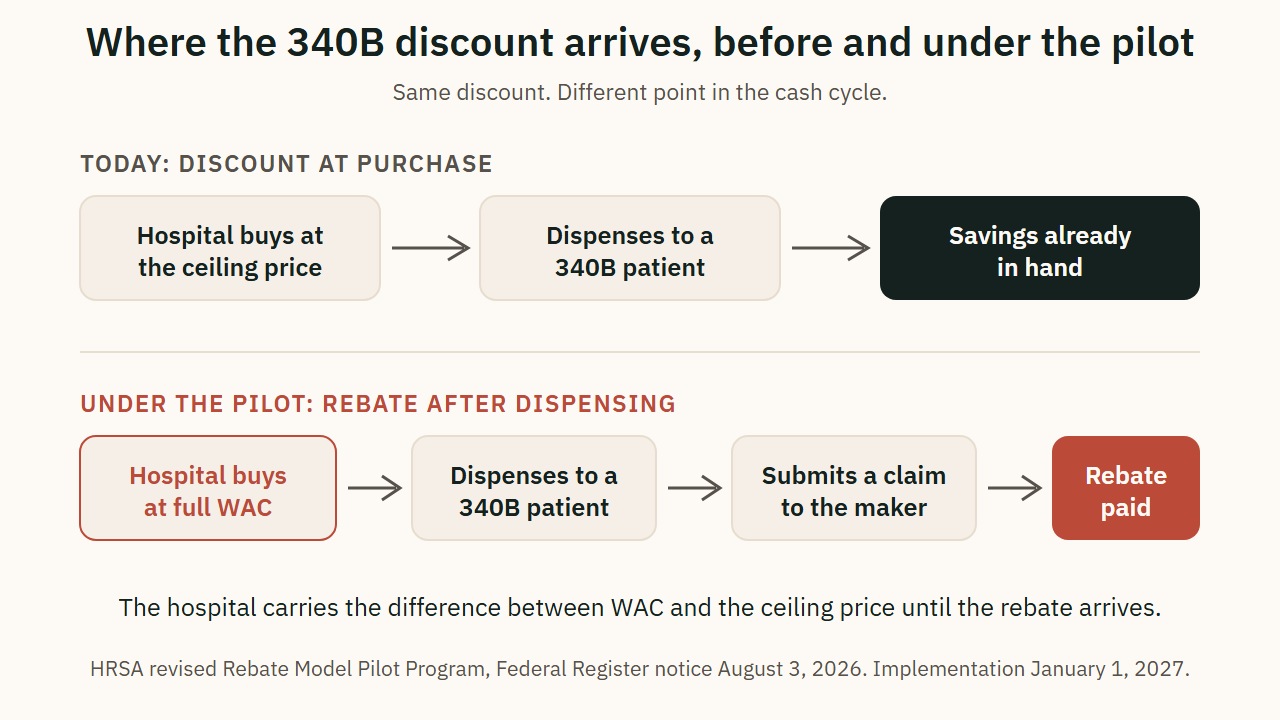
The operational landscape of the 340B Program is undergoing its most significant transformation since the program's inception. For decades, the model was built on "point-of-sale" discounts, allowing covered entities to preserve capital by purchasing medications at or below a defined ceiling price. As of August 3, 2026, the Health Resources and Services Administration (HRSA) has effectively retired that certainty for a subset of the highest-stakes drugs in the pharmacy.
The rules have shifted from immediate discounts to a reimbursement model. Under this new pilot, covered entities must buy specific drugs at the full Wholesale Acquisition Cost (WAC) and claim rebates later to recoup the 340B discount. For pharmacy directors and CFOs, the time for advocacy is effectively over; the time for arithmetic has begun. The program moves from a discount-at-purchase model to a "wait-and-see" model where the hospital carries the financial burden of the manufacturer's float.
The Scope Expansion: 25 Drugs, 13 Manufacturers, and Zero Room for Error
The finalized pilot program is significantly more aggressive than the initial proposal. While the first iteration suggested a scope of 10 drugs from eight manufacturers, the revised pilot has more than doubled to include 25 drugs from 13 manufacturers. This expansion is driven explicitly by the inclusion of drugs subject to price negotiations in both 2026 and 2027.
The clock is ticking on two fronts. First, manufacturer plan submissions are due by August 24, 2026. This is the date when the specific "rules" of submission will be dictated by the pharmaceutical industry. Second, the pilot officially implements on January 1, 2027. This leaves a razor-thin window for facilities to adjust procurement workflows and auditing systems to accommodate high-cost, high-volume products that will no longer be discounted at the wholesaler level.
The "Admin Tax": HRSA's Own $34,320 Price Tag
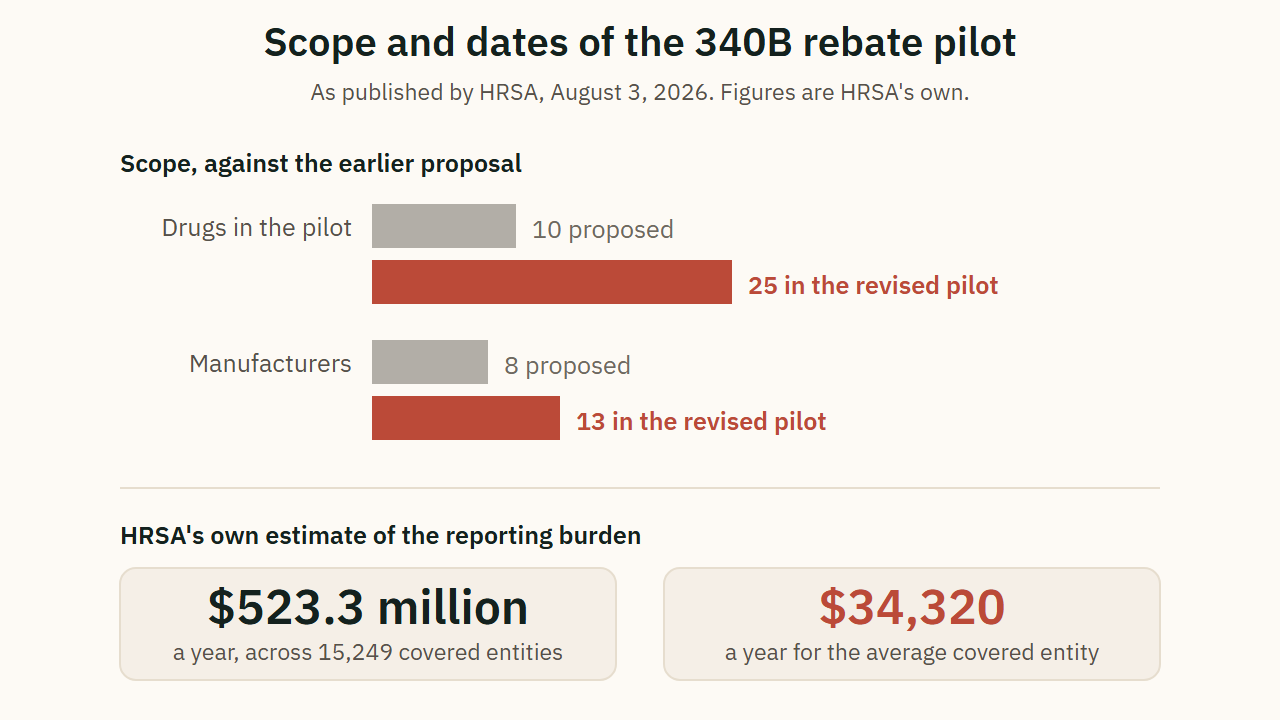
Transitioning to a rebate model introduces a massive administrative burden that functions as a hidden tax on covered entities. HRSA has acknowledged this by providing its own estimates for the cost of compliance, a figure that is likely conservative given the systemic complexity of hospital pharmacy.
For a Healthcare Finance Strategist, this $34,320 is not just a paperwork cost; it is a compounding cost. It represents the labor and system spend required to chase the millions of dollars in cash flow that will now be tied up in the "float." This estimate covers reporting only, it does not include the actual capital carrying costs or the loss of interest on funds effectively loaned to manufacturers.
The Cash Flow Collision: Projections vs. Reality
A central tension exists between hospital leadership and federal regulators regarding liquidity. While HRSA has stated on the record that it believes the pilot is unlikely to result in "unstable cash flow," hospitals have argued that higher short-term acquisition costs will lead to delayed access to savings.
To be clear: Under this pilot, the hospital is providing an interest-free loan to the manufacturer. The "carrying cost" is the price of that loan. To navigate this, CFOs must bring Pharmacy, Finance, and Revenue Cycle leadership into the same room to answer four operational questions left open by the HRSA notice:
| What | Why it matters |
|---|---|
| Payment Timing | HRSA will monitor how long it takes for rebates to be issued but has not established a mandatory turnaround. |
| Denied Claims | Every denied rebate is a lost 340B discount that was already budgeted. This creates a new "denial queue" that someone must own. |
| Data Ownership | The process relies on a split data stream: dispensing data from pharmacy systems and eligibility data from 340B software. |
| Contract Pharmacy Friction | When drugs are dispensed via third parties, the data path is longer and involves a third party, significantly increasing the risk of friction and manufacturer denial. |
The Operational "New Normal": Who Owns the Denial?
In the current model, savings are "locked in" at purchase. Under the rebate pilot, the discount is only realized if a claim is successfully submitted, accepted, and paid. This creates a dangerous accountability gap. Because the required data is split between disparate software systems, claims will fall through the cracks unless an owner is appointed.
Action is required now: Hospital leadership must explicitly appoint a leader, likely a 340B Program Manager or a Revenue Integrity lead, to own the submission process and the "denial queue." This role must manage manufacturer-level disputes with the same rigor the Revenue Cycle team applies to payer denials.
Furthermore, do not wait for January to discover technical limitations. You must interview your 340B software vendor and your wholesaler this month to determine exactly what they are building to automate these submissions. If they aren't building an automated bridge, your $34,320 administrative cost will likely triple.
The Critical Quarter-Four Calculation
To prepare for the January 1 start date, hospital finance departments must move beyond generalized projections and calculate their specific "carrying cost." Perform the following calculation this quarter:
| What | Why it matters |
|---|---|
| Identify Scope | Determine which of the 25 pilot drugs your facility currently purchases and your annual 340B units for each. |
| Determine the Spread | Identify the dollar difference between the WAC and the 340B ceiling price per unit for those specific drugs. |
| Model Payment Lags | Multiply that spread by your volume and model the impact of the rebate arriving at 30, 60, and 90-day intervals. |
| Add the Admin Tax | Add HRSA's $34,320 administrative estimate to the result of your highest lag model. |
This total dollar figure is the only concrete way to have a productive conversation with hospital finance regarding the working capital the facility must carry starting January 1.
Conclusion: A Program Under Evaluation
The 340B Rebate Model Pilot Program is scheduled for a formal evaluation by April 30, 2028. Over the next year, HRSA will monitor payment timing and dispute outcomes. However, facilities cannot afford a "wait-and-see" approach.
With 66.7% of 340B leaders already naming the program as their top concern, the introduction of this pilot adds a layer of financial risk to a system already pushed to its limit. The most pressing question for any covered entity today is no longer about policy, it is about liquidity: Is your facility prepared to act as an interest-free creditor to pharmaceutical manufacturers starting January 1st?
Related
- HRSA on the 340B rebate model pilot
- Healthcare Finance News on the revised pilot
- The Business of the Pharmacy, on the drug budget, purchasing and where 340B savings show up
- Keeping the Pharmacy Compliant, on 340B program integrity and audit readiness
Want the practice knowledge behind this?
Your First Year as a Hospital Pharmacist covers the clinical judgment a residency front-loads. Part of the Pharmacy Handoff library.
See the book