Making the business case for a new pharmacy position

Why good requests get refused
It is a scenario familiar to almost every pharmacy leader: after months of overwork, rising drug shortages, and a dedicated team stretched to the breaking point, you submit a well-reasoned request for a new staff position. You highlight patient safety and clinical necessity. You wait. Then, the rejection arrives, usually citing a lack of funds or a "hiring freeze."
The frustration is real, but the failure often has nothing to do with the merit of the request. Most pharmacy resource requests fail because they are delivered in the wrong "language," aimed at the wrong interest, and delivered at the wrong point in the fiscal year. To move from "asking for a favor" to "presenting a business case," you must stop talking like a pharmacist and start acting like a resource strategist.
Here are six counter-intuitive strategies to transform your staffing requests into professional business arguments.
Ask in finance's vocabulary
A request that claims "workload is unsafe" is a clinical claim delivered to an audience that does not make clinical decisions. The person approving a full-time equivalent (FTE) is accountable for a productivity target; if your request ignores that target, it reads as a request to make their performance numbers worse. To succeed, you must adopt the vocabulary of the people who hold the budget.
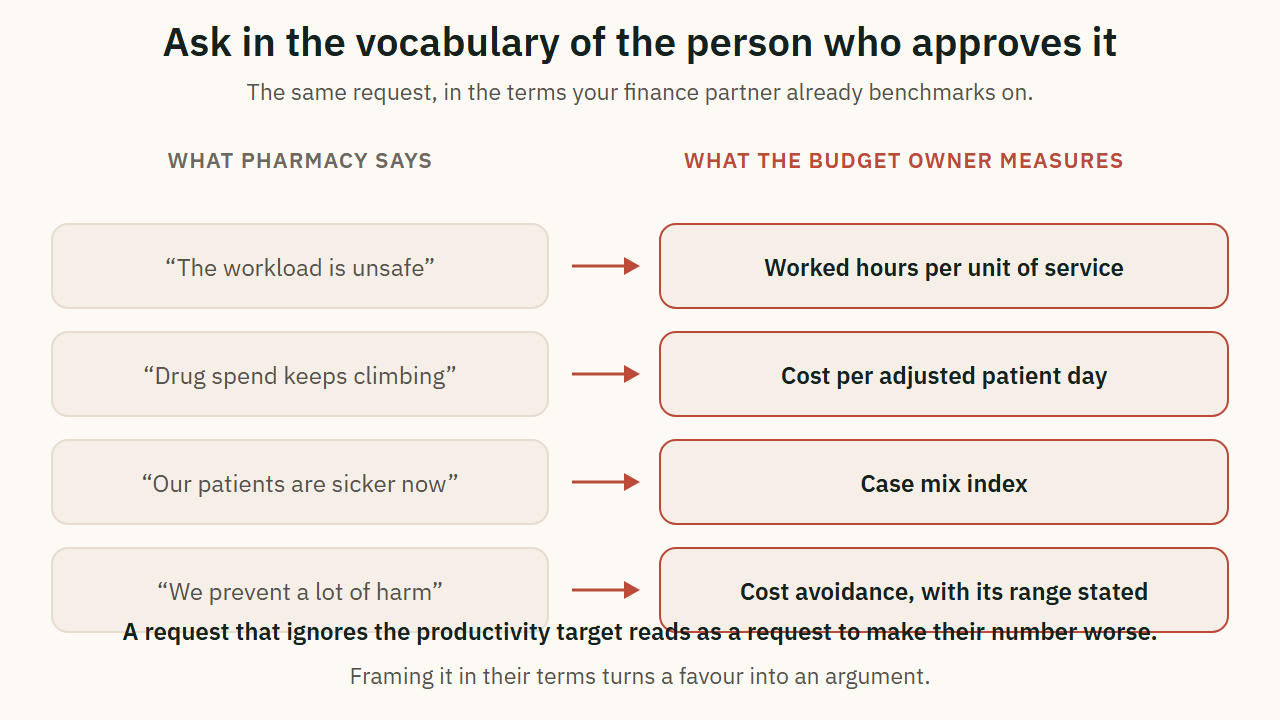
Use the following financial benchmarks to frame your argument:
| Term | What it means | Why it belongs in the ask |
|---|---|---|
| Cost per adjusted patient day | Drug spend normalized to hospital activity volume. | Allows you to show cost movement independent of patient volume. |
| Case mix index (CMI) | The average "sickness" or acuity level of the patient population. | Explains rising complexity that current headcount hasn't tracked. |
| Worked hours per unit of service | The productivity denominator used by finance. | This is the number your request will be judged against regardless of your terminology. |
| Cost avoidance | Spending prevented (rather than spending reduced). | The category where most pharmacy interventions fall, and the most credible way to frame ROI. |
"Framing the ask in the target's own terms converts it from a favour into an argument."
The work already being done
The strongest business case demonstrates that you aren't asking for "new" work, you are asking to fund work that is already occurring inefficiently.
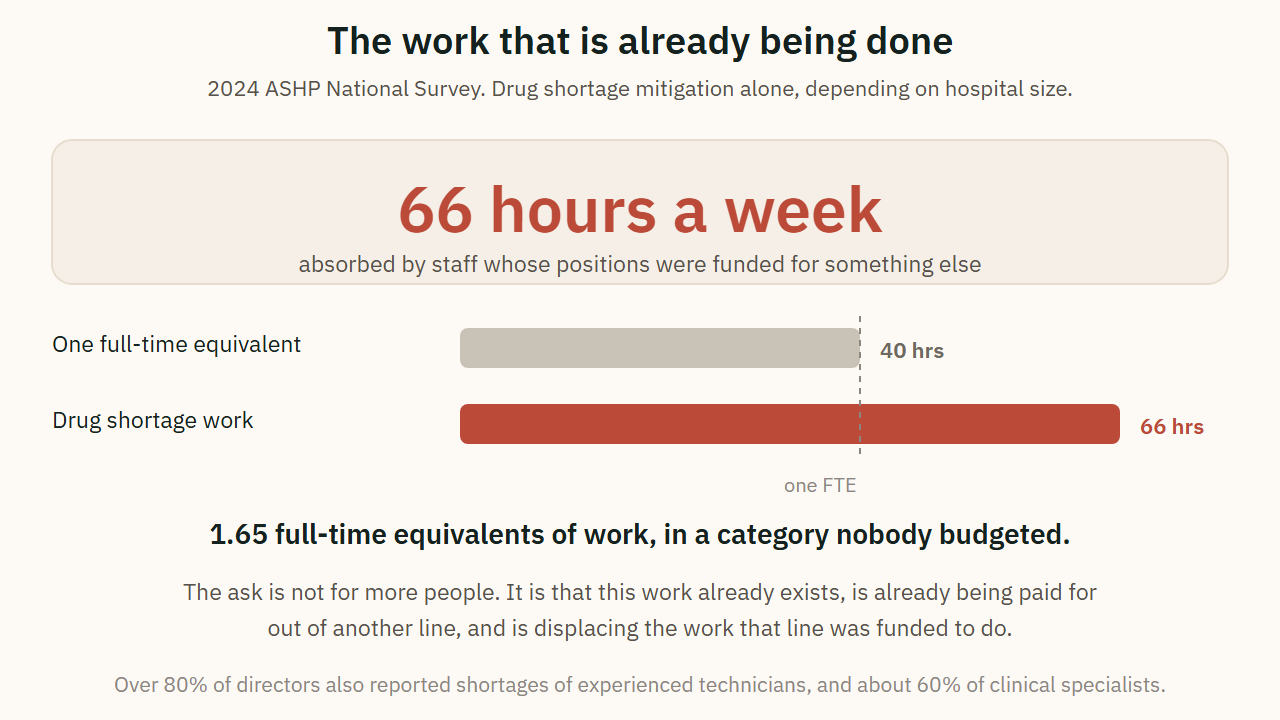
The 2024 ASHP National Survey of Pharmacy Practice in Hospital Settings (published in the American Journal of Health-System Pharmacy in September 2025) surveyed directors at 1,497 hospitals with a 16.7 percent response rate. The data reveals that pharmacy staff spend up to 66 hours per week merely mitigating drug shortages.
At a 40-hour week that is 1.65 full-time equivalents of labor already being paid for out of other lines. When you absorb this work without a dedicated position, it quietly converts a clinical service into a shortage-management service without any executive ever approving that decision.
When arguing for specific roles, use the following national comparators from the survey to provide objective criteria for your coverage:
- General med-surg: 73.3%
- Critical care: 68.5%
- Oncology: 56.9%
- Cardiology: 48.5%
- Infectious disease/Antimicrobial stewardship: 48.1%
- Emergency department: 46.5%
The return on investment literature, and its limits
There is a vast literature on the Return on Investment (ROI) of pharmacy services, but presenting only the most optimistic numbers damages your credibility. CFOs are trained to look for outliers.
In the review by Schumock and Perez, the median ROI for clinical pharmacy services ranged from 1 to 4.81. While the wider set of pharmacoeconomic reviews reports ratios as high as 1 to 75.84, presenting a 75:1 ratio is not a credible claim in a budget meeting.
Intellectual honesty is your most powerful tool for building trust. A systematic review of 41 studies found cost avoidance varies widely, and the quality is uneven: only 6 of those 41 studies met at least 7 of the 10 "Drummond checklist" criteria for economic quality. By admitting these limitations before your finance partner finds them, you demonstrate that you are a leader who analyzes data with rigor rather than an advocate cherry-picking abstracts.
"A defensible range with its limitations stated is what a CFO recognizes as an honest analysis, and honesty is the thing being assessed as much as the number."
Interests, not positions
Based on the Fisher and Ury framework of principled negotiation, you must distinguish between your "position" and the underlying "interests."
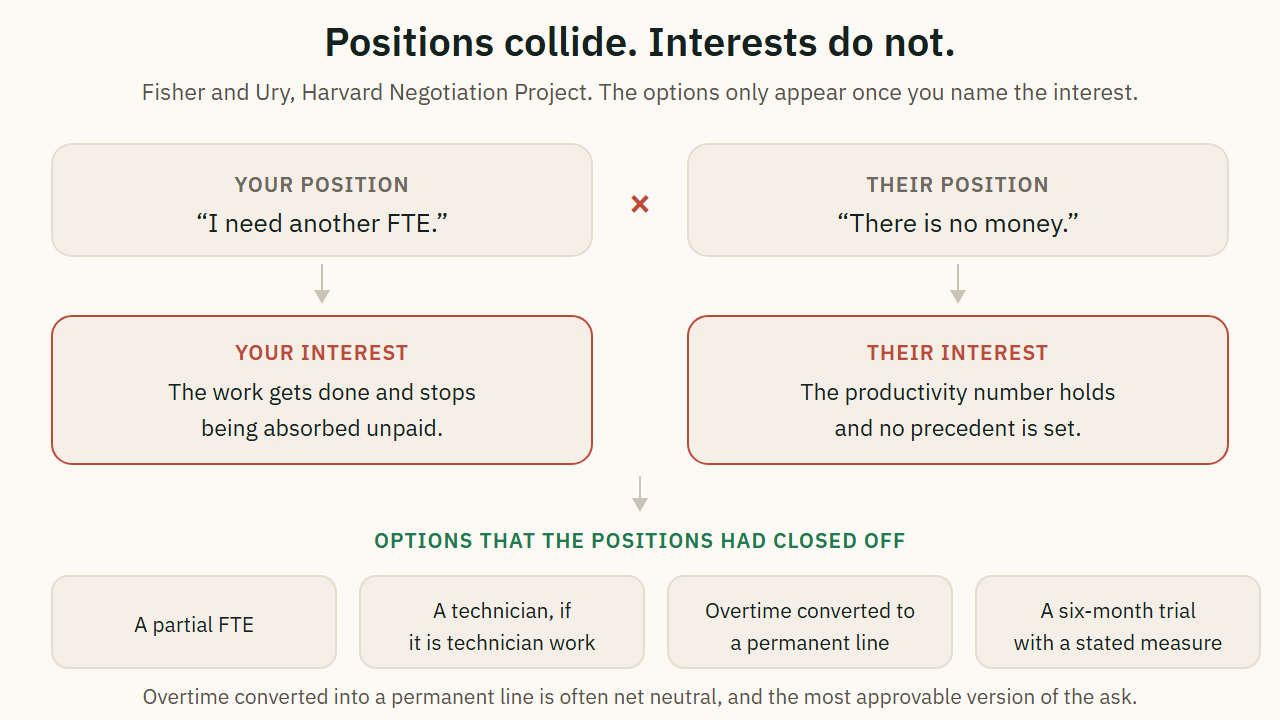
- The Positions: You say, "I want an FTE." Finance says, "There is no money."
- The Interests:
- Pharmacy Interests: Getting the work done, reducing clinical risk, and stopping staff from absorbing unpaid labor.
- Finance Interests: Maintaining productivity numbers, avoiding precedents for other departments, and preventing unbudgeted mid-year arrivals.
Once interests are visible, you can generate options that resolve both sides. The "Gold Standard" move, and the single most approvable version of this request, is the conversion of existing overtime into a permanent line, which is often net-neutral to the budget. Other options include:
- Requesting a technician instead of a pharmacist if the work is technical.
- Funding the position through avoided contract labor spend.
- Proposing a six-month trial with a stated performance measure.
Timing the ask to the budget cycle
Most requests are made the week after a particularly difficult shift. However, budget decisions are made on a fixed calendar. A request made at the wrong time is not rejected, it is "deferred," which is functionally the same result.
You must stop competing against a "closed spreadsheet." You need to know three specific dates:
- When the capital and operating budget process opens.
- When position requests are due.
- When the current fiscal year ends.
A request submitted in "month seven" of the fiscal year is almost impossible to approve. A request submitted before the process opens, backed by trended data, is competing on its merits.
Naming the consequence of no
A business case that only describes the "upside" reads as a wish list. A professional assessment must name the operational consequences of a rejection. The key is to state consequences flatly, describing what service is reduced or what the queue looks like, without directing the consequence at the decision-maker.
- Operational Consequence (Use This): "Without this position, we will be unable to sustain weekend stewardship coverage, and the medication reconciliation queue will increase by an estimated four hours."
- Personnel Threat (Avoid This): "I cannot be responsible for what happens to patient safety if we don't get this staff."
The latter converts a business argument into a personnel matter, which often triggers a defensive rejection.
Why bother if it might be refused
Building a business case is an investment in your own professional capital. It provides an "intangible return" that benefits your career regardless of the immediate outcome:
- Creates a Leadership Artefact: A written business case is a professional artefact that proves you can convert operational problems into executive decisions. It often circulates to senior leaders who do not see your daily work, demonstrating your readiness for higher responsibility.
- Shifts Motivation: Moving from reacting to workload to owning the resource process shifts you from "controlled" to "autonomous" motivation. You cease being a victim of your circumstances and become a leader of your resources.
- Secures Your Queue Position: Many budget refusals are based on timing. A sourced, trended, and ready-to-go business case is often the first one approved the moment a hiring freeze lifts or a vacancy is released. The people who get resources are usually the ones who asked before the money existed.
The action plan
To move from frustration to action, use "implementation intentions" to bind your goals to specific situational cues. Commit to these two plans this week:
- If you are in the office this week, then ask your finance business partner for the budget timeline by email.
- If your organization's budget calendar opens, then before the first meeting, pull three numbers from the last four quarters: your department's worked hours per unit of service, your overtime and contract labor spend, and the ASHP national percentage for the coverage you are requesting.
Are you currently a victim of your workload, or a leader of your resources?
The one-page business case
| Element | Why it Matters |
|---|---|
| One-sentence request and cost | Readers decide whether to continue in the first ten seconds. |
| Trended numbers (last 4 quarters) | Moves the conversation from anecdotes to objective data. |
| Current work absorption | Establishes that the labor already exists and is being paid for inefficiently. |
| National comparators | Provides objective criteria via ASHP survey percentages. |
| Honest financial range | Uses the 1 to 4.81 median; identifies limitations to build trust. |
| Three options (not one "ask") | Includes the "Gold Standard" overtime-to-FTE conversion. |
| Success measures | Converts the request into a trial that can be evaluated. |
| Operational consequence | Stated flatly; defines the cost of a "no" by naming which service is reduced. |
References
- ASHP National Survey of Pharmacy Practice in Hospital Settings: Clinical Services and Workforce, 2024. Am J Health-Syst Pharm 2025;82(18):979. PMID: 40557732.
- Schumock GT, Perez A, et al. Reviews of economic evaluations of clinical pharmacy services.
- Economic impact of clinical pharmaceutical activities in hospital wards: a systematic review of 41 studies. PMID: 32819880.
- Fisher R, Ury W. Getting to Yes: Negotiating Agreement Without Giving In. Harvard Negotiation Project.
- Gollwitzer PM, Sheeran P. Implementation intentions and goal achievement: a meta-analysis of effects and processes. Adv Exp Soc Psychol 2006;38:69-119.
- Deci EL, Ryan RM. Self-determination theory: autonomous versus controlled motivation.
Want the practice knowledge behind this?
Your First Year as a Hospital Pharmacist covers the clinical judgment a residency front-loads. Part of the Pharmacy Handoff library.
See the book