The DSCSA "Small Dispenser" Deadline: Why Your Pharmacy Might Already Be Out of Compliance
Many pharmacy directors and compliance officers are operating under a dangerous regulatory assumption: that the "small dispenser" exemption grants them a reprieve from the Drug Supply Chain Security Act (DSCSA) until late 2026. However, this belief often stems from a fundamental misunderstanding of the FDA's criteria. If your organization has miscalculated its status, you aren't waiting for a future deadline, you have been operating out of compliance since November 2025.
The stakes of this oversight are high. Does "small" actually mean what you think it means, or are you currently exposed to significant regulatory risk?
The Hidden Math of the "Small Dispenser" Test
The criteria for the small dispenser exemption are precise and unforgiving: a dispenser must have 25 or fewer full-time licensed pharmacists and qualified pharmacy technicians.
This headcount is the primary trap for pharmacy leadership. In most professional contexts, a pharmacy's size is measured solely by its pharmacist count. However, the DSCSA aggregate includes qualified pharmacy technicians. For an industry analyst, this is a glaring red flag: a department with 12 pharmacists, seemingly well under the 25-person limit, loses its exemption the moment those 12 are joined by 14 or more technicians. By including both roles in the calculation, the FDA has ensured that the "small" designation is much narrower than many realize.
It's a Corporate Count, Not a Site Count
The second major point of failure in compliance strategy is the "site-level" fallacy. The small dispenser definition applies to the entire corporate entity, not individual pharmacy locations. The headcount must encompass every licensed pharmacist and qualified technician across the owner's entire organization.
This rule is particularly impactful for small hospital sites or satellite clinics that are part of a larger health system. While an individual facility may feel like a small operation, its compliance deadline is dictated by the size of the parent corporation.
The "Frozen Count" and the Burden of Self-Determination
Crucially, your status is not dynamic. The employee totals were fixed as of November 27, 2024. According to the FDA guidance, growth since that date does not move you out of the exemption, and a reduction in force since then does not move you into it.
Furthermore, the responsibility for this math falls entirely on the dispenser. There is no application process and no notification to the FDA is required; a dispenser determines its own eligibility. Because there is no external check to catch an incorrect determination, the burden of proof remains with you during a regulatory audit or investigation.
Note that for departments utilizing complex staffing models, such as heavy reliance on part-time or per-diem staff, the calculation of a "full-time employee" (FTE) is not explicitly defined in the guidance. The advice is direct: ask your corporate counsel to validate your FTE mapping before November, rather than trying to justify it after a violation is cited.
The Clock is Ticking (Or Has Already Stopped)
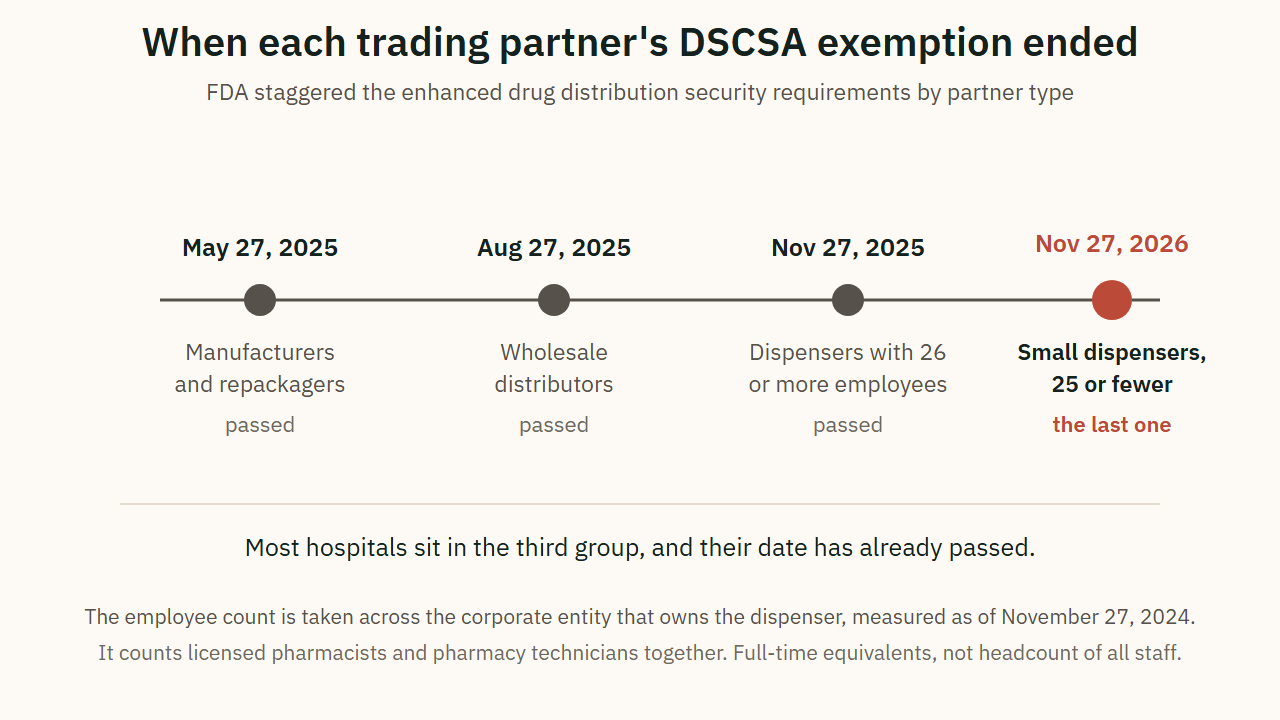
The FDA established staggered deadlines for the end of exemptions from enhanced drug distribution security requirements. For those who have miscalculated their headcount, the "wait and see" period ended nearly a year ago.
The critical DSCSA deadlines are as follows:
-
Manufacturers and Repackagers: May 27, 2025
-
Wholesale Distributors: August 27, 2025
-
Large Dispensers (26+ employees): November 27, 2025
-
Small Dispensers (25 or fewer employees): November 27, 2026
If your corporate headcount was 26 or more on the fixed measurement date, you are already required to be in full compliance.
"Exempt" Doesn't Mean "Excused" from DSCSA
One of the most dangerous phrases in pharmacy operations today is "We are exempt from DSCSA." This is a legal oversimplification. The small dispenser exemption applies strictly to five "enhanced" security requirements:
| What | Why it matters |
|---|---|
| Electronic package-level transaction exchange | Moving transaction information electronically for every purchase. |
| Package-level verification | The ability to verify the product identifier on a specific package. |
| Prompt response to regulators | Producing transaction data quickly during investigations or recalls. |
| Gathering transaction history | Tracing product info back through the supply chain. |
| Saleable returns | Accepting returns only with the associated transaction documentation. |
All other DSCSA obligations, including the mandate to transact only with authorized trading partners and the strict protocols for handling suspect and illegitimate products, remain in full effect. For a compliance auditor, "exempt" is a narrow clinical status, not a total pass.
The Afternoon Audit: Three Steps for Your Wholesaler
Whether your deadline is behind you or ahead of you, the data you need lives with your suppliers. You can bridge the gap between "math" and "action" in a single afternoon by verifying these three areas:
| What | Why it matters |
|---|---|
| Confirm Electronic Data Reception | Access your primary wholesaler's portal. The data has been flowing since their own deadline in August 2025. If no one in your department knows how to access this package-level information, you have an immediate compliance gap. |
| Verify On-Demand Retrieval | Do not trust the system in theory. Pick a specific product from your shelf, attempt to retrieve its transaction information, and time the process. |
| Check Secondary and Specialty Suppliers | While primary wholesalers are generally prepared, secondary and specialty sources often lag behind. These secondary sources are where compliance gaps hide, and you cannot fix these gaps if you haven't identified them yet. |
Conclusion: The November Mandate
Your immediate priority is to confirm your corporate employee count as of November 27, 2024. If that number is 26 or higher, the "Afternoon Audit" is no longer a preparation exercise, it is a mandatory self-audit for a deadline you have already missed.
Waiting for a regulatory investigation or a high-stakes recall to test your systems is a recipe for disaster. Are you truly prepared to defend your "small dispenser" status and produce package-level data under pressure?
Related
- FDA on DSCSA and its exemptions
- NABP on the small dispenser exemption
- Keeping the Pharmacy Compliant, on building a survey-ready record for requirements like this
- The Business of the Pharmacy, on wholesaler contracts and what the portal is supposed to give you
Want the practice knowledge behind this?
Your First Year as a Hospital Pharmacist covers the clinical judgment a residency front-loads. Part of the Pharmacy Handoff library.
See the book