What reduced hours do to a career over ten years

The desire for a better work-life balance is not a character flaw; it is a near-universal professional reality. Whether you are a pharmacist navigating the exhaustion of a residency, a new parent, or a mid-career professional caring for an aging relative, the offer to reduce your hours, shifting to a 0.8 FTE or a job-share, frequently looks like a lifeline.
But here is the reality your HR department won't tell you: what you treat as a temporary schedule adjustment often behaves like a permanent trajectory change. I am not here to talk you out of your life choices or suggest you prioritize a pharmacy bench over your family; I am here to make sure you don't get robbed by a lack of clarity. If you are going to change your schedule, you must "price" the decision before you sign the paperwork.
What a whole country's payroll records show
When assessing career deceleration, we must move past subjective surveys and "feelings." To understand the true mechanics of how careers break, we look to the 2019 study by Henrik Kleven, Camille Landais, and Jakob Egholt Søgaard: "Children and Gender Inequality: Evidence from Denmark."
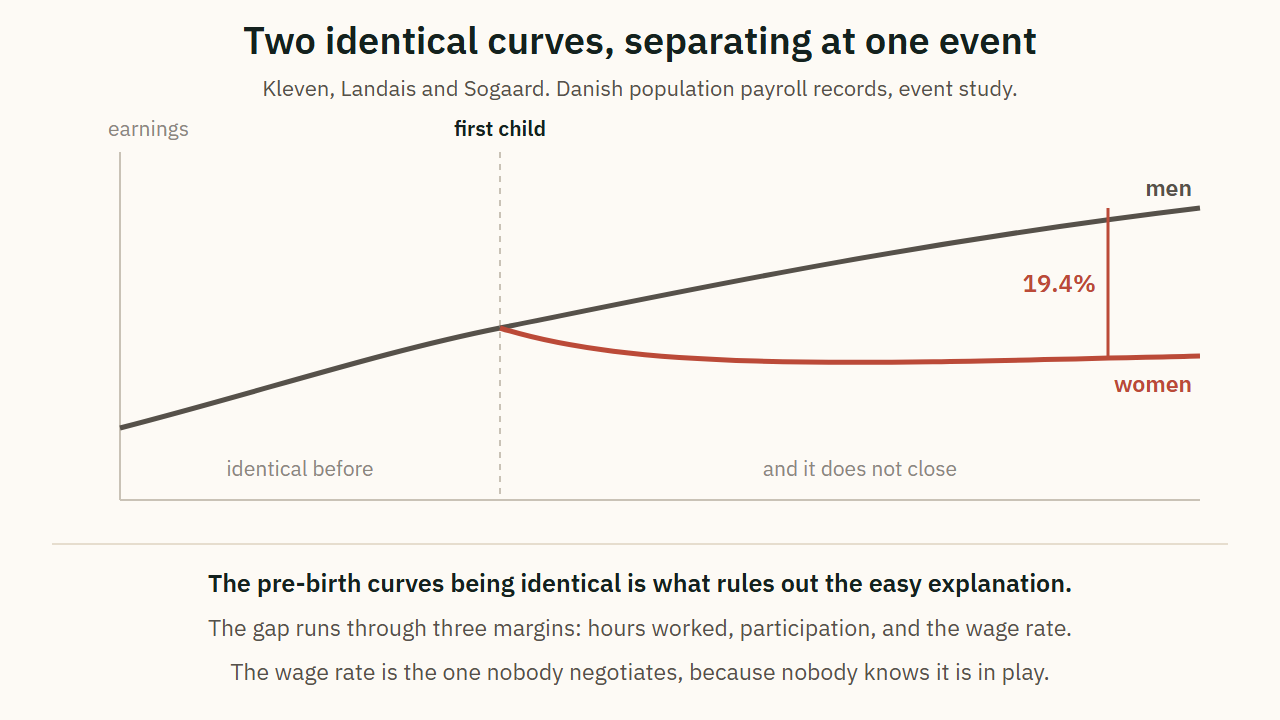
This study is the gold standard because it doesn't rely on people's fuzzy memories of their careers. It uses Danish administrative tax records covering an entire population. Using an "event study" design, researchers tracked earnings before and after the birth of a first child. The data revealed a chilling divergence.
"Men and women follow almost identical earnings trajectories until the first birth, then diverge sharply. Ten years after the first child, the long-run penalty in women's earnings relative to men's is 19.4%, and it does not close."
The most critical takeaway here is that the trajectories were identical before the child. This rules out the "easy" psychological explanation that mothers were simply less ambitious or less capable workers from the start. They were on the same track until the schedule changed. Once the trajectory shifted, it stayed shifted.
A caution: The 19.4% figure is a measurement of the Danish labor market. Because the U.S. and the pharmacy profession operate under different labor laws and childcare systems, this specific number is not a direct measurement of your local market. However, the shape of the finding, the permanent divergence, is universal.
The wage-rate mechanism
A career penalty is more than a question of fewer hours. The Kleven study identifies three distinct drivers: hours worked, labor force participation, and the wage rate.
The wage-rate mechanism is the trap. It isn't just that you are being paid for 32 hours instead of 40; it is that your value per hour begins to lag behind your full-time peers. In a pharmacy department, this happens through "reasonable local decisions" that aggregate into a career ceiling.
It looks like this:
- You are dropped from the on-call rotation because "we don't want to burden you."
- You are moved to a shift that has no overlap with the clinical pharmacy or residency committees.
- Management stops assigning you to new service rollouts or pilot programs because they assume you are already at capacity.
Individually, these seem like supportive gestures. Collectively, they are the mechanism that ensures you are bypassed for the next promotion.
The arithmetic of compounding
The cost of a 0.8 schedule is not "20% of my pay", and getting this wrong in either direction will cost you the negotiation. Work it through, because the answer is not the obvious one.
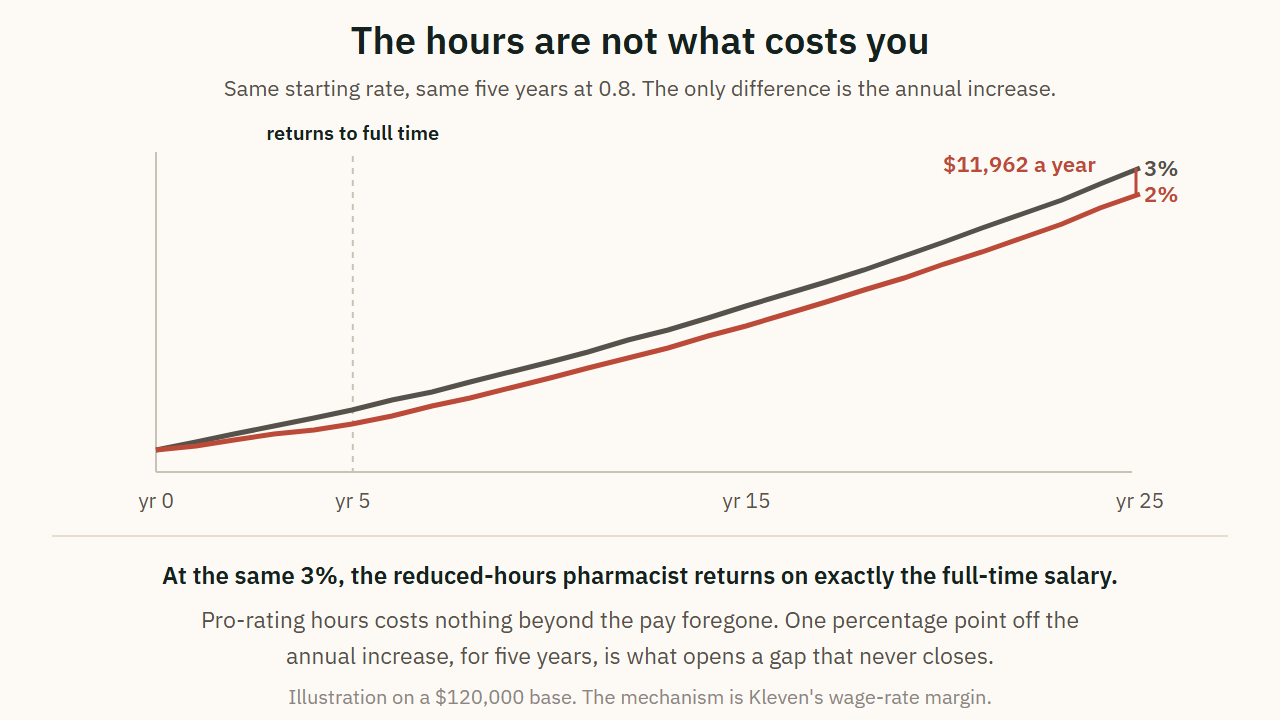
Take two pharmacists on $120,000. A stays full time. B moves to 0.8 for five years and then returns. Assume both get the standard 3% a year, applied to the full-time-equivalent rate.
- B is paid $96,000 in year one rather than $120,000, which is the 20% everybody calculates.
- At year five, A is on $139,113. B's full-time-equivalent rate is also $139,113, because the same 3% was applied to the same underlying rate.
- B returns to full time on exactly A's salary. Pro-rating hours, on its own, costs nothing beyond the pay foregone during the reduced years.
That result surprises people, and it matters, because it locates the real problem. The penalty does not come from working fewer hours. It comes from the wage rate diverging while you are on the reduced schedule, which is the third margin Kleven identifies and the one nobody negotiates.
Change one thing and watch what happens. Suppose B's rate rises 2% a year rather than 3% during those five years, because B came off the on-call rotation, was not put forward for the band review, and was assumed to be at capacity when the new service was assigned.
- At year five, A is on $139,113 and B's full-time-equivalent rate is $132,490. B returns $6,623 behind.
- Twenty years later, with both back on 3%, A is on $251,253 and B is on $239,291. The annual gap has grown to $11,962, and it was never about the hours.
One percentage point, for five years, is what separates those two lines. That is why the four terms in the next section are worth more than an argument about the schedule.
The four things to negotiate
If the trade is worth the cost, you must negotiate the terms of your trajectory at the moment of agreement. These four items are your shield against the wage-rate mechanism.
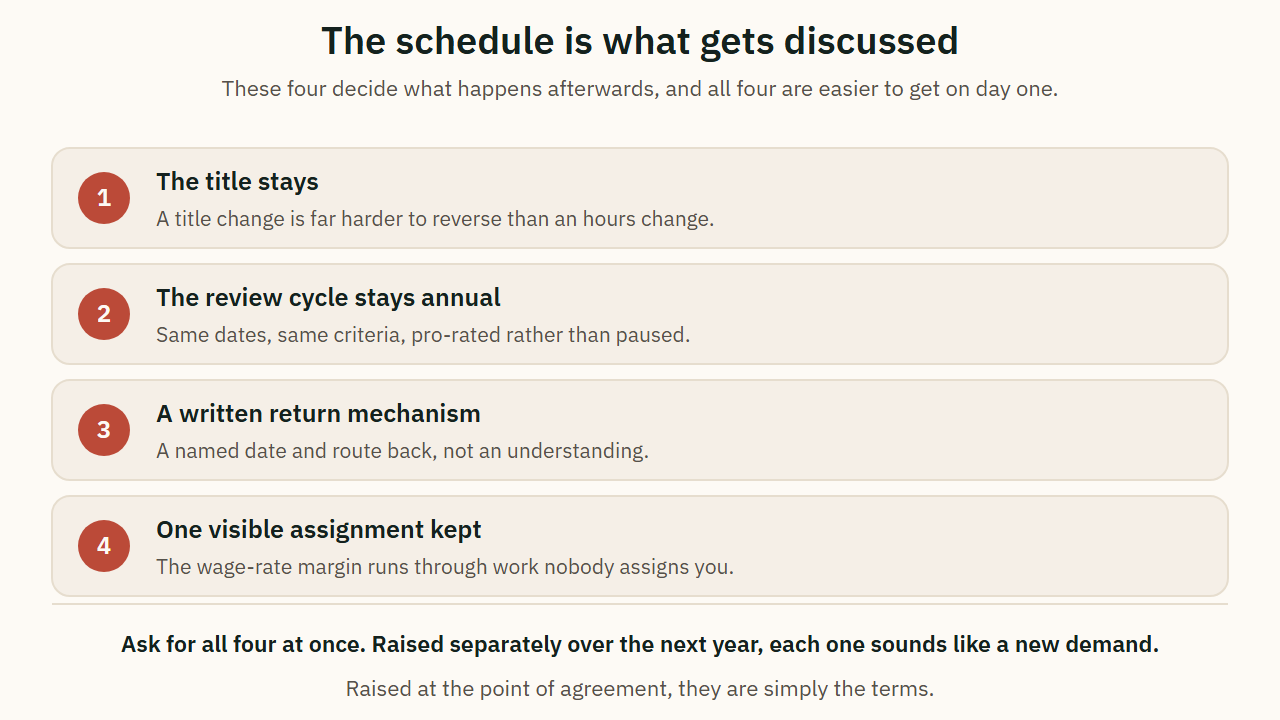
- Retain the Title: Never trade "Senior Clinical Pharmacist" for "Staff Pharmacist" just because your hours changed. Titles are far harder to recover than hours.
- Maintain the Annual Review Cycle: Your reviews must remain annual, on the same date as your peers, and based on the same criteria (pro-rated for volume).
Do not let them "pause" your seniority. 3. Written Return-to-Full-Time Mechanism: "We'll see how it goes" is not a contract. Get a specific date and a specific mechanism for returning to 1.0 FTE in writing. 4. Retention of One Visible Assignment: Choose one high-visibility project, the one that gets noticed by the Director, and insist on keeping it.
The Negotiation Script When you sit down with your manager, use these exact words. Do not raise them one by one over several months; raise them as a package deal:
"I want to make this work and I want to be direct about the terms. I am asking for [the schedule]. I am also asking that my title stays as it is, that my review remains annual on the same criteria pro-rated, and that we write down now what returning to full-time would look like and when. And I would like to keep [the specific assignment], because I do not want to come off the work that gets noticed."
For managers, the decision made silently
If you are a manager who approves a reduced schedule and then quietly stops considering that employee for new services or high-visibility projects, you are making a promotion decision without having the courage to announce it. You are effectively firing them from the future of the department.
The Simple Check: When the next visible assignment arises, audit your selection process. Who did you not consider? If the answer is "the part-timer," ask yourself if that is based on their actual capability or your own bias about their "commitment." If you don't audit these assignments, you will eventually lose your best talent to resentment.
Setting the local precedent
Negotiating these terms isn't just a selfish act of career preservation; it is a cultural necessity. When you successfully insist on keeping your title and your annual review cycle, you are setting the "local precedent." You are making it easier for the next pharmacist, and the one after that, to reduce their hours without being punished for it. You are negotiating against the "standard" terms so that the next person starts from your floor, not the basement.
The trajectory checklist
| Action to Take | Strategic Purpose |
|---|---|
| Price the compounding | To calculate the permanent impact on your lifetime earnings base. |
| Keep the title | Titles represent professional status; hours represent a schedule. |
| Keep the review cycle annual | To prevent a "paused" trajectory and ensure seniority continues. |
| Put return-to-full-time in writing | To replace a vague "understanding" with a reliable mechanism. |
| Retain one visible assignment | To stay in the line of sight for future opportunities. |
| Ask what you were not considered for | To surface and challenge silent managerial decisions. |
| Audit assignments (Managers) | To prevent making unannounced trajectory shifts for your team. |
Pricing, not dissuasion
The goal of this strategy is to avoid "Year Ten Resentment." Professionals who are angry a decade after a schedule change are usually not angry about the hours they spent with their children or the health they recovered. They are angry because they were blindsided. They are angry because they didn't realize that a schedule change had capped their career until it was too late to fix.
By naming these mechanisms and pricing the decision upfront, you can defend the choice to your future self. You can look back and say, "I knew the cost, and I negotiated the best possible terms."
Final Thought: Are you negotiating just your hours, or are you negotiating your future trajectory?
References
- Kleven H, Landais C, Søgaard JE. Children and gender inequality: evidence from Denmark. American Economic Journal: Applied Economics 2019;11(4):181-209. NBER w24219.
- Kleven H et al. Child penalties across countries: evidence and explanations. NBER w25524.
Want the practice knowledge behind this?
Your First Year as a Hospital Pharmacist covers the clinical judgment a residency front-loads. Part of the Pharmacy Handoff library.
See the book