Managing people who were your colleagues last month

It starts the moment you walk into the break room and the conversation stops. Yesterday you were the one complaining about the schedule. Today you are the one who wrote it.
Most people treat a promotion as a reward for performing well, a slightly more senior version of the job they already had. That is the misunderstanding that causes most of the damage. The move from peer to supervisor is not a bigger version of your old role. It is a different occupation, and the thing it asks you to give up is the thing that got you promoted.
The study, and what it actually was
The canonical research here is Linda Hill's, in Becoming a Manager. She followed nineteen new managers through the first year of the job with repeated interviews.
Say the number out loud, because it matters: this is a deep qualitative study of nineteen people, not a population survey. It is the best account we have of what the first year feels like from the inside, and it should not be dressed up as anything more than that.
Hill found that management is a psychological overhaul rather than a skills upgrade. Her new managers struggled with three things consistently:
- Reconciling the idea of being in charge with what the daily reality turned out to be.
- Handling friction with people who had, until recently, been equals.
- Making sense of what their own superiors actually wanted, which is the one nobody warns you about.
You expected authority and you got dependence
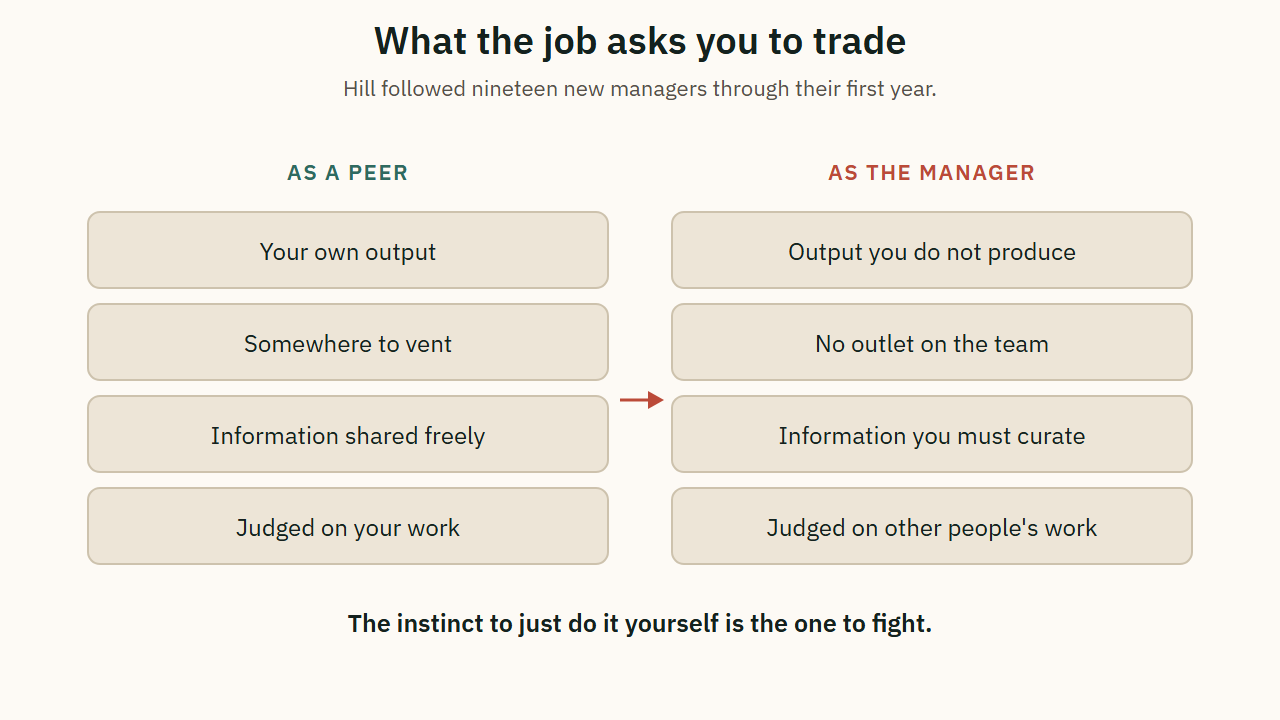
The first thing to break is the idea that the job comes with power. Strong individual contributors often want management because they want the authority to get things done properly. What arrives instead is dependence.
You are now accountable for output you do not personally produce. For somebody used to winning on their own effort, that is the hardest adjustment in the job. When the pressure comes on, the instinct is to do the work yourself, and that instinct is the one to fight. Your results now run through other people, and there is no version of the role where that stops being true.
The relationship has been rewritten, and nobody announced it
The change is not abstract. It shows up in specific, uncomfortable places.
- Venting stops. You have lost your usual outlet. You cannot complain about a policy to the people you are now enforcing it on, because to them you are the policy.
- Information gets curated. Things you would have passed along freely as a peer are now confidential, or premature, or somebody else's news to share.
- The social invitations change. Your presence at the table alters the table, whether or not anybody intends it to.
The moment it becomes real is usually the first time you have to say no to somebody who used to cover your shifts. That is when the professional boundary and the personal one come apart, and it is the actual start of the job.
The failure that looks like kindness
The most common failure in Hill's material is the attempt to stay one of the gang. It is a comfortable way to avoid the awkwardness of the new status, and it costs the team more than the awkwardness would have.
When a manager will not draw a clear line, the team loses its bearings. Decisions stop being predictable, and people spend energy working out where they stand instead of doing the work.
By trying to reduce the discomfort of your own authority, you increase the uncertainty for everybody who works for you.
The first two weeks
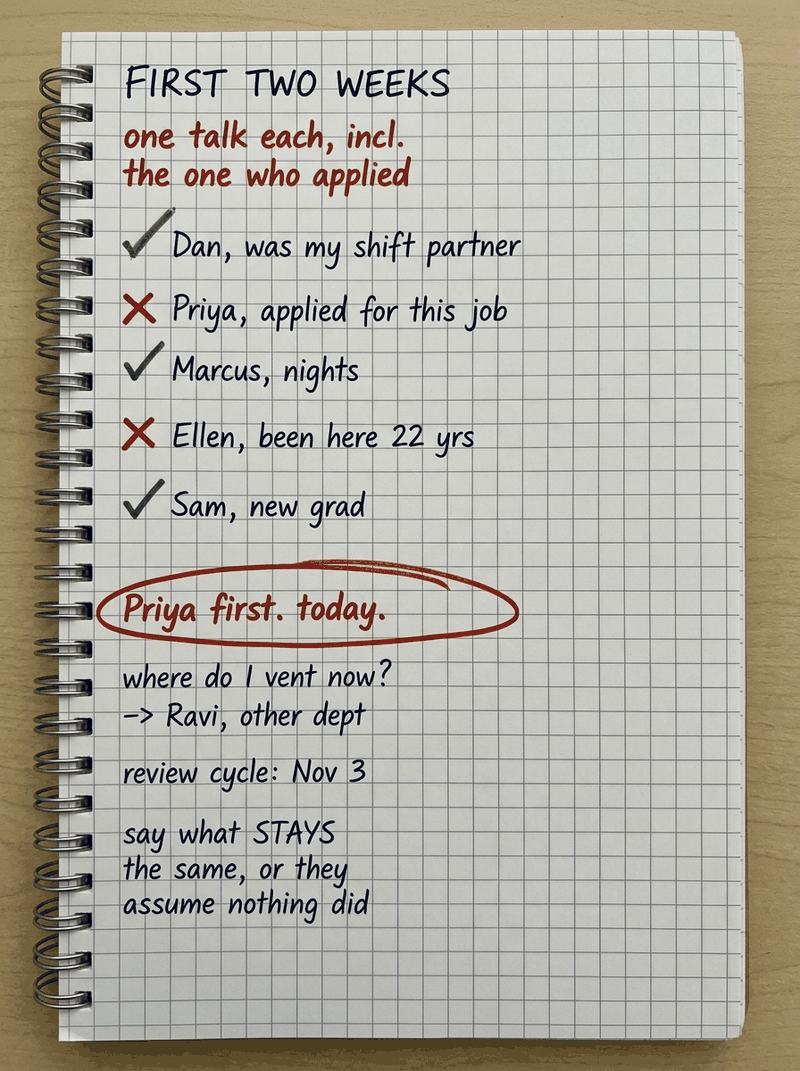
The practical core, and the thing to get right, is that you have to be the one who names the awkwardness. Inside the first two weeks, hold a direct one-to-one with every member of the team. That includes the people who were peers, and especially anyone who applied for the job you now have.
"I want to be direct about this. Me moving into the role changes how we work together. What has not changed is what I think of you or what I want for your career. What has changed is that I am now accountable for the team's output and for your performance in it. I need your help on the winter staffing plan, and I want to hear what you need from me."
"I have looked at the schedule and I can't approve it. We need full coverage that week and I don't have the cover to give. If something changes on the schedule I will come back to you."
Do not attach an apology to the second one. Anything along the lines of "as a friend I'd love to say yes" signals that you do not consider the decision yours to make, and it invites the next request to be an appeal rather than a question.
The checklist
| Do this | Why it matters |
|---|---|
| List everyone on the team who was a peer | These conversations are the ones that will not happen by themselves |
| Note who applied for your job | This one needs its own conversation and it needs to be soon |
| Write down what you can no longer share | Getting this wrong once is hard to undo |
| Find somewhere outside the team to take your own complaints | You have lost the outlet you had and you still need one |
| Check when the first review cycle falls | It arrives faster than it feels like it will |
| Decide what stays the same and say so | People assume everything changed unless told otherwise |
If you are promoted over former peers, then in the first two weeks book one conversation with each of them and say plainly what changes and what does not.
What is not settled
The evidence here is nineteen people, studied in depth, in organisations that were not hospitals. It describes the shape of the transition rather than measuring how often each part happens, and it cannot tell you the odds of anything.
The second limit is that some of this is not fixable by preparation. Hill's managers did not read their way out of the first year, they went through it. What preparation buys is recognising the pattern while it is happening rather than a year later, which is worth something but is less than a solution.
References
- Hill LA. Becoming a Manager: How New Managers Master the Challenges of Leadership. Harvard Business School Press.