What pharmacy leaders wear

Judgments in a hospital corridor are made in a second or two. Before you reach the bedside or the podium, the people in front of you have already reached a conclusion about your role.
For a lot of pharmacy leaders the friction shows up as being misidentified. A director mistaken for a vendor in a finance meeting, a clinical lead assumed to be a visitor on the floor. Each one is a hurdle to clear before the actual work starts. Reading this correctly is not vanity, it is making sure the message is not slowed down by a misreading of who you are.
What patients actually read
Hospital cultures have loosened, and patient preferences have not moved as much as you might expect. A 2025 systematic review update found patient preference leans toward formal attire and the traditional white coat, and that those markers are tied to perceptions of trust, professionalism and the perceived quality of communication.
A universal dress code is a myth, though. The right answer varies by specialty and by clinical setting, which makes this a judgment rather than a rulebook.
The part that is not equal
The most important finding for any leader is that attire does not signal the same information for everybody.
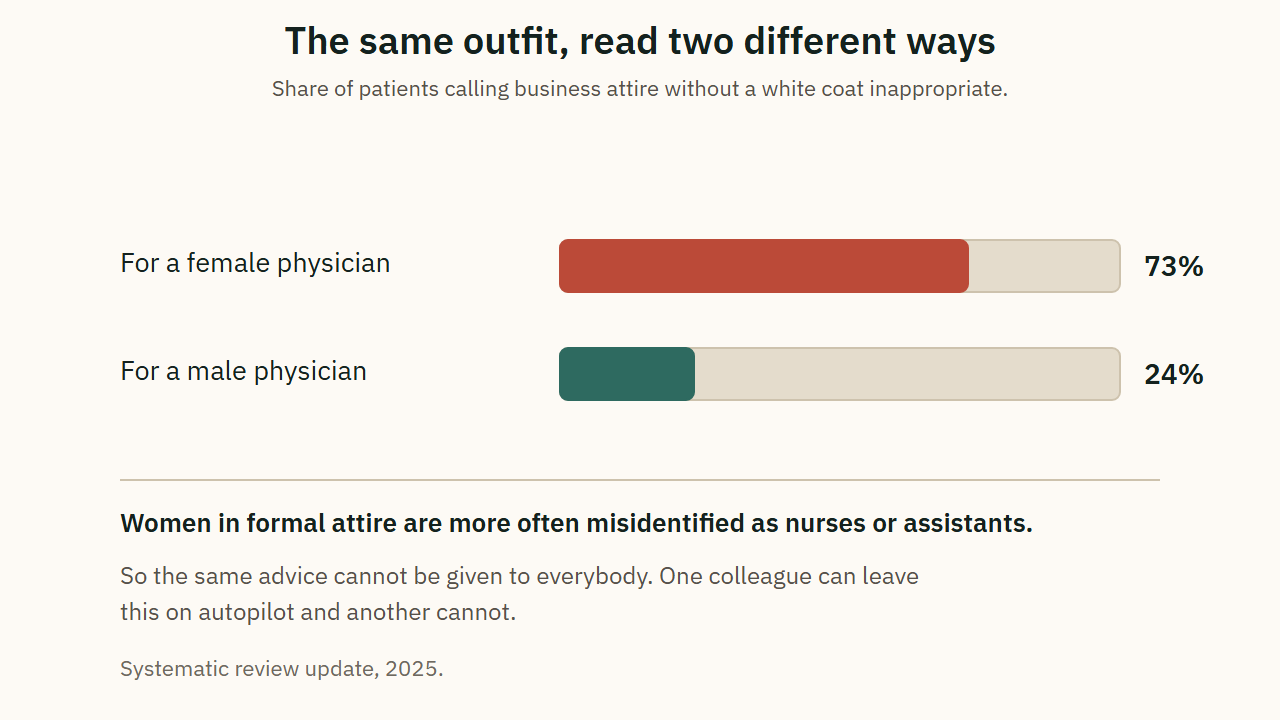
73% of patients judge business attire without a white coat inappropriate for a female physician, against 24% for a male physician. Female clinicians in formal business attire are frequently misidentified as nurses or assistants, which is rarely something their male colleagues deal with.
The same outfit carries different information depending on who is wearing it. That is why universal advice is a trap: one colleague can leave this on autopilot and another cannot.
What follows from it is practical rather than philosophical. Where the badge sits and whether it is readable. Whether you introduce yourself with your role or expect it to be inferred. Whether the coat is doing work for you or against you in this particular room. Those are decisions, and for some people they are decisions that have to be made every day.
What the clothing says about which job you are doing
In a pharmacy, clothing signals which mode of work you are in. This section is professional convention rather than research. Nobody has published a study of what a director of pharmacy wears on a Tuesday, and it would be dishonest to present the following as though somebody had.
- Scrubs signal an operational focus. You are here to move product, manage workflow, troubleshoot the line.
- A white coat signals a clinical focus. You are the medication expert and the safety check.
- Business attire signals a management focus. You are here about strategy, money and how the system fits together.
The common mistake on promotion is continuing to dress for the job you left rather than the audience you now face. Walking into a budget meeting in scrubs does not signal that you are practical; it signals that you are still an operator rather than someone finance should treat as a peer.
Five rooms, five audiences
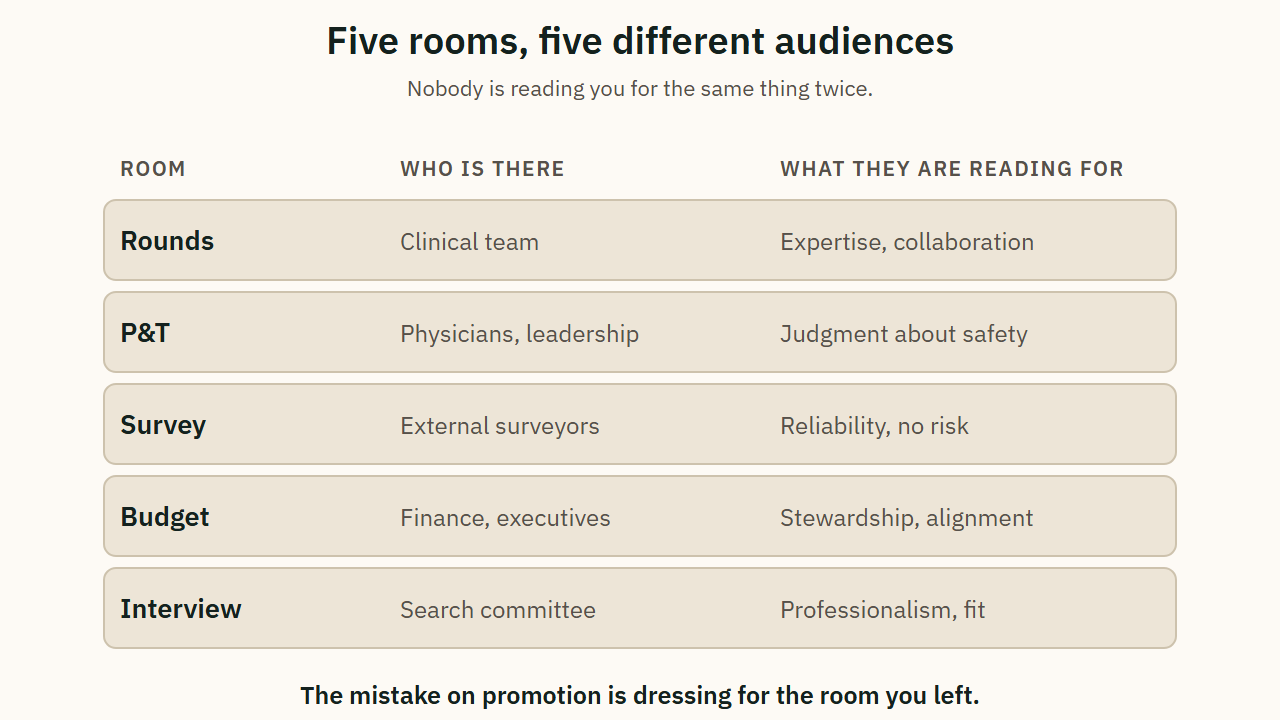
| Setting | Audience | What they are reading for |
|---|---|---|
| Rounds | Clinical team and patients | Clinical expertise and willingness to collaborate |
| P&T | Physicians and leadership | Evidence and judgment about safety |
| Accreditation survey | External surveyors | Operational reliability, absence of risk |
| Budget presentation | Finance and executives | Fiscal stewardship, alignment with the system |
| Interview | Search committee | Professionalism and fit |
The three seconds that fix most of it
The highest-leverage item here is not a coat or a jacket, it is a spoken anchor. It is also the closest thing to a direct fix for the asymmetry above, because it replaces an inference with a fact.
"I'm the director of pharmacy, and I'm here to go through the quarterly budget alignment."
Name, role, why you are here. It costs three seconds and it settles the question before anyone has to guess, which keeps the conversation on your expertise rather than on your presence in the room.
The checklist
| Check | Why it matters |
|---|---|
| What the written dress code actually says | Most people have never read it |
| What people one level above you wear | The real norm is observed, not published |
| What you wear to your highest-stakes recurring meeting | This is the one that compounds |
| Whether your badge is readable at conversational distance | The cheapest fix for misidentification |
| Whether you state your role when you introduce yourself | Three seconds against several minutes of confusion |
| What you would change if finance called a meeting now | If the answer is "everything", that is the gap |
If you have a meeting with finance or the executive team, then dress one step above the room rather than one step above yourself.
What is not settled
Signalling is not competence. A suit does not make anyone a better leader and a white coat does not make anyone more accurate. An article about clothing risks implying otherwise, so it is worth saying plainly.
The goal here is the lower and more defensible one: not being misread. And the second limit is that the research is about patient perception of physicians. It is the best available evidence and it is not evidence about how a chief financial officer reads a pharmacist, which is a room nobody has studied.
References
- Patient perception of physician attire: a systematic review update, 2025. PubMed 40796220.
- Public perceptions of physician attire and professionalism in the United States.