Precepting your first pharmacy student

Taking on your first pharmacy student often triggers a specific kind of professional anxiety. It is the sudden realization that while you have spent years mastering clinical therapeutics, you were likely never taught how to teach. In the absence of formal training, most pharmacists fall into the "default trap": they simply imitate the preceptors they had, regardless of whether those methods were effective.
imitation without reflection is how bad habits become professional traditions. If we do not apply the same evidence-based rigor to our teaching that we apply to our pharmacotherapy, we risk stagnating the profession. The following toolkit of "microskills" is designed to transform precepting from a perceived burden into a strategic professional advantage.
The four preceptor roles, in sequence
According to ACPE Standards 2016 and ASHP professional materials, effective precepting requires moving through four distinct roles. These are not options to pick from; they are a necessary sequence for student development.
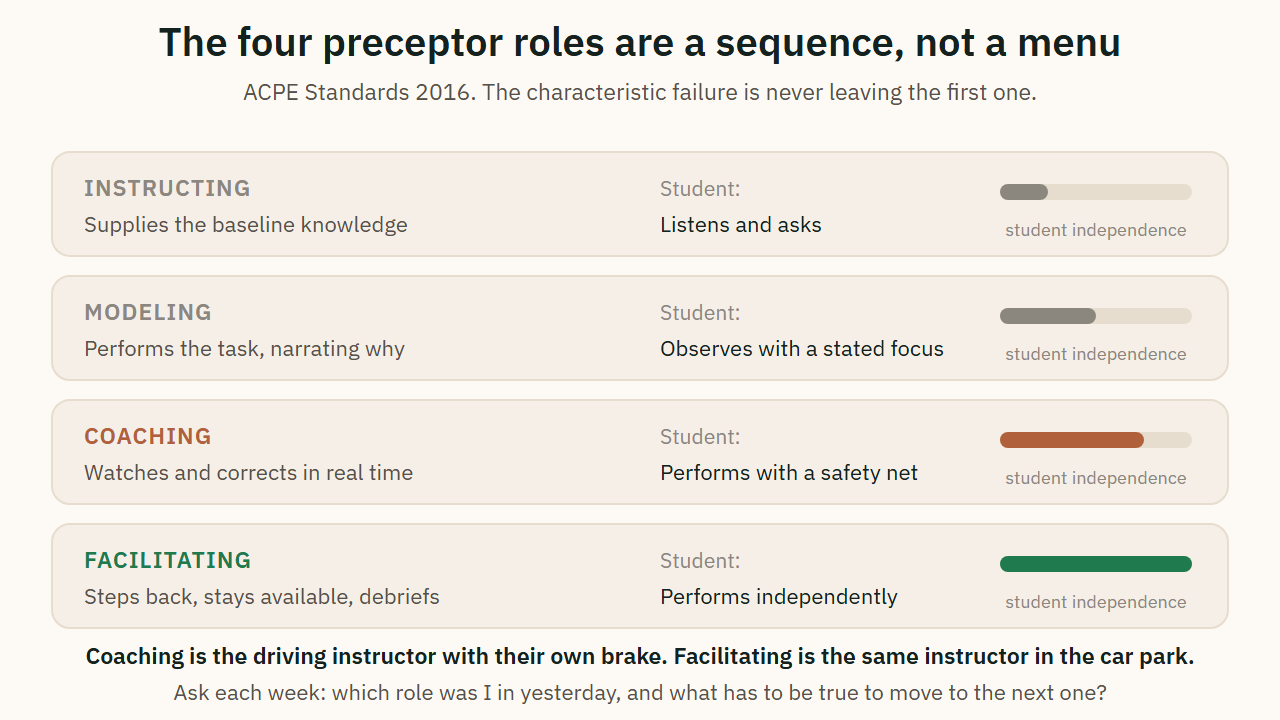
- Instructing: The preceptor supplies the baseline knowledge the skill requires; the student listens and asks questions.
- Modeling: The preceptor performs the task, narrating what to notice and why; the student observes with a specifically stated focus.
- Coaching: The preceptor watches the student perform and provides real-time correction; the student performs with a "safety net."
- Facilitating: The preceptor steps back but remains available for debriefing; the student performs the task independently.
The characteristic failure for new preceptors is parking a student in the first role for too long. A student left in the instructing phase for six weeks is being lectured; they will leave the rotation able to describe work they have never done. Conversely, dropping a student straight into facilitating because you are busy creates a "student-staffer" who merely absorbs what they happen to see.
Think of it like a driving instructor: Coaching is being in the passenger seat with your own brake pedal. Facilitating is standing in the parking lot while they drive. The transition between the two is a deliberate judgment of readiness.
The Diagnostic Question: Which role was I in yesterday, and what has to be true for me to move to the next one?
The One-Minute Preceptor
Developed by Neher, Gordon, Meyer, and Stevens (1992), the "One-Minute Preceptor" is the most widely adopted clinical teaching model in existence. It allows a busy clinician to teach a general principle in five minutes or less using five microskills:
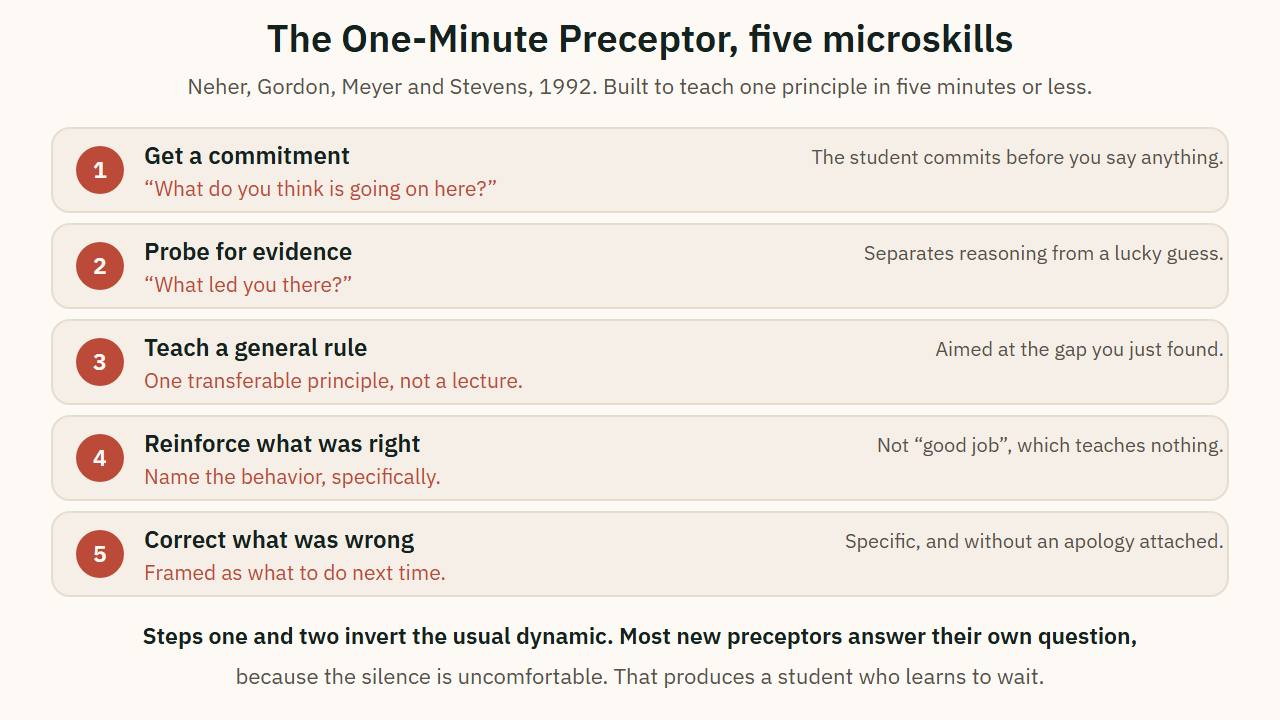
- Get a commitment: Ask the student what they think is going on (e.g., "What do you think is the cause of this patient's potassium drop?").
- Probe for evidence: Ask "What led you there?" to distinguish clinical reasoning from a lucky guess.
- Teach a general rule: Offer one transferable principle, not a lecture. (e.g., "When potassium and magnesium are both low, repleting potassium alone usually fails").
- Reinforce rights: Specifically name the behavior they performed correctly. Avoid generic "good job" markers.
- Correct wrongs: Provide specific feedback framed as what to do next time.
The psychological hurdle here is that most new preceptors answer their own questions. We do this because silence is uncomfortable and answering feels like teaching. However, this produces a student who "learns to wait." By requiring a commitment first, you ensure your teaching targets the actual knowledge gap and makes the student's reasoning visible, which is the only thing you can truly assess.
Why the feedback sandwich fails
The "praise-criticism-praise" sandwich is the intuitive default for the untrained, but it is actively worse than saying the thing directly.
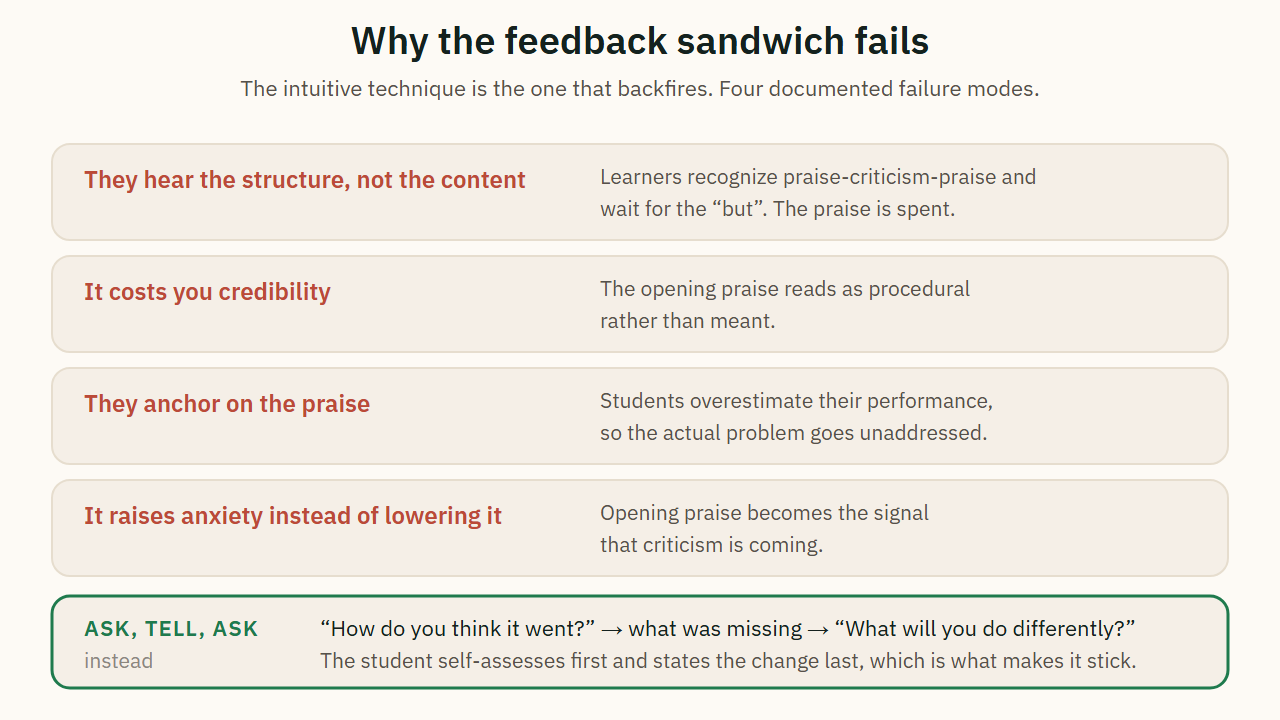
- Learner Discounting: Students recognize the pattern and learn to ignore the initial praise because they know a "but" is coming.
- Reduced Credibility: The praise feels procedural rather than genuine, undermining your authority as a mentor.
- The Anchoring Effect: Students often "anchor" on the opening praise, overestimating their performance and leaving the actual problem unaddressed.
The praise-criticism-praise sandwich increases learner anxiety rather than reducing it, as the opening praise becomes a signal that criticism is imminent.
Ask-Tell-Ask
For daily feedback, use the Ask-Tell-Ask model. This is a collaborative approach that maps onto how adults naturally process correction:
- Ask: Have the student self-assess first (e.g., "How do you think that consult went?").
- Tell: Provide specific, unhedged feedback on what was missing.
- Ask: Have the student state the plan for change (e.g., "What will you do differently on the next one?").
For standard daily feedback, you must follow the "hard rules" of directness: No apology, no opening praise, and no softening clauses. Use the Behavior-Effect-Expectation framework.
The literal script: "I want to talk about the vancomycin consult from this morning. Before I give you my read, tell me how you think it went... Here is what I saw. You had the trough and renal function right [Behavior]. What was missing was the indication; nobody documented why the patient was still on it, which was the actual question the consult was asking [Effect]. Next time, before you calculate anything, find the indication and stop date [Expectation]. What will you check first on the next one?"
For rotations that are going badly or conversations you are dreading, reserve the R2C2 model (Relationship, Reaction, Content, Coaching).
Write your expectations before day one
Most rotation failures trace back to expectations that existed only in the preceptor's head. Writing them down is the highest-return preparation you can do. Your "Week One" document should include:
- Arrival times and physical locations.
- Lookup requirements before rounds.
- Patient load (e.g., 2 patients in Week 1, 8 by Week 4).
- Feedback frequency and format.
- What constitutes a "problem worth interrupting you for."
Without this, the student spends their first week "solving for what you want" instead of learning the work. Ambiguity always resolves in the direction of the student doing less.
Precepting as management rehearsal
Precepting is a compressed, lower-stakes rehearsal of the management job. It allows you to practice essential leadership skills before you have permanent direct reports:
- Setting clear expectations.
- Observing and assessing performance.
- Delivering correction that results in behavior change.
- Judging professional readiness.
- Documenting an assessment that someone else (the school or a future employer) will rely on.
For a pharmacist eyeing a leadership role, a six-week rotation is the cheapest management rehearsal available. It is the only place to practice the two skills that separate people who get promoted into management from people who succeed there: setting expectations and delivering correction.
Two honest cautions
Before moving to action, you must accept two structural truths:
- A rotation is not a staffing plan. If you take a student solely to offload your workload, you are not precepting; you are exploiting. This costs your site placements and produces incompetent practitioners. Precepting must be resourced as teaching time.
- Observation is non-negotiable. Every model in this guide assumes you can see the student work. If your rotation structure prevents you from watching them perform tasks, no feedback model can fix it. Schedule and protect at least two observed encounters per week.
The action plan
It is common to worry that students will slow you down. However, the alternative is repeating the mistakes of the past through unreflective imitation. To make these strategies stick, use implementation intentions (Gollwitzer and Sheeran, 2006), "if-then" plans that specify when and how you will act.
Adopt these two plans immediately:
- If your student's start date is on the calendar, then before that date, write a one-page, six-heading expectations document.
- If you catch yourself about to answer your own question, then stop, ask "What do you think?" instead, and wait through the silence.
The profession's teaching capacity relies on a volunteer system. In the framework of Deci and Ryan, "Relatedness" is a basic human need, the understanding that our profession only survives because those who were taught choose to teach in turn. If we only teach the way we were taught, are we evolving the profession, or just repeating it?
Before the student arrives
| Do this | Why it matters |
|---|---|
| Write week-one expectations before you meet them | Removes the week the student spends solving for what you want |
| Name which of the four roles you are in, each week | The common failure is never leaving instructing |
| Get a commitment before you teach | Aims the teaching at the actual gap, and makes reasoning visible |
| Teach one general rule, not the topic | Neher's model is built around transferable principles |
| Drop the praise sandwich | Learners discount the praise and anchor on it, both at once |
| Ask before you tell, and ask again after | The student states the change, which is what makes it stick |
| Reserve R2C2 for the conversation you are dreading | Built for feedback the learner will resist |
| Write the evaluation as you go, not in week six | Recall degrades, and a vague evaluation helps nobody |
References
- Accreditation Council for Pharmacy Education, Standards 2016. Preceptor aptitude for instructing, modeling, coaching and facilitating.
- Neher JO, Gordon KC, Meyer B, Stevens N. A five-step microskills model of clinical teaching. J Am Board Fam Pract 1992;5:419-424.
- Sargeant J, et al. Evidence-informed facilitated feedback: the R2C2 model. MedEdPORTAL.
- Ask-Tell-Ask feedback model. PAEA Committee on Clinical Education.
- Gollwitzer PM, Sheeran P. Implementation intentions and goal achievement: a meta-analysis of effects and processes. Adv Exp Soc Psychol 2006;38:69-119.
- Deci EL, Ryan RM. Self-determination theory: relatedness and competence.
Want the practice knowledge behind this?
Your First Year as a Hospital Pharmacist covers the clinical judgment a residency front-loads. Part of the Pharmacy Handoff library.
See the book