What remote work does to your promotion odds
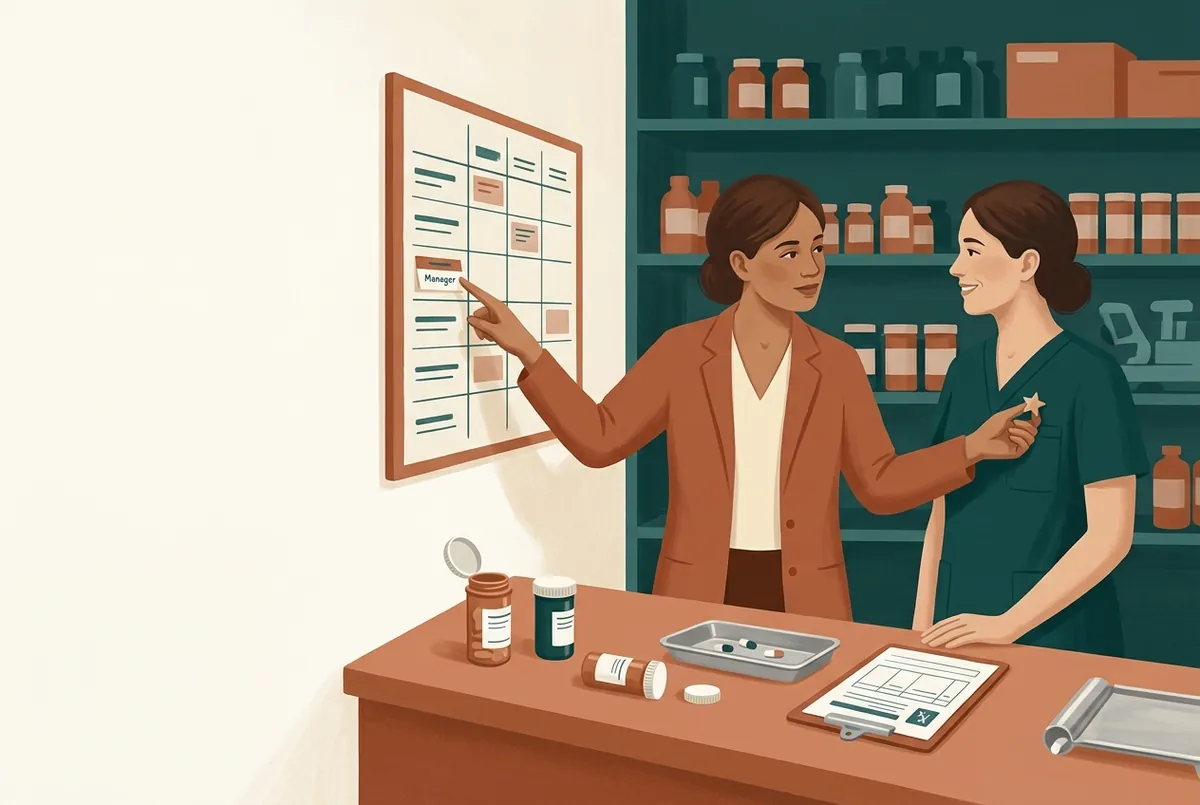
The decision to verify orders from a home office rather than the hospital bench is almost always discussed as a lifestyle choice, a way to reclaim hours from a commute or find a quiet environment away from the chaos of the central pharmacy. However, the data suggests that while the lifestyle benefits are immediate, the professional impact is a separate calculation. Remote work is often settled as a lifestyle preference, but it functions as a career decision with permanent, long-term consequences.
This creates a central tension for the modern inpatient pharmacist: Can you be a measurably better employee and still get passed over for a promotion? According to the best available research, the answer is a resounding, and sobering, yes.
Why higher output did not mean more promotions
In 2015, a landmark randomized controlled trial published in the Quarterly Journal of Economics revealed a striking productivity paradox. Researchers at Ctrip, a Chinese travel company with 16,000 staff, randomly assigned call centre employees who had volunteered for home working to either work from home or stay in the office for nine months.
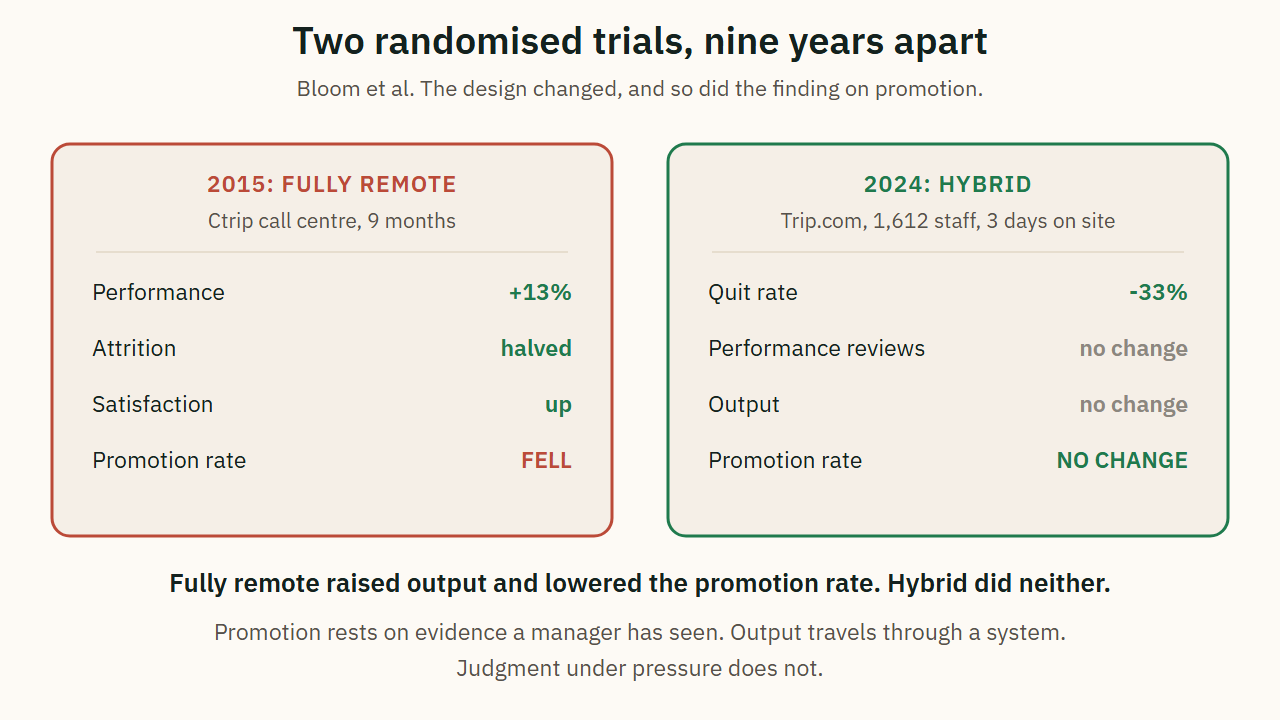
The remote workers were undeniably more effective:
- Performance: Rose by 13% (9% from working more minutes per shift; 4% from higher efficiency in a quieter environment).
- Attrition: Dropped by 50%.
- Employee Satisfaction: Increased significantly.
Despite these gains, the study found a "Promotion Penalty." The promotion rate for remote workers, conditional on performance, fell. These were not underperforming employees; they were measurably superior to their office-based peers, yet they were promoted less often.
The reason is structural, not just prejudice. Promotion decisions rest on evidence a manager has seen. While raw output, such as verifying 400 orders a day, is a number that travels easily through a system, the "intangible half" of the job does not. Your judgment under pressure, how you handle a heated disagreement with a prescriber, and your reputation as the "go-to" person during a 2:00 AM crisis are qualities that must be seen to be believed.
A pharmacist at home produces a number; a pharmacist at the bench produces a number and a reputation.
What changed when the trial tested hybrid
The career penalty of remote work is not a universal law; it is a consequence of total absence. A subsequent 2024 study published in Nature followed 1,612 employees at Trip.com, comparing full-time office staff with hybrid workers (three days in the office, two days at home).
The results for the hybrid group were transformative:
- Quit rates fell by 33%, with the largest improvements among non-managers, women, and those with long commutes.
- Performance reviews and promotions showed a "null effect", meaning there was no career penalty for hybrid workers compared to full-time office staff.
This is the most useful finding for the strategic professional: the career risk is specific to fully remote arrangements. Hybrid work offers the retention and satisfaction benefits of remote work without the "visibility tax" that stalls advancement.
What a delayed promotion costs over a career
When considering a remote role, it is tempting to view a delayed promotion as an abstract setback. This is a mistake. A promotion delayed by three years is not simply three years of a higher salary lost. It is a permanent downward shift in your lifetime earnings trajectory.
Every subsequent percentage-based raise for the rest of your career applies to a lower base figure. This is the "silent" cost of remote work. It is dangerous because it is invisible in the short term; you don't notice the promotion you were never considered for. You only notice it five years later, when peers with the same clinical output have titles and salary brackets that have far outpaced your own.
Visibility as a set of actions
Many pharmacists resist "visibility" because it feels like shallow self-promotion. In reality, visibility is a set of tactical actions, not a personality trait. Influence is what allows you to get a policy changed, get a technician position approved, or have your clinical read on a case trusted when it contradicts a prescriber.
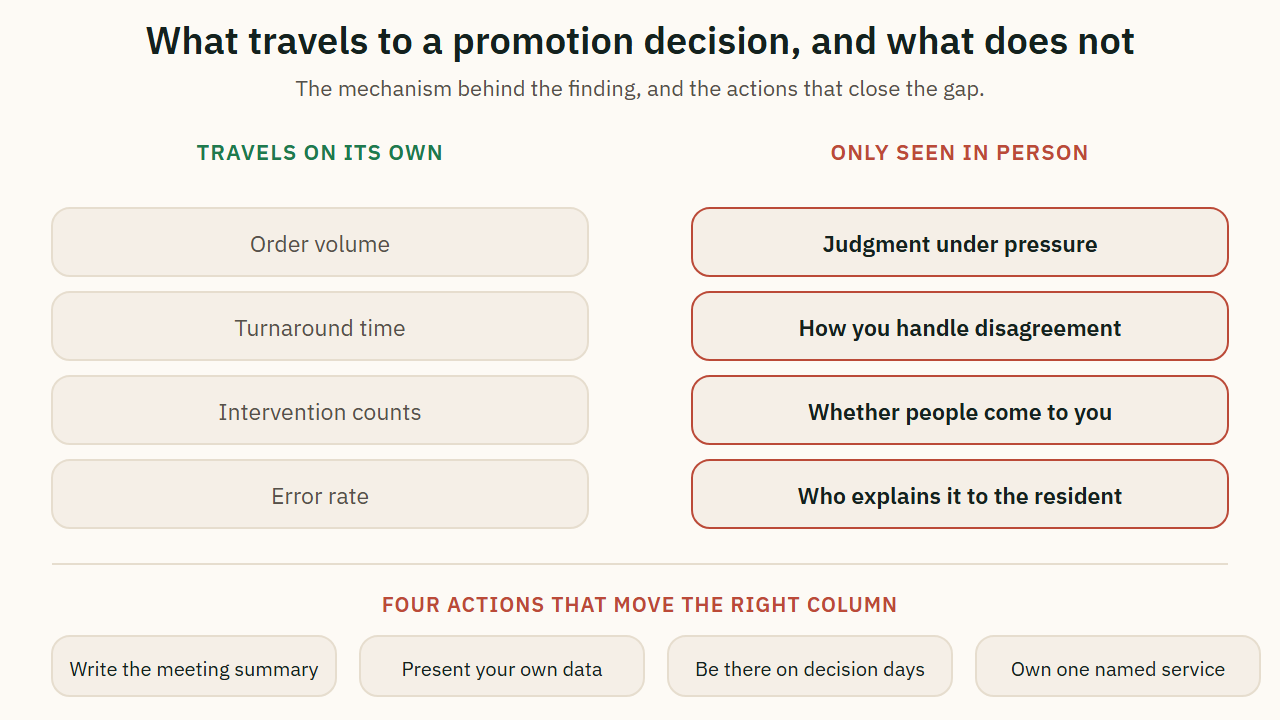
Visibility Actions for the Remote/Hybrid Pharmacist:
- Write the Summary: Be the person who distributes the summary after a clinical or departmental meeting. It is the cheapest visibility action available.
- Own the Presentation: Instead of emailing a report, present your data yourself at the P&T Committee or staff meetings.
- Choose Your Days Strategically: Don't pick your on-site days based on when it's quietest. Identify the days when major decisions are made and ensure you are at the bench then.
- Handle the Heavy Lifting: Occasionally take interruption-heavy shifts. It ensures leadership remembers your face and your willingness to support the team's shared workload.
The question that gets you the local answer
National data provides the shape of the risk, but your specific department determines its size. To uncover the local reality, you must ask targeted questions that seek a mechanism rather than mere reassurance.
To a Hiring Manager:
"I want to understand the shape of this role beyond the schedule. Who has moved up out of the remote team here in the last three years, and what did they do differently? And if I take this, which meetings would you want me on site for?"
To Your Current Manager:
"I want to keep the remote arrangement and also stay in the running for the next step. Can I own [specific report/service] and present it myself, and can we pick two standing meetings I attend in person?"
The single question that resolves the risk:
"Who has been promoted out of the remote team here in the last three years, and what did they do differently?"
The answer, including any hesitation or pause before the answer, is the "tell" that reveals whether your department has a functional path for remote advancement.
What the evidence does not cover
While these studies provide the best available evidence, exercise caution. These findings come from technology and call center environments, not hospital pharmacy. While the underlying logic, that managers promote based on seen evidence, is likely universal, the specific percentages are not. Anyone quoting a "13% productivity increase" as a benchmark for pharmacy verification is overreaching. Treat these figures as a guide to the mechanism of promotion, not as settled law.
Choosing the trade deliberately
The evidence points to a trade-off rather than a verdict on remote work. By opting for a hybrid model or employing specific visibility tactics, the career penalty can be mitigated or avoided entirely.
The goal is to choose with full awareness of the stakes. As you evaluate your current or future arrangement, ask yourself: Am I choosing this for the lifestyle I want today, or for the career I want five years from now?
The action plan
If you are offered a remote or hybrid role, then before you accept, ask the hiring manager who has been promoted out of that team in the last three years. The answer, including any pause before the answer, is the local version of Bloom's finding.
Second plan, for anyone already remote:
If a meeting is on the calendar where a decision gets made, then attend that one in person, even if you attend nothing else that week.
The checklist
| Do this | Why it matters |
|---|---|
| Separate fully remote from hybrid when you evaluate a role | The promotion evidence differs between the two |
| Ask who was promoted out of the remote team | Turns national evidence into your department's number |
| Count the compounding, not the annual gap | A delayed promotion lowers the base every later raise applies to |
| Choose your on-site days by what happens on them | Presence on a decision day is worth more than presence on a quiet one |
| Write the summary after the meeting | The cheapest visibility action available |
| Present your own data rather than emailing it | Judgment is seen, not reported |
| Re-ask the question at every review | The trade changes as the department changes |
References
- Bloom N, Liang J, Roberts J, Ying ZJ. Does working from home work? Evidence from a Chinese experiment. Quarterly Journal of Economics 2015;130(1):165-218. NBER w18871.
- Bloom N, Han R, Liang J. Hybrid working from home improves retention without damaging
performance. Nature 2024. PMID 38867040. 1,612 employees, randomised, Trip.com Shanghai.
arithmetic,
what-is-a-fair-pharmacist-salaryfor base numbers.
Want the practice knowledge behind this?
Your First Year as a Hospital Pharmacist covers the clinical judgment a residency front-loads. Part of the Pharmacy Handoff library.
See the book