What to do after you make a medication error

It is 3:00 AM. You are halfway through a grueling night shift when you realize a medication order you verified two hours ago contained a significant dosing error. The sinking sensation in your chest is immediate and visceral.
In this moment, the mistake has already occurred. What matters now is your response over the next sixty minutes. This hour determines one of three documented professional trajectories: whether you eventually drop out of the profession, merely survive it, or find a way to thrive. I can tell you that the greatest risk to your career is the failure to recognize that the event is reportable and requires a structured response.
Why most events go unreported
Clinical instincts often suggest that reporting is blocked by fear of retribution. However, data indicates the primary barrier is classification, a failure to recognize harm when it occurs.
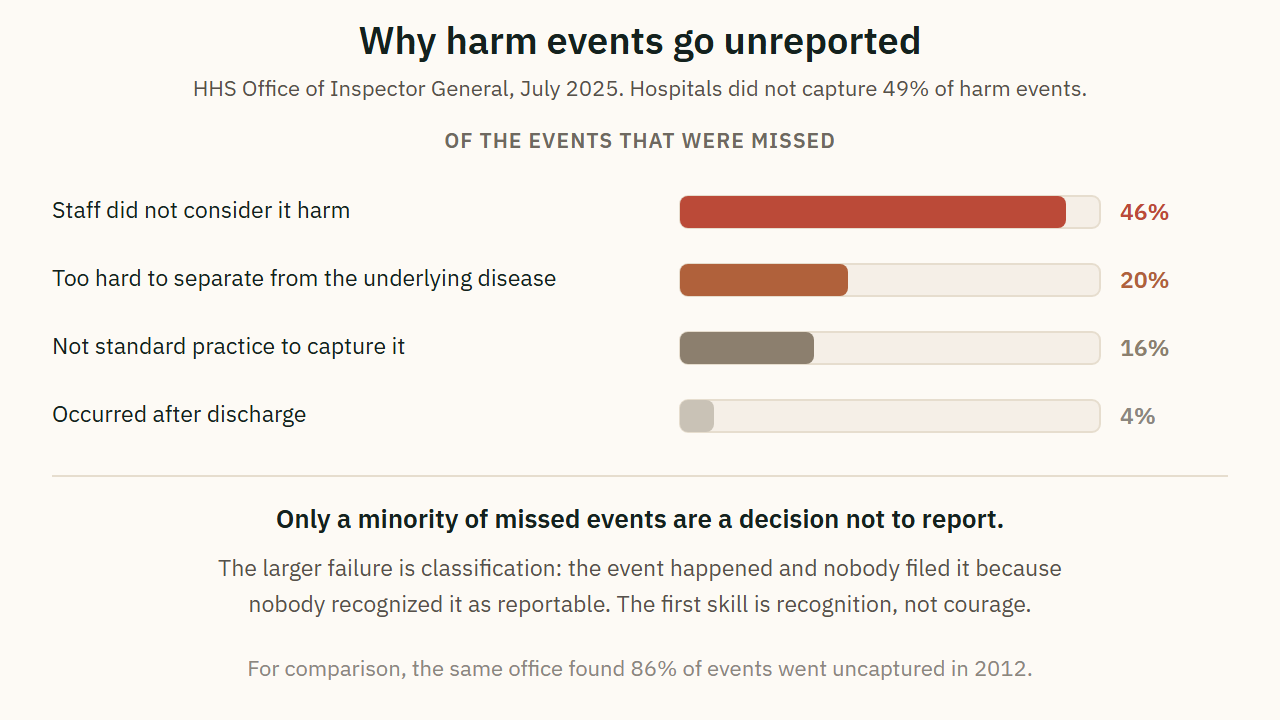
According to July 2025 data from the HHS Office of Inspector General (OIG report OEI-06-18-00401), hospitals failed to capture 49% of known patient harm events. The reasons for this gap are revealing:
- In 46% of the missed events, staff did not consider what happened to be "harm."
- In 16%, capturing the event was not standard practice at that hospital.
- In 20%, the event was judged too difficult to distinguish from the patient's underlying disease.
There is significant variance in how pharmacists define reportable events. A near-miss at the dispensing cabinet or a late antibiotic dose may be reported by one pharmacist while being ignored by another in the same building. While the 49% figure is high, it represents significant progress; in 2012, the OIG found that 86% of events went unidentified (OEI-06-09-00091). Closing this gap requires moving past narrow, inherited definitions of "harm."
How the response is decided
To navigate the aftermath of an error, you need David Marx's Just Culture Algorithm before you need it. This framework shifts the focus from the severity of the patient outcome to the nature of the practitioner's behavior.
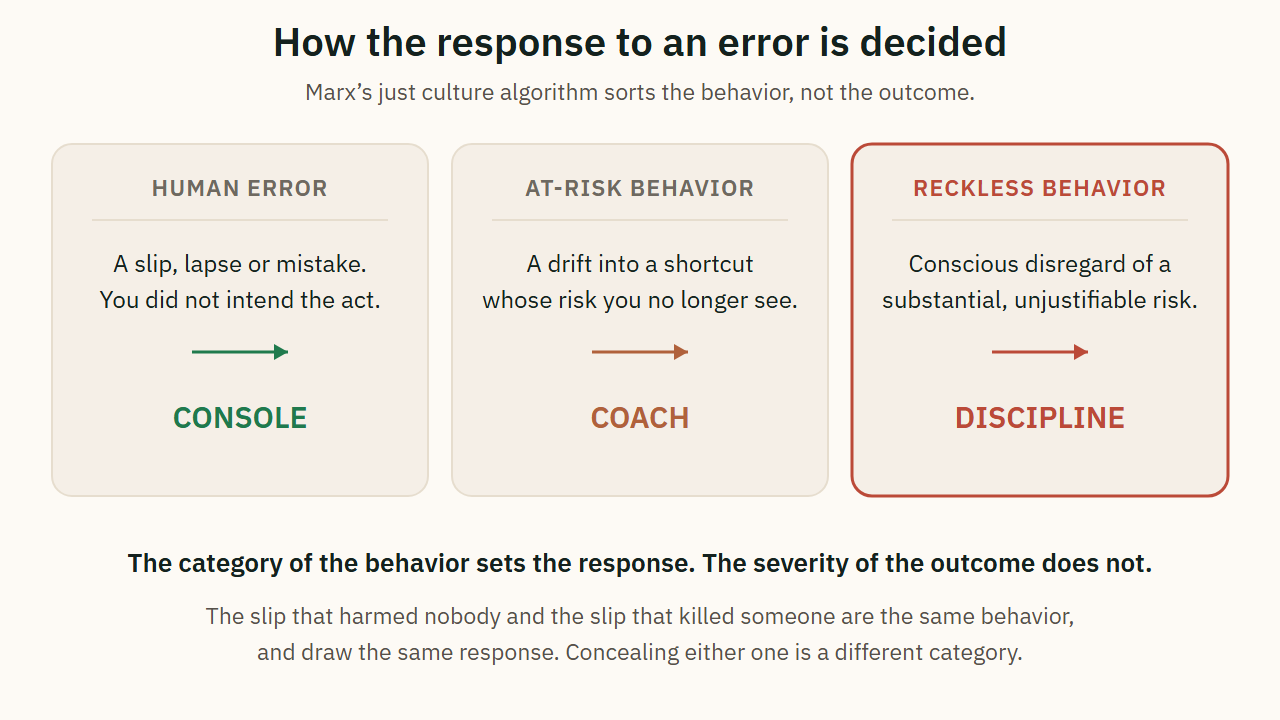
| Behavior | Description | Organizational Response |
|---|---|---|
| Human Error | A slip, lapse, or mistake; the act was unintentional. | Console |
| At-Risk Behavior | A drift into a shortcut where the risk is no longer recognized. | Coach |
| Reckless Behavior | Conscious disregard of a substantial and unjustifiable risk. | Discipline |
The logic of a Just Culture is counter-intuitive: the response is dictated by the behavior category, not the outcome.
"An identical slip that harms no one and one that kills someone are categorized as the same behavior and warrant the same organizational response."
When you calibrate your willingness to report based on "how bad" the result was, you are operating in a blame culture. In a safety culture, we evaluate the choice, not the luck of the draw.
What to write in the report
When filing a report through an incident reporting system, avoid the "confession" style. A report is a data record for quality and risk analysts; it is not a platform for emotional processing.
Strict Narrative Rules: Use facts, times, roles, and conditions. Do not use adjectives.
- No Apologies: Contrition is not a retrievable data point and adds no value to clinical analysis.
- No Theories of Fault: Speculating on who else is to blame pre-empts objective analysis and makes the report appear defensive.
The Verbatim Structure:
- Time/Context: "At [Time], I verified an order for [Drug, Dose, Route, Frequency] on [Unit]."
- The Discrepancy: "The order was [Actual Order]. I [Action Taken]."
- Discovery: "The discrepancy was identified at [Time] by [Role, not name]."
- Impact: "The patient received [Doses received or 'no doses']."
- Status: [Current clinical status of the patient.]
- Contributing Factors: List only conditions, not people (e.g., look-alike labeling, staffing levels, high-frequency alerts).
The three outcomes after an event
Susan Scott's research into the "second victim" phenomenon (PMID: 19812092) outlines six stages of recovery: chaos, intrusive reflections, restoring integrity, enduring the inquisition, obtaining emotional first aid, and moving on.
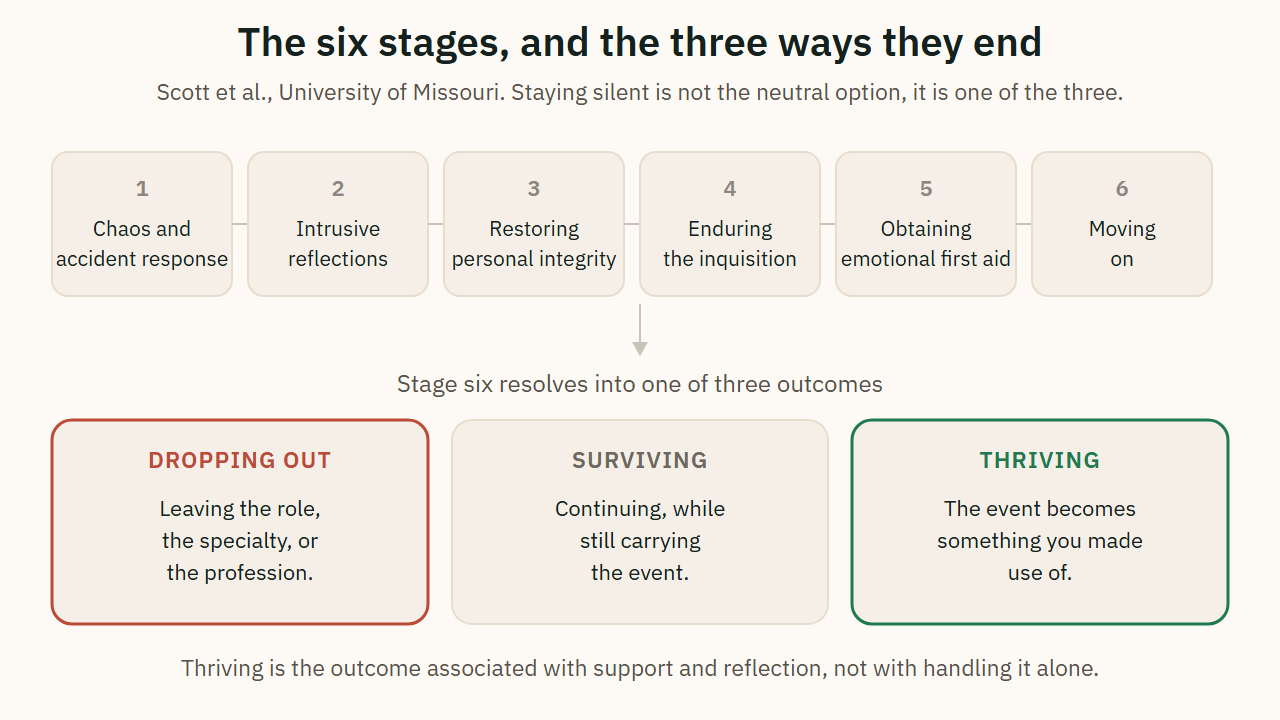
Stage six, moving on, results in one of three outcomes:
- Dropping Out: Leaving the role, specialty, or profession entirely.
- Surviving: Continuing in the profession while carrying the weight of the event.
- Thriving: Using the event as a catalyst for growth and system improvement.
The myth that staying quiet is "neutral" is dangerous. Silence does not exempt you from the recovery trajectory; it simply selects "dropping out" as the destination. Thriving is only possible through support models like the forYOU Team, a peer-support system that has supported more than 1,360 second victims at MU Health Care.
Why the best units report the most
In 1996, Amy Edmondson discovered that high-performing nursing units appeared to make more errors than low-performing ones. The reality was that the high-performing units simply reported more frequently. Reporting rates are a metric of psychological safety, the interpersonal climate of the unit, not a measure of incompetence. Filing a report signifies that you are part of a high-performing team that prioritizes safety over optics.
What happens after you file
The leading barrier to reporting is the absence of any feedback afterwards (PSNet). When reports disappear into a "black hole," staff perceive reporting as a waste of time.
You must act as a "leader without a title": Investigate the status of the last report filed in your area. If there is no answer, the issue is an operational failure in the feedback loop. The OIG confirms this, noting that few captured events lead to actual investigations or system improvements.
Why bother reporting at all
Reporting is voluntarily producing evidence against yourself. However, four factors outweigh this risk:
- Isolation is the Enemy: You cannot choose if the event affects you, only whether you process it. Isolation leads to dropping out.
- Algorithm Protection: Marx's algorithm protects human error. However, an error discovered later that was intentionally hidden is judged as "concealment," which carries a much harsher disciplinary response.
- The "Expert" Peer: Based on Autonomous Motivation (Deci and Ryan), clinicians who process errors often become the most trusted colleagues. In a department, the pharmacist who has filed an error and can describe it plainly is the one a new grad asks for help at 2:00 AM. Nobody asks the person who has never admitted to anything.
- System-Level Fixes: Your report is the only way to trigger the analysis that fixes the look-alike label or the ineffective alert.
The action plan
Research by Gollwitzer and Sheeran (2006) demonstrates that "implementation intentions", linking a situational cue to a specific action, are far more effective than general goals. Use these "If-Then" plans to secure your professional survival:
| If/When [Situation/Cue] | Then [Action] |
|---|---|
| If I am on shift this week | Then I will open a blank reporting form once to ensure I know the interface before a crisis. |
| If I am writing a narrative | Then I will use only roles and times, omitting all names and adjectives. |
| If I file a report today | Then I will tell one trusted colleague immediately to secure emotional first aid. |
| If I am about to close the report | Then I will set a 2-week calendar reminder to ask leadership for the feedback loop status. |
| When I am in the recovery phase | Then I will find out if my hospital has a peer-support model (e.g., forYOU Team). |
Two honest cautions
- Not a Shield: This framework does not protect reckless behavior. Conscious disregard of risk remains a disciplinary matter.
- The Policy-Practice Gap: Just Culture is often a stated policy that does not reflect actual practice. Review your organization's AHRQ Hospital Survey on Patient Safety Culture results. If "Nonpunitive Response to Error" scores are low, proceed with an understanding of your local reality.
If you make a mistake tonight, are you choosing to survive it, or are you choosing to drop out?
The one-hour checklist
| Do this | Why it matters |
|---|---|
| Open the blank reporting form before you need it | You will not learn a new interface during stage one, chaos and accident response |
| Write times and roles, not names and adjectives | The report is a data record, not a statement |
| Describe conditions you observed, not causes you inferred | Naming a cause pre-empts the analysis and reads as defensive |
| Classify the behavior before you classify yourself | Marx's three categories: error, at-risk, reckless |
| Tell one colleague the same day | Stage five is obtaining emotional first aid, and it predicts the thriving outcome |
| Find out whether your hospital has peer support, and how it is reached | forYOU-style programs exist in many systems and most staff do not know |
| Diarise the two-week loop-close | Absent feedback is the leading barrier to future reporting |
References
- HHS Office of Inspector General. Hospitals Did Not Capture Half of Patient Harm Events. OEI-06-18-00401, July 2025.
- HHS Office of Inspector General. Hospital Incident Reporting Systems Do Not Capture Most Patient Harm. OEI-06-09-00091, 2012.
- Scott SD, et al. The natural history of recovery for the healthcare provider second victim after adverse patient events. Qual Saf Health Care 2009. PMID: 19812092.
- Edmondson AC. Learning from Mistakes is Easier Said Than Done. J Appl Behav Sci 1996;32:5-28.
- Gollwitzer PM, Sheeran P. Implementation intentions and goal achievement: a meta-analysis of effects and processes. Adv Exp Soc Psychol 2006;38:69-119.
- Marx D. Just Culture Algorithm. See also Boysen PG. Ochsner J 2013. PMC3776518.
Want the practice knowledge behind this?
Your First Year as a Hospital Pharmacist covers the clinical judgment a residency front-loads. Part of the Pharmacy Handoff library.
See the book