The $232.50 Paradox: Why the Newest Non-Opioid is Splitting Expert Opinions
The arrival of suzetrigine in January 2025 marked a genuine milestone in clinical pharmacology: the first NaV1.8 inhibitor to target the peripheral nervous system rather than the central mu-opioid receptors. By mid-2026, prescription volumes had already approached one million, signaling a desperate appetite for opioid alternatives. Yet, beneath this commercial surge lies a profound clinical schism.
When the ICER Midwest advisory council reviewed the evidence, the experts were nearly unanimous in their skepticism, voting 14 to 0 against its "net benefit" compared to cheap, existing NSAIDs and 12 to 2 against it compared to opioids.
However, the same review's economic model reached a startlingly different conclusion, labeling the drug "dominant", meaning it is both more effective and less costly than the status quo. This creates a central paradox for every Pharmacy and Therapeutics (P&T) committee: How can a drug that costs 100 times more than a generic opioid be considered "cost-saving," and should we pay a premium for "potential" risk avoidance before long-term data exists?
Takeaway 1: The "Invisible" Benefit Gap
The conflict between the expert panel's rejection and the economic model's "dominant" status is not a mathematical error; it is a clash of temporal perspectives. The advisory council focused on the immediate clinical data, pain scores captured over a 48-hour window. In those trials, suzetrigine struggled to prove it was superior to what we already have in our kits.
The economic model, conversely, looks past the bedside to the horizon of societal harm. It justifies the price by modeling the prevention of "downstream" consequences that the clinical trials were never designed to capture.
Takeaway 2: The Math of Opioid Avoidance (0.43% vs. 0.02%)
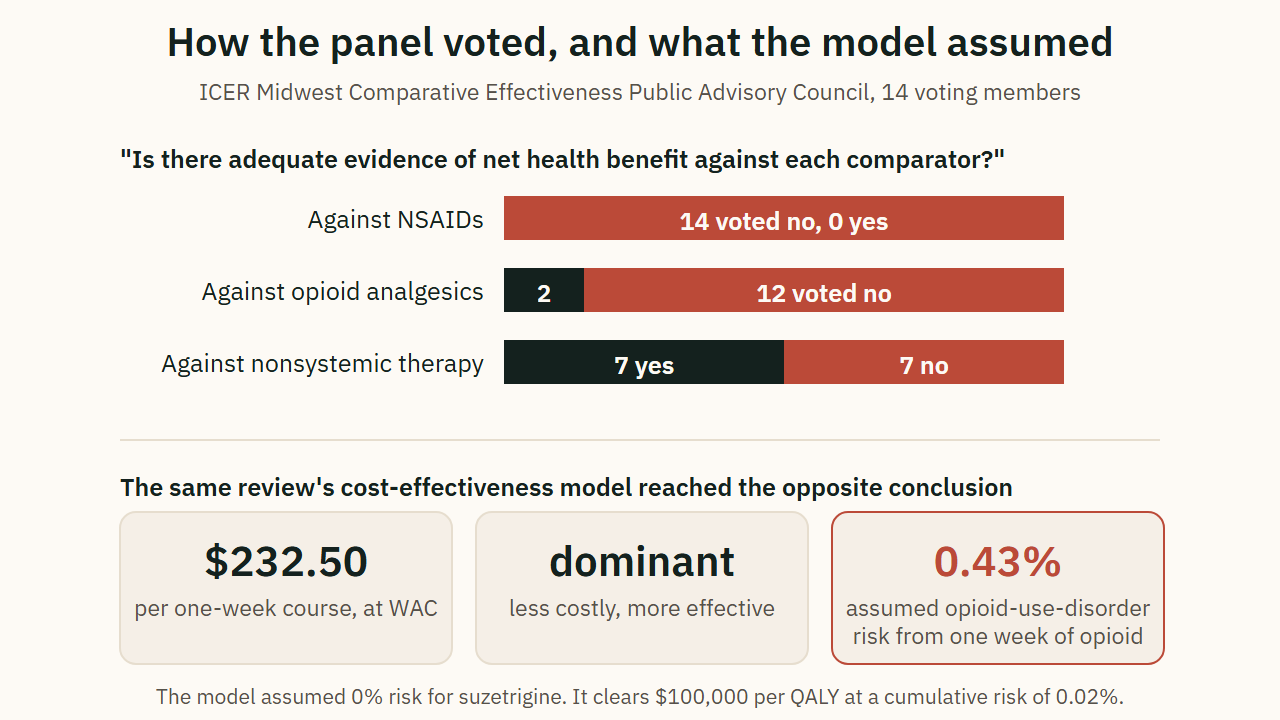
The entire value case for suzetrigine rests on a single, pivotal assumption: the risk inherent in a one-week course of opioids. The model assumes a 0.43% risk of developing Opioid Use Disorder (OUD) over three years following a single seven-day prescription of hydrocodone/acetaminophen. By displacing this risk, the drug generates enough avoided societal cost to offset its high acquisition price.
For hospital leaders, the decision hinges on the "sensitivity threshold." To be considered "valuable" at a $100,000 per QALY threshold, the drug doesn't need to be a miracle; it only needs to prevent a tiny fraction of the assumed risk.
-
232.50 Acquisition Cost: The total WAC price for a one-week course (15.50 per 50 mg tablet).
-
0.02% Sensitivity Threshold: The drug is considered cost-effective if it prevents a cumulative OUD risk of just 2 in 10,000 patients.
Takeaway 3: Bone vs. Soft Tissue - Not All Pain is Equal
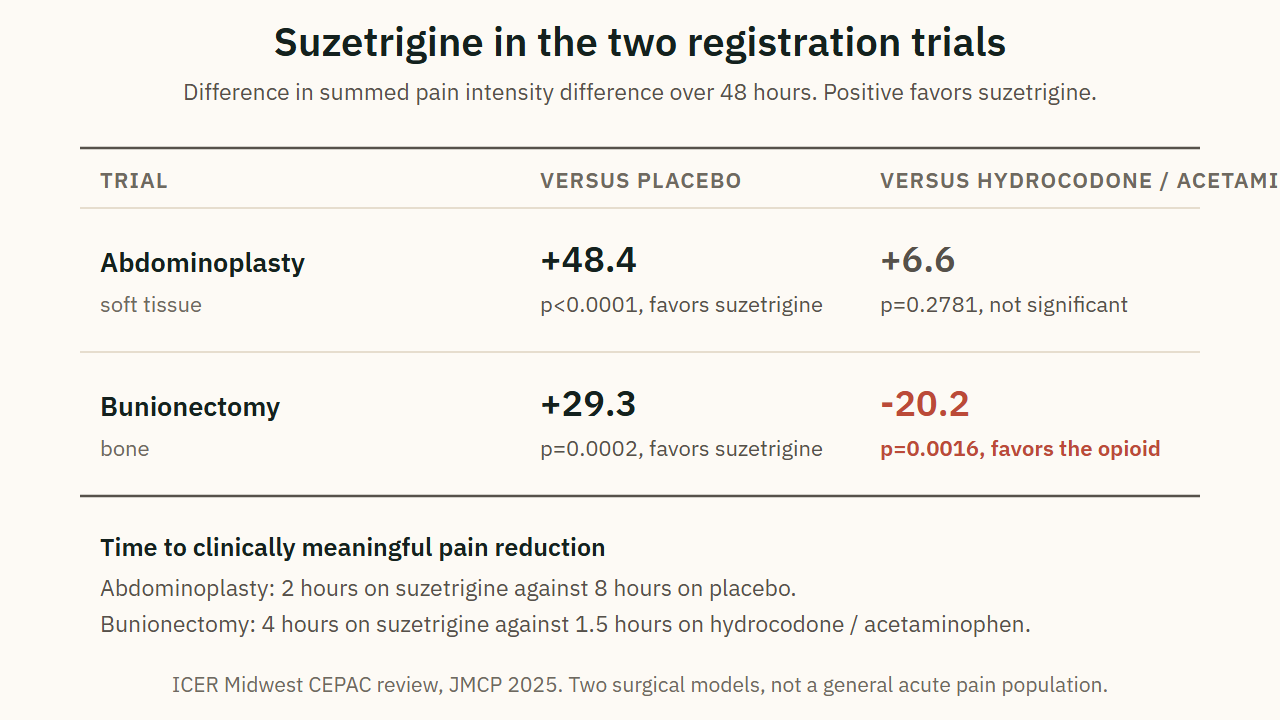
The NAVIGATE trials reveal that suzetrigine's performance is highly dependent on surgical "case mix." While the drug beat placebo in both trials, the magnitude of that win and its performance against opioids varied significantly between tissue types:
-
Abdominoplasty (Soft Tissue): Suzetrigine won with a Least Squares Mean Difference (LSMD) of 48.4 against placebo.
-
Bunionectomy (Bone): The win against placebo was narrower (LSMD 29.3), and more importantly, suzetrigine actually lost to hydrocodone/acetaminophen (p=0.0016).
For hospital administrators, the most critical metric may be throughput. In the bunionectomy trial, suzetrigine took 4 hours to reach meaningful pain reduction, while the generic opioid took only 1.5 hours. This 2.5-hour delay in relief onset is not just a clinical nuance; it is a bottleneck that can negatively impact Post-Anesthesia Care Unit (PACU) discharge times and overall surgical efficiency.
Takeaway 4: The "Zero-Percent" Assumption Gamble
The "cost-saving" label depends on a critical, unproven assumption: that suzetrigine itself carries a 0% risk of OUD. Because this is a first-in-class agent, we are essentially operating in a data vacuum regarding its long-term safety profile.
Modeling the risk at "zero" is a mathematical necessity for current economic projections, but as a clinical policy columnist, I must frame it as a theoretical gamble. Treating "non-opioid" as synonymous with "zero-risk" for future dependency is a dangerous statistical placeholder until real-world surveillance data matures.
The Strategy: Four Pillars of Smart Restriction
To bridge the gap between clinical skepticism and economic optimism, P&T committees should move away from a binary "yes/no" vote. Instead, they should build a defensive perimeter around the drug through four specific restriction criteria:
| What | Why it matters |
|---|---|
| Opioid-naive patients only | The value case is predicated on preventing new opioid initiation. For patients already on chronic opioids, there is no initiation risk to displace. |
| Specific procedure lists | Prioritize soft-tissue surgeries where the drug was competitive, and restrict use in orthopedic or bone-related surgeries where the onset of action lags behind standard care. |
| NSAID contraindications | Respect the 14-0 expert vote. Suzetrigine should be reserved for patients where NSAIDs are clinically inappropriate or have already failed. |
| Defined course length | The economic model is built on a one-week regimen. Access should be tied to a strict seven-day stop date to avoid unstudied, open-ended use. |
Conclusion: A Decision, Not a Permanent Position
The most effective way to handle suzetrigine is to write the restrictions before the committee meets. This shifts the debate from the $232.50 price tag to the more important question of appropriate patient selection.
Committees must also recognize the "relief valve" provided by the HCPCS code C9818, which took effect in January 2026. This code allows for separate payment in outpatient settings, effectively shifting the financial burden away from the hospital's bundled payment. If the drug is reimbursable, the "net cost" to the institution changes overnight.
Finally, any formulary addition must be paired with a firm reassessment date. In a year or two, we will have real-world data to replace the "zero-percent" assumption. Until then, the central question remains: Is our healthcare system ready to pay a 100x premium for the potential avoidance of risk based on a 0.43% statistical projection? Your answer to that question will determine suzetrigine's place on your formulary.
Related
- ICER review summary in JMCP
- VA formulary monograph for suzetrigine
- VA Formulary Advisor, which publishes monographs like it for most new agents
- Running the Clinical Program, on building a formulary restriction that clinicians will follow
- The Business of the Pharmacy, on what a high-cost addition does to the drug budget
Want the practice knowledge behind this?
Your First Year as a Hospital Pharmacist covers the clinical judgment a residency front-loads. Part of the Pharmacy Handoff library.
See the book