Why Your Drug Shortage Strategy is Probably Wrong: Lessons from a Single Thread
The Hidden Fragility of the Formulary
On a professional forum for pharmacists, a user recently asked if shifting tariffs meant it was time to "order up" on certain products. While formal market analyses and ivory-tower white papers often get lost in the weeds of trade economics and geopolitical forecasting, a single-line reply from a practicing pharmacist offered more strategic clarity than a dozen over-complicated economic reports: "Heparin and animal-derived products." This pharmacist had already increased their stock.
As a strategist, this highlights a systemic failure in how we monitor risk. Most stakeholders are watching the wrong signals, headlines and trade wars, instead of the hard biological and geographic constraints of their supply chain. The truth is that your next crisis won't be sparked by a tariff line, but by a biological bottleneck that the world's most sophisticated manufacturing logic cannot override. To secure your formulary, you must abandon traditional procurement assumptions and apply the "Four-Question Test."
The "Chinese Pig" Problem (Species Over Brand)
The risk to heparin supply is fundamentally biological and geographic, not commercial. Unlike synthetic small molecules that can be manufactured in any compliant lab with the right chemical precursors, heparin is a crude material harvested from pig intestinal mucosa.
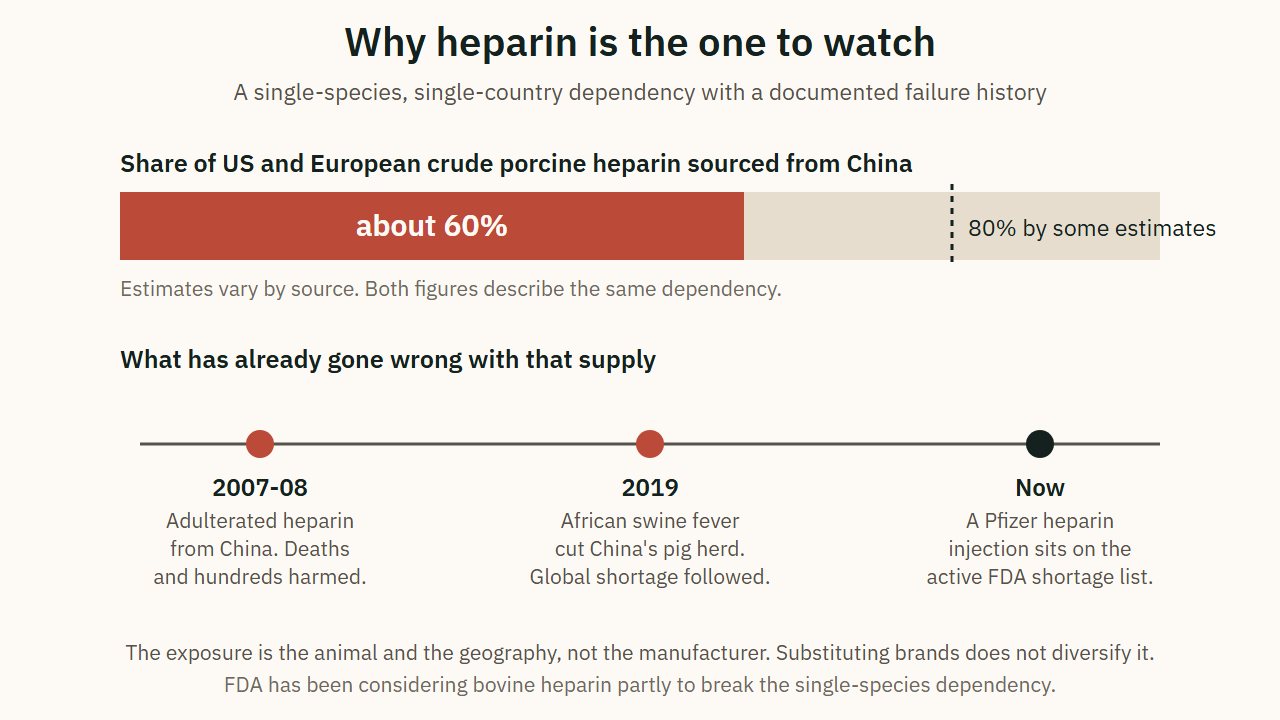
Approximately 60% to 80% of the crude porcine heparin used in the United States and Europe originates from China, which maintains the largest pig population globally. Because the supply is tethered to a specific species and a specific location, the traditional security measure of "switching brands" provides a false sense of safety.
When the supply of the raw biological material is concentrated in one region, every manufacturer downstream is equally vulnerable. Changing the label on the vial does not change the origin of the pig.
When Biology Dictates the Bottom Line
The heparin supply chain has failed twice in the last two decades, illustrating that these are not manufacturer errors, but systemic failures inherent to biological sources.
-
2007-2008 Quality Failure: Adulterated porcine heparin sourced from China reached the global market, resulting in patient deaths and hundreds of adverse events. This was a quality crisis born from an opaque, multi-layered supply chain.
-
2019 Volume Failure: An outbreak of African swine fever decimated China's pig population. This biological event triggered a global heparin shortage because the raw material simply ceased to exist in the required volumes.
Because heparin relies on pig mucosa, there is a hard ceiling on supply. Synthetic drugs can be scaled by adding extra shifts to a factory; biological drugs are limited by the birth, gestation, and processing rates of livestock. You cannot "overtime" a pig's growth cycle. The fragility is so acute that the FDA has even considered reintroducing bovine (cow-derived) heparin to break the total dependency on a single species.
The Illusion of Redundancy
A common misconception in pharmacy procurement is that having contracts with multiple suppliers equates to a secure supply. In the world of biologics, redundancy at the brand level is often an illusion.
Different finished-product manufacturers, the companies that fill and finish the final vials, often draw from the same upstream pool of crude material. If a pharmacy has contracts with three different heparin suppliers, but all three suppliers source their crude porcine heparin from the same region in China, that pharmacy effectively has only one supply chain. If that single upstream source is disrupted, all "redundant" suppliers will fail simultaneously.
The 4-Question Concentration Test
To identify which products in your formulary are at high risk, apply the following diagnostic tool. When a product hits "Four Yeses," it represents a critical exposure point.
| Question | The Heparin Example | Why It Matters |
|---|---|---|
| Is it biologically sourced? | Yes, pig intestine | Biological inputs cannot be scaled on demand. |
| Is input concentrated in one country? | Yes, 60%-80% in China | One policy change or disease outbreak moves the whole supply. |
| Are there few finishers? | Yes, handful of suppliers | Redundancy at the brand level is not real redundancy. |
| Is there a therapeutic alternative? | Limited/Clinical decision | A shortage immediately becomes a direct patient care problem. |
As of February 2026, 30 of 100 tracked drugs were in active FDA shortage. It is no coincidence that every drug in active shortage also appears on the WHO or FDA Essential Medicines List. These shortages are not hitting niche products; they are hitting the foundation of clinical care. The common thread, particularly among sterile injectables, is a combination of low margins, manufacturing complexity, and a lack of easy substitutes.
Moving Beyond "Ordering Up"
Stockpiling, or "ordering up," is a reactive tactic. While it moves your institution up the queue, it does nothing to resolve the underlying vulnerability. Furthermore, the GAO has recommended that HHS build a mechanism to coordinate its own shortage activities, a clear signal that even the federal government currently lacks central visibility. This means the individual pharmacy must lead its own defense.
True resilience requires four proactive steps:
| What | Why it matters |
|---|---|
| IDENTIFY HIGH-RISK PRODUCTS | Run your highest-spend and highest-criticality items through the four-question test to map your true exposure. |
| FIND UPSTREAM SOURCES | Move past the brand name. Ask your wholesaler representatives if your various suppliers share a single upstream pool of crude material. |
| WRITE THERAPEUTIC ALTERNATIVES EARLY | Establish clinical protocols for substitutes before a shortage begins. It is far easier to decide on an alternative anticoagulant at a Pharmacy and Therapeutics (P&T) meeting than during a code blue. |
| DEFINE THE DECISION-MAKING PROCESS | Clearly establish who has the authority to trigger a substitution and how that change will be communicated to clinical units to prevent downstream care errors. |
The New Map of Risk
Understanding supply risk requires looking past the manufacturer's label and into the geography of the raw material. While systemic shortages can be resolved, such as the 0.9% sodium chloride shortage that finally cleared in 2026, these resolutions are measured in years, not weeks. The saline crisis took eight years of manufacturing investment and regulatory flexibility to fix.
For the products currently on your shelves, the risk is already baked into their biology. If you run your top ten products through the four-question test today, how many would actually survive a single week of disruption?
Related
- The original thread on Student Doctor Network
- FDA drug shortages
- GAO on drug shortage coordination
- The Business of the Pharmacy, on purchasing, contracts and the drug budget
- Running the Pharmacy, on managing a shortage after it starts
Want the practice knowledge behind this?
Your First Year as a Hospital Pharmacist covers the clinical judgment a residency front-loads. Part of the Pharmacy Handoff library.
See the book