What staying at one hospital costs

It is remarkably easy for a decade to slip by at a single institution. You know the rhythms of the pharmacy, the nuances of the EHR, and the specific preferences of your most difficult prescribers. For many hospital pharmacists, being a "loyal employee" is a badge of honor, a sign of professional stability and deep-rooted clinical trust.
Because you are generally satisfied with your role, you likely haven't felt the need to check a job board or audit your market value in years. You assume that your annual merit raises and occasional cost-of-living adjustments are keeping you in line with the profession. However, that assumption often masks a quiet erosion of your market value.
Professional loyalty is a choice, but it is one that comes with a specific price tag. This "Loyalty Tax" represents the financial delta between those who stay and those who move. This article provides a clinical, data-driven look at that cost using the latest ADP Pay Insights, allowing you to evaluate your career with the same precision you apply to a pharmacokinetic profile.
The published number for what moving is worth
In the current labor market, the cost of staying put is no longer a matter of anecdotal guesswork. It is a knowable metric updated every month. According to recent ADP Pay Insights data, the median year-over-year pay growth for job stayers is 4.4%, while job changers are seeing growth between 6.6% and 7.0%. This creates a current "loyalty premium" of roughly 2.2 to 2.6 percentage points.
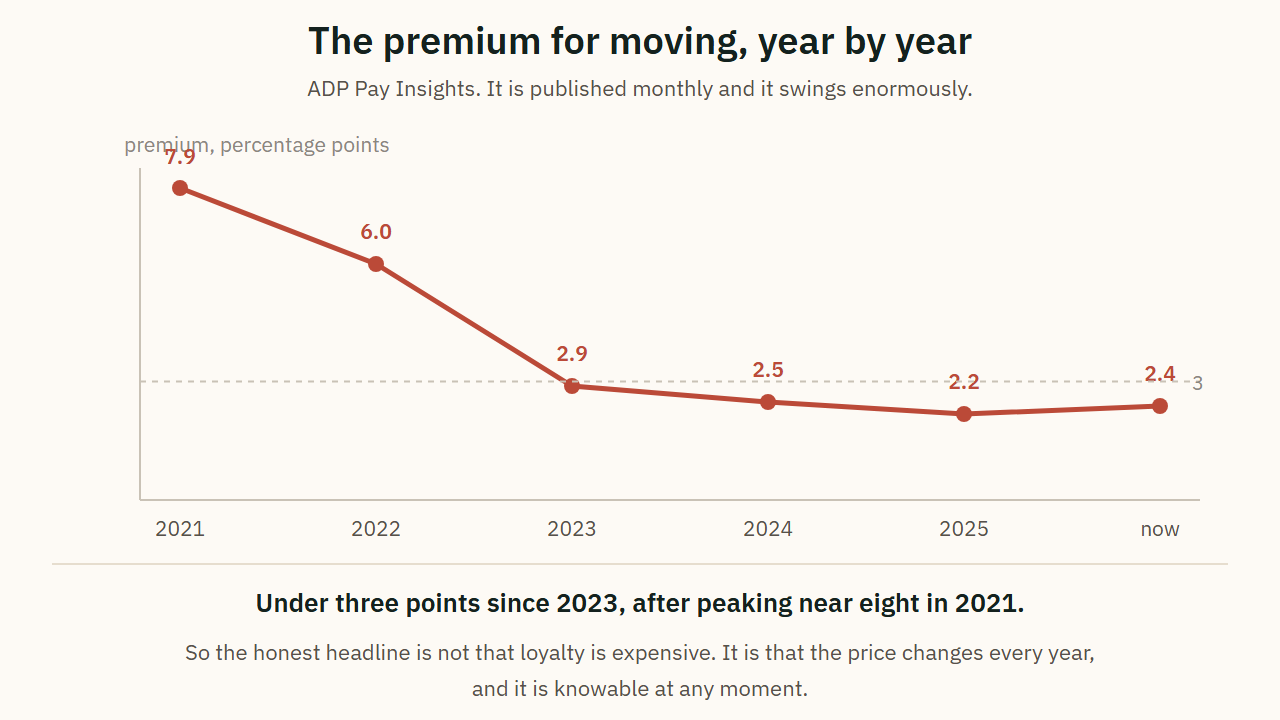
It is important to view this number as a variable market rate rather than a fixed penalty. During the hiring frenzy of 2021, the premium for changing jobs peaked near 8 percentage points. As the market has softened, it has trended under 3 points since 2023, ending 2025 at about 2.2.
"The premium... is knowable at any moment."
For the hospital pharmacist, this means the "cost" of being a loyal employee varies by year. Currently, the market is at the low end of its historical range. However, even a small annual gap has profound implications when viewed through the lens of long-term career math.
The arithmetic of compounding
A 2.2 percentage point difference is easy to dismiss as noise in a single performance review. Compounding is what turns it into a number that is hard to ignore. The gap is not merely the two-point difference in a single year; it is the fact that every future increase is applied to a different base.
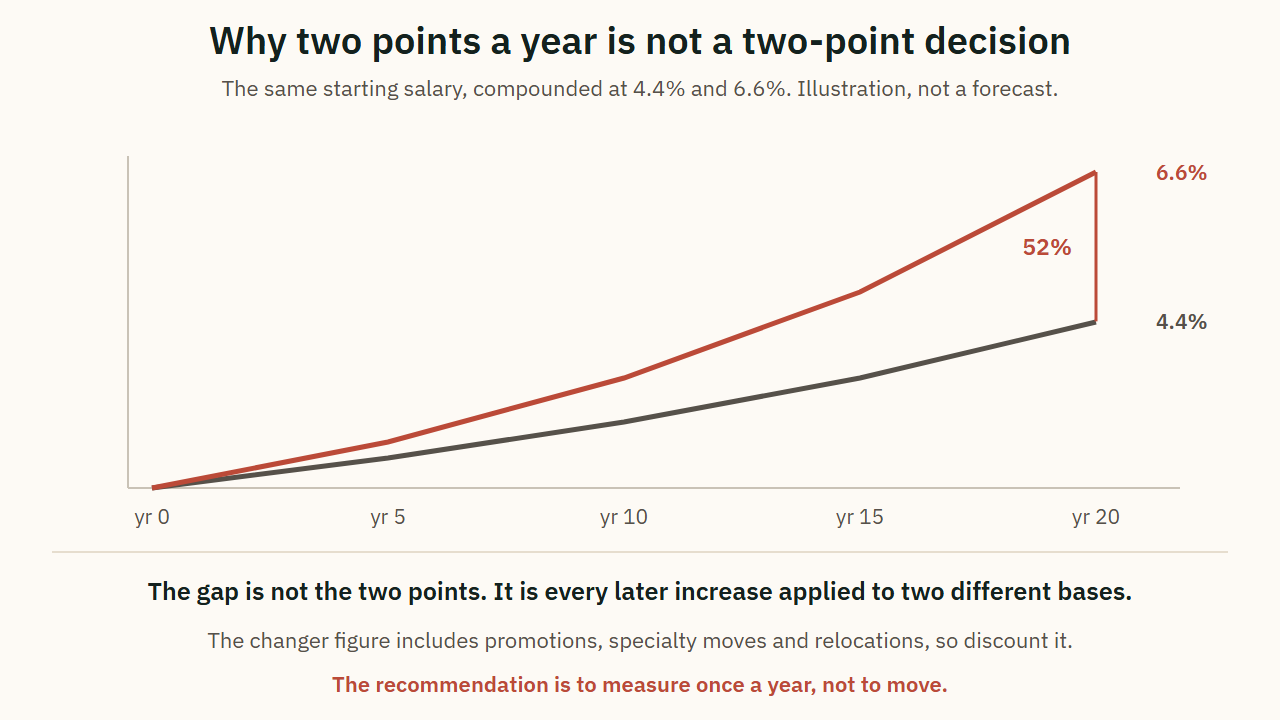
To see the "Loyalty Tax" in action, consider a hypothetical starting salary of $150,000. If we project the current growth rates over a career, the trajectories diverge sharply:
- Year 5: the stayer is on $186,035 and the changer on $206,480, an annual gap of $20,445.
- Year 10: the stayer is on $230,726 and the changer on $284,226, an annual gap of $53,500.
- Year 20: the stayer is on $354,896 and the changer on $538,562, an annual gap of $183,665.
This arithmetic, rather than opinion, is the most compelling argument for measuring the market. A gap you can ignore in Year 1 becomes a figure that alters your retirement timeline by Year 20.
You are negotiating a band, not a raise
Understanding the structural reality of hospital pay is essential to interpreting these numbers. Most healthcare systems operate within rigid, pre-defined pay bands. This structure is the primary reason internal raises tend to converge on a fixed, often lower, percentage, they are designed to keep you within the ceiling of your current bucket.
When you move to a new employer, you aren't just getting a "raise"; you are being priced against an entirely different band or a different entry point within a new structure. This explains why the most common internal counter-offer for a high-performing pharmacist is a title change (e.g., from Pharmacist II to Clinical Specialist). A title change moves the band; a merit increase merely moves you toward the ceiling.
The useful reframe is this: internal negotiations are rarely about the "percentage", they are about the band.
What staying buys
An objective analysis must also account for the items that don't appear on a W-2. Loyalty is not a "tax" paid for nothing; it is a purchase of "invisible" professional assets. These assets are often the essential preconditions for the promotable work discussed in our companion strategic guides. Staying at one institution buys:
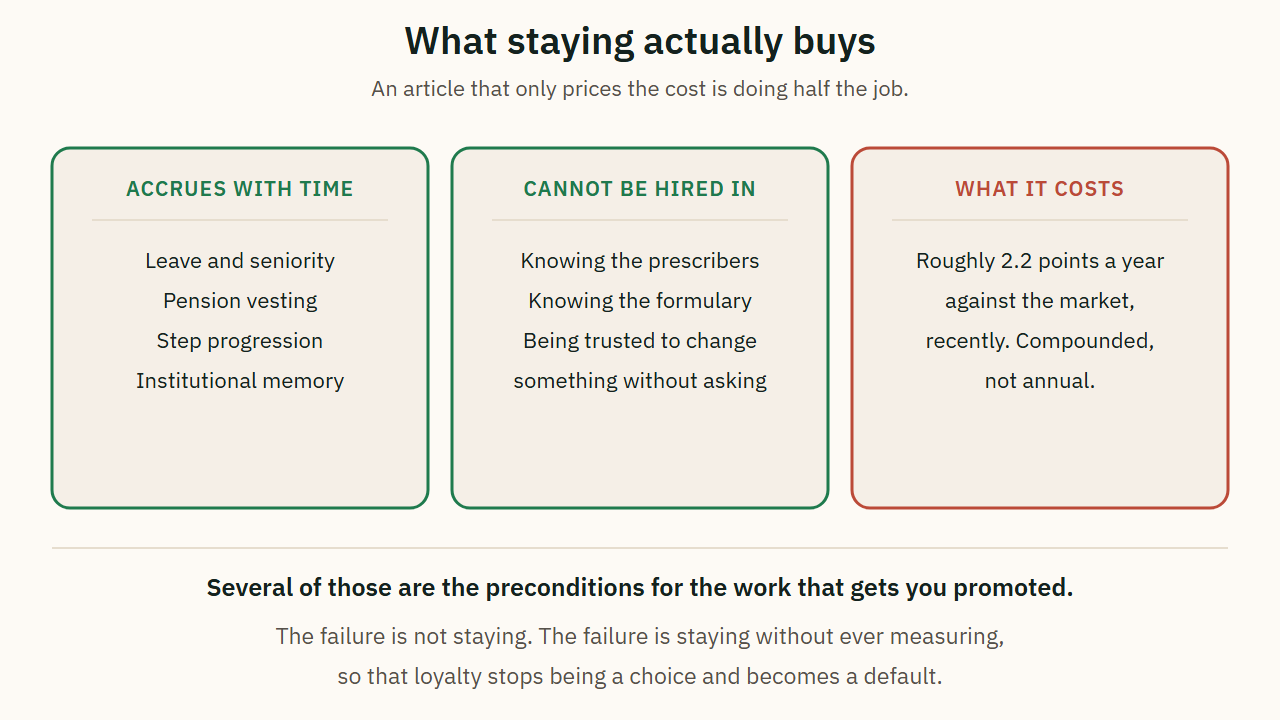
- Accrued seniority and increased leave tiers.
- Pension vesting and 403(b) matching milestones.
- Deep institutional knowledge of the formulary and EHR.
- High-velocity trust with the medical staff.
- The clinical credibility required to design and run a service rather than simply staffing one.
"The failure is not staying. The failure is staying without ever measuring, so that loyalty stops being a choice and becomes a default."
The goal is to ensure that these "invisible assets" are worth more to you than the compounding cash gap you are leaving on the table.
Running the comparison annually
Measuring your market value should be a neutral, annual administrative task, not a reaction to a "bad week" at the hospital. By running this comparison on your work anniversary, you remove the emotion from the data.
The data should be used to facilitate better internal conversations. Most pharmacists who feel underpaid resort to ultimatums, which usually costs them the relationship. Instead, use the market data to ask a strategic question about your path within the organization.
What to say internally: "I've been looking at what comparable roles are paying and the current ADP job-changer figures. I want to stay and continue building our oncology service. What I am asking is what the path to the next pay band or title looks like, and what would have to be true for me to be on it within the next twelve months?"
This approach signals that you are aware of your market value while reaffirming your commitment to the team, focusing on the band rather than a simple percentage hike.
Two honest cautions
To maintain professional credibility, we must apply two "honest cautions" to the ADP data. First, these figures are economy-wide and represent private-sector payrolls across all industries. Hospital compensation is generally more banded and less volatile than the private-sector average, so these numbers should be viewed as directionally useful rather than a pharmacy-specific benchmark.
Second, the "job changer" figure is not a clean causal estimate. The group of people who change jobs often includes those receiving significant promotions, relocating to higher-cost-of-living areas, or switching specialties. It measures what changers received as a group, not necessarily what an identical pharmacist would receive by moving across the street.
Why bother running the comparison
Knowing your market number changes your professional posture. A pharmacist who understands the current market asks more precise questions and handles critical feedback more objectively because their value is no longer a mystery. Furthermore, this data allows you to advocate for your staff's compensation with the authority of numbers rather than the weakness of a "feeling."
The greatest risk to a long-term hospital career is the resentment that builds when loyalty goes unexamined. Not knowing your value is not loyalty; it is a lack of professional due diligence. By measuring the market annually, you ensure that staying is a proactive choice based on the total value of your role.
If your annual review is on the calendar, are you walking in with a feeling, or are you walking in with the numbers?
The action plan
If your annual review is on the calendar, then before you walk in, look up the current ADP job-stayer and job-changer figures and write both numbers at the top of your notes. They take two minutes to find and they change what you ask for.
Second plan:
If it is your work anniversary, then run the comparison, whatever you intend to do with it. Anniversary, not crisis, is the point of the exercise.
The checklist
| Do this | Why it matters |
|---|---|
| Look up the current stayer and changer figures annually | The premium swings from under 3% to nearly 8% by year |
| Compound the gap over five, ten and twenty years | Two points a year is not a two-point decision |
| Ask about the band or title, not only the percentage | Hospital pay is structured, and a band moves what a raise cannot |
| Write down what staying buys you | Seniority, trust and standing are real and usually uncounted |
| Take the comparison to your manager as a question, not a threat | An ultimatum costs the relationship more often than it wins the money |
| Discount the changer figure honestly | It includes promotions, specialty and region changes |
| Repeat on your anniversary, not in a bad week | Decisions made in a bad week are about the week |
References
- ADP Pay Insights, monthly. Median year-over-year pay growth for job stayers and job
changers. Recent figures 4.4% stayers against 6.6% to 7.0% changers; premium about
2.2 percentage points at the end of 2025; under 3% since 2023; peak near 8% in 2021.
salary-negotiation-hospital-pharmacy,what-is-a-fair-pharmacist-salary.
Want the practice knowledge behind this?
Your First Year as a Hospital Pharmacist covers the clinical judgment a residency front-loads. Part of the Pharmacy Handoff library.
See the book