Where the jobs went: the 2026 pharmacist labor market, in the actual numbers
The pharmacy profession is no longer simply "evolving", it is undergoing a structural decoupling. Based on the federal wage data released in May 2025 (and synthesized in June 2026), we are witnessing the breakdown of the traditional safety net that has defined the pharmacist labor market for a decade. This annual "census" of the profession reveals a market moving in two opposing directions: a floorless contraction in retail and a disciplined, capped expansion in hospital systems.
For the strategic professional, the 2025 data isn't just a collection of figures; it is a diagnostic tool showing that the math of the profession has fundamentally changed.
The Safety Net Has Sprung a Leak
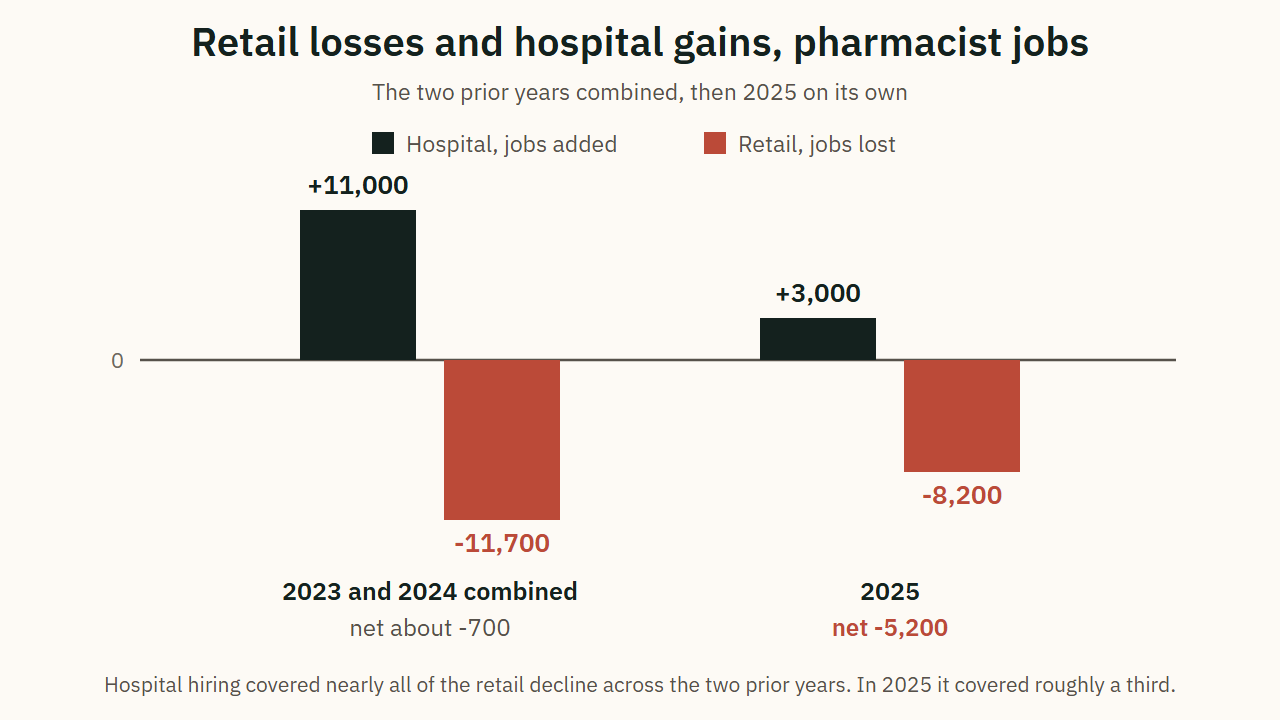
For years, the labor market relied on a predictable "absorption pattern." As retail positions evaporated, hospital systems expanded their headcounts almost exactly in proportion, catching displaced workers. Between 2023 and 2024, the retail sector shed 11,700 positions, while hospitals added 11,000. It was a reallocation of talent, not a loss of opportunity.
That pattern broke in 2025. While the retail decline accelerated, hospital hiring hit a ceiling, covering only about a third of the losses. This shift transformed a "reallocation" into a net loss of 5,200 positions across these primary sectors. This is a critical warning: hospital hiring is dictated by clinical census and regulatory mandates, not by the availability of retail refugees.
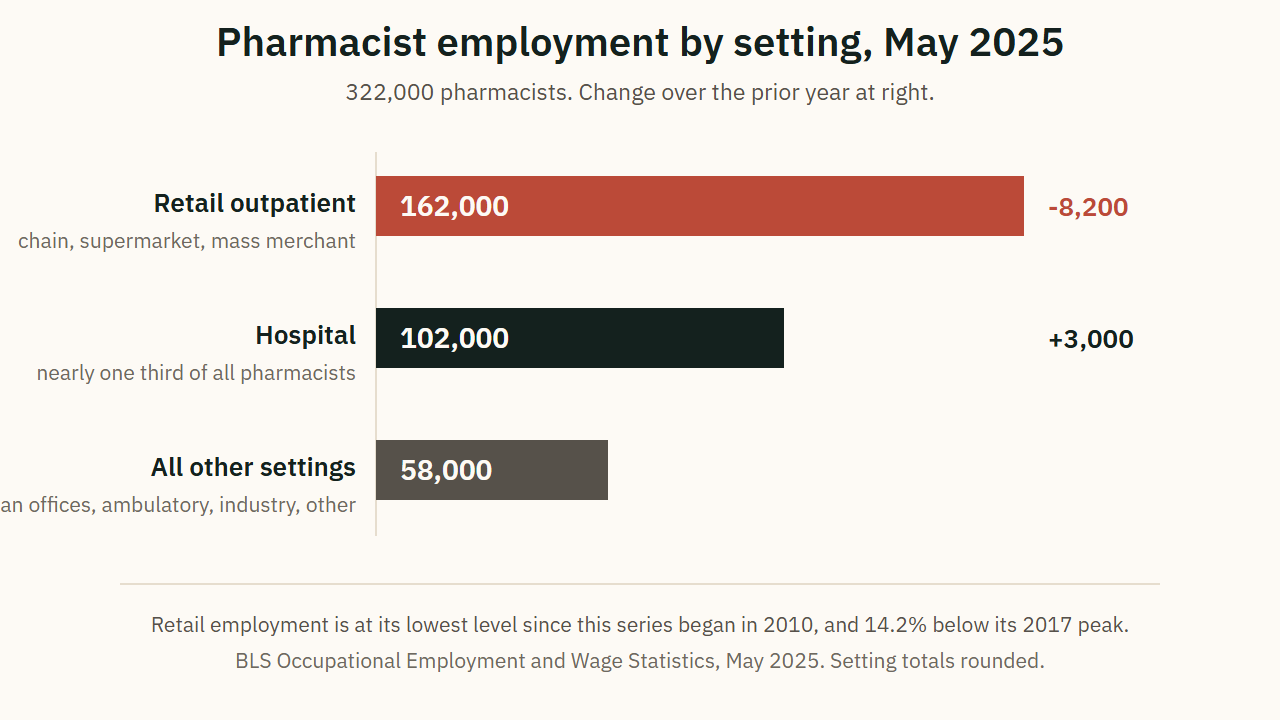
The 2025 Shift: In May 2025, retail outpatient pharmacy held 162,000 positions, down 8,200 (4.8%). During the same period, hospitals held 102,000 positions, up 3,000 (3.0%). Retail employment is now at its lowest level since 2010, 14.2% below its 2017 peak.
The Retail Paradox: Fewer Jobs, Higher Pay
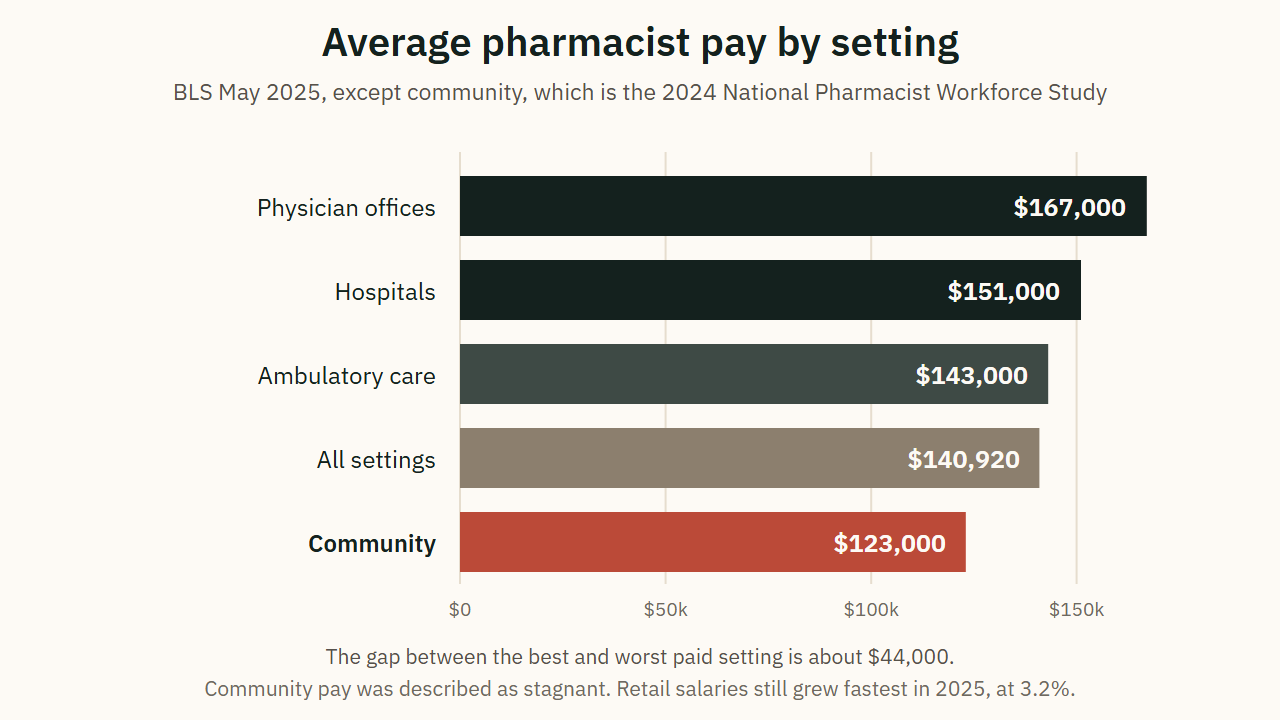
Retail pharmacy is currently exhibiting a "demand signal" paradox. Despite shedding thousands of jobs, it remains the sector with the fastest wage growth. This is not a sign of sector health; rather, it is a "desperation tax" paid by employers. As the retail footprint shrinks, the remaining roles become increasingly difficult to fill, forcing a premium on retention even as the ship lightens its load.
Annual Pay Growth by Setting (2025):
-
Retail: 3.2%
-
Hospital: 2.2%
-
Physician Offices: 0.2%
The "Growth" Mirage
Headlines frequently tout the Bureau of Labor Statistics (BLS) projection of 14,200 annual openings. While the number is factually correct, it is a statistical mirage for those seeking new industry growth. The vast majority of these openings are "replacement hiring" rather than job creation.
Of those 14,200 annual openings, only roughly 1,700 represent actual new positions. The remaining 12,500 exist solely to backfill pharmacists who are retiring or exiting the profession entirely.
Analyst's Warning: A common and dangerous error is to subtract the 322,000 employment count from the 335,100 projection base to calculate "available" jobs. These figures are derived from entirely different BLS programs with different methodologies. They are not statistically comparable, and attempting to reconcile them produces a made-up number.
The $167,000 Hidden Gem
If you are following the money and the quality of life, the data points toward non-traditional, small-base settings. Physician offices and ambulatory care remain the "hidden gems" of the market, offering the highest pay and satisfaction levels. However, these are "growth mirages" of a different sort: high percentage growth on a very small foundation.
-
Physician Offices: These roles offer the highest average pay at $167,000 but represent less than 3% of the total pharmacist workforce.
-
Ambulatory Care: This setting reports the highest job satisfaction in the 2024 National Pharmacist Workforce Study, with average pay around $143,000. It accounts for only 5% of the workforce.
While these sectors are lucrative, their small bases mean they cannot absorb the volume of pharmacists currently being displaced by the retail contraction.
The "Unfillable" Hospital Roles
Even with a slower growth rate in the hospital sector, a severe mismatch exists between the skills available and the skills required. Hospital pharmacy directors are not desperate for generalists; they are desperate for specialists.
"Hospital pharmacy directors report shortages of clinical specialists and clinical coordinators at about 60%, and of experienced technicians at over 80%.", ASHP National Survey of Pharmacy Practice in Hospital Settings (n=1,497; 16.7% response rate)
These roles are often "hard to reach" for those coming from a retail background. The smartest career move in the current climate is a form of labor market arbitrage: moving from a high-instability sector (Retail) to a high-demand specialty (Hospital). The most effective way to do this is the "staff-to-specialist" internal move, securing a general staff position first to gain the internal leverage required to transition into a specialized, "unfillable" role.
Conclusion: Geography is Destiny
National trends provide the background, but your local market provides your reality. The pharmacist labor market is increasingly fractured by geography. A city with a massive health system expansion may be a "growth system" that defies the national contraction.
Is your local market a growth system or a contraction zone, and do you have the data to prove it?
Do This: Access the BLS state and metropolitan wage and employment tables. Find your specific metropolitan area and compare its local employment change against the national benchmark of -8,200 retail positions and +3,000 hospital positions. This ten-minute diagnostic will tell you if you are navigating the national trend or a local exception.
Related
- BLS Occupational Employment and Wage Statistics
- BLS Occupational Outlook Handbook, Pharmacists
- Drug Channels on the 2025 pharmacist figures
- Your First Year as a Hospital Pharmacist, if the move you are planning is into a hospital
- Running the Pharmacy, on how a department decides to post a position at all