The $17,000 Discrepancy: Which Pharmacist Salary Number Should You Use to Ask for a Raise?

When you prepare for an annual review, the data seems straightforward until you look at the primary sources. Currently, three reputable national figures put pharmacist pay at $140,920, $151,000, and $167,829. All three are technically correct, yet they vary by nearly $17,000.
This discrepancy creates a dilemma. Bringing the wrong number to your manager can end a negotiation before it truly starts. If you quote a figure that includes management salaries for a staff-level role, you risk appearing uninformed, making it easy for a manager to dismiss your request as an "apples-to-oranges" comparison that is structurally impossible for them to meet.
To secure a raise, you must understand the mechanics behind these numbers. Navigating a compensation conversation requires moving past national averages and focusing on the specific data that applies to your role, your market, and your actual responsibilities.
Takeaway 1: The $17,000 Spread is About "Who" You Ask, Not Math Errors
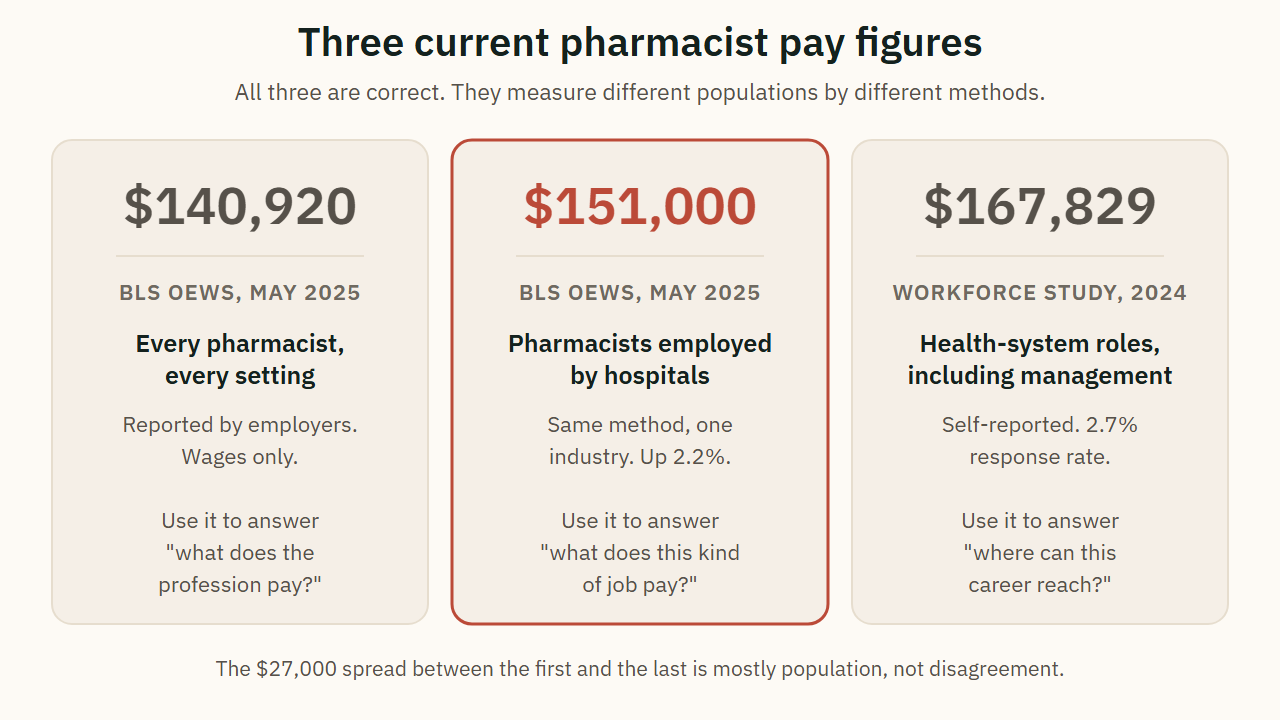
The gap between the federal Bureau of Labor Statistics (BLS) data (151,000) and the National Pharmacist Workforce Study (167,829) is a result of different measurement instruments and populations.
The BLS survey asks employers to report the wages they pay for specific industry codes, providing a "clean" look at what hospitals actually spend. In contrast, the Workforce Study asks pharmacists to self-report their own salaries. This study had only a 2.7% response rate and, as the authors note, the respondents skew female, older, and Midwestern relative to the licensed population. Self-reported data also tends to be higher because pharmacists often report total compensation rather than just base wages.
"Health-system" is broader than "hospital." The workforce study's category covers employment across a health system, which includes clinical managers, directors, specialty pharmacy and ambulatory roles that belong to the system. Management pay is in that average.
The BLS "Hospital" figure is a narrower definition of staff on a hospital payroll. The Workforce Study's "Health-system" figure is naturally inflated by the inclusion of high-level management and specialty roles.
Takeaway 2: Hospitals and Ambulatory Care are the "Raise Hotspots"
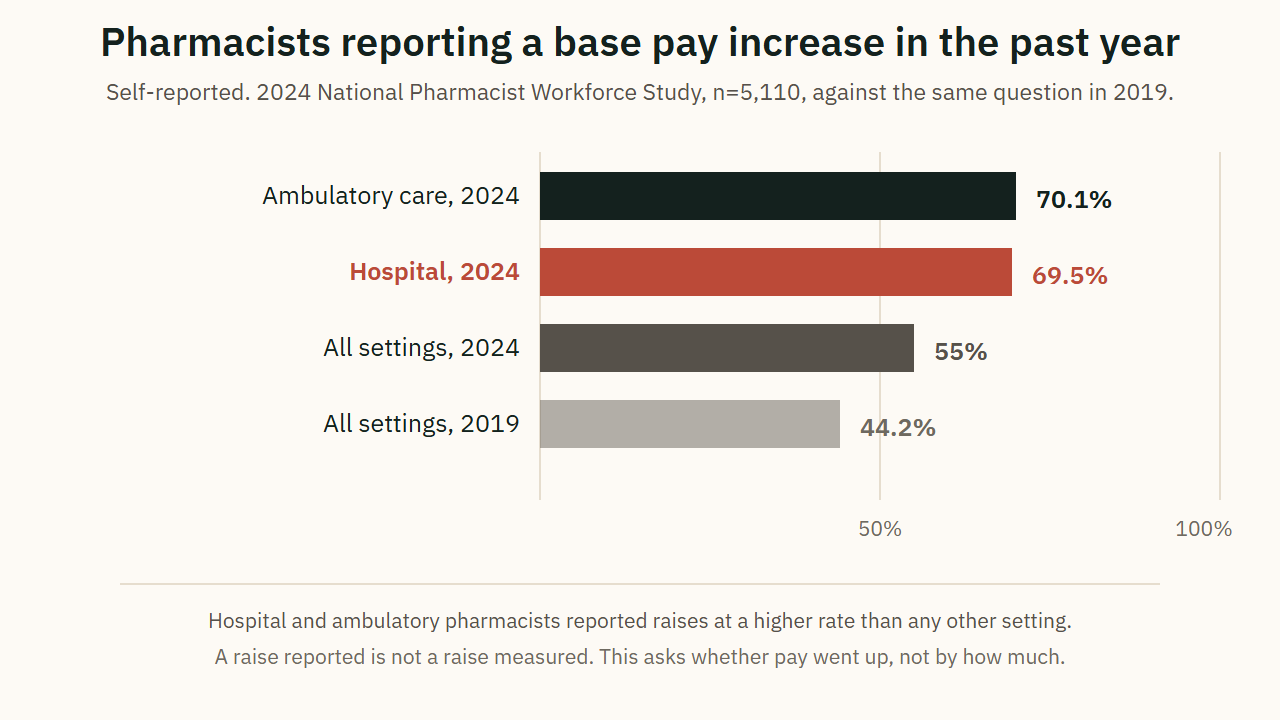
The current climate for pharmacy compensation shows that asking for a raise is not an unusual or outlier activity. Recent data indicates that raises are becoming the standard in specific clinical settings, with hospital and ambulatory care leading the surge.
-
Ambulatory Care Respondents: 70.1% reported a base pay increase in the past year.
-
Hospital Respondents: 69.5% reported a base pay increase.
-
National Average: 55% of all pharmacists reported a raise (an increase from 44.2% in 2019).
In an environment where seven out of ten hospital pharmacists are receiving increases, a compensation review is a standard professional expectation. You aren't asking for a favor; you are asking to remain competitive in a shifting market.
Takeaway 3: The "Shrinking Premium" Contextualizes Your Growth
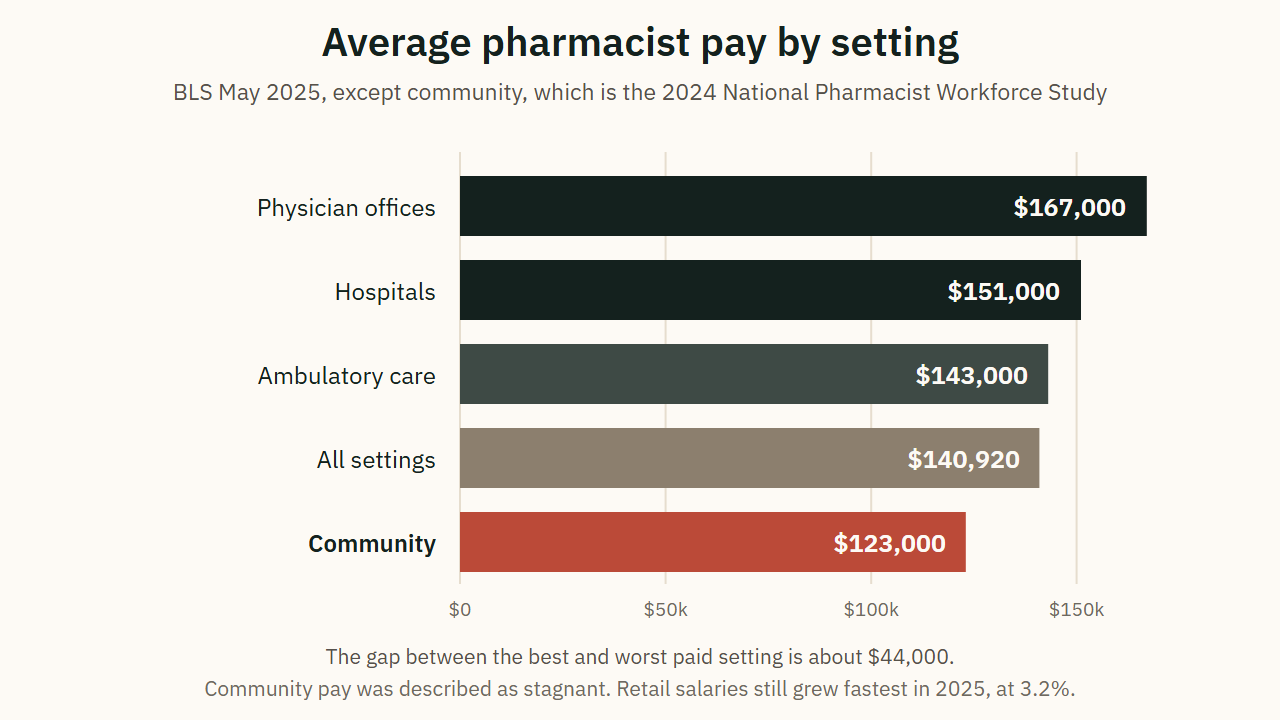
While salaries are rising, the profession's relative standing compared to other healthcare workers is shifting. Pharmacist pay has not fallen, but other healthcare wages have risen at a faster rate, eroding your relative leverage.
This compression provides the "intelligent" justification for an aggressive negotiation. While the 2.7% average pay increase is higher than the 2.4% rise in the Consumer Price Index (CPI), it leaves only a 0.3% "real" wage growth. This statistical standstill means that if you only accept a standard cost-of-living adjustment, your economic position is essentially frozen while the rest of the healthcare market moves past you.
Takeaway 4: Local Percentiles Trump National Means
National means are useful for identifying trends, but they are too broad for a specific negotiation. To build a persuasive case, you should use the "Three-Number Structure" as your tactical checklist:
| What | Why it matters |
|---|---|
| Your Local 75th Percentile | Access the BLS metropolitan tables for your specific city. Do not look at the mean; use the 75th percentile to locate your value as an experienced, high-performing clinician in your specific market. |
| The National Hospital Mean ($151,000) | Use this to establish the "floor" for hospital-sector roles, ensuring you are comparing like-for-like (hospital vs. hospital) rather than a retail-inclusive average. |
| Your Role-Specific Responsibilities | List the work you do that the job description does not capture. This is the bridge between a national average and your personal value. |
Takeaway 5: The Danger of the $167,829 Figure
Using the highest available number, $167,829, just because it is the largest is a strategic error for those in staff positions. Because this figure includes directors and managers, using it to price a staff role ruins your credibility. A manager's budget is often tied to BLS industry codes; by quoting a self-reported figure from a skewed demographic that includes management, you invite a fact-based correction that ends the negotiation immediately. Use the $151,000 figure as your national hospital benchmark instead.
Conclusion: Beyond the Job Title
National and local numbers establish the floor for your compensation, but they do not win the raise on their own. The most effective negotiations focus on "what the role contains that the title does not." This includes responsibilities such as:
-
Protocol ownership and specific stewardship metrics.
-
Unique service line coverage or specialist expertise.
-
Precepting loads and educational contributions to the department.
-
Weekend or call obligations that exceed the baseline.
A published average describes a job title; your negotiation should describe the work. Before your next shift, open the BLS metropolitan tables and find your specific market's data. How does your current metropolitan percentile align with the actual responsibilities you manage every day?
Related
- BLS wage tables by state and metropolitan area
- 2024 National Pharmacist Workforce Study
- Drug Channels on the 2025 pharmacist figures
- The Business of the Pharmacy, on how a department's labor budget is actually built
- Running the Pharmacy, on what a manager can and cannot change about a pay band