Beyond the max statin: what the 2025 ACS guideline changes about the drugs
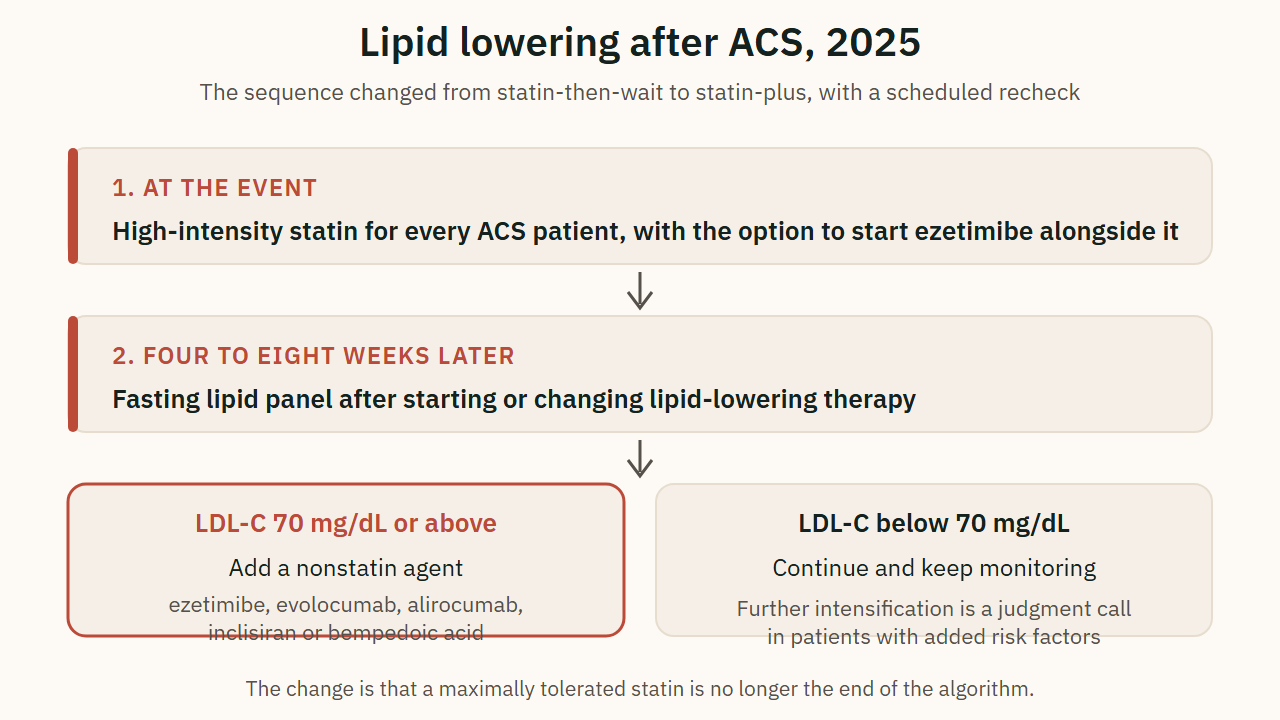
For years, the clinical comfort zone for Acute Coronary Syndrome (ACS) discharge has been predictable: initiate a "maximally tolerated statin," prescribe clopidogrel by default, and consider the clinical work finished. However, the 2025 ACS guidelines have fundamentally shifted the goalposts for pharmacy and cardiology teams. These updates move away from a "set and forget" mentality, transforming lipid and antiplatelet management from static discharge orders into active, sequential treatment pathways.
For clinical operations, this means transitioning from a checklist approach to managing a proactive, long-term strategy where the most critical decisions happen weeks after the patient leaves the hospital.
Takeaway #1: The Lipid Algorithm No Longer Ends at Statins
Under previous standards, reaching the highest dose of a tolerated statin was often viewed as the finish line. The 2025 guidelines refit this as merely a stepping stone. If a patient's LDL-C remains at 70 mg/dL or higher at the four-to-eight-week recheck, the guideline mandates the addition of a nonstatin agent.
While ezetimibe remains the accessible first-line addition due to its low acquisition cost, the algorithm now explicitly includes PCSK9-directed therapies and bempedoic acid. Operationally, the lipid pathway often "stalls" at the transition to PCSK9-directed agents because of the administrative burden of Prior Authorizations (PAs). Without a designated process or team member to manage these access pathways, the clinical intent of the guideline remains unfulfilled.
Takeaway #2: The P2Y12 Default has Flipped
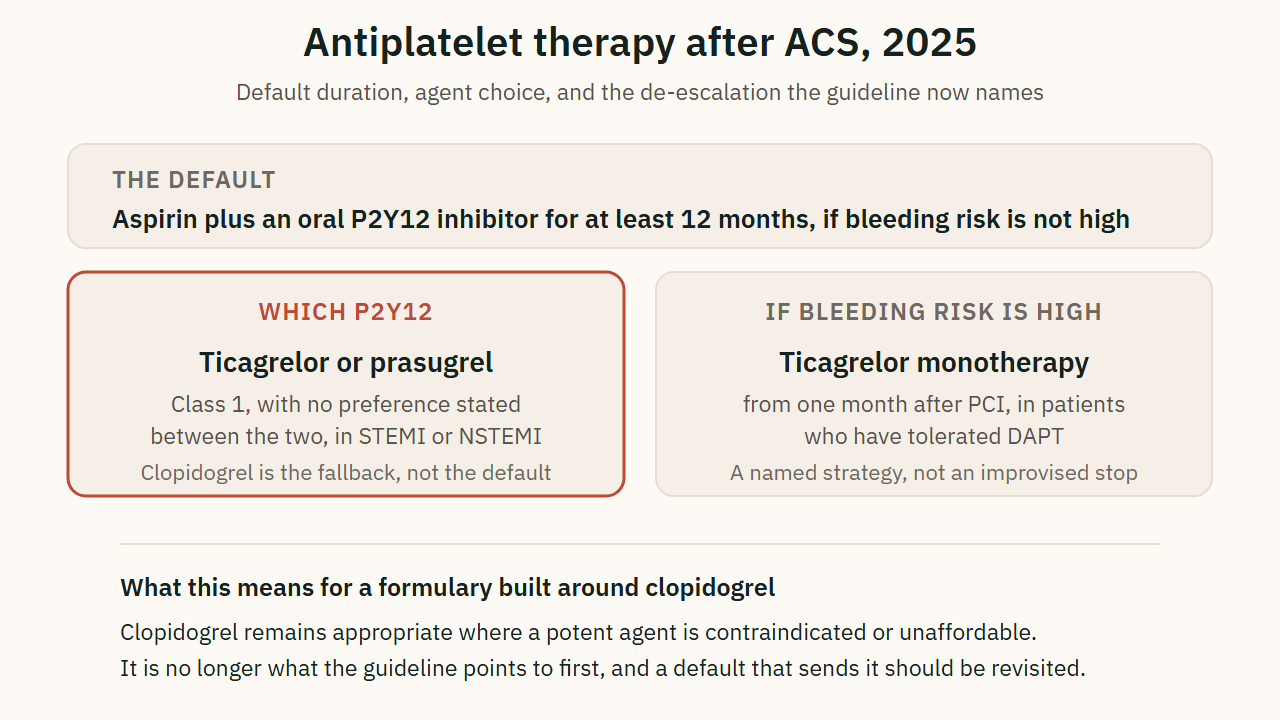
The hierarchy of antiplatelet therapy has undergone a significant reversal. Ticagrelor or prasugrel are now the Class 1 defaults for both STEMI and NSTEMI patients, with clopidogrel relegated to a "fallback" reserved for patients with specific contraindications, prohibitive bleeding risks, or insurmountable cost barriers. Clinical operations teams must recognize that a discharge order set that continues to pre-select clopidogrel is effectively making a choice that contradicts the current guideline.
From a pharmacist's perspective, the primary friction point here is adherence: ticagrelor requires twice-daily (BID) dosing, whereas prasugrel and clopidogrel offer once-daily convenience. In cases where adherence is the binding constraint, this pharmacological nuance becomes the deciding factor in agent selection.
Takeaway #3: The "Invisible" Failure Point (The 4-8 Week Recheck)
The most significant point of system failure in these new guidelines is the scheduling of the follow-up lipid panel. The fasting lipid panel at 4-8 weeks is no longer a clinical suggestion; it is a formal recommendation and a "scheduling obligation." This gap is "invisible" because it occurs post-discharge. If the lab is not hardcoded into the discharge process, the lack of results isn't flagged within the acute care environment.
Without this specific data point, the entire lipid algorithm, and the subsequent escalation to necessary nonstatin therapies, collapses. Success requires the hospital to view the 4-8 week lab not as a follow-up, but as a mandatory diagnostic step for the next phase of treatment.
Takeaway #4: A Named Strategy for De-escalation
To manage bleeding risk, the guidelines now provide a specific "named strategy" for de-escalation rather than the "ad hoc" or improvised early stops of the past. For patients who have tolerated Dual Antiplatelet Therapy (DAPT) for at least one month following Percutaneous Coronary Intervention (PCI), the recommended strategy is a transition to ticagrelor monotherapy.
This provides pharmacists with a specific, evidence-based recommendation to offer during profile reviews or P&T committee discussions. Having a named, guideline-supported pathway allows clinicians to reduce bleeding risk with the confidence that they are not compromising ischemic protection through an unstudied, improvised regimen.
Takeaway #5: The Order Set is Your Only Real Lever
Guidelines only "live" if they are hardcoded into the workflow via the ACS discharge order set. This document is the primary lever for moving an entire institution toward the new standard of care. However, the order set only initiates the process; the results must be managed. This is where ambulatory pharmacist services, operating under Collaborative Practice Agreements (CPAs), become essential.
These services are the logical "who" for acting on 4-8 week follow-up results and navigating the PA process for high-cost therapies. To align with the 2025 standards, you must audit the following four defaults in your ACS order set:
| What | Why it matters |
|---|---|
| P2Y12 Selection | Defaulting to ticagrelor or prasugrel for all STEMI/NSTEMI patients. |
| Statin Intensity | Ensuring high-intensity statins are the default, not an option. |
| Concurrent Ezetimibe | Providing a clear pathway to start ezetimibe alongside the statin at the time of the event. |
| The 4-8 Week Lab Order | Automating the order for the follow-up fasting lipid panel at the point of discharge. |
Conclusion: The New Target
The landscape of dyslipidemia management is moving faster than most order sets can keep up with. While the 2025 ACS guidelines focus on the 70 mg/dL threshold, the 2026 dyslipidemia guidelines have already set an even more aggressive target of LDL-C < 55 mg/dL for very high-risk patients. This confirms that the trend toward multi-drug lipid therapy is only going to accelerate.
Is your current discharge order set a bridge to the new standard of care, or a barrier to it? The most important immediate action is to check whether your ACS discharge order set includes the 4-8 week lipid panel order. Without that result, the rest of the guideline cannot happen.
Related
- The 2025 ACS guideline in JACC
- Antiplatelet and anticoagulant key recommendations
- ACC summary of the guideline
- Andexanet alfa is off the US market, on the anticoagulation side of the same service
- Running the Clinical Program, on turning a guideline into an order set that holds
Want the practice knowledge behind this?
Your First Year as a Hospital Pharmacist covers the clinical judgment a residency front-loads. Part of the Pharmacy Handoff library.
See the book