The Ghost in the Order Set: Why the Disappearance of Andexxa is a Documentation Emergency
The 3:00 AM Crisis: The Dead-End Order
Imagine a critical scenario in the Emergency Department at 3:00 AM: a patient presents with a catastrophic intracranial hemorrhage while on apixaban. The attending physician, working with muscle memory and urgency, opens the hospital's "Intracranial Hemorrhage" order set. There it is: andexanet alfa. They click the order, select the high-dose bolus, and hit sign.
Precious minutes pass. Then comes the phone call from the pharmacy. "We don't have that drug. It was withdrawn from the market months ago."
Effective December 22, 2025, AstraZeneca voluntarily withdrew Andexxa (andexanet alfa) from the U.S. market. This was a regulatory withdrawal, not a product quality recall; the manufacturer and the FDA could not agree on a path to convert the drug from accelerated to traditional approval. For many institutions, the clinical shift is minor, but the "ghost" of the drug in your electronic systems is a dangerous liability. When a life-threatening bleed is progressing, a dead-end order is a patient safety event waiting to happen.
The 14.6% Reality: Why Restoration Isn't Free
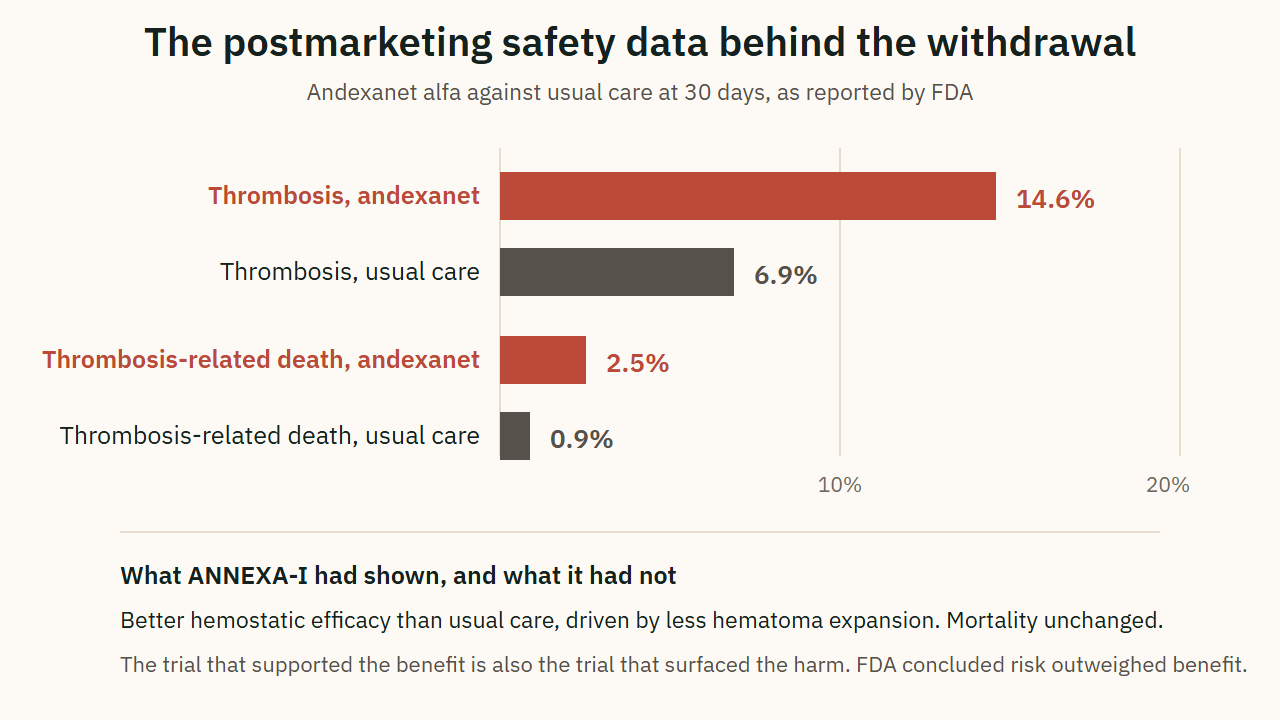
The primary driver behind the withdrawal was postmarketing safety data that challenged the drug's benefit-risk profile. While andexanet alfa was specifically engineered to neutralize factor Xa inhibitors, the ANNEXA-I data revealed a sobering increase in thrombotic events compared to "usual care."
The FDA eventually concluded that the risks of the product outweighed its benefits, noting a significant "thrombotic cost" to rapid reversal:
As clinicians, we must reflect on the counter-intuitive reality that restoring coagulation in a patient who requires anticoagulation for an underlying condition, such as atrial fibrillation or VTE, carries a high, measured risk. When that risk is double that of usual care, the clinical argument for the agent evaporates.
Biochemical Victory vs. Bedside Reality: The Mirage of Surrogate Data
The saga of andexanet alfa is a definitive case study in the limitations of accelerated approval. The drug was initially brought to market in 2018 based on its performance against a surrogate endpoint: anti-factor Xa activity. In the ANNEXA-I trial, the drug achieved a stunning 92% reduction in anti-factor Xa activity and demonstrated superior hemostatic efficacy by limiting hematoma expansion.
However, the biochemical victory did not translate to a survival benefit. Mortality did not differ between the andexanet group and the usual care group. This disconnect highlights why surrogate endpoints can be misleading; neutralizing a drug in the lab does not always save a life at the bedside, particularly when the mechanism of neutralization introduces new, systemic harms.
Back to the Future: 4F-PCC as the Practical Default
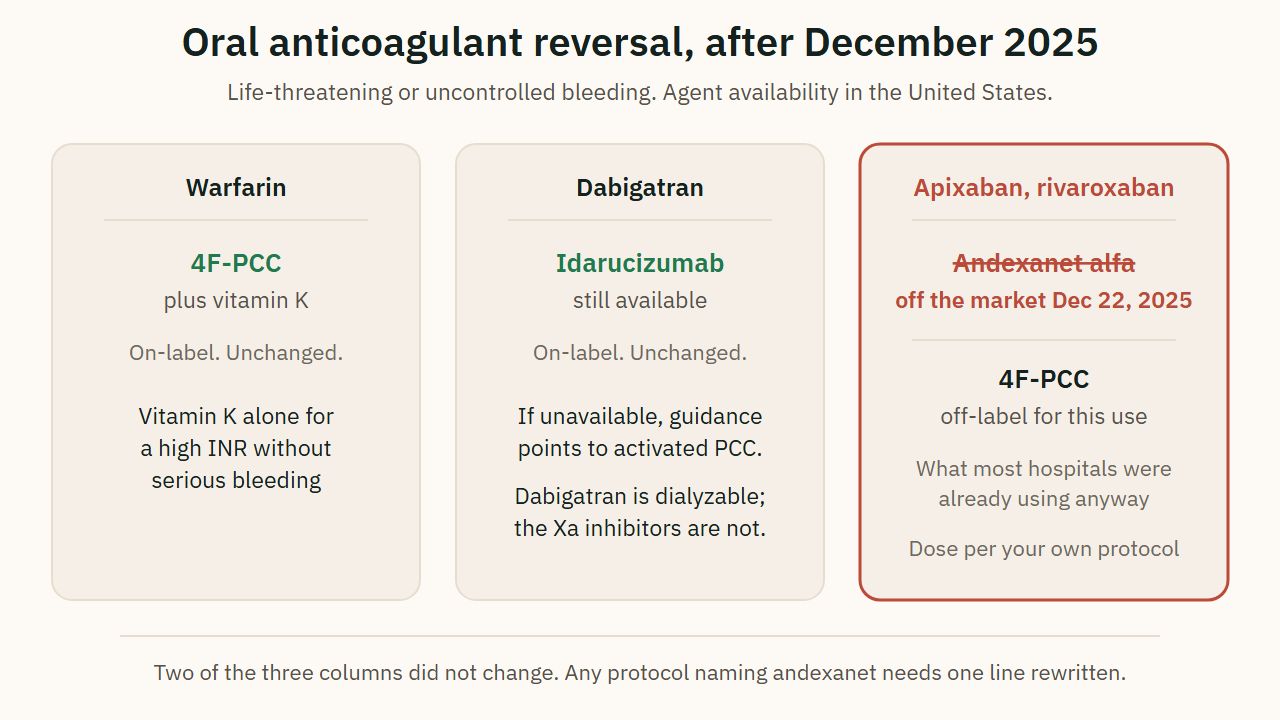
For the reversal of apixaban and rivaroxaban, four-factor prothrombin complex concentrate (4F-PCC) is now the primary remaining option. While its use in this context remains off-label, this shift is less of a clinical shock than it might seem. Many healthcare systems were already using 4F-PCC due to the staggering cost, complex preparation, and limited availability of andexanet alfa.
Current Scientific and Standardization Committee (ISTH) guidance already pointed toward PCC for factor Xa inhibitor reversal when andexanet was unavailable. The withdrawal simply consolidates the treatment pathway into a single, familiar branch. As a consultant's caveat: because the use of 4F-PCC here is off-label, dosing protocols, whether fixed or weight-based, vary significantly by institution. You must refer to your specific, updated institutional guidelines for administration.
The Stable Pillars: Warfarin and Dabigatran Protocols
It is crucial for frontline staff to understand that the "documentation emergency" is isolated to the factor Xa inhibitor column. Other established reversal protocols remain unchanged and on-label:
-
Warfarin: Reversal remains the standard 4F-PCC plus Vitamin K.
-
Dabigatran: Idarucizumab remains the primary on-label reversal agent. Furthermore, clinicians should remember that dabigatran is dialyzable, a distinct clinical advantage that factor Xa inhibitors like apixaban and rivaroxaban do not share.
The clinical pathways for these agents are stable; our goal is to ensure the confusion surrounding the Andexxa withdrawal does not bleed into these unrelated protocols.
The Five-Point Audit: Scrubbing the "Ghost" from Your System
From a systems perspective, an orderable drug that cannot be filled is a failure of governance. Healthcare leadership and P&T committees must act to prevent administrative friction from becoming clinical delay. I recommend a thorough audit of these five areas:
| What | Why it matters |
|---|---|
| The Primary Reversal Protocol | Update the master decision trees and guidelines approved by the Pharmacy and Therapeutics (P&T) committee to remove andexanet as an option. |
| Order Sets | Meticulously review EHR order sets for Massive Transfusion, Intracranial Hemorrhage (ICH), and GI Bleeds. A "dead-end" order in an emergency is a high-risk failure point. |
| Formulary Records and Approval Workflows | Deactivate the drug in the formulary and delete any associated restriction or specialist approval workflows that may still be live in the system. |
| Reference Materials | Audit the "shadow sources" of truth, ED wall charts, pocket cards, intranet PDFs, and residency orientation decks. |
| Pro-Tip | These are often the most common sources of medical errors because they exist outside the official EHR update cycle and are rarely inventoried. |
| Patient/Prescriber Communications | Update anticoagulation clinic cards or discharge education materials that may lead patients or providers to believe a targeted reversal agent is still available. |
Conclusion: A 10-Minute Audit to Prevent a 3:00 AM Disaster
The disappearance of andexanet alfa is not a therapeutic crisis; it is a paperwork emergency. Because most hospitals were already utilizing 4F-PCC as a practical default, the clinical risk is no longer pharmacological. The risk is now operational: the minutes a clinician might waste trying to obtain a drug that no longer exists on the US market.
The therapy barely changed. The paperwork changed everywhere.
Your library is likely currently housing a liability. Search your policy catalog and EHR order sets for "andexanet" and "Andexxa" today.
Related
- FDA update on the safety of Andexxa
- ISTH guidance on reversal of direct oral anticoagulants
- Anticoagulation reversal, a current review
- How to read the statistics in a clinical trial, on surrogate endpoints and why the harm needed a control group
- Running the Clinical Program, on keeping protocols and order sets in step with the formulary
Want the practice knowledge behind this?
Your First Year as a Hospital Pharmacist covers the clinical judgment a residency front-loads. Part of the Pharmacy Handoff library.
See the book