What changes when you stop being paid for time

You have spent years balancing clinical interventions against the pace of a high-volume hospital pharmacy. Then comes the day the director pulls you into an office and offers you a move into management. It is a moment of professional pride, and it is framed as a promotion.
For many pharmacists that transition turns into a confusing arithmetic problem. You are moving from a structure where you are paid for your presence to one where you are paid for outcomes, and almost nothing written about the change explains the part that decides your pay.
The number everyone leads with does not apply to you
Most articles on exempt status open with the salary threshold and treat it as the gatekeeper. For a pharmacist it is a red herring, and any advice that leads with it is answering a question you do not have.
Following the 15 November 2024 federal court vacatur and the Department of Labor's technical amendment of 14 May 2026, the standard threshold was restored to its 2019 level of $684 per week, about $35,568 a year. Even the highly compensated employee threshold sits at $107,432.
Set that against what hospital pharmacists are actually paid. The Bureau of Labor Statistics put average pharmacist pay at $140,920 in May 2025, with hospitals at $151,000. The salary test was satisfied on the first day of your first job, and it has never come up since.
The test that does decide it
The real determination is the duties test. Under the Fair Labor Standards Act, the learned professional exemption applies to work requiring advanced knowledge, in a field of science or learning, customarily acquired by a prolonged course of specialized intellectual instruction.
The Department of Labor lists pharmacy among those fields. To make the logic concrete, compare two roles you work beside every day:
- Registered nurses registered by a state examining board generally meet the learned professional test, because a specialized academic degree is a standard prerequisite for entry.
- Licensed practical nurses generally do not, for the same reason in reverse.
Most hospital staff pharmacists already meet the legal criteria for exemption. If you are currently paid time and a half beyond forty hours, it is very likely not because the law requires it. It is because your employer has chosen to pay it, to stay competitive in the market or to satisfy a collective agreement.
Exemption is a floor of protection, not a ceiling on what an employer may pay. Nothing in the FLSA stops a hospital paying overtime to someone it could classify as exempt, and many do.
That reframes the whole transaction. Your promotion is not the moment your legal status changes. It is the moment your employer stops making a discretionary payment.
What the exemption rests on afterwards
When you move into management, the foundation of your exempt status usually shifts from your degree to your role.
- The executive exemption turns on managing at least two full-time employees as a primary duty, with genuine weight in hiring and firing decisions.
- The administrative exemption turns on office or non-manual work directly related to management or general business operations.
The divisor problem
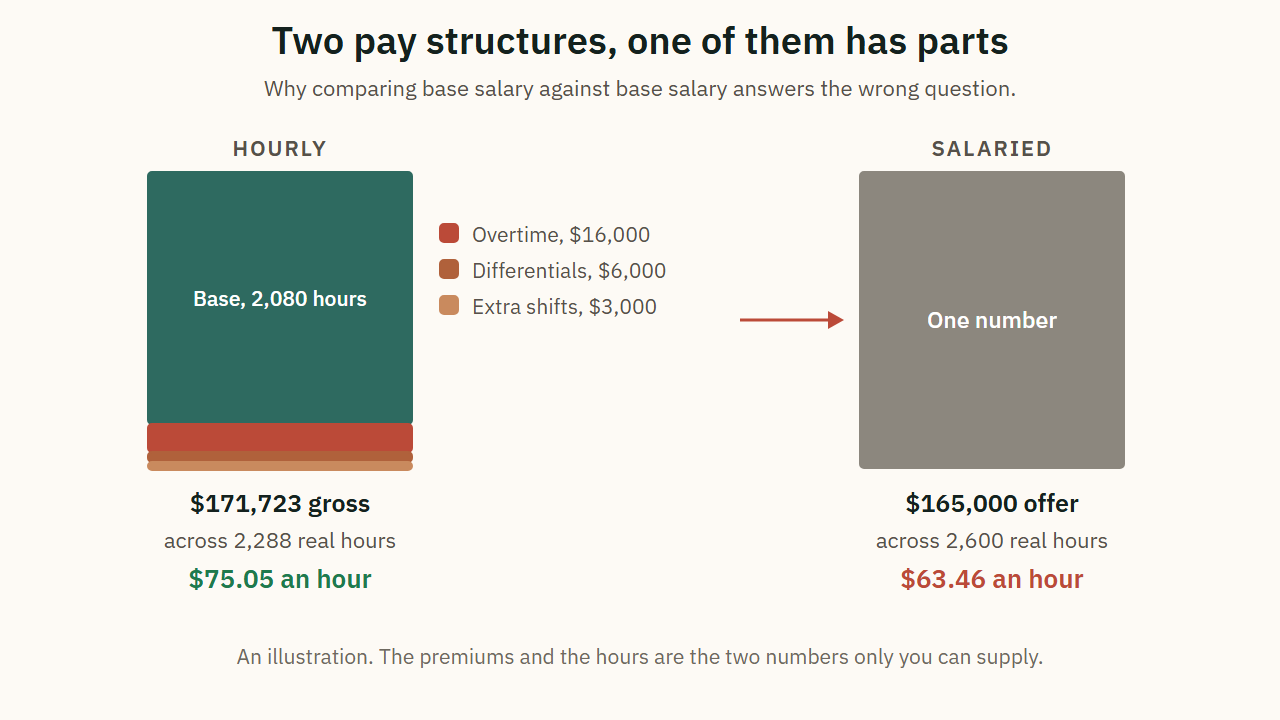
In an hourly role your divisor is forty. In a salaried role your divisor is whatever the job takes.
When the hourly arrangement ends, these components generally stop:
- Time and a half beyond forty hours
- Shift differentials for evenings, nights and weekends
- Call-back and on-call pay
- Incentive or extra-shift premiums, which in a short-staffed department can be the largest single item
The one calculation worth doing
Rather than guess at what a manager is paid, work the question backwards. Ask what the salaried offer would have to be to leave your effective hourly rate unchanged. That number is your break-even, and every input is either published or already sitting in your own payslips.
The 2024 National Pharmacist Workforce Study, released in June 2025, put the average full-time pharmacist hourly wage at $70.54. Use your own rate; this one is here so the worked example has a real starting point rather than an invented one.
The figures below are an illustration, not a typical case. The overtime, the premiums and the hours are the two numbers only you can supply.
- Start with base. $70.54 an hour across 2,080 hours is $146,723.
- Add what actually landed. Suppose overtime and differentials came to $25,000 last year. Real gross: $171,723.
- Divide by hours actually worked, not scheduled. At 44 hours a week, that is 2,288 hours, so your effective rate is $75.05.
- Apply the new hours. If the management role runs to 50 hours a week, that is 2,600 hours.
- Multiply. $75.05 across 2,600 hours is $195,130.
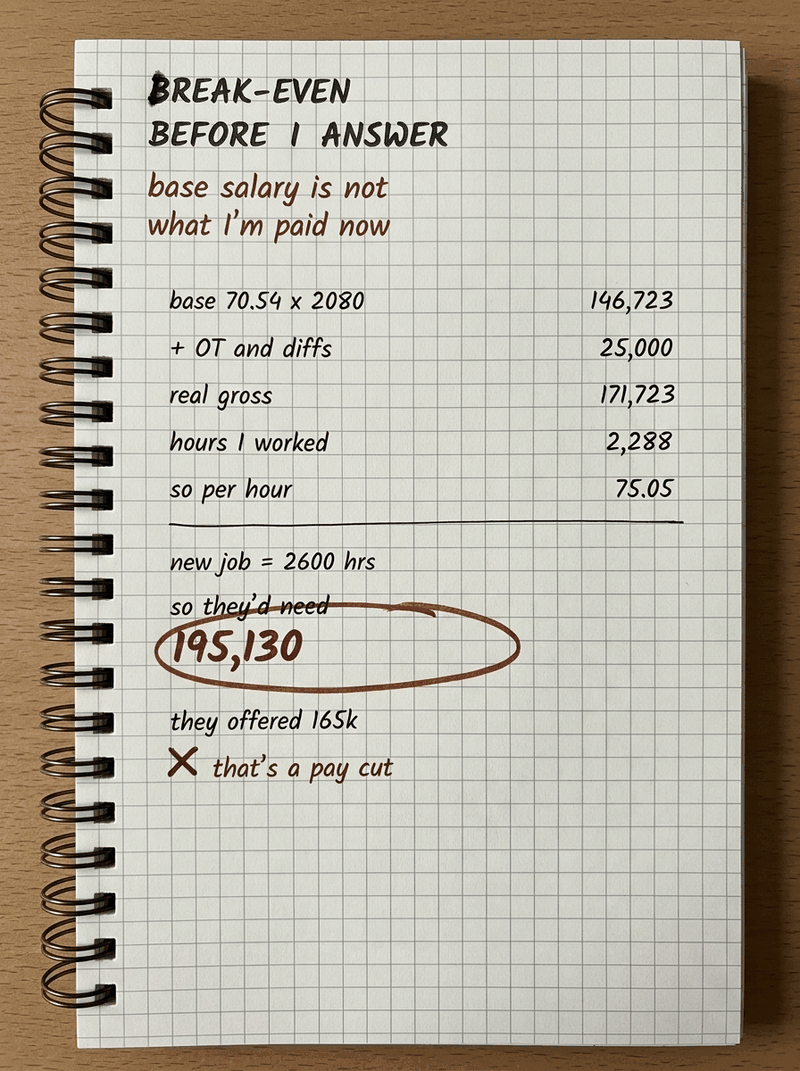
In that illustration the offer has to reach roughly $195,000 simply to hold your effective hourly rate flat, against a base of under $147,000. An offer of $165,000 looks like an $18,000 raise on the base and is a real-terms reduction once the premiums stop and the hours rise.
Run it with your own numbers. The arithmetic takes twenty minutes and it is the difference between accepting a promotion and accepting a pay cut you did not price.
Why take it anyway
If the arithmetic can be that punishing, the obvious question is why anyone accepts. The answer is that you stop selling time and start buying something else.
A management role carries decision rights, the authority to change how the department works rather than absorbing how it currently works. It also carries access. A staff pharmacist rarely has the standing to advocate for anybody; a manager does, which is the mechanism described in what a sponsor does that a mentor cannot.
That is a real purchase and for many people it is worth a lower effective hourly rate for a period. The argument here is not that you should refuse the job. It is that you should know the number before you say yes.
What to ask before you accept
"I want to make sure I'm reading the whole package correctly. Since this moves away from the hourly structure, could you tell me which exemption the role sits under, and how the department defines the primary duties for it?"
"I see the role covers holiday and weekend rotation. With the salaried status, what is the expectation for on-site time against on-call time? I would like that clear before we finalise it."
The checklist
| Do this | Why it matters |
|---|---|
| Add up last year's real gross, every premium included | The base salary is not what you are currently paid |
| Count hours you actually worked, not scheduled | This is the divisor that changes |
| Work out your effective hourly rate | The only number that compares the two structures |
| Ask which premiums survive the move | Some departments keep call-back pay for managers |
| Get the coverage expectation in writing | The vaguest item and the most expensive later |
| Confirm whether the review date resets | A reset cycle can delay your next raise by a year |
If you are handed a management offer, then before you reply, add up last year's actual gross including every differential and divide it by the hours you really worked.
What is not settled
This is not legal advice, and classification is fact-specific. Whether a particular role qualifies for an exemption depends on the duties actually performed rather than the title on the offer letter, and misclassification carries real consequences for an employer. If something looks wrong in your own classification, that is a conversation for your HR department or an employment lawyer, not for an article.
The second limit is jurisdictional. Everything above is the federal floor. Several states set higher salary thresholds and apply stricter duties tests, and California operates its own overtime scheme entirely. Check your own state before assuming the federal position is the whole picture.
References
- US Department of Labor, Wage and Hour Division. Fact Sheet 17A, exemption for executive, administrative, professional, computer and outside sales employees.
- US Department of Labor, Wage and Hour Division. Fact Sheet 17D, exemption for professional employees.
- 2024 National Pharmacist Workforce Study, released June 2025.
- US Bureau of Labor Statistics, Occupational Employment and Wage Statistics, May 2025.