What a sponsor does that a mentor cannot

You've done everything right, the residency, the board certifications, the thankless volunteer committees, and yet, you're invisible when the promotion list is drafted. For many pharmacists three to fifteen years into their practice, there is a frustrating realization that following the standard professional playbook no longer yields results.
The gap is usually between receiving good advice and gaining a seat at the table. If you find yourself over-advised but under-promoted, you are likely optimizing for the wrong type of professional relationship. While mentorship is valuable for clinical growth, it is rarely the mechanism that triggers a career jump. To break the plateau, you must shift your focus from seeking mentors to earning a sponsor.
The high cost of advocacy
The fundamental asymmetry between mentorship and sponsorship is one of risk. A mentor gives you their perspective, which costs them an hour of their time. A sponsor deploys relationship capital.
A sponsor is someone who puts your name forward in a room you are not in, risking their own professional judgment and reputation on your behalf. If you fail, it is their credibility that is questioned.
This difference in cost explains why a mentor can be requested, while a sponsor must be earned.
| Dimension | Mentor | Sponsor |
|---|---|---|
| Cost to them | Time, usually an hour | Relationship capital and reputation |
| What they give | Advice and perspective | Advocacy in closed-door meetings |
| How it is asked for | Can be requested directly | Earned through performance and trust |
| Association | General career guidance | Satisfaction with rate of advancement |
The evidence that only one of them moves people
This distinction was measured before it was named. In September 2010, Herminia Ibarra, Nancy Carter and Christine Silva published Why Men Still Get More Promotions Than Women in the Harvard Business Review, drawing on a Catalyst survey of more than 4,000 high potentials and 40 in-depth interviews.
Their finding was that high-potential women were overmentored and undersponsored. More of them had mentors than their male counterparts did, and they advanced less. In their first jobs after an MBA they were paid $4,600 less and held lower-level positions.
The mechanism is general even though it was measured on a gendered gap. That is simply where somebody thought to look.
You are probably being mentored by someone who thinks they are sponsoring you
According to the 2018 Coqual survey of 3,213 white-collar professionals, the supply of sponsorship is far thinner than standard career advice implies. Only 24% of respondents identify as sponsors at all.
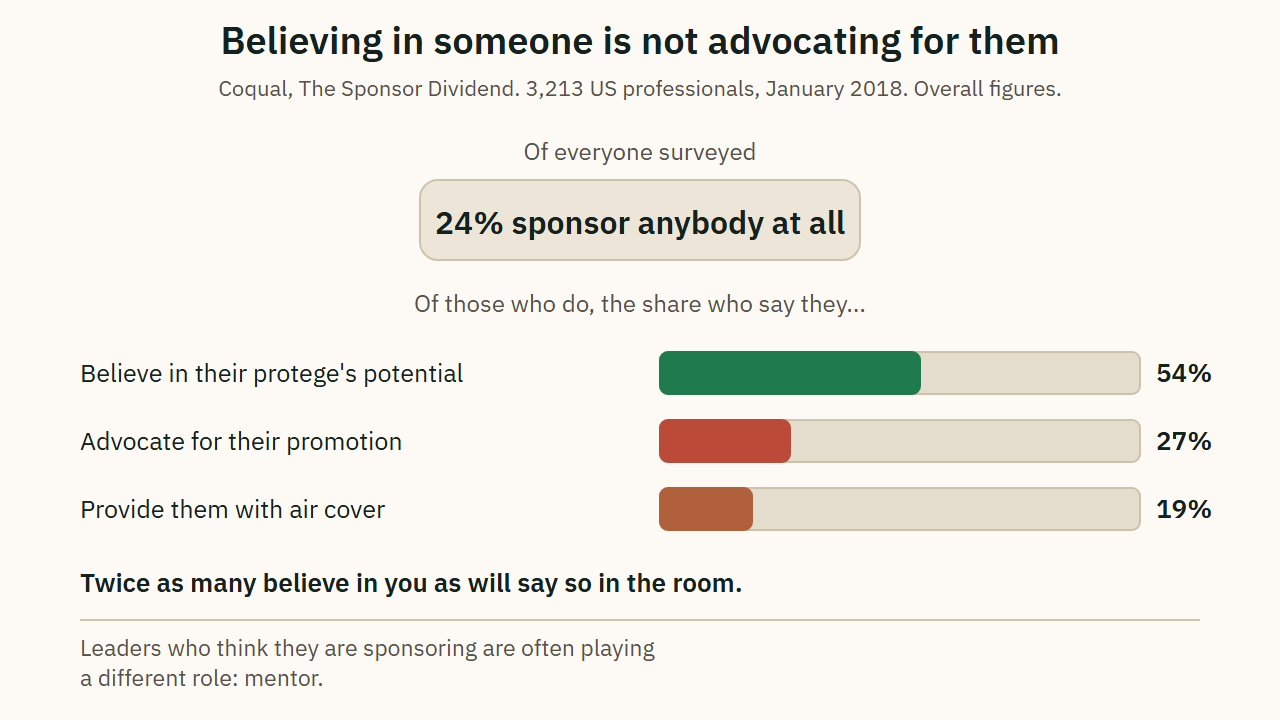
Among those who do identify as sponsors, 54% say they believe in their protege's leadership potential. Only 27% say they advocate for their protege's promotion, and only 19% say they provide air cover.
Encouragement and belief feel identical to advocacy right up until the moment a decision is made without you. You may think you are being sponsored when you are actually being mentored. Mentorship helps you do the job; sponsorship helps you get the job.
Why your department is structurally short of sponsors
In pharmacy, this is often an architectural problem of the hospital hierarchy rather than a personal failing of leadership.
- Hospital pharmacists report the lowest satisfaction with advancement of any practice setting.
- Structured succession planning exists in only 14% of mid-level departments and 36% at the system level.
- While 73% to 79% of pharmacy leaders report a severe shortage of leadership candidates, only 28% of mid-level managers express interest in advancing. See what actually moves someone up in hospital pharmacy.
In a flat department structure with no formal succession, a director has very few chips to play. If they only have one promotion slot every five years, their risk in choosing someone who resembles them is even higher. This lack of occasion to spend capital creates a bottleneck where merit goes unrewarded because no one is willing to risk their limited influence.
Stop being a smaller copy of your boss
The instinct to mirror your superior's skills is a tactical error. While 73% of sponsors look for raw ability as the entry ticket, only 23% currently look for skills or management styles that they themselves do not possess.
That 23% is your opening. To provide true value, you should be the thing they are not. If your director is a strategist but dislikes the granular detail of 340B compliance or informatics, your value is your mastery of that specific gap.
The five steps, and why the order matters
To move from being mentored to being sponsored, you have to build a record of attributable value.
Step 0: articulate the goal. An advocate cannot fight for an unspecified ambition. State clearly where you want to be in three years. "I want to grow" gives a sponsor nothing to say in a closed-door meeting.
Step 1: the bounded ask. Do not ask for a mentor; ask a specific question. It costs the other person one conversation, and it is also an audition.
"I'm currently weighing two options on our department's inventory transition. You've handled similar shifts before. Could I get fifteen minutes of your perspective on the risk?"
Step 2: earned, not asked. You cannot ask for a sponsor. It is a status that is only noticed after you have delivered results that make the senior leader look good.
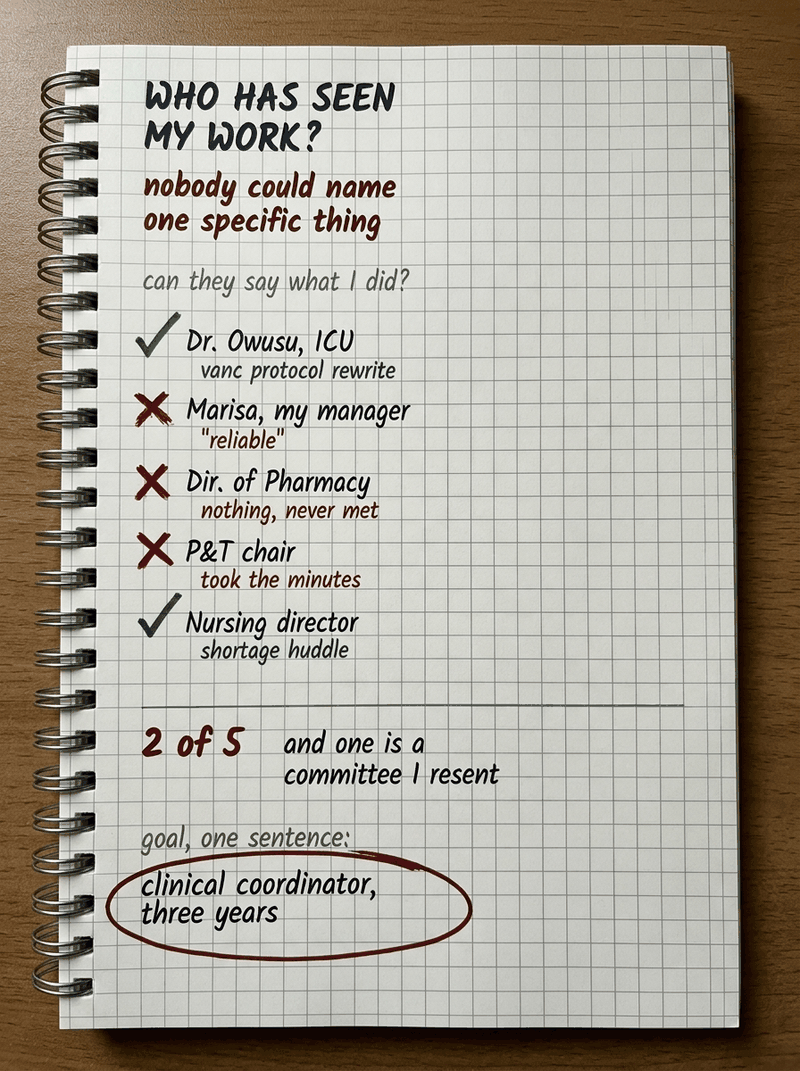
Step 3: attribution. Your work must be traceable. A sponsor who can only say "they are great" has no leverage. They need to be able to say "they rebuilt the vancomycin protocol and the staff actually use it." That means focusing on visible work rather than the tasks nobody sees.
"I can lead this analysis. To make sure the final report is useful for the executive committee, should I focus it on the cost side or the staffing side?"
Step 4: offer the gap. Identify a skill your potential sponsor lacks and become the person who covers it.
Step 5: audit your search. Because sponsors gravitate toward people who resemble them, look deliberately outside your own demographic mirror.
The honest limit, and it has a number
We should be honest about the structural barriers here: sponsorship often reproduces existing hierarchies. 71% of sponsors are the same gender or race as their primary protege. Senior leaders gravitate toward individuals who resemble them, because they feel more comfortable betting their reputation on someone they read as a known quantity.
A 2025 study in Advances in Health Sciences Education finds the same pattern holds within the health professions. Acknowledging this is not a complaint, it is a strategic reality. You are not only working toward a promotion, you are working against the instinct of leaders to sponsor their own mirror image.
A message for the reader who is already senior
Sponsorship is not an act of charity, it is a professional investment. For the reader in a position of power, the data shows a clear association between sponsoring others and your own effectiveness.
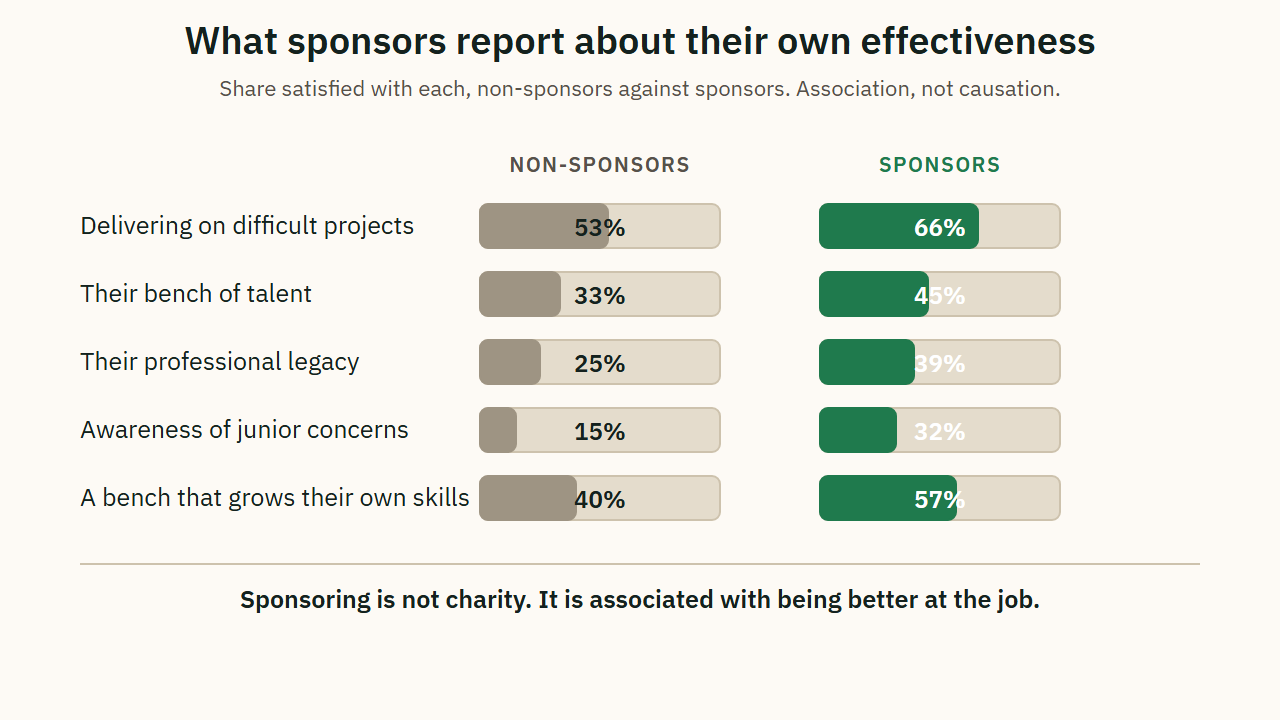
| Satisfied with | Non-sponsors | Sponsors |
|---|---|---|
| Ability to deliver on difficult projects | 53% | 66% |
| Bench of talent | 33% | 45% |
| Professional legacy | 25% | 39% |
| Awareness of junior colleagues' concerns | 15% | 32% |
| A bench that expands their own skill set | 40% | 57% |
These figures are a cross-sectional association, not causation. Sponsoring a broad bench is correlated with higher senior-level effectiveness; it has not been shown to cause it.
The checklist
Advancement requires shifting your focus from seeking advice to building attributable value. To assess where you currently stand:
| Question | Why it matters |
|---|---|
| Who has seen your work in the past year? | Visibility is the prerequisite for sponsorship |
| Could they name a specific thing you delivered? | General goodness is not something an advocate can use in a meeting |
| Which of your commitments have your name on them? | Unattributed work is invisible work |
| Which of them are non-promotable? | These consume the time you need for the gaps that count |
| Can you state your three-year goal in one sentence? | If you are not clear, your advocate cannot be either |
| Who holds the capital in your department? | You need to know whose judgment is respected before you earn it |
If a senior colleague asks you to take something on this week, then before you answer, ask what the deliverable is and who will see it.
What is not settled
The statistics here are primarily from the 2018 Coqual report, a national survey of 3,213 US white-collar professionals. It is cross-sectional, showing associations at a single point in time, and it is not a pharmacy population. It tells you that sponsored people report more satisfaction with their advancement. It does not prove that sponsorship produced it.
The second limit is harder. Because sponsorship selects for resemblance, pharmacists who do not fit the demographic profile of their current leadership face a structural hurdle that individual effort alone may not resolve. The advice in this article is worth following anyway. It is not sufficient.
References
- Coqual (formerly the Center for Talent Innovation). The Sponsor Dividend. National survey of 3,213 US white-collar professionals, January 2018, fielded by NORC at the University of Chicago.
- Ibarra H, Carter NM, Silva C. Why Men Still Get More Promotions Than Women. Harvard Business Review, September 2010.
- Beyond mentorship: the promise and perils of sponsorship in health professions education research. Advances in Health Sciences Education, 2025.