What saying yes to everything costs you

The hospital pharmacy environment is defined by its sensory intensity: the rhythmic hum of the automated dispensing cabinets, the sharp scent of isopropyl alcohol in the IV room, and the constant chime of the clinical intervention queue. In this high-stakes setting, many pharmacists find themselves caught in a professional paradox. You are indispensable, often the first to volunteer for a crisis or a committee, yet you feel strangely invisible when leadership opportunities arise.
The profession runs on volunteered effort. However, this effort is often unevenly distributed in a way that is both measurable and predictable. While your workload increases, your career trajectory may be stalling. This is the result of the "Non-Promotable Task" (NPT), the invisible weight that holds back the most reliable members of the team.
The research behind the term
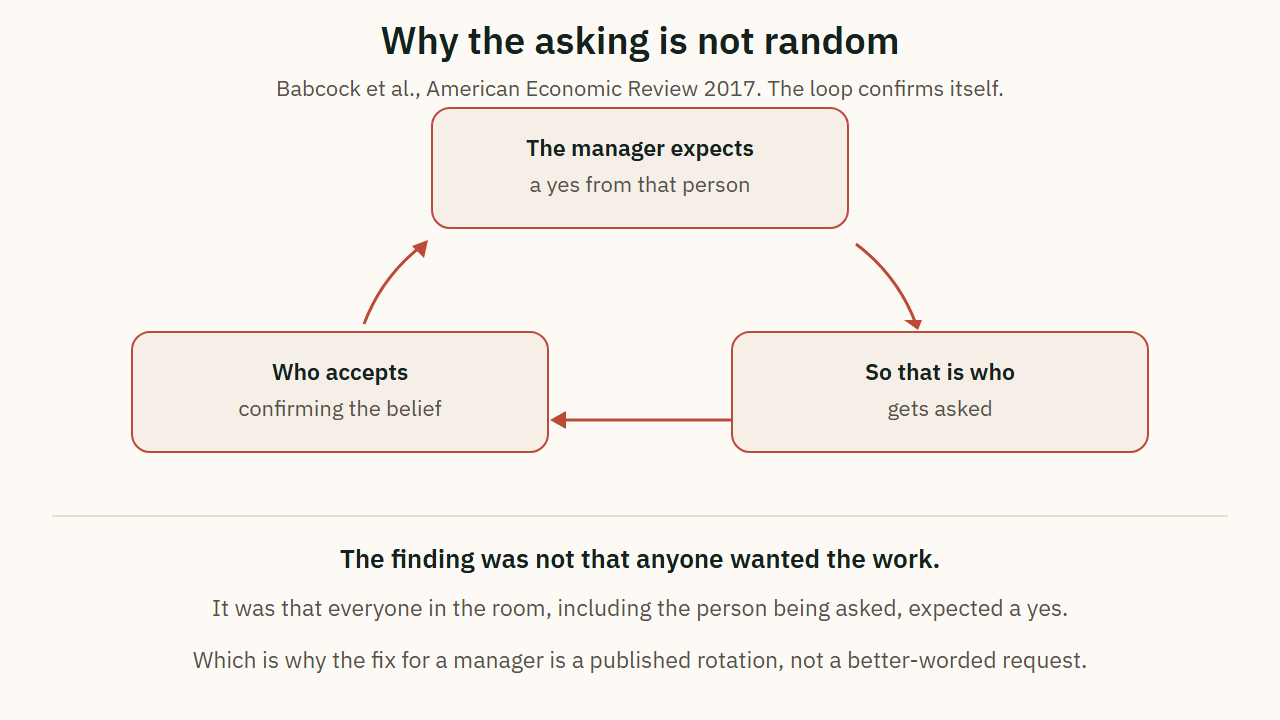
The term "non-promotable task" was coined by researchers Linda Babcock, Maria Recalde, Lise Vesterlund, and Laurie Weingart in their 2017 study published in the American Economic Review. They defined NPTs as tasks that are essential to the organization's function but do not contribute to an individual's professional advancement.
The study's core finding is a systemic gender disparity: women are asked to volunteer for these tasks more often than men, they volunteer more frequently even when not asked, and they are significantly more likely to accept when a request is made.
This isn't a matter of personal preference or women "wanting" to help more. It is driven by a collective Expectation Mechanism. Everyone in the environment, including managers and other colleagues, expects a certain person to say yes. This creates a self-reinforcing feedback loop: Belief produces the ask, the ask produces the acceptance, and acceptance confirms the belief.
The authors state the consequence plainly:
"If some people hold tasks that are less promotable than others' tasks, they will progress more slowly."
Sorting promotable work from the rest
To manage your career strategically, you must distinguish between work that offers an intangible return and work that results in a visible assignment. A task is promotable only when someone who decides your future sees the work and can attribute the result directly to you.
The difference isn't the difficulty of the task, but who sees the result. Hospital pharmacy is dense with near-identical pairs where one side "counts" and the other is effectively invisible.
| Promotable (Counts) | Non-Promotable (Invisible) |
|---|---|
| Presenting a monograph at P&T | Assembling the binder for the monograph |
| Owning the antimicrobial stewardship report | Pulling the data for someone else's report |
| Precepting a student on a rotation you designed | Covering someone else's student for a week |
| Chairing the medication safety committee | Taking the minutes for the committee |
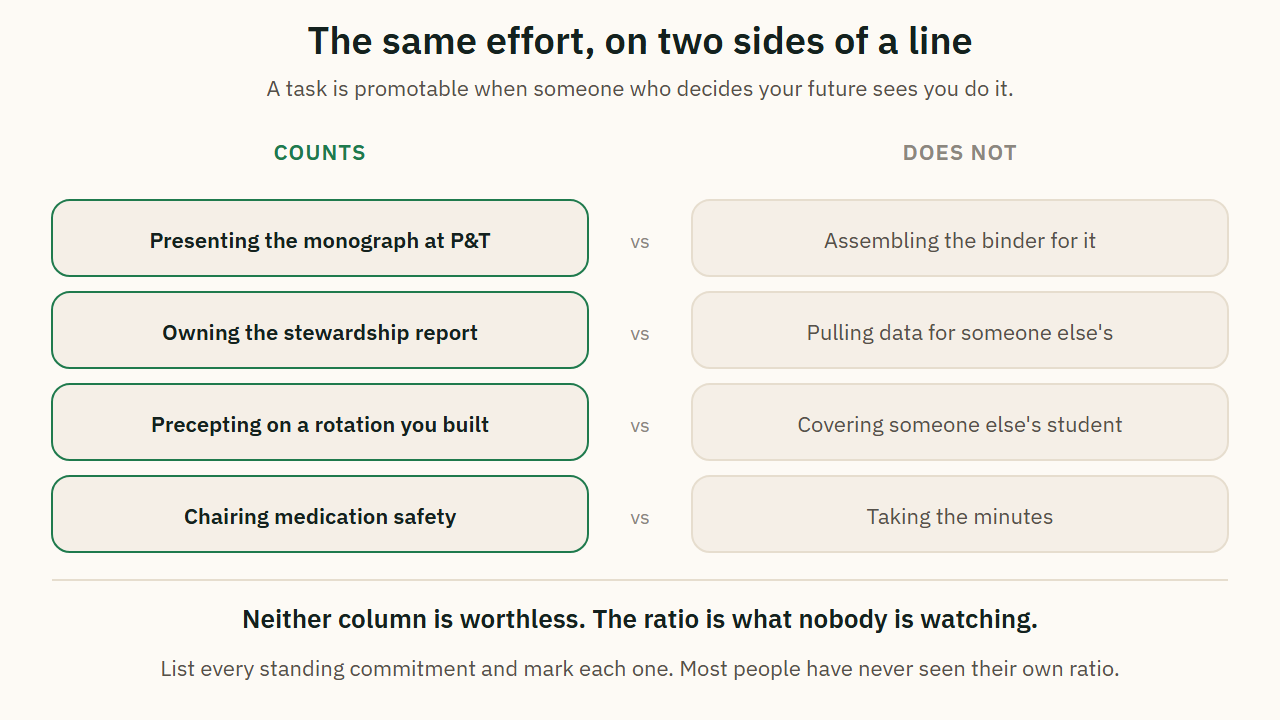
Neither column is worthless; the department needs both to survive. However, your career can quietly disappear into the second column if you fail to monitor your ratio of P to N tasks.
Auditing your own calendar
The damage caused by NPTs is rarely obvious in the moment because individual requests always seem defensible and necessary. The pattern is the problem, and the pattern remains invisible until it is written down.
To assess your standing, perform a Ratio Count:
- List every recurring commitment currently on your calendar.
- Mark each one with a 'P' for Promotable or an 'N' for Non-Promotable.
- Calculate your current ratio.
Most pharmacists have never seen this ratio in writing. This audit is your primary tool for negotiation; you cannot effectively argue for a change in workload based on a single "no," but you can argue based on a lopsided distribution of visible work.
Declining as a capacity statement
The reason we struggle to say "no" is that a refusal feels like a character judgment. To break this, you must reframe your response. The alternative to "yes" is not silence or a blunt rejection; it is a counter-proposal based on your current capacity.
This approach demonstrates judgment about priorities, the exact skill required for leadership roles. Those who never say no are often perceived as unable to prioritize, whereas those who name trade-offs demonstrate command over their professional contribution.
What to say when asked to take on new work:
- "I can do that, and I want to be straight with you about what it displaces. I am currently carrying [specific project], which is due [date]. If this new task takes priority, I will move that. Which would you rather have?"
What to say for recurring tasks that should be shared:
- "I'm happy to take it this cycle if we rotate it after. Who has it next?"
Both scripts hand the decision back to the requester with the trade-offs made explicit.
For managers, rotate rather than ask
If you are a director or pharmacy lead, the uneven distribution of NPTs is your problem to solve, not just a staff problem to manage. Because managers naturally ask the person they expect will say yes, the system inherently penalizes your most reliable staff.
To fix the system, move beyond asking for volunteers:
- Rotate work on a published schedule: Assign NPTs (like minute-taking or shift-covering) via a transparent, mandatory rotation.
- Track task holdings: Keep a record of who is doing the invisible work over the course of a year.
- Audit visible assignments: When handing out high-impact projects, notice who you offered it to first and why. Is it based on talent, or just the expectation of a "yes"?
Why bother, when saying yes builds a reputation
The most significant objection to declining NPTs is the fear of reputation damage. In short-staffed units, the cost of naming trade-offs is immediate and social, while the cost to your promotion is distant and hypothetical. It feels safer to just do the work.
However, you must distinguish between your Reliability Reputation and your Promotion Record. These are different assessments made from different evidence. Being known as dependable is not the same as being considered for a role. Plenty of people have the first and not the second, and they are usually the last to find out.
There is also the psychological discomfort of knowing that if you decline, someone else has to hold the task. This is why the management fix is essential; if the answer is only an individual "no," the work simply moves to the next person who can't say no, and the department learns nothing.
Keeping the ratio deliberate
The goal is not to reach zero non-promotable tasks. The goal is a deliberate ratio that allows you to contribute to the team while ensuring a decision-maker sees the value you bring.
The "First of the Month" Challenge: Spend ten minutes at the start of every month marking your commitments 'P' or 'N'. Review this ratio before every performance review to ensure your workload hasn't drifted back into the invisible column.
The next time you are asked to take on a task this week, do not give an immediate "yes." Instead, let this be the first sentence of your reply:
"If I take this on, what is the one thing it will displace?"
If you are asked to take something on this week, then before you answer, say out loud what it would displace. Not as a refusal. As the first sentence of the reply.
Second plan:
If it is the first of the month, then spend ten minutes marking every recurring commitment on your calendar P or N, and write down the ratio.
References
- Babcock L, Recalde MP, Vesterlund L, Weingart L. Gender differences in accepting and receiving requests for tasks with low promotability. American Economic Review 2017;107(3):714-747.
- Babcock L, Recalde MP, Vesterlund L. Gender differences in the allocation of low-promotability tasks: the role of backlash. American Economic Review Papers and Proceedings 2017.
Want the practice knowledge behind this?
Your First Year as a Hospital Pharmacist covers the clinical judgment a residency front-loads. Part of the Pharmacy Handoff library.
See the book