The Heavier Hour: Why Pharmacists Are Working Less but Feeling More Burnt Out

Introduction: The Shorter Shift Paradox
The 2024 National Pharmacist Workforce Study has surfaced a counter-intuitive reality that defies traditional labor logic: the average pharmacist is working fewer hours per week than they did a decade ago, yet workload stress has reached an all-time high. This is the "Heavier Hour" paradox. For healthcare operations leaders and frontline practitioners, the data suggests that the primary driver of the current staffing crisis isn't the length of the shift, but the increasing unit-of-time intensity packed into each hour on the clock.
The hours are shorter, but the weight of the work has intensified. Understanding this paradox is the difference between a department that perpetually chases "more bodies" and one that strategically optimizes for task density and professional sustainability.
Takeaway 1: The Numbers Don't Add Up (Or Do They?)
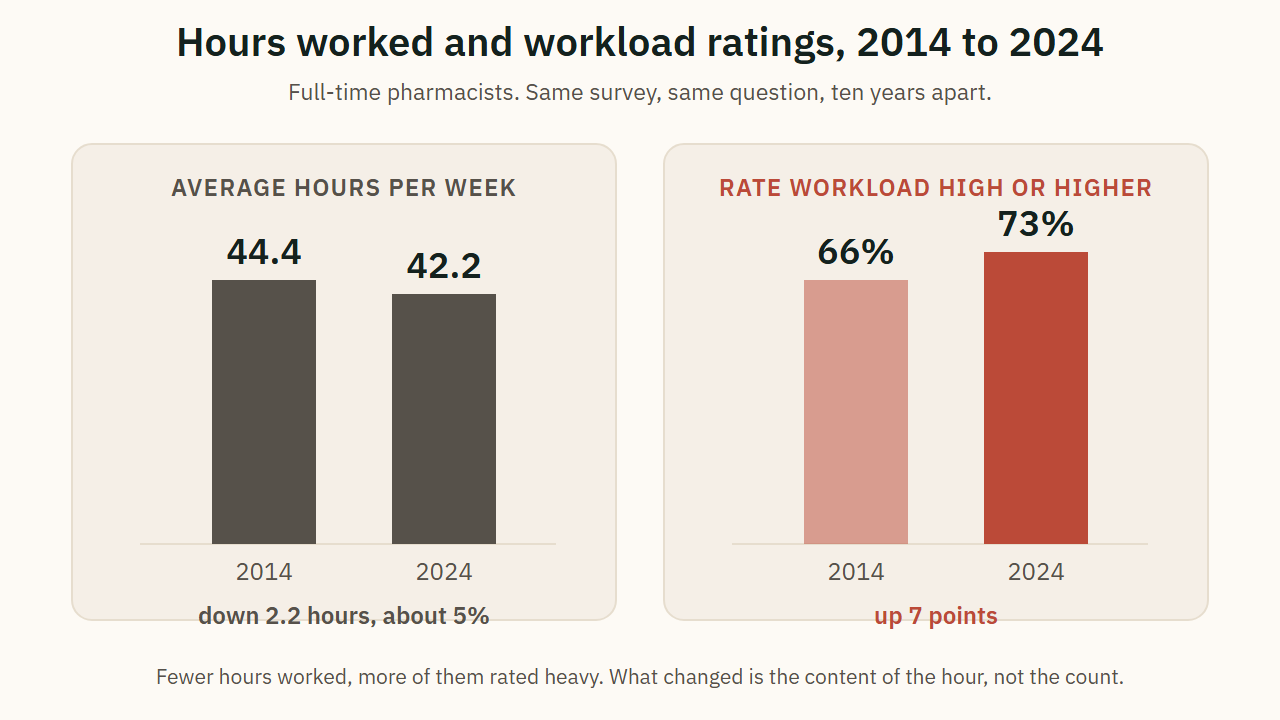
A strategic comparison of data from 2014 to 2024 reveals a widening chasm between time spent and task intensity. In 2014, full-time pharmacists averaged 44.4 hours per week. By 2024, that figure contracted to 42.2 hours, a 5% reduction in time on the floor.
Simultaneously, the share of pharmacists rating their workload as "high" or "excessively high" jumped from 66% to 73%. This inverse relationship confirms that the modern staffing crisis is a qualitative problem, not a quantitative one.
From an operations standpoint, the problem is not "time spent," but the "intensity of the time." We are seeing a significant rise in task density, more clinical decisions, more administrative hurdles, and more operational gaps being squeezed into a smaller window of time.
Takeaway 2: Setting the Stage, Retail vs. Hospital Realities
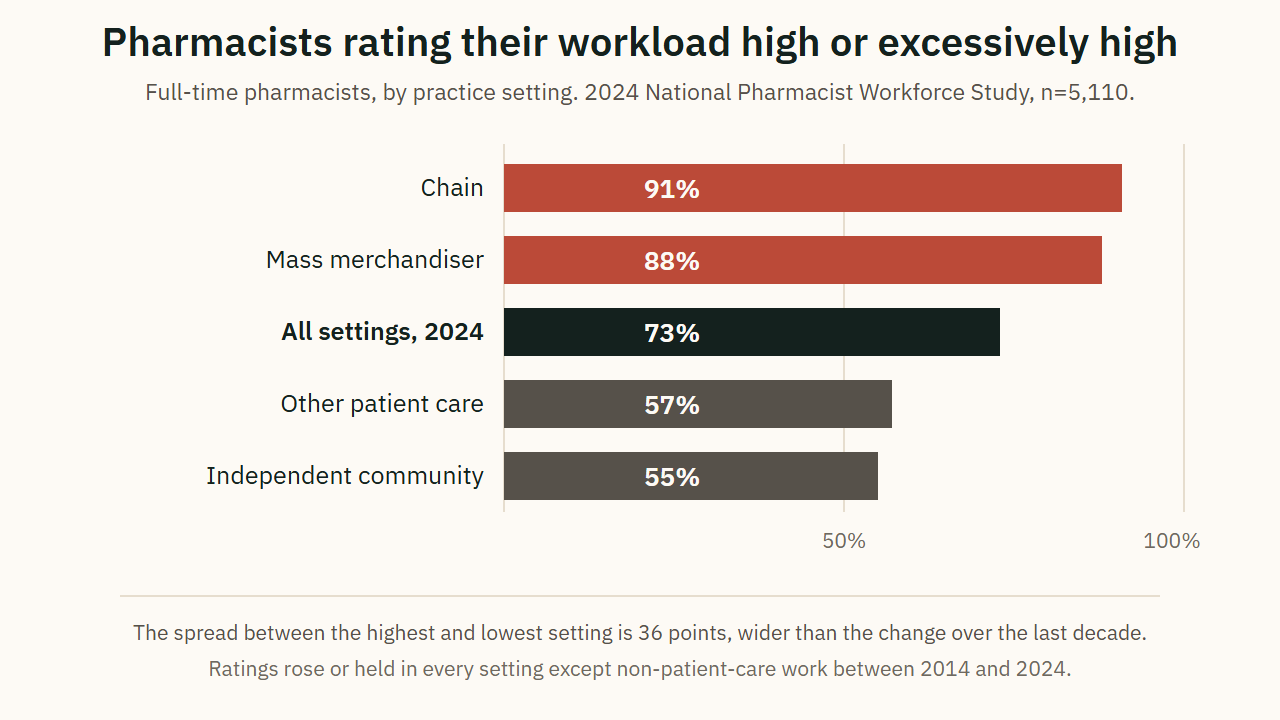
Workload ratings differ drastically by setting, yet the upward trend is nearly universal. The 2024 data highlights a stark 36-point spread between the highest and lowest stress environments:
-
Chain Pharmacy: 91% reported high workload.
-
Mass Merchandiser: 88% reported high workload.
-
Independent Community: 55% reported high workload.
-
Patient Care (Other/Hospital): 57% reported high workload.
Notably, this 36-point spread between practice settings is five times larger than the 7-point decade-over-decade change. This indicates that while the "Heavier Hour" is a profession-wide trend, environment remains the primary predictor of task intensity. However, because ratings rose or held steady in every sector except non-patient-care work, we are looking at a systemic failure in resource utilization rather than a retail-only phenomenon. Since hours fell even for management (43.7 hours) and staff positions (41.1 hours), we can rule out "overtime" as the primary driver of dissatisfaction.
Takeaway 3: The "Hidden" Culprit, Technician Vacancy
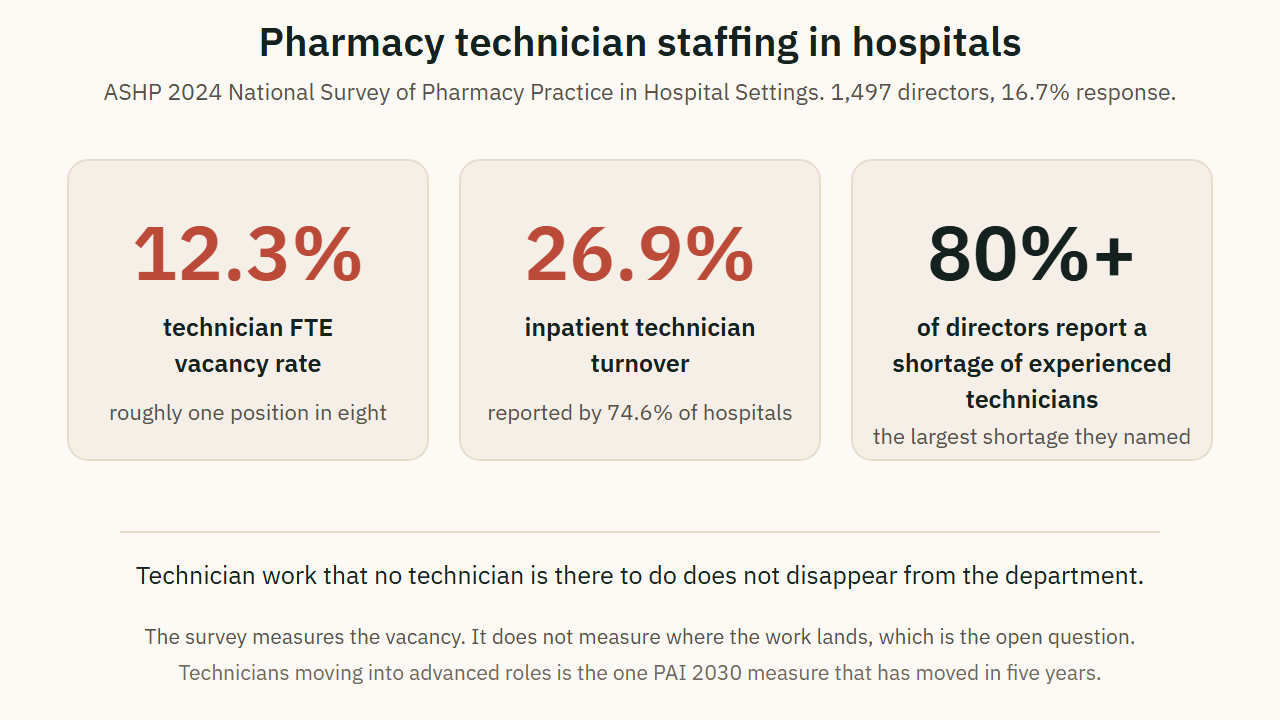
The most credible explanation for the increased task density is the erosion of the pharmacy technician workforce. According to the ASHP National Survey of Pharmacy Practice in Hospital Settings (published in AJHP 2025), hospitals are battling a 12.3% technician FTE vacancy rate and a staggering 26.9% inpatient technician turnover rate.
The operational mechanism is direct: critical tasks, cart fills, ADC restocking, and IV room compounding, cannot be deferred. When technician roles are vacant, these essential duties shift to the pharmacist. This results in an unsustainable cognitive load where high-level clinical oversight is constantly interrupted by foundational technical tasks.
This is a critical distinction. The loss of experienced technicians is particularly damaging to workflow efficiency, as it requires the pharmacist to provide more oversight for new hires while simultaneously absorbing the tasks of unfilled roles. This occurs even as the Practice Advancement Initiative (PAI) 2030 notes that technician advancement into higher-level roles is the only PAI measure showing significant movement. While technicians move up, the foundational vacancies they leave behind are creating a "gravity well" that pulls pharmacists away from their own clinical mandates.
Takeaway 4: The Misalignment of Professional Purpose
The "Heavier Hour" is exacerbated by "role displacement," where the work performed does not match the expertise of the clinician. Data shows that 42.6% of pharmacists feel their activities align with their desired tasks only "some of the time."
The opportunity cost of this misalignment is profound. When pharmacists spend a significant portion of their shift on technician-eligible tasks, they are not performing top-of-license clinical interventions that improve patient outcomes. This displacement has a measurable human cost: pharmacists now report an average of 8.1 poor mental health days per 30-day period. Furthermore, with 26% of pharmacists reporting workplace harassment (17.2% in hospital settings), the "heaviness" of the hour is a combination of volume, misaligned purpose, and environmental stress.
Takeaway 5: Turning "Vibes" into Actionable Data
To secure resources from Finance and Administration, pharmacy leaders must transform "morale issues" into "resource utilization issues." Unmeasured work is unbudgeted work. Moving from subjective complaints to objective data is the only path to a fundable business case.
Four Departmental Metrics to Track
| Metric | Why it Matters | Data Source |
|---|---|---|
| Technician FTE vacancy and turnover | High vacancy forces pharmacists to absorb technical tasks, creating a "gravity well" effect. Use the national 12.3% vacancy as a benchmark. | Position control logs, HR turnover reports. |
| Pharmacist hours on technician-eligible tasks | This quantifies the most visible form of role displacement and identifies the exact ROI of hiring more technicians. | Two-week self-log or workflow system task data. |
| Interruptions per verification hour | Phone and in-person interruptions increase cognitive load and lengthen the time required for clinical tasks. | Call volume logs by hour, missing-dose call logs. |
| Verification volume per pharmacist hour by shift | This identifies volume concentration. If total volume is flat but concentrated in "peaks," the solution is scheduling and distribution, not just adding staff. | Order verification data from the EHR. |
Conclusion: From Complaint to Business Case
The "heavier hour" is not a mystery; it is a measurable operational deficit. To move the needle, staff pharmacists and managers must stop asking for "help" and start presenting data.
The strategy is simple: log your technician-eligible tasks for two weeks. If the data shows that pharmacists are spending 30 hours a week on work that could be performed by a technician, you have a fundable business case to present to the C-suite. A general complaint about being "busy" is ignored; a report showing that 12.3% vacancy rates are forcing high-cost clinicians into low-complexity tasks is a resource problem that Finance must address.
Ultimately, we must decide how to address the deficit. If the "heavier hour" is driven by vacancy and peak concentration rather than total volume, are we solving for volume when we should be solving for distribution? Measurements get budgeted; feelings do not. Use the data to make the case for the hour to be lightened.
Related
- 2024 National Pharmacist Workforce Study
- ASHP National Survey of Pharmacy Practice in Hospital Settings, 2024
- Running the Pharmacy, on building a schedule around where the volume actually is
- The Business of the Pharmacy, on turning a staffing case into a budget request