The Promotion Paradox: Why Hospital Pharmacy Roles Feel Unattainable (Even When They're Unfilled)

Many hospital pharmacists currently find themselves in a professional stalemate. Despite possessing advanced clinical skills and a track record of reliability, there is a pervasive sense of being "stuck" in a perpetual staff role. This is the Promotion Paradox: a market contradiction where hospital pharmacists report the lowest satisfaction with career advancement in the profession, yet the majority of department directors claim they cannot find qualified talent to fill higher-level clinical roles.
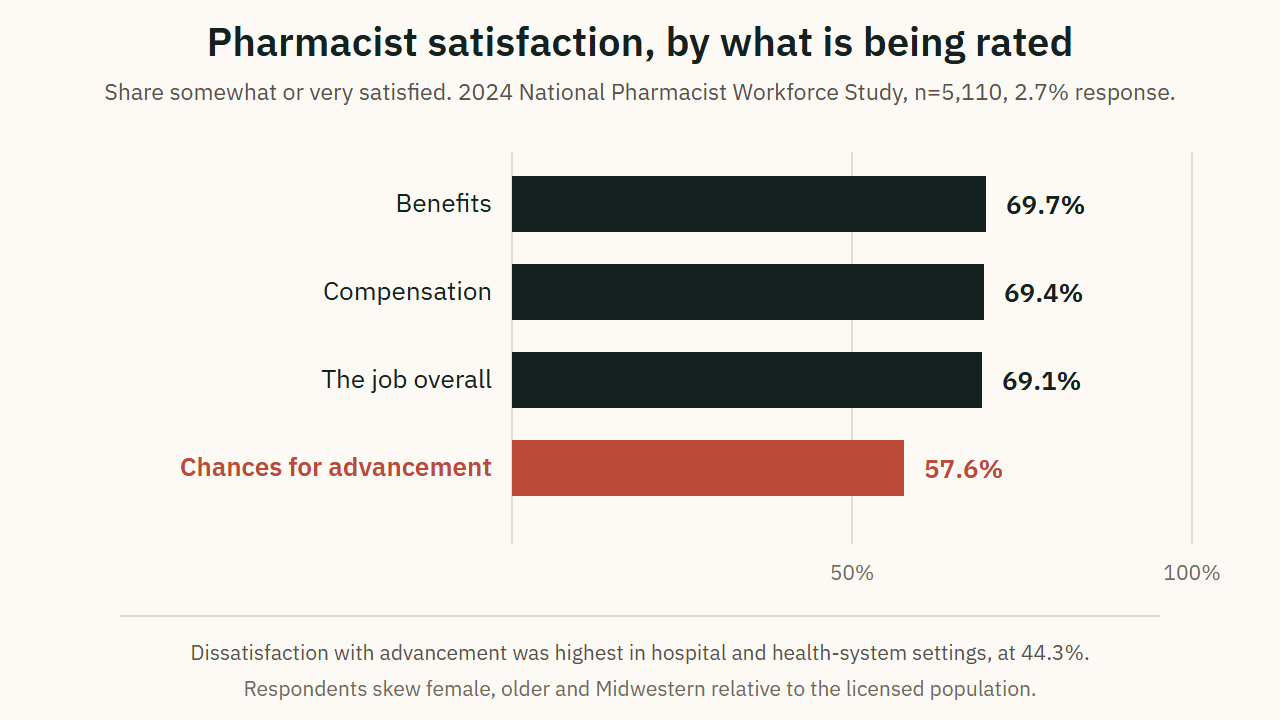
The 2024 National Pharmacist Workforce Study quantifies this stagnation. While satisfaction with benefits (69.7%) and compensation (69.4%) remains stable, satisfaction with advancement opportunities sits at just 57.6% across the profession. In hospital and health-system settings, the data is even bleaker: dissatisfaction with advancement peaks at 44.3%, with 32.1% of pharmacists reporting they are behind where they expected to be in their careers.
A note on the data, because these figures need one. The 2024 National Pharmacist Workforce Study had a 2.7% response rate, and the ASHP director survey had a 16.7% response rate. These numbers represent market signaling and trends rather than a perfect census, but the disparity they reveal is too large to ignore.
The Hidden Reality of the "Shortage" vs. the "Vacancy"
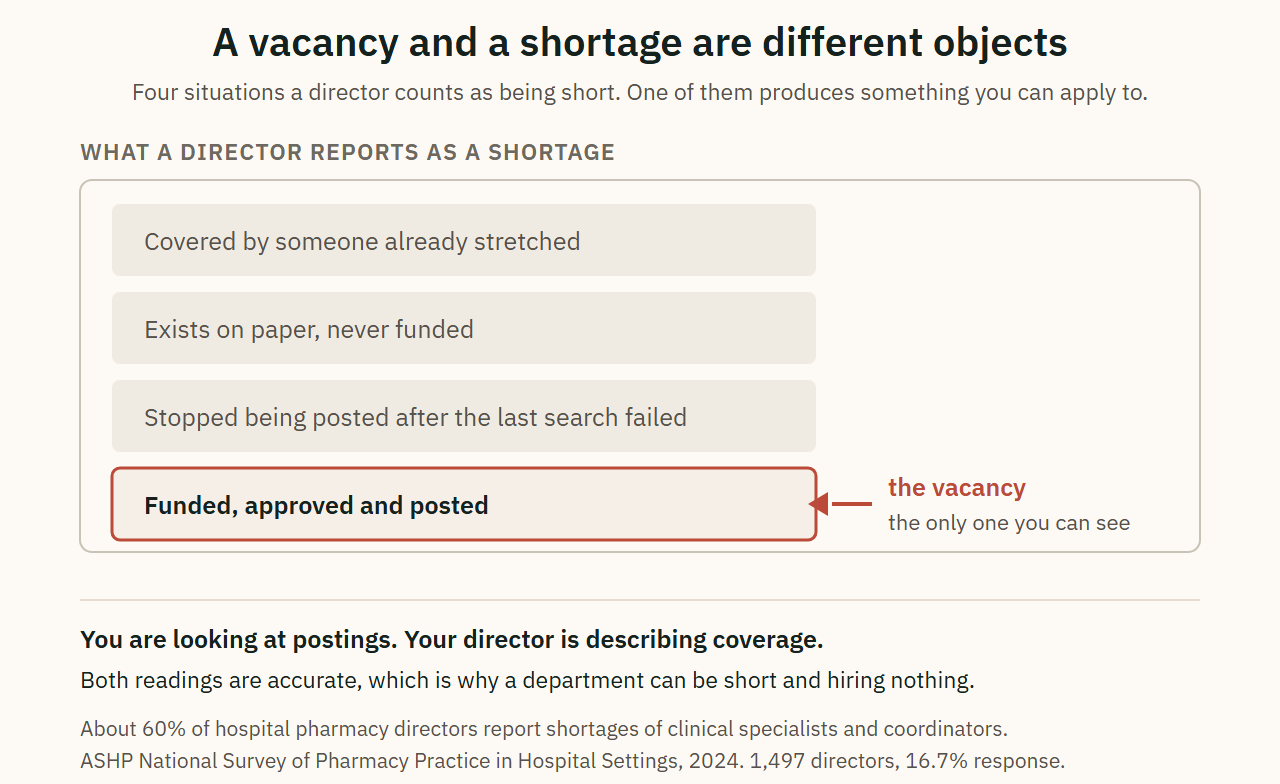
The frustration of the "stalled" pharmacist often stems from a misunderstanding of resource allocation. To a pharmacist, a vacancy is a funded, approved, and actively posted position. If the HR portal is empty, the door appears closed.
To a director, however, a shortage is a clinical "pain point." This includes roles currently being filled by overstretched staff, roles that exist on paper but lack current funding, or specialized positions that the department has stopped posting because previous searches yielded no viable candidates. While approximately 60% of hospital pharmacy directors report a perceived shortage of clinical specialists and coordinators, many of these roles aren't currently "vacant" in the eyes of HR.
The opportunity for the ambitious pharmacist lies in the "visibility gap." You must solve the director's clinical pain point through the transferability of your clinical capital before a formal vacancy is ever announced.
Surviving the Succession Vacuum
One of the greatest barriers to promotion is the near-total lack of structured advancement. In a 2024 survey of 788 pharmacy leaders, structured succession planning was present in only 14% of mid-level departments and 36% at the system level. Remarkably, half of all pharmacy leaders have identified no replacement should they leave tomorrow.
In this vacuum, promotions are rarely the result of a formal "ladder." Instead, they are decided by the informal shortlist. By solving a pain point mentioned above, you bridge the gap between being a "staff pharmacist" and "the obvious successor."
In the absence of a formal process, selection defaults to whoever the manager can already picture performing the duties. If you haven't signaled your intent through visible contributions, you effectively do not exist as a candidate.
Management is a Negotiation, Not Just a Promotion
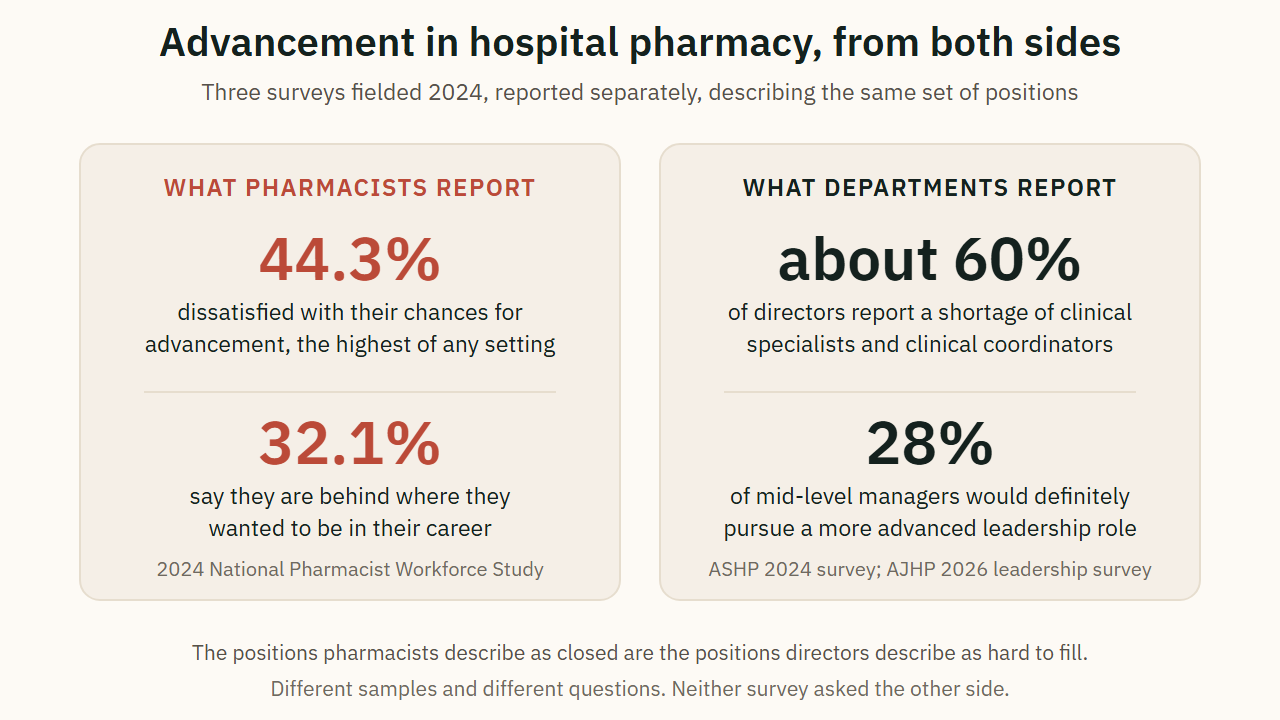
There is a documented "Mid-Level Leadership Crisis" in hospital pharmacy. While 73% to 79% of respondents across all levels describe a "severe shortage" of candidates for leadership, only 28% of mid-level managers express a definite interest in moving further up the chain.
This hesitation is rational. Moving into management often means leaving a bargaining unit or losing overtime eligibility. To succeed, you must treat the transition as a strategic negotiation. In fixed-schedule or unionized environments, you generally have only two levers, use them:
-
Salary Step Matching: Explicitly request that your accrued steps and seniority be reflected in your entry point on the management pay scale. This is often the primary compensation lever available.
-
Protected Administrative Time: Demand a named commitment to administrative hours within the schedule.
The 11-Point Leverage Window
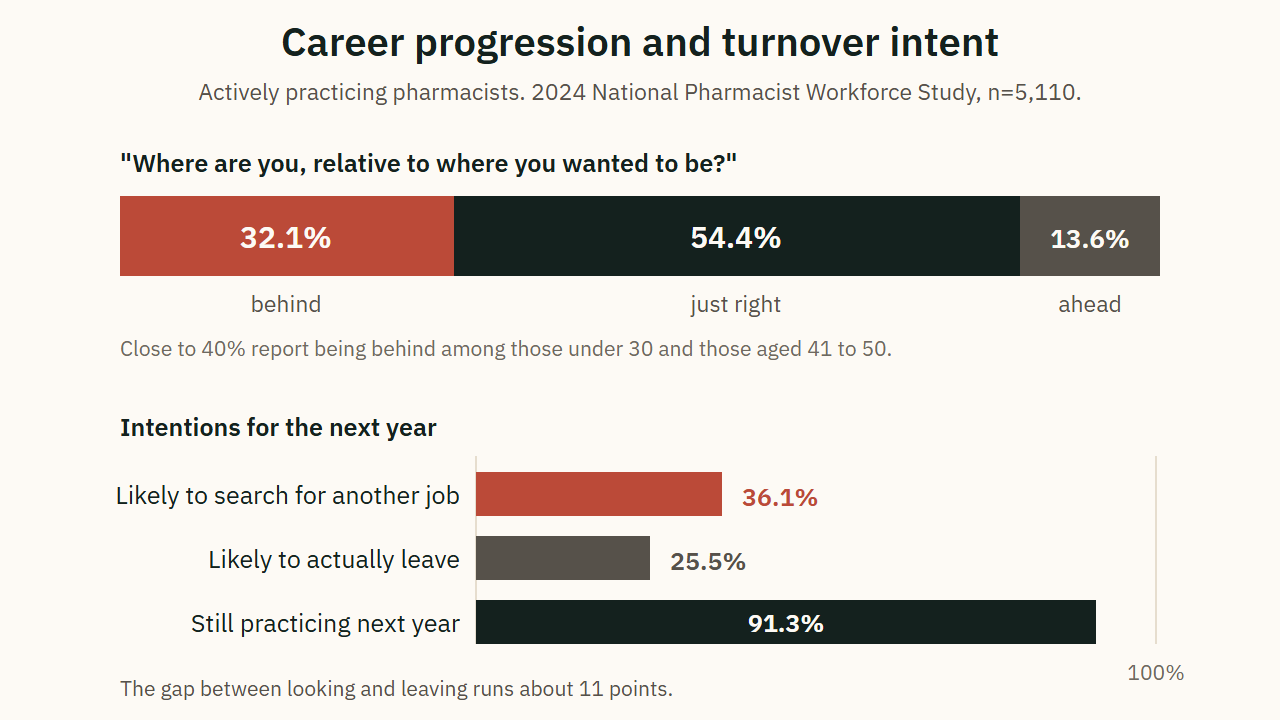
Workforce data shows a significant gap between pharmacists who are likely to "search" for a new job (36.1%) and those who are likely to actually "leave" (25.5%). This 11-point spread represents a leverage window.
During this phase, searching the market is not an act of disloyalty; it is a tool for data collection. A competing offer acts as a diagnostic tool for your current employer's intent. It forces a clear "market signal": is the organization willing to invest in your advancement, or have they reached their limit for your clinical capital? Use this spread as a psychological buffer during performance reviews to negotiate from a position of real-world value.
Building a Verifiable Record of Contribution
Internal candidates are evaluated on work the department has already witnessed. To move from the basement to the clinical suite, you must build a record of "Four Verifiable Contributions." When choosing your focus, prioritize service lines with the highest market demand to ensure your expertise is transferable.
| Area of Contribution | What it Demonstrates | Evidence Location (Where it Shows Up) |
|---|---|---|
| Service Line Depth | Marketable expertise in high-demand units: Med-Surg (73.3%), Critical Care (68.5%), Oncology (56.9%), Cardiology (48.5%), ID (48.1%), or ED (46.5%). | Daily interventions, provider feedback, specialty credentials. |
| Protocol/Order Set Rewrites | Professional judgment and project completion; ability to influence system-wide practice. | P&T minutes, the order set itself, approval records. |
| Metric Movement | Ability to move the "numbers" that leadership reports (e.g., safety or stewardship metrics). | Stewardship reporting, safety dashboards, survey readiness. |
| Precepting | Ability to develop staff, the primary core competency of a coordinator or specialist. | Residency/school evaluations, orientation records. |
The Career-Altering Diagnostic Question
You do not need to wait for a job posting to test your standing within the department. Use this specific diagnostic question to force a reveal of your manager's roadmap:
The response to this question is your ultimate data point. A manager who provides a concrete, actionable roadmap is signaling a path to growth and inviting you onto the informal shortlist. A manager who cannot provide an answer, or who offers vague platitudes, has revealed that the department lacks a path for you. Treat a "no answer" response as a clear signal to exit and begin testing the market.
Moving from Stale to Strategic
Breaking the stalemate in your career requires shifting from a passive wait for an HR listing to a strategic demonstration of value. The path forward is a two-step sequence:
-
Select one verifiable contribution (Protocol rewrite, precepting, or service line depth) that your department currently lacks and commit to delivering it this quarter.
-
Ask the diagnostic question once the contribution is visible.
By doing so, you stop being a staff pharmacist waiting for a door to open and start being the candidate the manager already relies on to run the department.
Are you waiting for a listing, or are you building the roadmap yourself?
Related
- 2024 National Pharmacist Workforce Study
- ASHP National Survey of Pharmacy Practice in Hospital Settings, 2024
- Salary negotiation in hospital pharmacy, on what is open once the band is set
- Is it ever too late to climb?
- Running the Clinical Program, on what a clinical coordinator role actually contains
- Teaching the Next Pharmacist, if precepting is the item you pick up first