The 40% Fallacy: Why Being "Behind" in Your Pharmacy Career is Your Greatest Competitive Edge

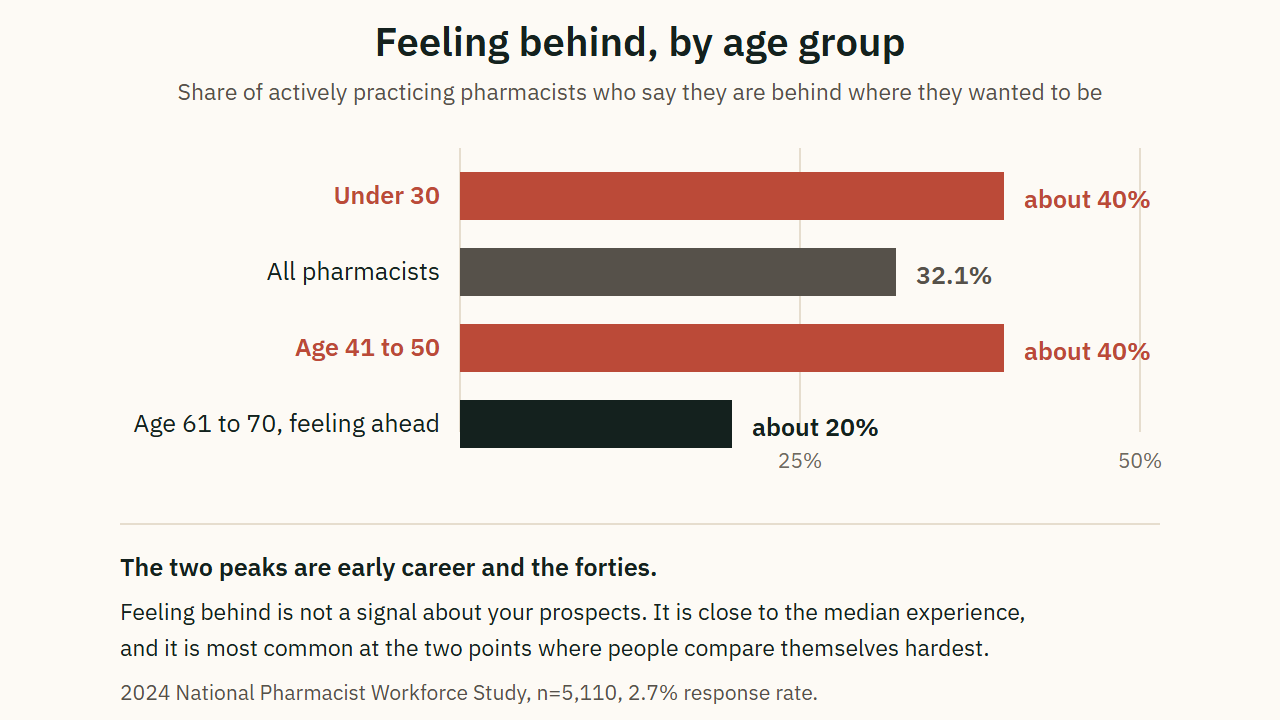
If you are a pharmacist in your 40s and feel like you have missed the window for leadership, you are experiencing a massive cognitive dissonance. Roughly 40% of pharmacists in their 40s report feeling "behind" where they expected to be in their careers. Curiously, 40% of pharmacists under 30 feel the exact same way. This suggests that "feeling behind" is not a reflection of your actual progress, but a universal mid-career anxiety.
While you are busy worrying about your age or a "missing" decade of management experience, the industry is facing a crisis of a different kind. There is a severe, structural shortage of leaders. The primary constraint in the current market is not a lack of qualified young talent, it is a lack of people willing to step up.
The Great Mismatch: A Market Starved for Leaders
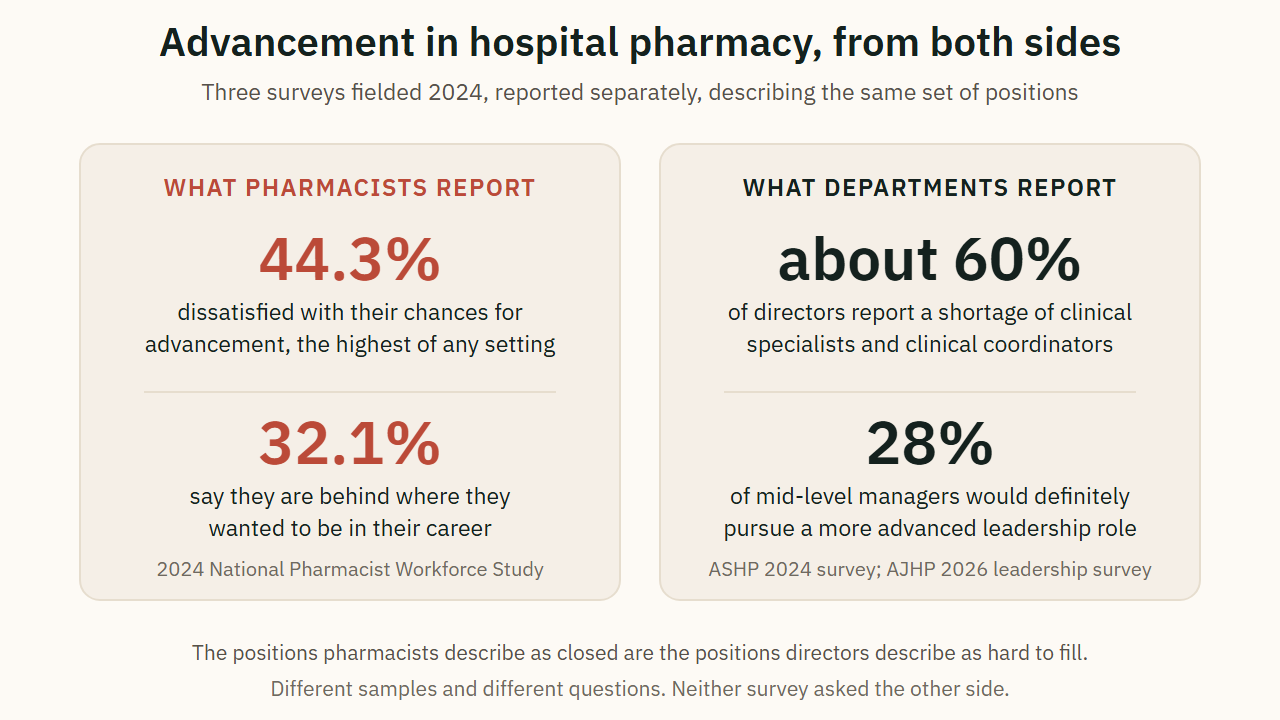
The data reveals a startling disconnect between professional perception and market reality. According to the 2024 National Pharmacist Workforce Study, 32.1% of pharmacists feel behind their career goals. Contrast that with data from the American Journal of Health-System Pharmacy (AJHP), which shows that between 73% and 79% of pharmacy leaders at every level describe a severe shortage of leadership candidates.
This shortage isn't limited to the Director's office. Approximately 60% of hospital pharmacy directors report a severe shortage of clinical specialists and clinical coordinators. The door isn't just open for administrators; it is wide open for clinical leaders as well.
The bottleneck is a lack of willingness. Only 28% of mid-level managers say they would definitely consider a more advanced leadership role, compared to 47% at the system level.
The "Published Pathway" is a Filter, Not a Rule
If you look at a standard job posting for a Pharmacy Director, you'll see the "published pathway": five years of progressive leadership, or an HSPAL residency plus two years. System roles often demand seven to ten. If read literally, these descriptions imply a queue that you should have joined years ago.
The reality: These requirements are frequently bypassed because the alternative is leaving the role open.
Consider this real-world timeline:
-
2017: Licensed as a pharmacist.
-
2023: First management role (with zero prior management experience).
-
2024: Appointed Director of Pharmacy.
This trajectory reached the Director level in just seven years, completely ignoring the traditional 12-to-15-year career arc. This wasn't a result of rare talent; it was a result of a structurally empty internal pipeline. The department needed clinical currency more than administrative history, and a candidate was willing to put their hand up.
The Ghost of Succession Planning
Many pharmacists fall into the trap of waiting for an "internal tap" on the shoulder. They assume that if they work hard, they will be identified for the next level. This is a failing strategy because the processes to find you largely do not exist.
Structured succession planning is present in only 36% of system-level departments and a mere 14% of mid-level departments. Even more telling, half of all surveyed leaders have no identified replacement. If you are waiting for a formal process to recognize your potential, you are waiting for a ghost. You must be the one to initiate the move.
The Strategic Shortcuts: Small Hospitals and Relocation
If you have clinical expertise but lack a management title, you can bypass the traditional "years in the seat" requirement by leveraging two specific factors:
-
Look at smaller departments: Smaller hospitals typically have thinner internal pipelines. This lack of internal competition creates an "open door" for a mid-career candidate who can prove their clinical value.
-
Geographic flexibility: If you are willing to relocate, you move from a local pool of candidates to a national market where the leadership shortage is most acute.
Verifiable Work Over Years of Service
To a hiring panel, your "years of service" is a static number. What actually moves the needle is verifiable work. If you want to jump the queue, focus on these four areas:
| What | Why it matters |
|---|---|
| Service Lines | Have you built or managed a specific clinical service? |
| Protocol Rewrites | Can you point to clinical or operational policies you authored? |
| Stewardship Metrics | Do you have quantifiable data on drug-use improvements or cost savings? |
| Precepting | Can you demonstrate that you have taught and led others? |
One more thing on transparency: acknowledging exactly what you lack in experience, and remaining steady about it, is perceived by panels as a sign of high-level leadership judgment. Overstating your experience is what costs you the role; transparency builds the trust necessary to hire you.
Strategic Realism: The Honest Limits
While the doors are wider than most believe, we must acknowledge certain structural realities:
| What | Why it matters |
|---|---|
| HSPAL Residencies | This is a "graduation-adjacent" decision. It is practically closed once you are deep into your career, but it is only one of many routes. |
| Geographic Stagnation | If you cannot relocate, you are limited to the specific openings in your immediate metro area, which may require more patience. |
| The Choice to Stay | Not everyone should climb. 54.4% of pharmacists report being "just right" where they are. Remaining in a role you have mastered is a legitimate professional destination, not a failure. |
The honest limits
Some doors do close on time. An HSPAL residency is a graduation-adjacent decision, and it is practically closed once you are years into practice. That is one route, and its closure is not the closure of leadership.
Willingness to move is doing a lot of work in the argument above. If you are geographically fixed, the market is your metro's departments, and that is a materially smaller number of doors. It is not zero, and it changes the timeline rather than the possibility.
Not everyone should climb. 54.4% of pharmacists say they are exactly where they wanted to be. Staying in a role you are good at, going deeper clinically, is a legitimate destination and not a failure to advance.
Conclusion: The One-Evening Test
The pharmacy market is not short of young leaders; it is short of willing ones. When half of the current directors have no successor in place, the assumption that the "door is closed" is a theory that remains largely untested by the average pharmacist.
The cost of staying still is a lifetime of "what if" and career anxiety. The cost of testing the market is a single evening.
The Directive: Apply for one role this week that feels like a "stretch." Do not do it with the absolute expectation of an offer, but to challenge your assumptions. You may find that the "published pathway" is much softer than the paper it's printed on.
Related
- What actually gets a hospital pharmacist promoted
- Do you need an MBA to become a pharmacy manager or director?
- What does a director of pharmacy actually do?
- Going back for a residency six years after graduating
- Running the Pharmacy, on what the first leadership role actually contains