The MBA Myth: Why Your Next Degree Won't Land You That Pharmacy Director Role

Many clinical pharmacists are operating under a costly delusion: the belief that they are exactly one degree away from a leadership role. The internal narrative is almost always the same: "Once I get my MBA, I will finally be qualified to move into management."
Pharmacists waste thousands of dollars and hundreds of hours over-indexing on credentials while the very leadership roles they covet remain vacant. If the degree were truly the key, why are departments struggling to find directors? The truth is that you are likely misreading the market, and your "credential-first" strategy is actually a high-risk gamble that ignores where the real leverage lies.
"Preferred" is the Most Misunderstood Word in Hiring
When you look at a job posting for a Pharmacy Director, you are likely conflating "Required" with "Preferred." In the world of executive recruitment, these are not synonyms. A PharmD and an active license are non-negotiable requirements. An MBA, MS, or MHA is almost always a "nice-to-have."
You must understand the logical asymmetry of the hiring room:
A candidate with an advanced degree but no leadership experience is unqualified. Conversely, a candidate with the required experience but no advanced degree is a qualified candidate with a single missing preference.
Hiring committees do not trade experience for paper. If you are waiting for a degree to give you "permission" to lead, you are fundamentally misunderstanding your value proposition.
The 70% Factor: The Candidate Shortage is Your Leverage
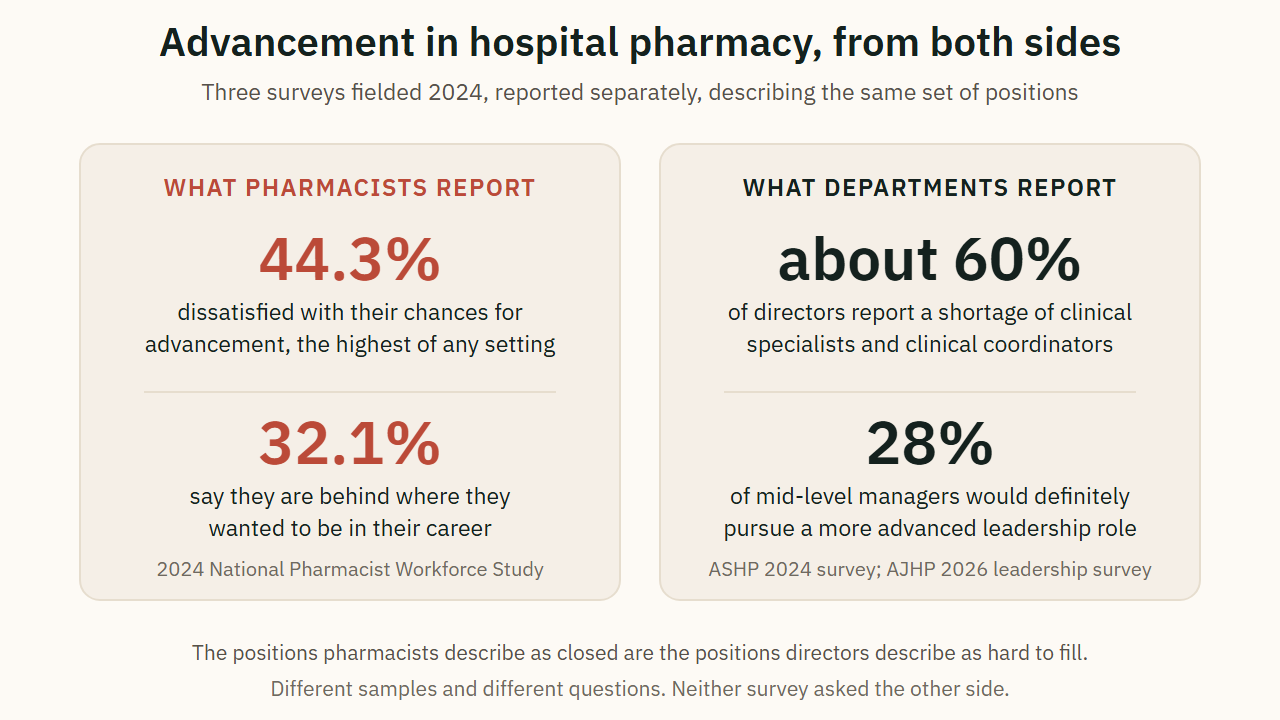
A stated requirement is only as firm as the depth of the applicant pool. Current industry data reveals that the pharmacy leadership pipeline isn't just leaking; it's dry. Research indicates that between 73% and 79% of pharmacy leaders report a severe shortage of candidates for leadership roles.
Even more startling: only 28% of mid-level managers are willing to consider moving into more advanced roles. With half of all current leaders reporting they have no identified replacement, the "preferred" requirements are the very first things to be waived. When the talent pool is this thin, your clinical expertise and institutional knowledge are far more valuable than a mid-tier MBA.
Experience is a Fixed Gate, Not a Suggestion
While educational requirements are flexible, the timeline for experience is a fixed gate. Most director-level postings demand five years of "progressive pharmacy leadership experience." System-level or multi-site roles typically require seven or more years, including three to five years at the enterprise level.
An MBA is not a time machine. It does not count as "progressive leadership experience." You cannot study your way past the experience requirement; you have to work through it. If you haven't managed people, navigated a budget variance, or survived a regulatory survey, a piece of paper won't convince a VP of Operations that you can lead a department of 100 people.
The Order of Operations: Stop Funding Your Own Onboarding
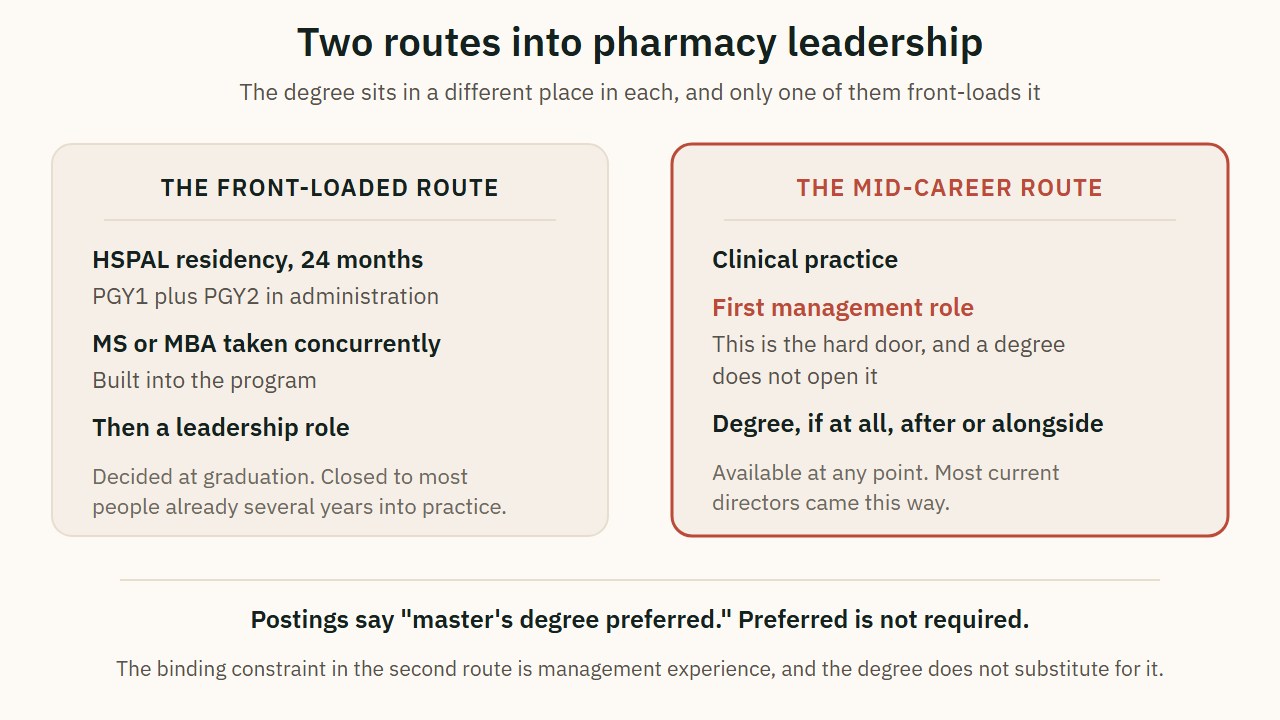
There are two distinct routes to the director's office, and you need to know which one you are on:
-
The Front-Loaded Route (HSPAL): This is the 24-month PGY1/PGY2 residency track that builds a master's degree into the curriculum. If you didn't take this exit at graduation, that window is likely closed.
-
The Mid-Career Route: This is the path for the vast majority of current directors. You move from clinical practice into a first management role based on your "clinical currency" and visibility, then you get the degree later.
Self-funding an MBA before you have a "Director" title is the most expensive way to advance. Most health systems offer tuition assistance that goes unused every year. The strategic move is to secure the management role first and let the employer foot the bill for the degree once it becomes a legitimate requirement for system-level advancement. If you want a middle-ground credential that costs a fraction of an MBA, look at the ASHP Certified Pharmacy Executive Leader (CPEL), it demonstrates strategic intent without the $60,000 price tag.
Visibility vs. Credentialing: The Four Things Panels Verify
A degree addresses knowledge gaps, finance, strategy, and organizational behavior. It does nothing to address the "visibility gap." A hiring panel is looking for four specific things they can verify, none of which are found on a transcript:
| What | Why it matters |
|---|---|
| Project Track Record | Can you move a metric from Point A to Point B? |
| Departmental Influence | Do your peers follow you when you aren't "in charge"? |
| Operational Stress Management | How do you perform when the automation goes down or the budget is slashed? |
| Clinical Currency and Authenticity | Can you speak the language of the frontline staff while making administrative decisions? |
If your department hasn't seen you lead a task force or optimize a workflow, three new initials after your name won't change their perception of your leadership potential.
The Three-Question Litmus Test
Before you write a check to a business school, answer these three questions:
-
Have you actually been rejected for lacking the degree? Be honest. If you haven't applied for a role yet, the degree isn't the obstacle, your hesitation is. The test of the market is free; the degree is not.
-
Who is paying? If the answer is "me," you are taking a massive financial risk on a "preferred" item. Wait for the role to fund the credential.
-
What specific gap am I filling? If you can't read a balance sheet, take a certificate course. If you haven't led people, an MBA is the wrong tool for the job.
Conclusion: The 20-Minute Challenge
Experience is the required currency of pharmacy leadership; the degree is the optional polish. For your first management role, the MBA is effectively irrelevant to the final hiring decision.
The Challenge: Today, find ten job postings for the role you eventually want. Count how many list the master's degree as "required" versus "preferred." You will likely find that the path is wider than you imagined.
Are you pursuing a degree because the market demands it, or are you using it as a shield to avoid the vulnerability of applying for a role you feel underqualified for?
Related
- What actually gets a hospital pharmacist promoted
- Your employer will pay for a certificate. Which one is actually worth taking?
- Should you look at job boards when you are happy where you are?
- ASHP career resource center
- Running the Pharmacy, on what the first management role actually contains