Your Boss is Paying: Don't Waste Your Training Budget on the Wrong Pharmacy Certificate

It is a common and enviable position: your employer has set aside a budget for professional development and invited you to select a "certificate" program or advanced training course. In the high-pressure environment of inpatient pharmacy, the instinct is to find a program that sounds prestigious or aligns with a personal interest, such as infectious disease or critical care, and sign up immediately.
However, "free money" isn't free if it costs you a promotion because you chose the easiest course instead of the right one. In our profession, "certificate" is a dangerously loaded term. Without a clear understanding of the hierarchy of credentials, it is a professional tragedy to waste a finite training budget on a program that provides education but carries no weight in a credential-heavy market.
To spend your training budget strategically, you must recognize that your eligibility, not your interest, dictates your best move. Choosing the wrong path leads to career stagnation, where you may possess the knowledge but lack the formal title recognized by HR and hiring managers. Selecting the right program requires navigating the specific gates that guard the most valuable credentials in the industry.
Takeaway 1: The Three "Certificates" are Not Created Equal
In pharmacy, three distinct types of programs are frequently grouped under the "certificate" umbrella. They are not interchangeable, and mistaking one for another is a significant strategic error for a career-minded pharmacist.
| Type | What it is | Eligibility Gate | Renewal |
|---|---|---|---|
| BPS Board Certification | A credential with post-nominal letters (e.g., BCPS, BCCCP) | Yes, substantial | Annual fee plus recertification |
| Certificate Training Program | Structured training in a defined skill, often ACPE-accredited | Usually none beyond licensure | Typically none |
| CE Hours | Continuing education required to keep a license | None | Ongoing by state requirement |
The fundamental distinction here is between education and credentialing. A Certificate Training Program provides knowledge, but only BPS Board Certification provides a title. While you may learn a great deal from an ACPE-accredited course, that "certificate" does not function as a formal credential during those 60% staffing shortages when employers are filtering for verified experts. Board certification is the only path with a significant "gate," which is precisely why it signals a level of mastery that other programs cannot match.
Takeaway 2: The "Invisible" Gate to Board Certification
The most common mistake pharmacists make is assuming they can simply enroll in a Board of Pharmacy Specialties (BPS) program. In reality, BPS certification has strict eligibility rules that act as a barrier to entry. For the Pharmacotherapy (BCPS) specialty, or others like it, you must meet specific requirements before you are even allowed to sit for the exam.
The requirements include an ACPE-accredited degree and an active license, but the most critical gate is the experience requirement. You must meet one of the following within the seven years immediately preceding your application:
-
Completion of an ASHP-accredited PGY1 residency.
-
Three years of practice experience, with at least 50% of your time spent within the scope defined by the specialty's exam content outline.
This 50% practice scope requirement is not self-reported; it must be verified by an employer attestation on company letterhead.
"BCPS eligibility requires an ACPE-accredited degree, an active license, and one of the following within the past 7 years: at least 3 years of pharmacotherapy practice experience with at least 50% of time in the scope defined by the exam content outline, employer-attested on company letterhead; or completion of an ASHP-accredited PGY1. All practice experience must be post-licensure and within the seven years immediately preceding application.", BPS Examination Specifications, September 2024
This gate is what gives the credential its actual market value. Because it requires a verified, documented commitment to a specific area of practice, it distinguishes a board-certified pharmacist from one who has simply completed a course.
Takeaway 3: Follow the Growth (Critical Care and Infectious Diseases)
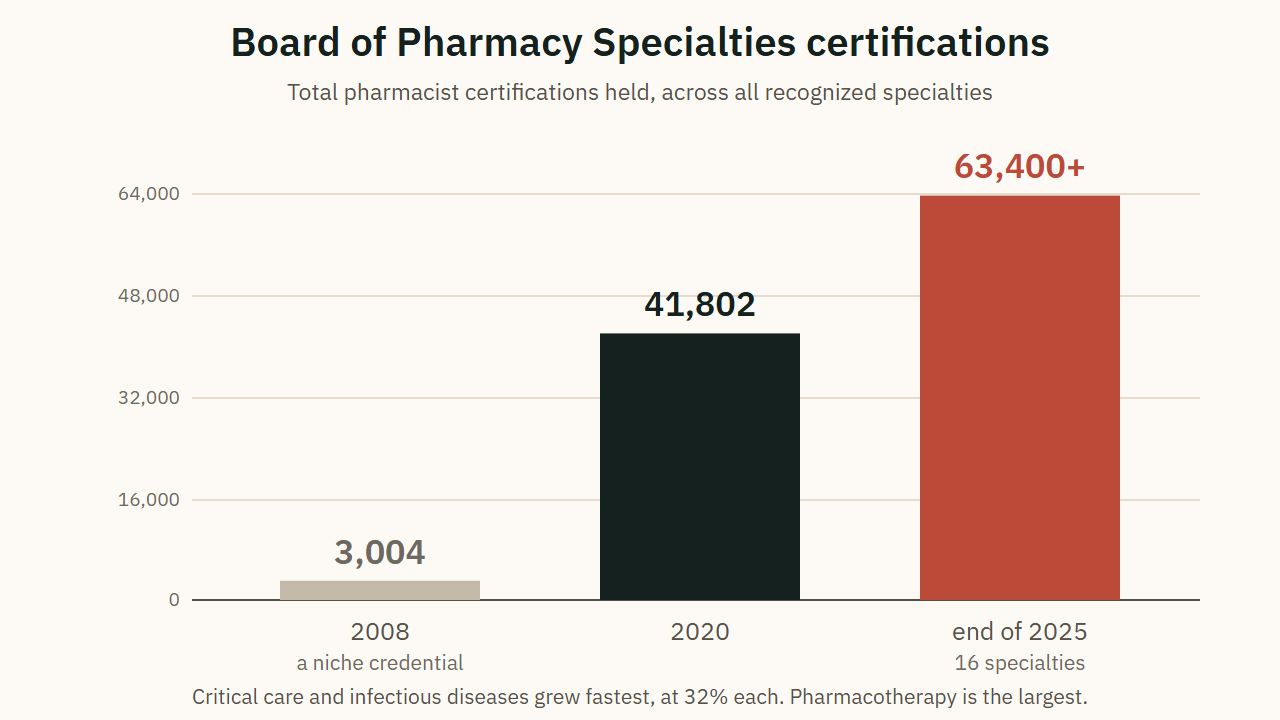
If you meet the eligibility requirements, your next move should be to align your training with the areas of maximum market demand. BPS certifications have transitioned from a niche pursuit to an industry standard, growing from 3,004 total certifications in 2008 to more than 63,400 by the end of 2025.
| What | Why it matters |
|---|---|
| Fastest Growing Specialties | Critical Care and Infectious Diseases (ID) are currently the "perfect storm" for career advancement, each showing a growth rate of 32%. |
| Largest Volume | Pharmacotherapy (BCPS) remains the dominant specialty, with a numeric growth of 20,624. |
| Specialty Stability | In May 2026, the BPS issued a moratorium on requests for new specialties, signaling that the field is stabilizing around established paths. |
This explosive growth is directly linked to a critical supply-demand gap: approximately 60% of pharmacy departments report insufficient staffing for advanced clinical roles. Obtaining a BPS certification in high-growth areas like ID or Critical Care isn't just about learning; it's about positioning yourself to fill the most desperate vacancies in the profession.
Takeaway 4: The Strategic Play for the Ineligible
If you have not completed a PGY1 and do not yet meet the 3-year/50% experience threshold, spending your training budget on a BPS exam prep course is a waste. If the "clock isn't running" on your verified experience, you cannot certify, regardless of how much you study. You must stop waiting for a clock that hasn't started ticking.
The Priority Order Action Plan:
| What | Why it matters |
|---|---|
| Change Your Work Assignments | This is a mandatory prerequisite. If your daily routine falls within the specialty scope less than 50% of the time, you are not accruing eligibility. You must have a stern conversation with your manager to adjust your clinical responsibilities. |
| Secure Employer Commitment | Confirm today that your employer is willing to provide the necessary attestation on company letterhead when you reach the three-year mark. Without this commitment, your hours may not count when it's time to apply. |
| Align Training Budgets | Only after your work experience is secured should you spend the budget on training for that specialty. |
Do not let your employer pay for a BCPS prep course if you aren't actually doing the clinical work 50% of the time. The easiest course to enroll in is rarely the one that moves your career forward.
Takeaway 5: The Cost of Admission
While the eligibility requirements are steep, the financial investment for BPS certification is the cheapest credential in the profession relative to the powerful career signal it sends.
-
Initial Application: $600
-
Retake Fee: $300
-
Annual Maintenance: $125 (Years 1 through 6)
Compared to expensive certificate programs that lack post-nominal recognition, board certification offers the highest return on investment, provided you have already cleared the eligibility gate.
Conclusion: Your First Move is a Conversation, Not a Course
Strategic career movement is dictated entirely by eligibility. Before you sign up for any program or spend a single dollar of your employer's budget, you must perform a cold, honest self-audit.
Call to Action: Pull up the official BPS content outline for your target specialty and audit your current work week. If the specialty scope accounts for less than 50% of your time, your first move is not a purchase, it is a conversation with your manager about your daily assignments.
Is your current daily routine actually building the credential you want, or are you just waiting for a clock that hasn't started ticking yet?
Related
- The original thread on Student Doctor Network
- BPS specialties and eligibility
- BPS fees and deadlines
- Board of Pharmacy Specialties, for eligibility and fees on every specialty
- What actually gets a hospital pharmacist promoted
- Running the Clinical Program, on what a clinical manager role requires
- Your First Year as a Hospital Pharmacist, for the practice knowledge underneath all of it