Why the Best Time to Browse Job Boards is When You Have Zero Intent to Leave

Common wisdom suggests that you only visit job boards when you are unhappy, underpaid, or ready to quit. However, this reactive approach ensures you make critical career decisions with the least amount of information and the lowest possible leverage. The reality is that information is cheap while you are happy, but expensive once you are not.
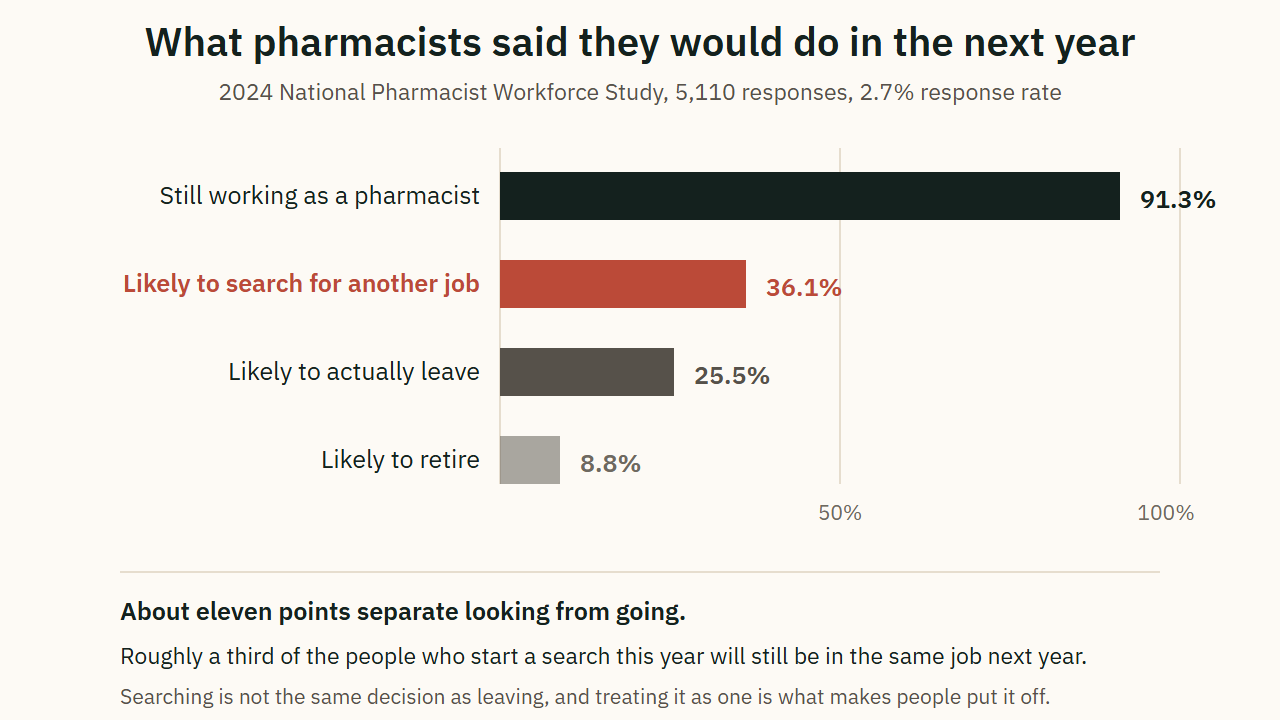
Recent data highlights a significant "Search vs. Leave" paradox. According to the 2024 National Pharmacist Workforce Study, 36.1% of pharmacists plan to search for a new job in the coming year, yet only 25.5% actually plan to leave their current positions. This gap reveals a strategic truth: roughly a third of people looking for jobs will stay exactly where they are.
For these professionals, searching is not about an immediate exit, it is about gathering intelligence. Searching and leaving are two entirely different decisions, and treating them as one is exactly what makes people avoid the first until they have already decided on the second.
Takeaway 1: Your Real-Time Market Valuation
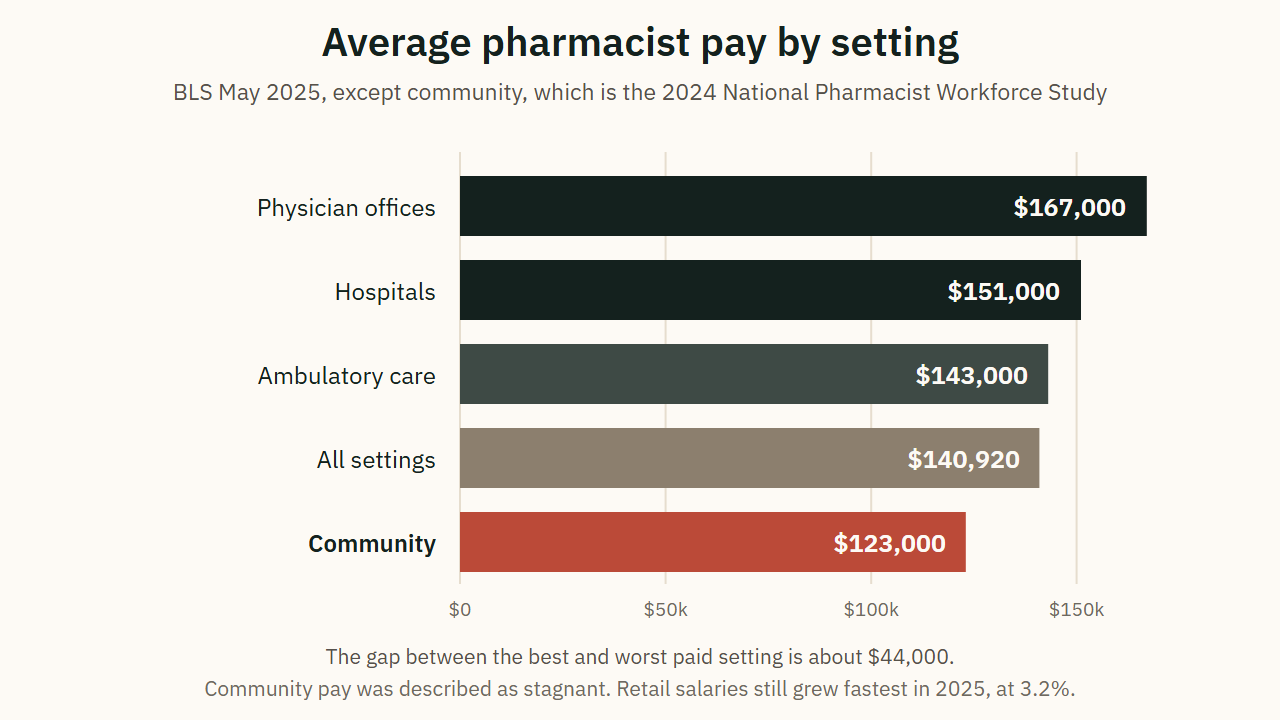
Regularly browsing job postings acts as a necessary "price check" for your current role. Most professionals only discover their market value twice: when they are hired and years later when a crisis occurs. Relying on your hire-date salary or standard annual raises is a mistake because it ignores local market shifts and the setting spread.
Nationally, the pay spread in pharmacy is approximately $44,000, ranging from roughly $123,000 in community pharmacy to $167,000 in physician offices. However, national averages are less important than your specific geography. To get a true valuation, you must use the tools provided by the Bureau of Labor Statistics (BLS). With every annual release, the BLS publishes state and metropolitan percentiles for pharmacists. Comparing these percentiles against active local postings allows you to enter any salary negotiation with data rather than desperation.
Takeaway 2: The "Hidden Curriculum" of Your Next Promotion
Job postings for roles one level above your current position serve as a high-accuracy, self-directed professional development plan. By applying the "Rule of Ten", reading ten postings for your target next role, you will likely find a recurring list of four or five essential skills. This list is a real-time curriculum, and it is almost always more current than a corporate development plan written three years ago.
Equally valuable is observing what is not being asked for. If you are considering an expensive, time-consuming certificate but find it appears in none of the requirements for the roles you actually want, you can save yourself thousands of dollars and months of effort. Knowing what the market doesn't value is just as strategic as knowing what it does.
Takeaway 3: You Can't Want a Job You Don't Know Exists
In modern pharmacy, job titles are far from standardized, and many specialized roles did not exist a decade ago. Roles such as 340B program manager, informatics pharmacist, medication safety officer, or transitions of care coordinator are rarely featured on traditional career-path diagrams in pharmacy school.
Browsing allows you to discover these emerging niches. You cannot aspire to a role or prepare for a career shift if you have never seen the job description. Seeing the description is the essential prerequisite for career imagination; it expands your view of what a pharmacy career can actually look like.
Takeaway 4: The Power of "Findability"
There is a significant shift in the modern market from "applying" for roles to "being found" through inbound contact. Many of the best positions are filled before they are even widely advertised, often starting with a recruiter reaching out to a potential candidate.
The requirement for being "findable" is surprisingly low. You do not need a perfectly polished or hyper-active profile; it simply needs to be current. I can speak to this from experience: my own last move started with a recruiter message rather than an application. The profile that produced that opportunity had not been touched in months, but it was current. Keeping a profile updated ensures that opportunities can find you while you are busy doing your current job.
The Technical Edge: How to De-Code a Job Posting
When you browse, look past the corporate boilerplate. To extract real value from a posting, focus on these three elements:
| The | Why it matters |
|---|---|
| The Verbs | Ignore the degree line and look at the action words. What does this person actually do all day? This reveals the reality of the daily workload and the skills you actually need to develop. |
| The Reporting Line | Who this role answers to tells you more about its real scope than the title does. A clinical coordinator reporting to a director has a completely different scope of work and authority than one reporting to a clinical manager. |
| The Re-post Frequency | If a role remains open for a long time, it is not always a red flag. According to ASHP survey data, 60% of hospital pharmacy directors report a shortage of clinical specialists and clinical coordinators. In this context, a long-open posting often signals a genuine shortage and a unique opportunity for a qualified candidate rather than a toxic workplace. |
Conclusion: Professional Maintenance, Not Disloyalty
Monitoring the market is not a plan to leave, nor is it an act of disloyalty. It is ordinary professional maintenance, equivalent to keeping your state licensure current. A manageable maintenance schedule requires very little time:
-
Twice a Year: Spend one hour browsing fifteen postings in your metro area, both at your current level and one level up, to see what skills are repeating.
-
Once a Year: Spend fifteen minutes checking your metropolitan wage percentiles through the BLS to ensure you aren't guessing about your value.
Professional security comes from knowing exactly where you stand in the broader market.
If you looked at fifteen postings for the job one level above yours today, which four skills would the market tell you to learn next?
Related
- Which pharmacist salary number to use when you ask for a raise
- When is the right time to leave a job?
- BLS wage tables by state and metropolitan area
- What actually gets a hospital pharmacist promoted
- Running the Pharmacy, on how a department decides to post a role at all