Stop Counting Years: The "Mandate" is the Only Signal That Matters

The Tenure Myth
One of the most persistent anxieties in this profession is the obsession with the clock. Professionals constantly ask: "How long should I stay at this job to avoid looking like a jumper?" They search for a magic number, two years, three, five, believing that tenure itself is a shield against professional scrutiny.
There is no evidence to support a "correct" number of years. The clock is an arbitrary instrument. The most vital signal that it's time to move on isn't how long you've been in the seat; it is whether the "mandate" of your role has fundamentally shifted under your feet.
The 11-Point Gap: Searching vs. Leaving
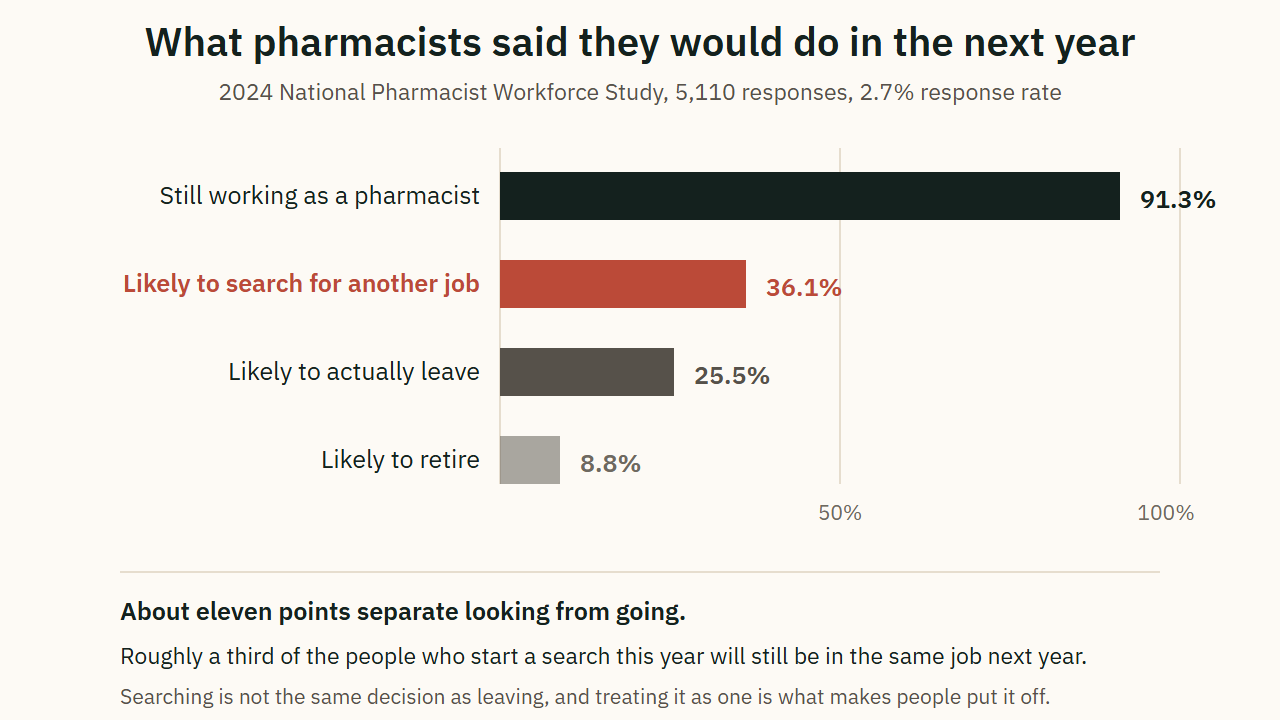
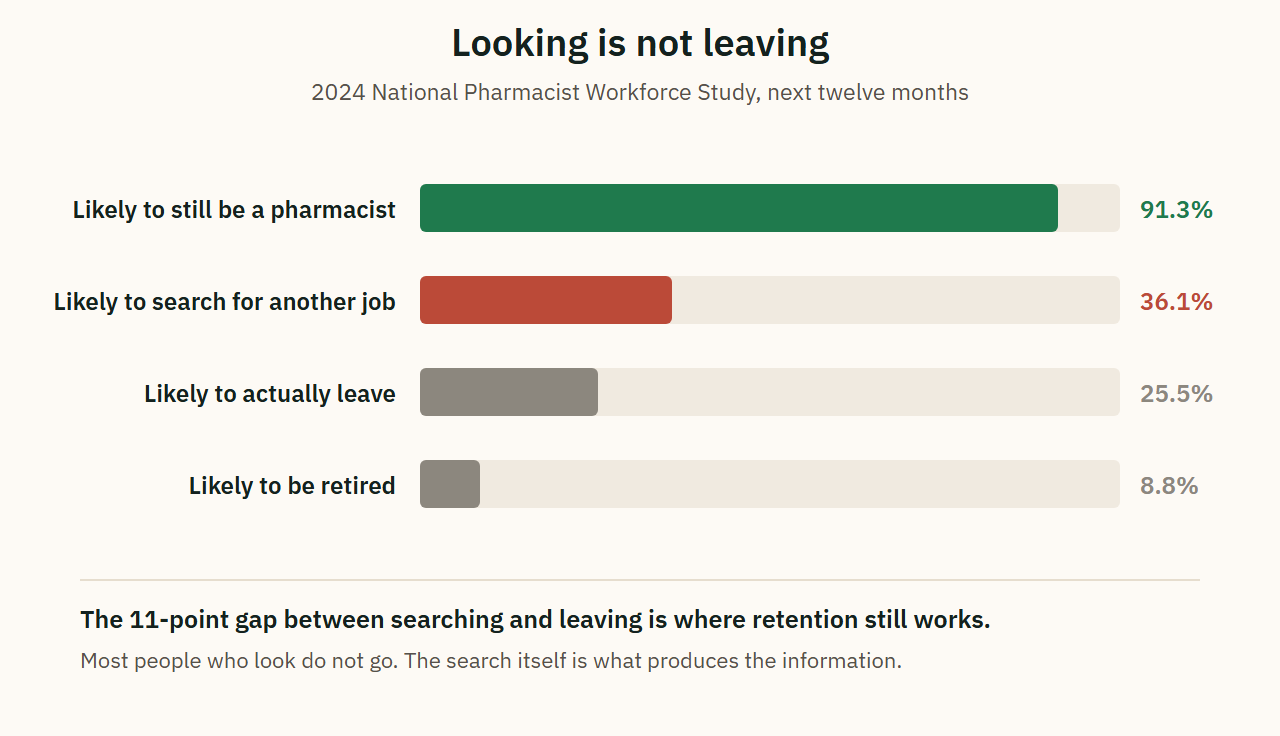
The 2024 National Pharmacist Workforce Study reveals a fascinating disconnect in professional behavior. While 36.1% of pharmacists reported they were likely to search for a new role within the year, only 25.5% expected to actually leave.
This 11-point gap is where the majority of the profession lives. From my perspective, this isn't a sign of indecision; it is a sophisticated period of information gathering. Searching is how you pressure-test your current value and determine if staying is a strategic choice or a default setting. While 31.2% of pharmacists reported an employment status change between 2022 and 2024, a slight dip from the previous 34.2%, this slowing movement suggests that professionals are becoming more discerning about why they move, not just when.
Takeaway 1: The "Mandate" Has Shifted (Even if Your Title Hasn't)
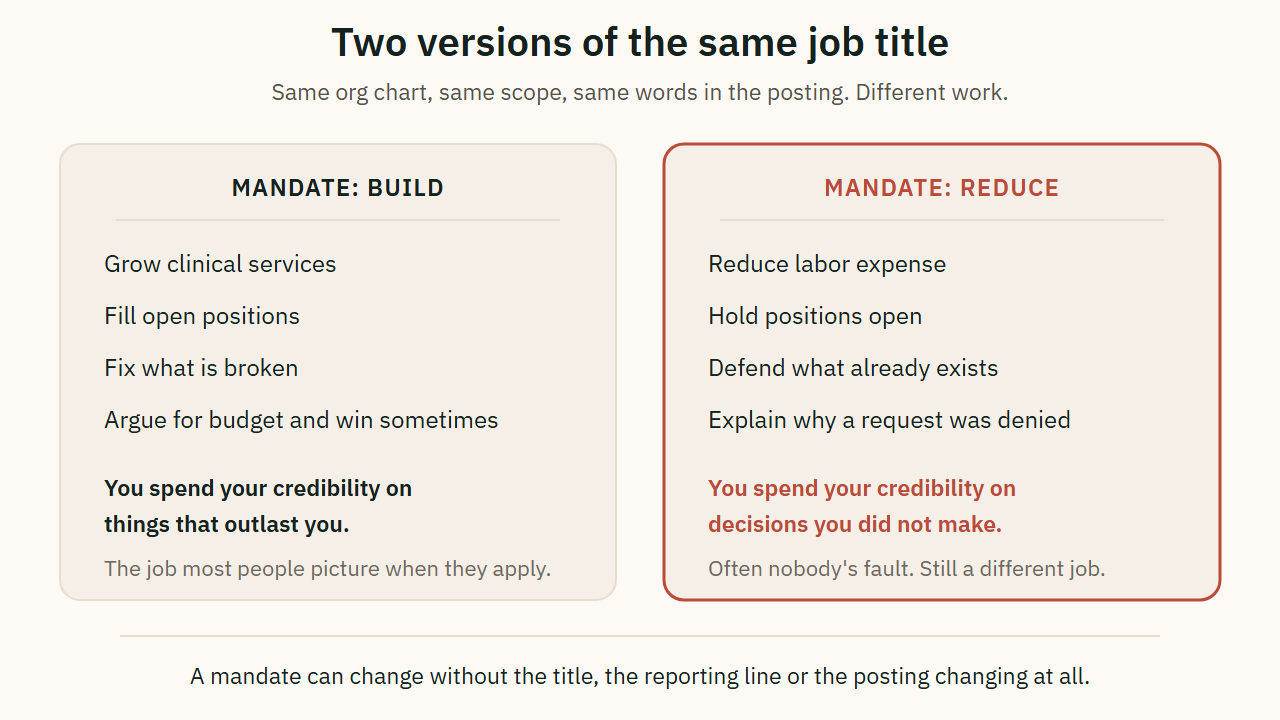
The most dangerous signal to leave is invisible. It doesn't appear on an org chart or a revised job description. It is a shift in the mandate, the underlying purpose of your position.
In my analysis, a mandate shift occurs when the organization's goals change, effectively turning your job into a different role while keeping the title the same. You might be hired with a mandate to "expand clinical services and innovate workflow." Two years later, under new financial constraints, that mandate becomes "reduce labor expense and defend the status quo."
When an organization pivots due to financial pressure, they aren't necessarily "wrong," but the job is no longer the one you signed up for. To diagnose this, I recommend the following litmus test:
The Mandate Test: If the posting for your own job were rewritten honestly today to reflect your current daily reality, the actual pressures, the resources available, and the goals of your superiors, would you apply for it?
Takeaway 2: The "Rule of Two" for Broken Promises
Organizations are frequently overtaken by external events, and a single deferral is often a manageable anomaly. However, the "Rule of Two" is absolute: one deferral is an accident; two is a pattern.
This pattern typically manifests in:
-
Promised FTEs or support staff that never arrive.
-
New service lines or clinical programs that stay permanently "on hold."
-
Promotions or scope changes that are perpetually "next quarter's priority."
If a resource or change has been deferred twice, you must operate under the assumption that the third deferral has already been decided. At this point, the delay isn't a hurdle; it's the new direction of the company.
Takeaway 3: The Visibility of the "Next Thing"
Stagnation is a structural failure of a role, not a personal failing of the employee. Data shows that only 57.6% of pharmacists are satisfied with advancement opportunities, the lowest rating in the study. This dissatisfaction spikes to 44.3% in hospital settings.
Why hospitals? In my analysis, hospitals are the epicenters of the "financial pressure" shifts mentioned earlier. When a system prioritizes holding the line over growth, the "next thing" for a high-performer disappears. There is a critical distinction between being "comfortable", which can be a healthy season, and being in a role where the next step is invisible. If you can see the entire shape of the job and asking about advancement produces only vague answers, you are in a stagnant group. Staying there indefinitely is a choice, not a requirement.
Takeaway 4: The Vanishing Support Layer
A job is only as healthy as the leadership backing it. Recent data from the AJHP study highlights a widening chasm in leadership satisfaction: 37% of mid-level managers reported worsening satisfaction, compared to just 24% at the system level.
This 37% represents the "vanishing support layer." Mid-level managers are the shock absorbers for mandate shifts; they are the ones tasked with delivering the news of budget cuts or frozen positions. When the support layer above you erodes or becomes deeply dissatisfied, your own job fundamentally changes. A role with the same duties but less backing is a harder, more exhausting job. This shift is rarely announced in a meeting, but its impact on your daily autonomy is a loud signal to exit.
Counter-Intuitive: Two Reasons That Are Not Signs to Leave
Before you resign, you must distinguish between structural job failures and personal or seasonal hurdles.
-
False Flag 1: Feeling "Behind." Roughly 32.1% of pharmacists feel they are behind their self-imposed career schedule, peaking at 40% for those under 30 and those aged 41-50. This is a personal timeline issue, not a job issue. Changing employers rarely fixes a timeline; more often, the goal needs adjusting, not the employer.
-
False Flag 2: A "Bad Stretch." Short-staffing or a brutal budget cycle can feel like a reason to quit. However, you must ask: Is this a season or a direction? A season has an end date; a direction is a permanent shift in the mandate.
The Strategy: How to Vet Your Next Mandate
To ensure your next move isn't just a repeat of the last, you must vet the mandate during the interview process. I advise asking these three specific questions:
-
"What is the department being asked to do over the next two years?" (This is a mandatory question for any leadership role as well). Listen for a mandate of "building/growth" versus "holding/cutting."
-
"What happened to the last person in the role?" This reveals whether the position is a stepping stone or a revolving door.
-
"What does support look like?" Don't accept "great culture" as an answer. Ask for a concrete, recent example of a department request that was actually approved by senior leadership.
Conclusion: The Clock is the Wrong Instrument
It is time to stop asking how long you have been at your company. Length of service is a vanity metric that tells you nothing about the health of your career. Instead, ask if the work you were hired to do is still the work being asked of you today.
A search for a new role is not a betrayal of your current employer; it is the only way to accurately value your skills and understand your current mandate. As you look at your calendar, ask yourself a harder question: Is your tenure a badge of loyalty to a mission you still believe in, or is it simply a record of how long you've accepted a mandate that no longer serves you?
Related
- 2024 National Pharmacist Workforce Study
- Should you look at job boards when you are happy where you are?
- What actually gets a hospital pharmacist promoted
- Running the Pharmacy, on what a department mandate looks like from the inside