Beyond the title: what a director of pharmacy actually does all day

In the hierarchy of hospital pharmacy, the title "Director" is often viewed as the natural pinnacle of a clinical career. However, there is a profound gap between the title and the daily reality of the role. For most, the transition to leadership is not just a step up the ladder, it is a complete departure from the practice of pharmacy itself.
The reality of the role is that you stop verifying orders and start "running the conditions under which other people practice." It is a move from task-oriented clinical work to the management of "standing conditions": people, money, compliance, and operations. To succeed, a director must shift their focus from direct patient outcomes to the systemic environment that makes those outcomes possible. It is a transition from saving patients to saving the system.
The "Mandate" Matters More Than the Job Description
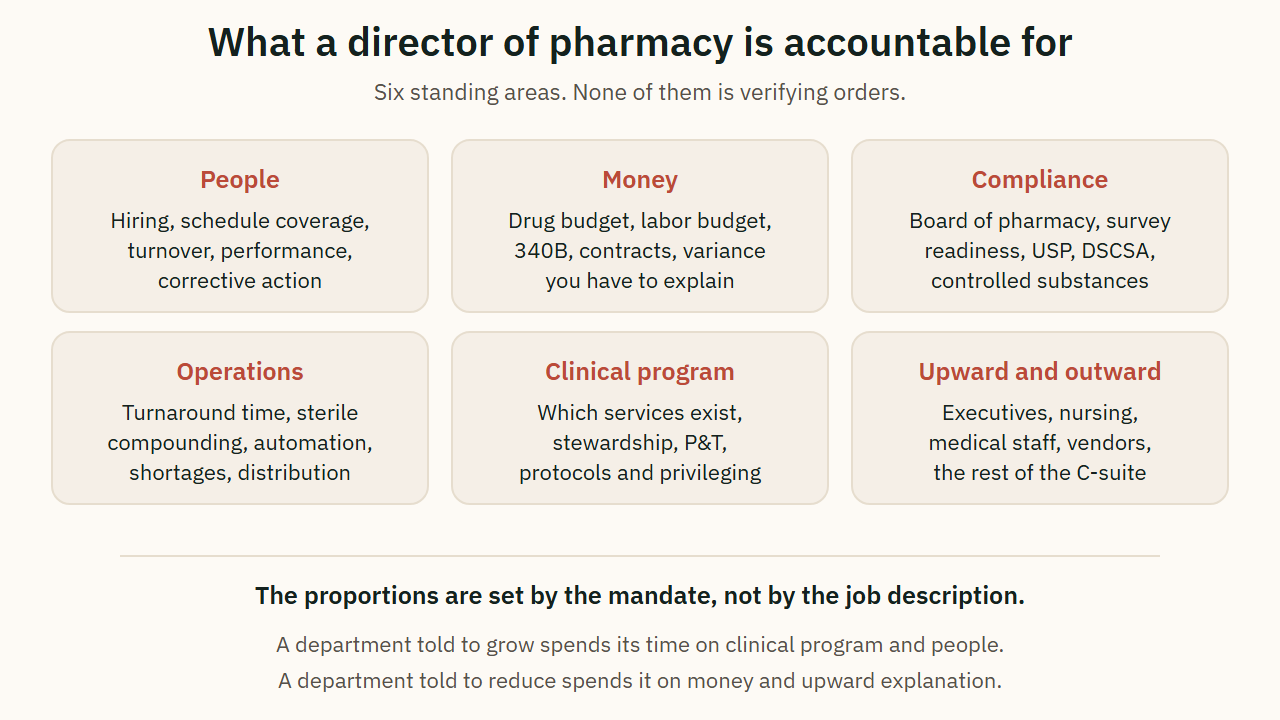
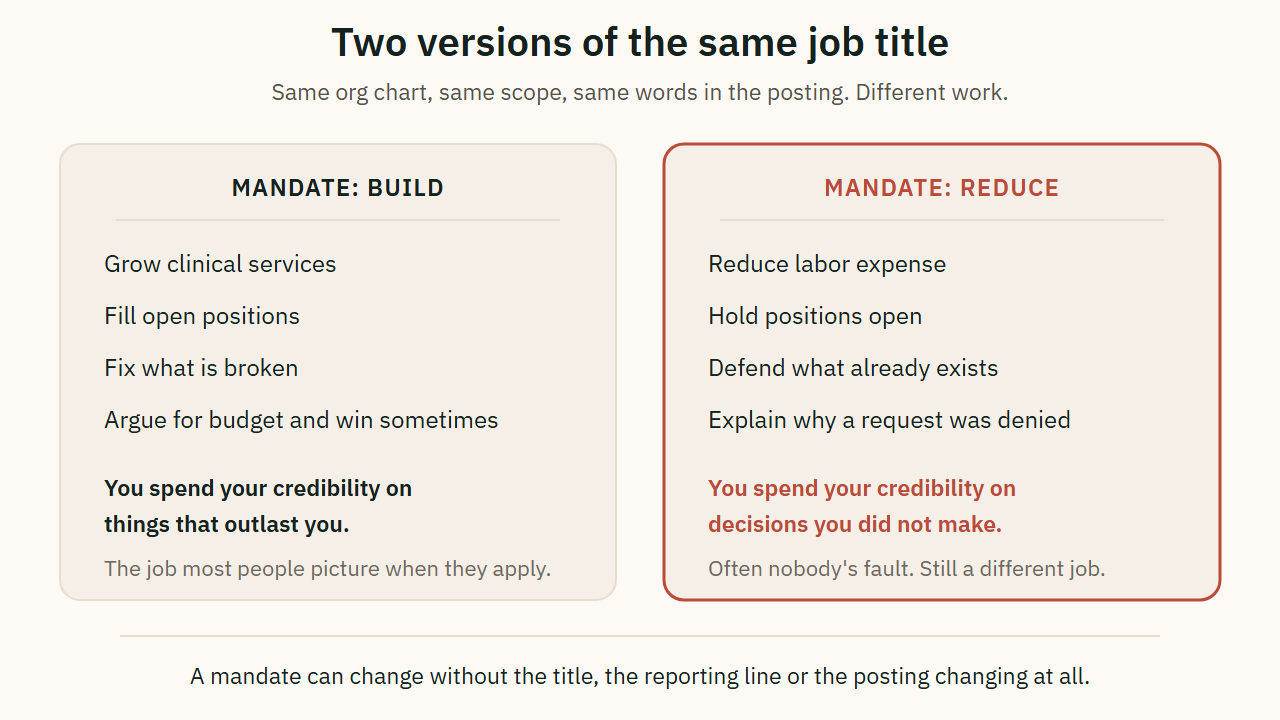
The single most decisive factor for any aspiring leader is the realization that identical titles in different hospitals often represent completely different jobs. What defines your workweek is not the job description, but the "mandate" the department has been handed by hospital leadership.
-
The Growth Mandate: A department tasked with expansion will see its director spending time on clinical program design, service implementation, and strategic hiring.
-
The Cost-Reduction Mandate: A department under financial pressure forces the director to focus on labor expenses, budget variances, and justifying every dollar upward to the executive suite.
I chose to leave a director role after only 18 months because the mandate shifted decisively toward reducing labor expenses at the expense of quality, service, and staff satisfaction. It was nobody's fault, an organization under financial pressure must make the decisions it has to make, but it was no longer the work I had signed up for.
Strategist's Tip: This distinction is the most important factor to verify before accepting a leadership role. If the organization's mandate and your personal professional goals are misaligned, the job will become a source of constant friction regardless of your talent.
You Will Spend More Time on Technicians Than Clinical Programs
While many pharmacists enter leadership hoping to revolutionize clinical services, the data suggests their attention will be consumed elsewhere. Specifically, the technician workforce is the primary consumer of a director's focus.
Over 80% of directors report significant shortages of experienced technicians, yet this is often the "invisible" part of the job to those in staff roles. While a staff pharmacist sees a missing technician as a "bad shift," the Director recognizes it as a systemic failure in the "standing conditions" of the department. The administrative churn required to maintain daily operations is relentless:
-
12.3% technician FTE vacancy rate nationally.
-
26.9% inpatient technician turnover.
Because technicians handle the foundational operations, their stability determines whether you can focus on higher-level strategy or are forced to spend your week managing daily coverage gaps.
The Loss of Clinical Practice is a Permanent Trade-Off
Transitioning into a director role means walking away from direct patient care, a move that many professionals underestimate. You spend years honing clinical judgment only to reach a position where that judgment is used "indirectly." Instead of managing a specific patient's drug therapy, you are managing the design of the program that allows others to do so. You are deciding which services exist, whether a stewardship pharmacist is hired, or who is privileged under hospital protocols.
Knowing which type of professional satisfaction you truly value is essential. Some leaders find the ability to influence care on a departmental scale to be a fair trade, the intellectual challenge of "system design" replaces the bedside. However, others view the move away from the patient as a permanent loss. If your primary professional joy comes from the immediate feedback of patient care, the director's office may feel more like a cage than a promotion.
You Are Accountable for Things You Cannot Control
The "Director's Paradox" is the reality of being held responsible for outcomes driven by external forces. Leadership at this level requires becoming comfortable with a misalignment between accountability and control. The job is not to be in total control, but to be the person who has a plan.
| What | Why it matters |
|---|---|
| Market Labor Forces | You are accountable for staff turnover even when it is driven by local market conditions and competitive wages set by the HR department. Strategic Insight: Your role is to build the business case for market adjustments before the vacancy rate becomes a crisis. |
| Manufacturer Pricing | You must manage a drug budget where the primary drivers are price increases set by manufacturers. Strategic Insight: The Director's role is not to stop the price increase, but to manage the executive expectation of the resulting variance through proactive communication. |
| Inherited Infrastructure | You are responsible for survey findings and compliance issues involving physical buildings and facilities you inherited. Strategic Insight: Leadership here means navigating the gap between "what is" and "what is compliant" by securing capital and prioritizing risk. |
Satisfaction is High, but the Pipeline is Empty
The data surrounding pharmacy leadership presents a confusing paradox: the people in the roles generally like them, but the perceived burden is deterring the next generation from stepping into management.
The Leadership Numbers:
-
76% of hospital-level pharmacy leaders report high job satisfaction.
-
71% would pursue leadership again if they were starting over.
-
31% report that their satisfaction has worsened over the past year (often due to shifting mandates).
-
73% to 79% of leaders report a severe shortage of candidates for leadership positions.
-
50% of current directors have no identified replacement or succession plan.
Conclusion: The One Question to Ask
The profession needs leaders who can find satisfaction in the success of others and the stability of the system. To determine if a specific department is the right fit for your leadership, you must look past the job description and examine the department's actual influence.
In your next interview, ask this specific question: "What was the last significant request this department made, and what happened to it?"
The answer is more revealing than any job description. It tells you whether the department is empowered to grow or is simply being managed as a cost center. It tells you what your mandate will truly be.
Ultimately, you must ask yourself one final question regarding your own career trajectory: Are you ready to stop being the one who saves the patient, so you can become the one who saves the system that allows the patient to be saved?
Related
- When is the right time to leave a job?
- What actually gets a hospital pharmacist promoted
- Do you need an MBA to become a pharmacy manager or director?
- Running the Pharmacy covers operations, and The Business of the Pharmacy covers the money
- Keeping the Pharmacy Compliant, on the third item on the list