Why Your Hospital Pharmacy Salary Is Not "Fixed" (and How to Actually Negotiate It)

One of the most common frustrations for hospital pharmacy job seekers is being told that a salary is "banded" and therefore non-negotiable. It is a phrase recruiters use to end conversations before they even begin. However, while the pay band itself is often determined by institutional leadership far above the pharmacy department, your specific location within that band is rarely set in stone.
Accepting the first offer without checking your experience credit or your placement percentile is essentially paying a "voluntary tax" to the hospital, a tax that compounds every year you stay. The reality of hospital compensation is that while the "box" may be fixed, your placement within it is a matter of discretion, data, and correction.
Two honest cautions
Management pay is banded by experience too. Moving into a first management role with less experience than other candidates generally means entering low in the management band. That is what happened to me, and it was a reasonable trade for a role I would not otherwise have been offered. Knowing it is coming lets you ask about the review timeline instead of being surprised by the number.
A move into management can cost you structurally. Where management positions sit outside a bargaining unit, accrued steps and seniority do not transfer, and a return to staffing may not restore them. That is an argument for asking exactly how it works before accepting, rather than an argument against the move.
Takeaway 1: Stop Attacking the Band, Start Negotiating the Placement
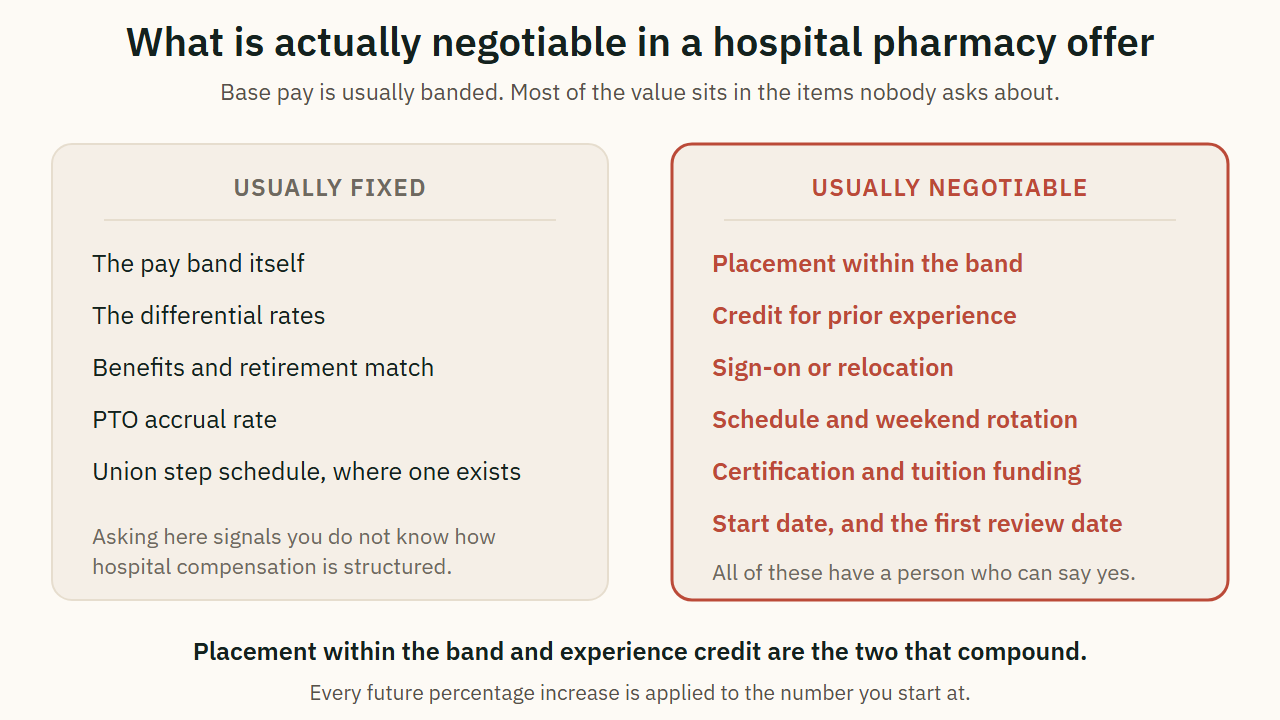
Hospital compensation is built on a rigid structure consisting of a "floor" and a "ceiling." These pay grades are established at an institutional level to ensure equity and budget control. Attempting to force a hiring manager to exceed the maximum of a band is a credibility killer; it signals that you do not understand the structural reality of the organization.
Instead, focus your leverage on placement. Discretionary decisions are made regarding whether an applicant enters at the 10th percentile or the 25th percentile of a given band. This distinction is critical because of the "compounding" effect: every future percentage-based raise is applied to your starting base. A 3% annual increase on a higher starting figure creates a widening gap in total earnings over a 20-year career.
What to say: "I appreciate the offer. Based on the metro percentile data and my inpatient experience, I would like to be placed at [X] within the band. Is there room for that?"
Takeaway 2: The "Correction" Loophole (Experience Credit)
Hospitals determine your starting salary using a formula for "Experience Credit." This formula is frequently calculated by HR generalists or automated software that often misses critical professional nuances.
Because this is framed as an accuracy check rather than a value judgment, it is a much softer and more successful request. Formulas often overlook "non-traditional" inpatient equivalents because HR software doesn't always recognize them as such. This includes:
-
Travel pharmacy work (often coded as "contract" rather than "clinical")
-
Telepharmacy roles
-
Long-term care experience
-
Part-time hospital coverage held concurrently with other roles
What to say: "Can I confirm how the years of experience were calculated? I want to make sure the travel and long-term care time is included."
Takeaway 3: Use the "Easy Yes" to Secure a Faster Raise
The most underutilized tool in pharmacy negotiations is the First Review Date. If a hiring manager insists the starting number is truly fixed due to current budget constraints, pivot to the timeline for your first salary increase.
This works because a future review date costs the department $0 today, making it the "easiest yes" for a hiring manager. Do not settle for a "feedback session." Request a six-month review for the purpose of a salary adjustment, with specific performance criteria documented in writing. This bypasses the standard one-year wait and puts you on a faster track for a merit increase.
What to say: "If placement is fixed, can we agree now on a review at six months with specific criteria for a salary increase?"
Takeaway 4: Your Leverage Is Local, Not National
Bringing national salary averages to a local negotiation is a credibility killer. For instance, the 2024 National Pharmacist Workforce Study (released in June 2025) cites a health-system average of $167,829. However, this figure includes management-level data and self-reported figures that do not reflect a staff role in your specific city.
To be credible, you must use the May 2025 Bureau of Labor Statistics (BLS) data specific to your metropolitan area.
Strong Leverage Weak Leverage Local metro-specific percentiles (e.g., 75th for experienced, 25th for new grads) National salary averages ($167,829 workforce figures) Documented years of inpatient experience (including travel/LTC) Management-blended salary figures used for staff roles Specific "corrections" to experience credit calculations Subjective claims of "market value" or "cost of living"
Takeaway 5: Negotiating for Quality of Life (The "Non-Cash" Wins)
When the budget for base pay is truly exhausted, several high-value items remain within a manager's direct control. These "non-cash" wins often have a more significant impact on your daily life than a 2% salary bump.
| What | Why it matters |
|---|---|
| Schedule and Rotations | Negotiate your weekend rotation frequency, specific shifts, or your placement on the holiday list for the first year. |
| Professional Development | Request that board certification fees, maintenance costs, and tuition assistance be covered. |
| Written Agreements | It is significantly easier to get certification funding or tuition assistance in writing at the time of hire than it is to request it after you have already joined the payroll. |
Takeaway 6: The Management Trade-Off
Moving into leadership is a strategic move, but it often comes with a structural "hidden cost." Management positions commonly sit outside of bargaining units (unions). This means that accrued "steps" and seniority protections do not transfer. You are effectively moving from a "Step" system (guaranteed increases) to a "Merit" system (performance-based).
Furthermore, entering a first-time management role often results in being placed low in the management band due to a lack of previous leadership experience. View this as a trade for career growth rather than a loss, but never sign without asking exactly how seniority is handled and when your first merit review will occur.
Conclusion: The 15-Minute Rule
Before you enter any offer conversation, take 15 minutes to research the 25th, 50th, and 75th percentiles for pharmacists in your specific metropolitan area. This small investment of time is the difference between asking for a raise and guessing at one.
Final Checklist:
| What | Why it matters |
|---|---|
| Check Placement | Are you being placed at the bottom of the band (10th percentile) or the middle (50th)? |
| Verify Experience Credit | Did HR count every year of travel, part-time, or specialized work? |
| Use Metro Data | Forget national averages; use the May 2025 BLS local percentiles. |
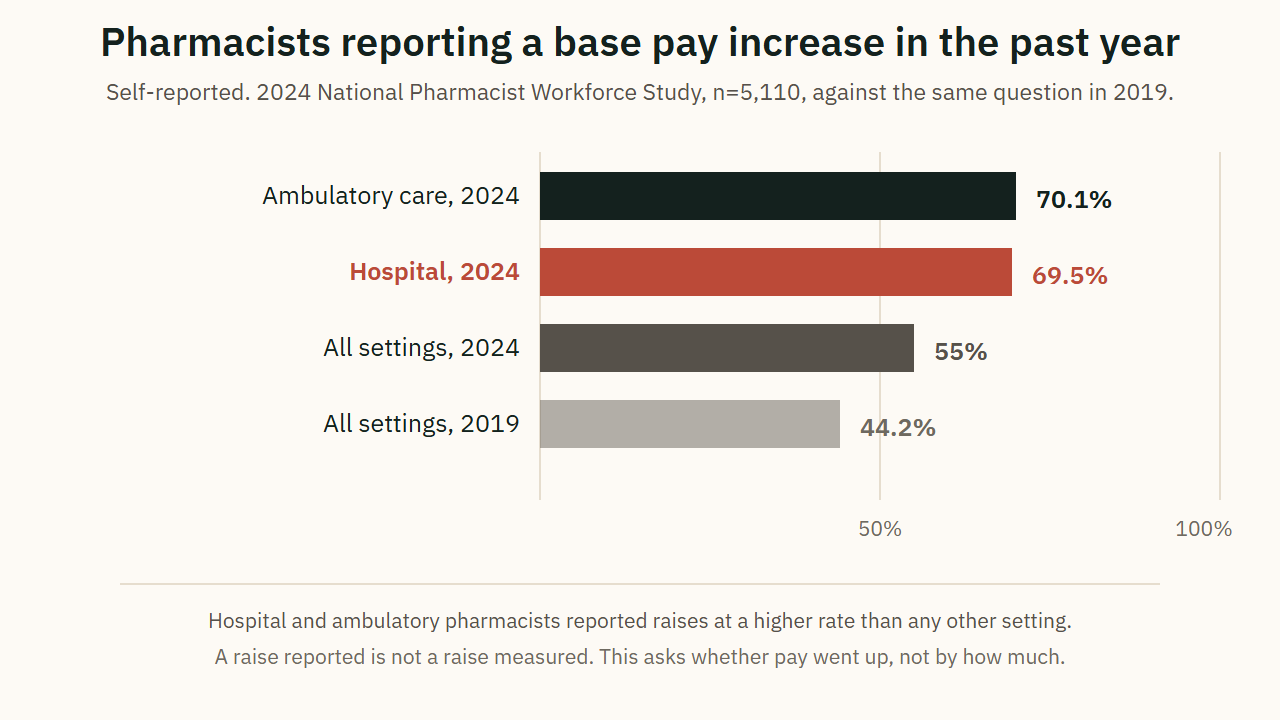
The current market is favorable, with 69.5% of hospital pharmacists reporting raises in the most recent year. If you do not correct your experience credit today, how much interest will you lose over the next twenty years? Professional negotiation isn't about breaking the band, it's about ensuring you aren't leaving your own money on the table.
Related
- BLS wage tables by state and metropolitan area
- Which pharmacist salary number to use when you ask for a raise
- Should you look at job boards when you are happy where you are?
- Do you need an MBA to become a pharmacy manager or director?
- The Business of the Pharmacy, on how a department's labor budget is actually built