The 2025 hypertension guideline: a new calculator that will not change your prescription
When a major medical organization announces a complete rewrite of a clinical guideline, the reaction is often one of high-stakes anxiety. For healthcare providers and patients alike, the headline "New Hypertension Guidelines" usually signals a looming surge in prescriptions and millions of people suddenly being reclassified as "sick." The assumption is that the diagnostic net has been cast wider, or the targets moved deeper into the territory of aggressive intervention.
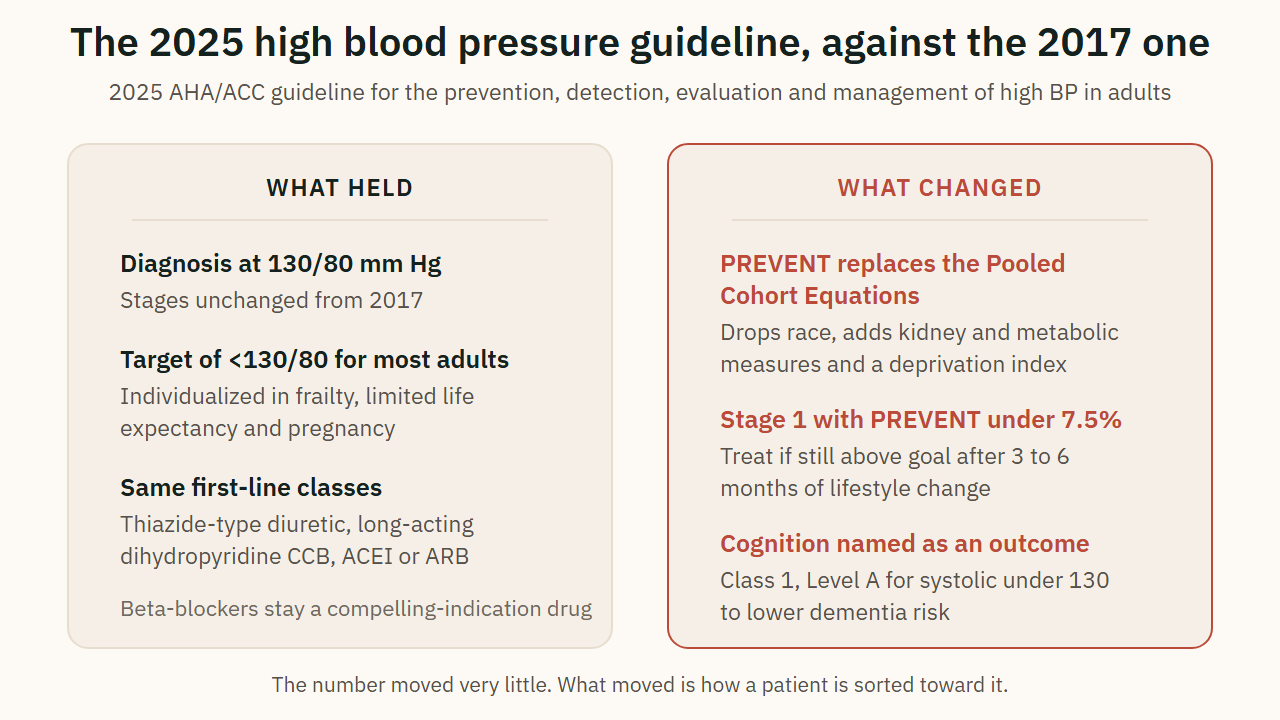
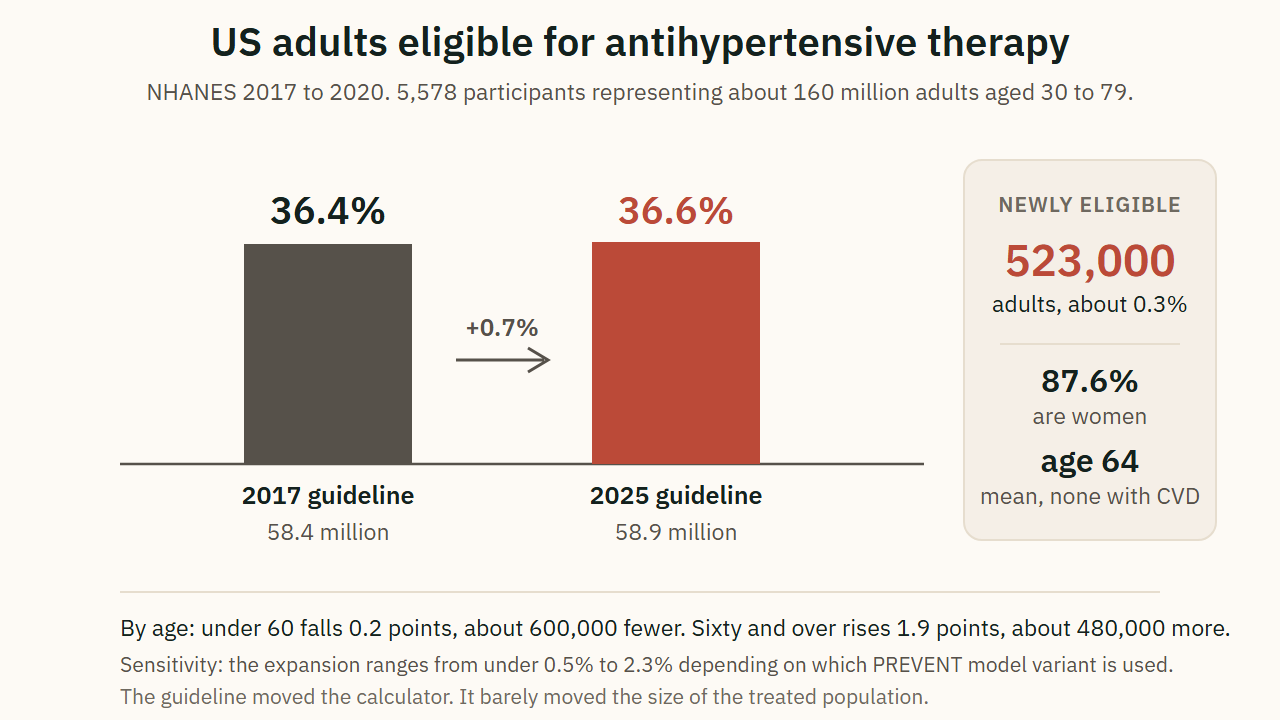
However, the reality of the 2025 AHA/ACC high blood pressure guideline is far more nuanced. While the document represents a significant intellectual overhaul, the diagnostic needle has barely moved. According to a modeling analysis of NHANES data, the net expansion of the treated population is just 0.7%, approximately 420,000 people. The revolution isn't in the pills we're prescribing, but in the silicon logic and social variables deciding who gets them.
The core premise of this update is a "stable revolution." While the "how" of assessing cardiovascular risk has been completely reinvented, the "who" and the "with what" remain remarkably consistent. The thresholds for diagnosis (130/80 mm Hg) and the first-line medication classes, thiazide-type diuretics, long-acting dihydropyridine calcium channel blockers, and ACE inhibitors or ARBs, stay exactly where they were in 2017.
The real changes are happening "under the hood" of our clinical decision-making. Here are the five most surprising shifts in the 2025 guidelines and what they mean for the future of care.
The Risk Calculator Gets a Human Upgrade (The PREVENT Shift)
The most technical change in the 2025 guideline is the retirement of the Pooled Cohort Equations (PCE) in favor of the new PREVENT equations. This isn't just a change in math; it's a change in philosophy. The PREVENT calculator makes several critical adjustments to how we view a patient's future by dropping race as a biological input and replacing it with more precise clinical and social markers.
The PREVENT calculator now includes:
| What | Why it matters |
|---|---|
| Kidney and Metabolic Health | It incorporates eGFR and HbA1c to acknowledge the interplay between renal function and metabolic syndrome. |
| Social Context | It uses a "social deprivation index" to account for the impact of socioeconomic environment on health. |
| Total Cardiovascular Scope | It estimates total risk, including heart failure, rather than focusing solely on atherosclerotic disease. |
Reflection: By removing race and adding kidney, metabolic, and social factors, the medical community is moving toward a more holistic, biological approach. This shift acknowledges that risk is a product of physiology and environment rather than a statistical byproduct of a social construct.
Blood Pressure Control is Now Officially Brain Care
For the first time, protecting the brain is a primary, top-tier goal of blood pressure management. The 2025 guideline gives cognitive protection a Class 1, Level A recommendation, the strongest possible endorsement the societies can offer. Maintaining a systolic target under 130 mm Hg is now explicitly linked to reducing the risk of cognitive impairment and dementia. The guideline provides a clear rationale for this target based on a robust dose-response relationship:
Reflection: This shifts the primary "selling point" of treatment. For many patients, the threat of a distant heart attack can feel abstract. However, the prospect of protecting immediate cognitive function is a powerful, tangible motivator. It changes the clinical conversation from "avoiding death" to "preserving the self."
The Surprising Gender Profile of the "Newly Eligible"
While the net increase in the treated population is small, the demographic shift within that expansion is profound. While 101,000 adults actually lose eligibility under the new rules, roughly 523,000 people become newly eligible for medication. This group has a very specific profile that challenges our traditional clinical intuition:
-
87.6% are women.
-
Mean age of 64.
-
Mean BMI of 32.9.
-
Zero established cardiovascular disease.
Reflection: This is counter-intuitive; guidelines often expand toward younger, high-risk men. This update finally captures older women whose cardiovascular risk was systematically underestimated by the previous statistical models. By incorporating kidney and metabolic markers, the 2025 guideline identifies high-risk women who were previously flying under the radar.
The Three-Month Clock for Stage 1 Hypertension
The 2025 guideline introduces an aggressive "explicit drug recommendation" for patients with Stage 1 hypertension (130-139/80-89 mm Hg) who have a low PREVENT risk score (under 7.5%). In 2017, these patients were largely managed through lifestyle changes. The new instruction is definitive: if blood pressure remains above the 130/80 goal after three to six months of lifestyle modifications, medication is now recommended.
Reflection: This turns a clinical guideline into a significant logistics challenge for clinics. This "follow-up obligation" requires a robust system to ensure patients are re-evaluated within that narrow window. To bridge this gap, healthcare systems should look toward Collaborative Practice Agreements (CPAs). CPAs allow pharmacists to manage this follow-up clock, titrating therapy and conducting the necessary counseling to ensure the three-month window doesn't become a missed opportunity.
The "Stealth" Change in Your Software (and Your Formulary)
Perhaps the most critical takeaway for healthcare professionals is also the most invisible. Because diagnostic thresholds and first-line drug classes haven't changed, providers may assume their systems are up to date. However, the move to PREVENT is "stealthy" and requires a deep dive into informatics.
The most impactful part of a 1,400-word guideline might just be a single informatics ticket to update the EHR. But beware: the PREVENT expansion ranges from under 0.5% with the "base" model to 2.3% if your system implements the "HbA1c" model. Informatics teams must be intentional about which variant they choose.
Furthermore, the "with what" of treatment has evolved toward simplicity. The guideline now recommends defaulting to a single-pill combination (fixed-dose combination) whenever a second agent is needed.
Reflection: This is a major shift for formulary management and adherence counseling. Read this as a directive to move away from multi-tablet regimens. For a pharmacist, a two-agent regimen on separate tablets is now a reason to ask for a change, prioritizing once-daily dosing to support long-term adherence.
Conclusion: The Future of Team-Based Care
The 2025 guidelines make it clear that the future of hypertension management is not a solo endeavor. The document explicitly names pharmacists, physicians, advanced practice providers, nutritionists, and support staff as essential members of the care team.
As the guidelines become "smarter", using better calculators and focusing on brain health, they also become more complex to manage. The new three-to-six-month follow-up clock for Stage 1 patients and the shift toward single-pill combinations are prime examples of gaps that a multidisciplinary team is designed to fill.
Final Thought: As we implement these smarter, more equitable guidelines, we must ask: Is our local healthcare system actually prepared to handle the increased counseling, formulary adjustments, and precise follow-up required to make these changes effective?
Related
- The 2025 guideline in Hypertension
- ACC summary of the guideline
- The NHANES eligibility analysis
- How pharmacists get prescribing authority in a hospital, if the follow-up problem above needs a protocol behind it
- Running the Clinical Program, on building a service around a guideline change
Want the practice knowledge behind this?
Your First Year as a Hospital Pharmacist covers the clinical judgment a residency front-loads. Part of the Pharmacy Handoff library.
See the book