The "Invisible" Authority: Why 1 in 5 Hospitals Already Have Pharmacists Prescribing (And How Yours Can Too)

The Gap Between Recommendation and Action
For the hospital clinical pharmacist, professional life is often defined by the "recommendation loop." You identify the clinical need, calculate the dose, and select the agent, only to wait for a final pen-stroke from a physician to make it real. While this boundary is often accepted as a fixed reality of practice, the data suggests otherwise.
According to the 2024 ASHP National Survey of Pharmacy Practice in Hospital Settings, which surveyed 1,497 pharmacy directors with a 16.7% response rate, pharmacists are now independently prescribing in 18.5% of U.S. hospitals. This nearly one-in-five figure represents a significant professional frontier that is often invisible to those in staff roles. The path to this authority is not a single gateway, but a three-layered alignment of policy that most pharmacists never fully investigate.
The 18.5% Surprise: More Common Than You Think
The 18.5% figure is a striking contrast to the general perception of hospital practice. While progress toward the ASHP Practice Advancement Initiative (PAI) 2030 goals has remained largely flat over the last five years, nearly a fifth of the nation's hospitals have moved beyond the recommendation model.
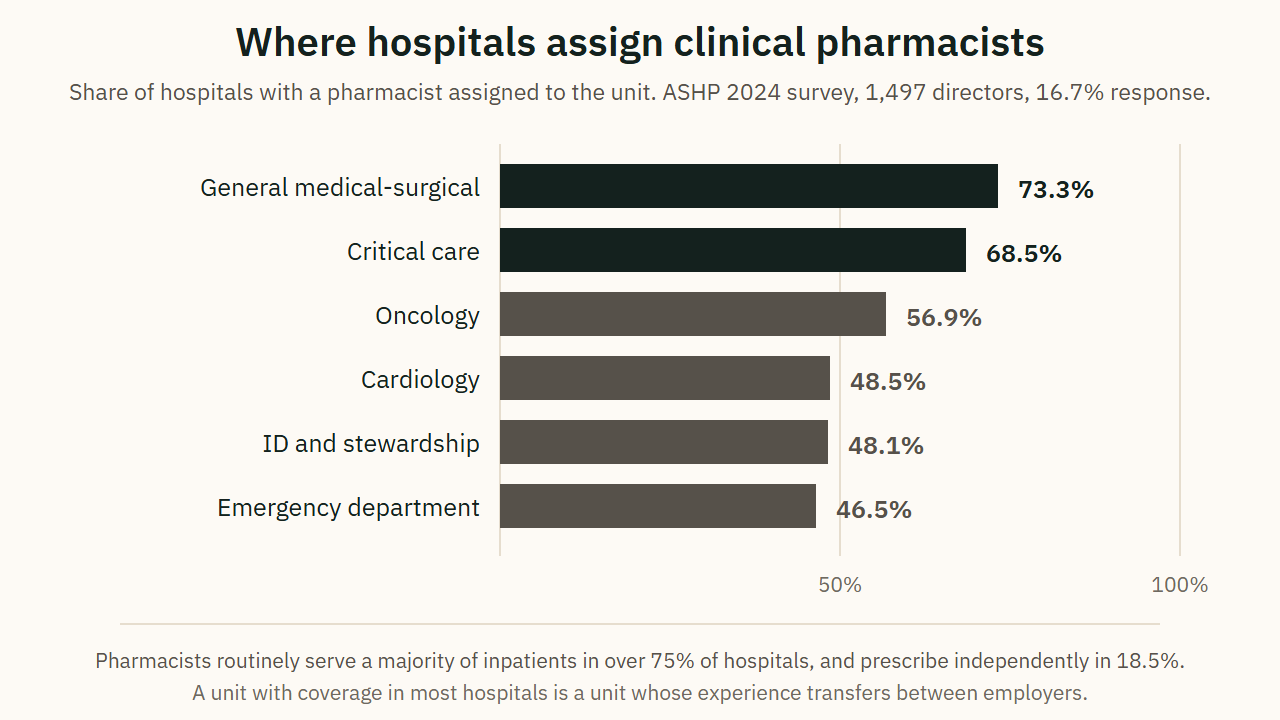
There is a massive discrepancy between presence and authorization. Today, pharmacists routinely provide clinical services to a majority of inpatients in over 75% of hospitals, yet they only sign the orders in a fraction of them. It is critical to understand what the "independent prescribing" figure actually counts. In policy terms, it is a catch-all destination that takes several shapes:
| What | Why it matters |
|---|---|
| Collaborative Practice Agreements (CPAs) | Written agreements between pharmacists and prescribers to manage specific therapies. |
| Department Protocols | Targeted authority for narrow services, such as renal dosing or IV-to-oral conversions. |
| Delegated Authority | State-level permissions for specific acts, like immunizations, that do not require an individual physician signature. |
The Three-Layer Filter: Why One Approval Isn't Enough
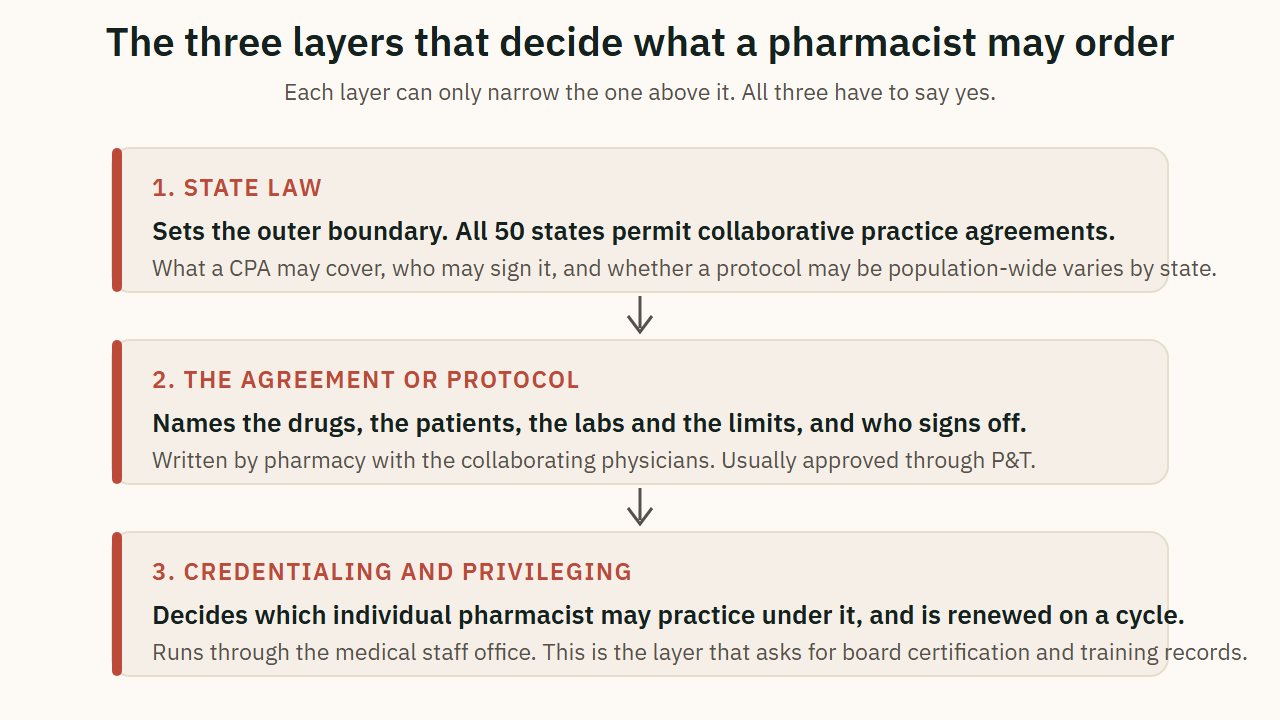
Gaining prescribing authority requires the alignment of three distinct layers. The most important rule of this framework is that each layer can only narrow the one above it.
| What | Why it matters |
|---|---|
| State Law | This is the outer boundary. It sets the legal maximum of what is possible. If the state does not permit pharmacists to initiate therapy, no local policy can override that. |
| Written Protocol or Agreement | This is the working scope. It defines the specific drugs, patient populations, and monitoring requirements. If the law allows broad practice but the local protocol is narrow, the pharmacist is restricted to the protocol. |
| Individual Credentialing | This is the final filter. Through the medical staff office, the hospital verifies an individual's training and grants specific privileges. |
Most pharmacists only ever see the third layer, credentialing, and assume that if they aren't "privileged," the route is closed. In reality, the bottleneck is almost always at the second layer.
The "Binding Constraint" is Closer Than the State Board
A common misconception among advocates is that state law is the primary hurdle. This is rarely the case. All 50 states now permit some form of collaborative practice.
The "binding constraint" is the local protocol. As a clinical advocate, you must recognize that state law tends to permit more than any given department has written a protocol for. This is the most empowering realization a practitioner can have: the law has already provided the space; the pharmacy department simply hasn't built the walls of the service yet.
"All 50 states permit pharmacists to enter collaborative practice agreements. What a CPA may contain, who may sign it and how it is executed is set by state law and varies.", CDC, Advancing Team-Based Care Through Collaborative Practice Agreements.
Follow the Demand: The Specialist Shortage Advantage
Expanded practice is rarely granted as a favor; it is granted as a solution to a capacity problem. Currently, 60% of hospital pharmacy directors report a shortage of clinical specialists and coordinators. When a department lacks clinical capacity, there is a systemic incentive to formalize the work pharmacists are already doing.
To find the highest chance of success, look for units where pharmacists are already "consistently present", creating the ideal foundation for a protocol. Per the ASHP survey, these target units include:
-
General Medical-Surgical (73.3% presence)
-
Critical Care (68.5% presence)
-
Antimicrobial Stewardship (48.1% presence)
Antimicrobial Stewardship is structurally perfect for a first prescribing protocol. It is a service that exists specifically to change therapy, it relies on established physician-pharmacist partnerships, and it already has the infrastructure to report clinical outcomes to leadership.
Start Small with a "Micro-Protocol"
The most common mistake is attempting to reorganize the entire department's scope at once. This creates a "project" that gets bogged down in committee. Instead, aim for an "approvable service", a single drug class or a specific unit protocol.
Before you draft a single word, you must master the "Inside Baseball" of your institution by reading these three documents:
| What | Why it matters |
|---|---|
| Your State's Collaborative Practice Statute | Use the NASPA state-by-state index to find the exact legal citations. You must know exactly who is allowed to sign and what documentation is required by law. |
| Existing Local Protocols | Find your facility's protocols for renal dosing or vancomycin. These provide the approved template and show you the path previous successful proposals have taken. |
| The P&T Charter | Look at the committee schedule. If you submit a proposal two weeks after the agenda closes, your initiative is dead for a full cycle. Timing is a policy tool; use it. |
Conclusion: Moving Beyond Recommendations
The transition from an informal "recommendation" to a formal "order" is the next logical step for clinical pharmacy. This transition is not waiting for a change in national legislation; it is waiting for local practitioners to align the three layers of authority that already exist.
Remaining in the "recommendation loop" is often a choice made by those who haven't investigated their own state statutes or local protocols. If the state law already allows it and the department is desperate for clinical capacity, which of the three layers is actually holding you back?
| What | Why it matters |
|---|---|
| Statutory Mastery | Spend one hour reviewing your state's specific collaborative practice regulations via the NASPA index. Identify the legal "outer boundary." |
| Protocol Audit | Locate and read one protocol currently active in your hospital. Analyze who signed it and what clinical triggers it uses. |
| Gap Analysis | Determine if the limitation on your practice is truly the law, or if it is simply the absence of a written local protocol. If it's the latter, the solution is in your hands. |
Related
- ASHP National Survey of Pharmacy Practice in Hospital Settings, 2024
- CDC on collaborative practice agreements and team-based care
- NASPA collaborative practice resources by state
- Running the Clinical Program, on building a service that P&T will approve
- Keeping the Pharmacy Compliant, on credentialing, privileging and the survey view of protocols