The Clinical Pharmacist Title Trap: Why the Industry's Most Coveted Label is Often a Lie

The "Clinical Pharmacist" title is the most effective piece of bait in the health-system recruiter's arsenal. For many staff pharmacists, securing this title is viewed as the ultimate career milestone, the definitive exit from the central pharmacy basement to the clinical front lines. Plenty of talented clinicians burn out within six months because they chased a title without auditing the operational reality.
The label is a catch-all that masks two fundamentally different work-life existences. Before you sign that offer letter, you need to know which version of the job you are actually buying.
The "Verification Queue" Litmus Test
The most critical distinction in hospital pharmacy isn't your rounding schedule or your white coat; it is how the department handles order verification. In a truly decentralized model, you are assigned to a service or a unit. You are there to practice at the top of your license, and the central verification queue is someone else's problem. In contrast, many roles are actually "staff roles with clinical duties," where you are expected to anchor the queue while simultaneously managing consults.
This distinction shifts your daily existence from proactive to reactive. A pharmacist carrying a queue is a slave to the "next" button, responding to digital notifications in a state of fragmented attention. A decentralized pharmacist identifies patient needs before a provider even opens the chart. When you are liberated from the queue:
When the unit is your focus, you are known by name to the medical team. Your work becomes anticipatory, and your interventions are based on clinical judgment rather than a response to a digital prompt.
The Clinical Landscape: It's Not All ICUs
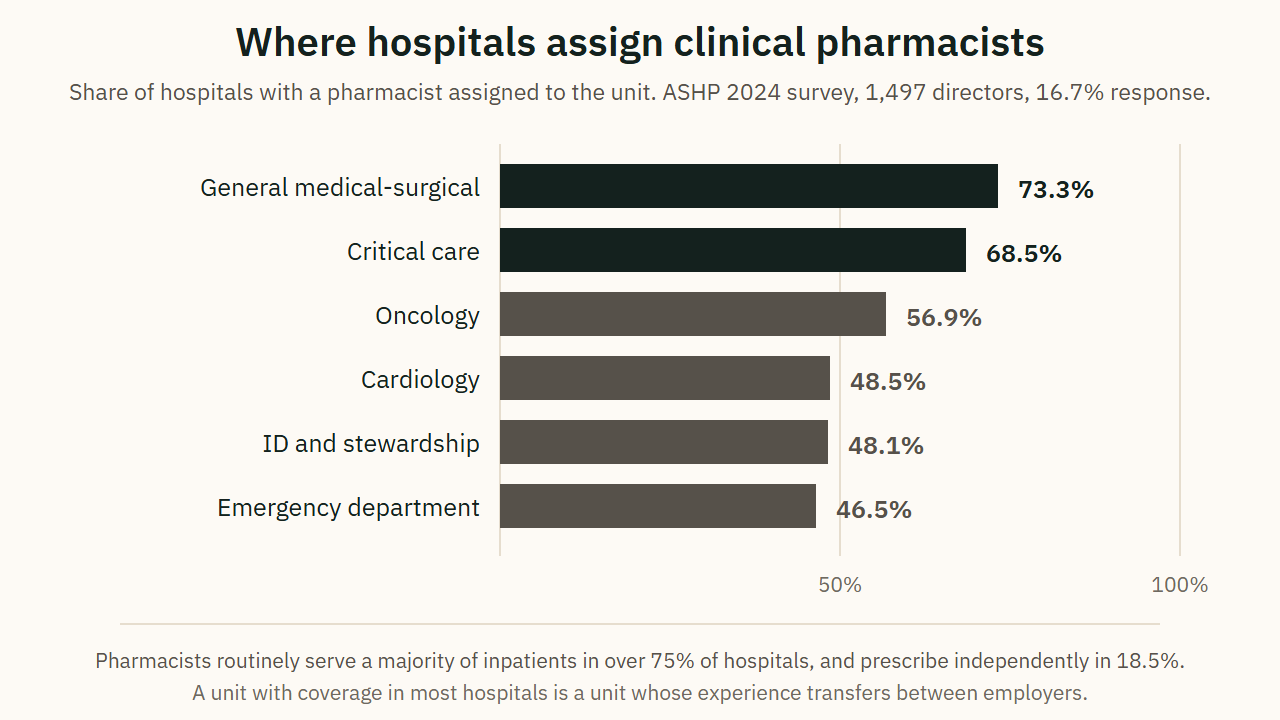
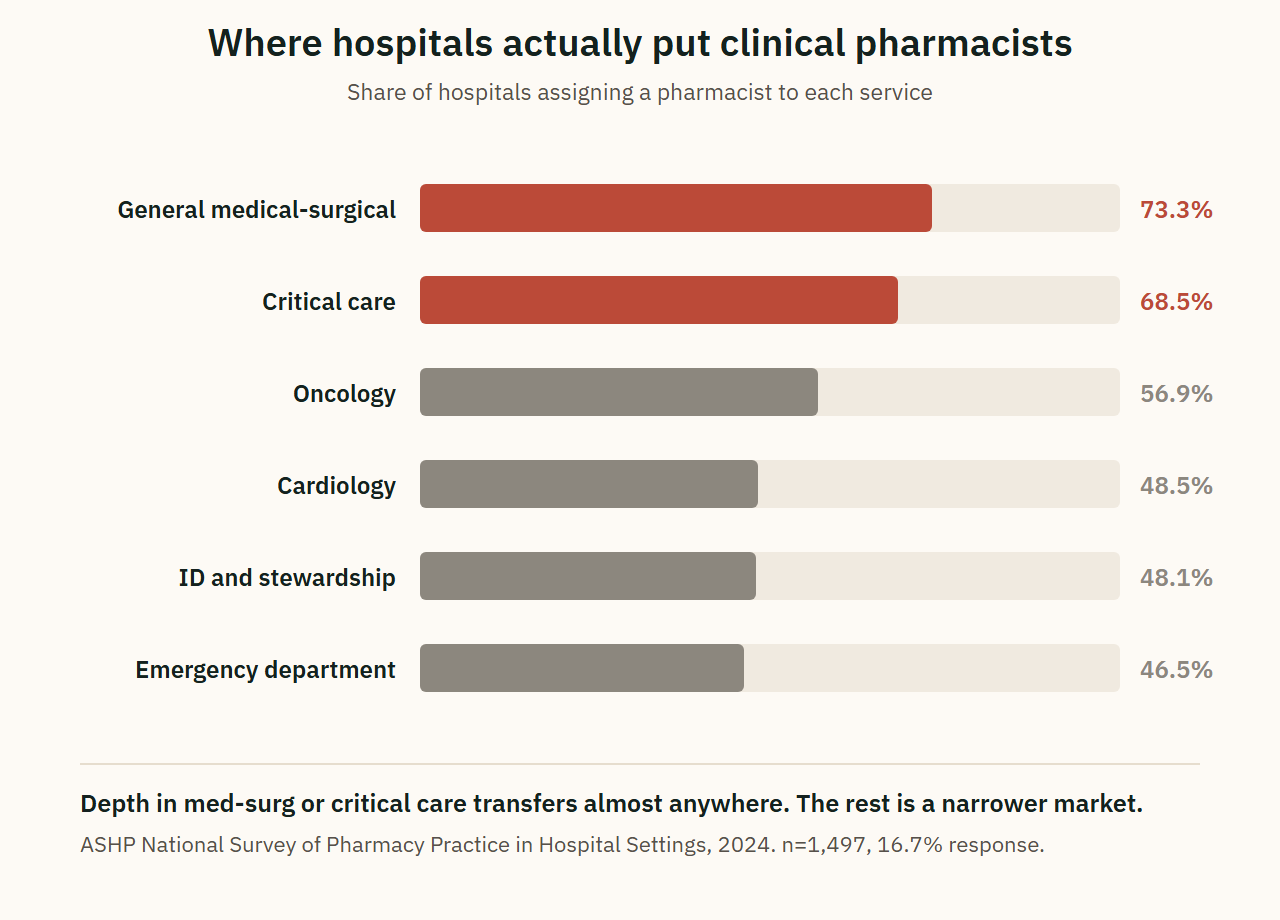
While the glamour of the ICU or Emergency Department dominates the conversation, true clinical pharmacy is ubiquitous. Pharmacists now routinely provide clinical services to a majority of inpatients in over 75% of hospitals. According to ASHP survey data, these roles concentrate in specific areas:
-
General Medical-Surgical: 73.3% of hospitals
-
Critical Care: 68.5%
-
Oncology: 56.9%
-
Cardiology: 48.5%
-
Infectious Disease/Antimicrobial Stewardship: 48.1%
-
Emergency Department: 46.5%
If you are looking for true autonomy, note that pharmacists independently prescribe in 18.5% of hospitals. From a strategic standpoint, "depth in a service line" like Med-Surg is often more valuable than hyper-specialization. If you specialize in a niche area that only 10% of hospitals staff, your geographic mobility is effectively zero. Med-Surg expertise, however, is the "blue chip" of the pharmacy labor market, it is portable, in demand, and exists in nearly every facility.
The Credential Paradox: BCPS as a Consequence
Many pharmacists delay their career moves, waiting until they have the "BCPS" letters after their name. This is a strategic error. Board Certification eligibility requires an active license and either an ASHP-accredited PGY1 or three years of practice with at least 50% of your time spent in pharmacotherapy activities.
Crucially, those three years must be employer-attested. This means your relationship with your director is a prerequisite for the credential, not the other way around. For most, the "practice pathway" clock only starts ticking once they are already in the role. Chasing the credential to get the role is the wrong order of operations; the role is the mechanism that allows you to qualify for the exam.
The "Invisible" Market: A 60% Shortage
While residency slots are hyper-competitive, the market for experienced clinical specialists is starving. Approximately 60% of pharmacy directors report a shortage of clinical specialists and coordinators. These are the hardest roles in the building to fill.
If you are an internal candidate, don't just "add letters" to your name. Strategically, you need visibility. A hiring panel isn't moved by a certificate; they are moved by evidence of ownership. Don't just attend a stewardship committee meeting, own the data for a specific drug class. Rewrite the vancomycin protocol. Precept a student. These actions prove you are already doing the work, making the title change a formality rather than a risk.
The Hard Truth About the "Clinical Ceiling"
We need to dispense with the myth that a clinical role is a promotion. In the majority of health systems, it is a lateral move with different scenery. Furthermore, the "clinical path" does not solve the problem of professional stagnation.
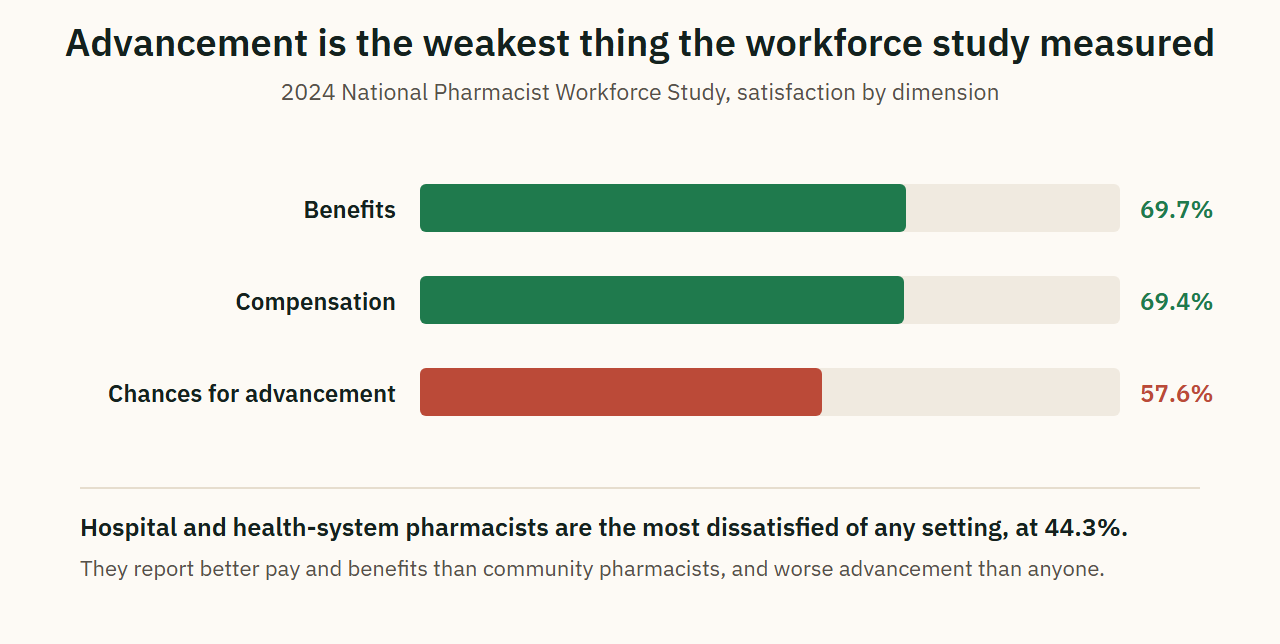
Data from the National Pharmacist Workforce Study shows that 44.3% of hospital pharmacists are dissatisfied with their opportunities for advancement, the highest dissatisfaction rate of any setting. The "Veteran Clinical Lead" knows why: once you reach the specialist level, the only remaining "up" is into administration.
You will eventually be forced to trade your stethoscope for a spreadsheet. Once you hit the specialist ceiling, the next step usually involves "Coordinator" or "Manager" in the title, which means trading patient rounds for budget meetings and staffing hurdles.
The honest limits
It is not a promotion in most departments. Frequently a lateral move with different work, sometimes with a differential, sometimes without.
The ceiling arrives sooner than people expect. Once you have the role, the next step is coordinator, manager or specialist in a narrower area, and 44.3% of hospital pharmacists are dissatisfied with their chances for advancement, the highest of any setting. Getting the clinical role does not solve that; it relocates it.
The autonomy depends on the protocol, not the title. A clinical pharmacist in a hospital with well-built protocols and privileging practices very differently from one in a hospital without them, and the title is identical in both.
Conclusion: Beyond the Title
Clinical pharmacy remains one of the most rewarding paths in healthcare, but its success depends on your ability to see through the recruiter's pitch. You must look past the job description to see if the environment allows for the anticipatory care you intend to provide.
Before you accept any clinical position, there is one litmus test that will tell you more about your future daily life than any other detail. In the interview, look the manager in the eye and ask: "Do I carry a verification queue?" If the answer is yes, you aren't a clinical pharmacist, you're a staff pharmacist with a much more stressful to-do list.
Related
- ASHP National Survey of Pharmacy Practice in Hospital Settings
- What actually gets a hospital pharmacist promoted
- How pharmacists get prescribing authority in a hospital
- Your employer will pay for a certificate. Which one is actually worth taking?
- Your First Year as a Hospital Pharmacist, on the clinical judgment underneath all of it