The ADA Just Changed the Rules for Hospitalized Diabetes Tech, But Most Hospitals Aren't Ready
The Hospital Technology Paradox
For decades, the standard clinical reflex when a patient arrived at the hospital wearing a continuous glucose monitor (CGM) or an insulin pump was immediate removal. Fearing inaccuracies in the acute setting or unfamiliar with specific proprietary interfaces, hospital staff would revert the patient to traditional fingersticks and hospital-administered subcutaneous insulin.
The 2026 American Diabetes Association (ADA) Standards of Care have officially flipped this script. The new default position has moved from "remove" to "keep it on." However, this shift creates a profound institutional tension: while the ADA now champions the continuation of personal diabetes technology, most hospitals lack the required infrastructure, training, and formal policy to execute this safely.
The New Clinical Default: A Paradigm Shift with Strings Attached
The 2026 Standards represent a radical departure from the traditional posture of device removal. The ADA now emphasizes that personal CGM and automated insulin delivery (AID) should be continued during hospitalization when clinically appropriate. However, these recommendations are not blanket permissions; they are heavily tied to evidence grades that signal institutional responsibility.
| Device Type | Recommendation | Evidence Grade |
|---|---|---|
| Personal CGM | Continue during hospitalization when clinically appropriate, with confirmatory point-of-care glucose for insulin dosing and hypoglycemia, under an institutional protocol. | B |
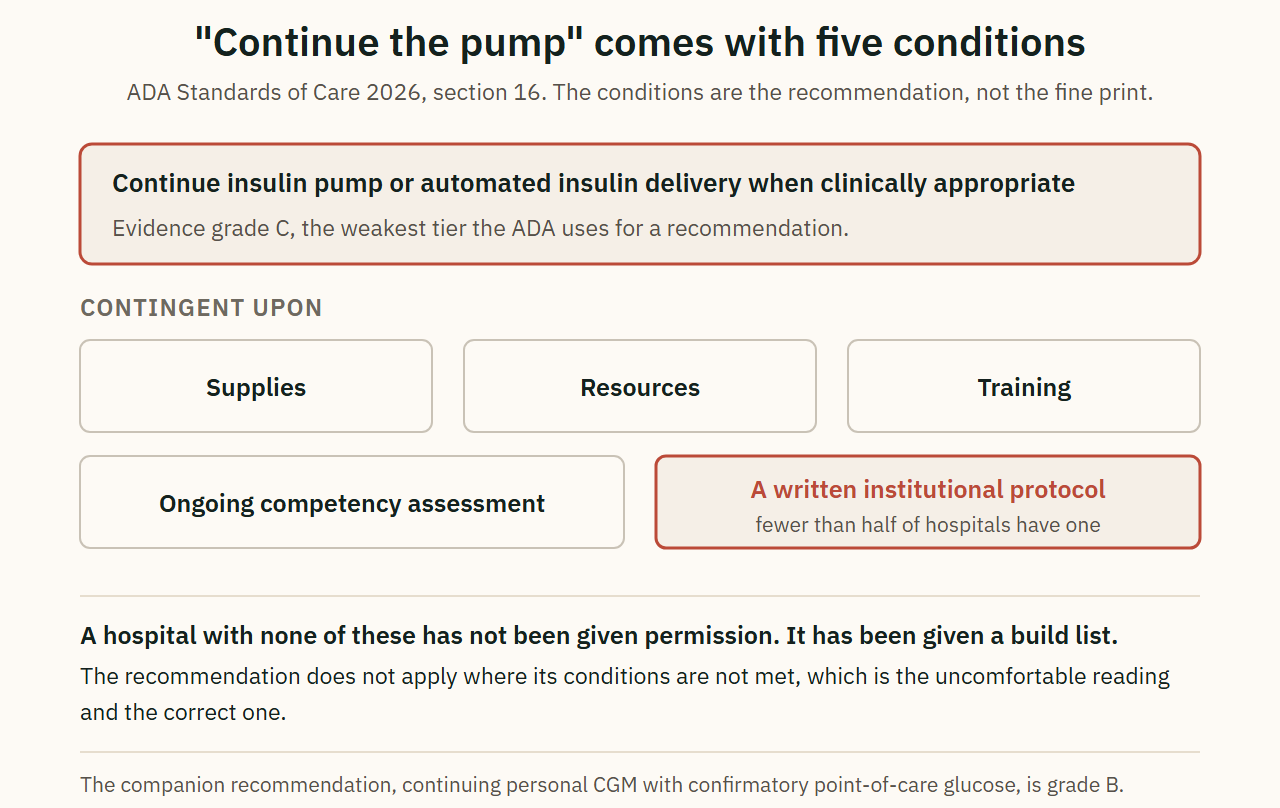
| Insulin Pump / AID | Continue when clinically appropriate, contingent on supplies, resources, training, ongoing competency assessments, and institutional protocols. | C |
As a strategist, the Evidence Grade "C" for insulin pumps is a critical signal. It marks the weakest tier of supporting evidence the ADA uses, indicating that while the clinical direction is correct, the supporting data is thin. This suggests hospitals should approach pump continuation with significantly higher caution and more robust oversight than CGM use.
The Conditionality Trap: Why Infrastructure is a Prerequisite for Use
The recommendation to continue insulin pump therapy is not absolute, it is contingent. The ADA identifies five specific criteria that must be met before a device stays on. If these conditions are absent, the recommendation defaults back to removal.
The Five Conditions for Pump Continuation:
| What | Why it matters |
|---|---|
| Availability of supplies | Ensuring the patient or hospital has the specific pods, sensors, or infusion sets required. |
| Resources | Adequate staffing and technical support to monitor continuous therapy. |
| Training | Comprehensive staff education on device interfaces and troubleshooting. |
| Competency assessments | Regular, documented validation of staff proficiency. |
| Implementation of institutional protocols | The existence of a formal, written organizational policy. |
This creates an "uncomfortable" reality for leadership: if your hospital lacks these five elements, the ADA recommendation effectively directs you to remove the device, as the safety conditions for its use have not been satisfied.
Redefining Policy: When the Protocol is the Recommendation
Despite these guidelines, a massive policy gap persists. Recent data cited in the Standards indicates that fewer than half of hospitals currently have written policies for managing diabetes technology. The 2026 Standards redefine the role of policy:
Without a protocol, the recommendation to continue the device cannot be safely fulfilled. The policy is the bridge between a theoretical clinical preference and a safe bedside reality.
The Strategic Blueprint: Six Questions Every Institutional Protocol Must Answer
To bridge the gap between the Standards and practice, a hospital protocol must provide concrete answers to these six systemic challenges:
| What | Why it matters |
|---|---|
| Confirmation Frequency | Since CGM continues but point-of-care (POC) glucose governs dosing and hypoglycemia treatment, the protocol must define the specific triggers and frequency for POC confirmation. |
| Self-Management Thresholds | These devices require a cognitively intact operator. The protocol must define the transition plan for when a patient becomes unable to self-manage due to sedation, delirium, or surgery. |
| Settings Ownership | A pump's basal rates and ratios are the patient's active medication regimen. The protocol must designate who is responsible for capturing these settings during medication history. If they aren't recorded on admission, they cannot be restored, and the patient faces a dangerous "guess-work" regimen at discharge. |
| Supply Chain | Hospitals rarely stock specialized sensors or pods. This is a pharmacy and materials management hurdle long before it is a clinical one; the protocol must clarify whether the hospital or the patient is responsible for providing consumables. |
| Imaging/Procedure Holds | Devices must often be removed for MRIs or surgery. The protocol must establish clear ownership over who removes the device and, more importantly, when and how it is reattached. |
| Documentation | Pump-delivered insulin is effectively "invisible" to standard electronic health records. The protocol must solve how this continuous delivery is reflected in the chart to prevent clinical errors. |
Flying Blind: The Risk of "Invisible Insulin" and Reconciliation Failure
From a pharmacy and nursing perspective, a pump-using patient represents a high-velocity safety risk. Because pump delivery does not appear on the Medication Administration Record (MAR), the medical team is essentially flying blind. This "invisible insulin" creates a high risk for double-dosing if supplemental subcutaneous insulin is ordered without realizing the pump is active.
Furthermore, this presents a severe medication reconciliation failure at the point of discharge. If a pump was held during the stay and never properly restarted or reconciled, the patient is often sent home on a disorganized regimen, a failure mode identical to a held medication that is never resumed, but with a much narrower margin for error.
Establishing New Baselines: Perioperative and Glycemic Targets
The 2026 Standards also introduce specific glycemic targets for various inpatient scenarios, including new operational metrics for preoperative optimization.
2026 Glycemic Targets
Setting Goal Range Critically Ill (once therapy is initiated) 140-180 mg/dL Not Critically Ill 100-180 mg/dL Initiate Therapy (at persistent hyperglycemia) At or above 180 mg/dL Selected Patients (e.g., cardiac surgery) 110-140 mg/dL (if achievable without hypoglycemia) Perioperative/Elective Surgery 100-180 mg/dL (with A1C <8% or Time in Range >50%)
Note: These targets serve as a professional pointer to the Standards. Because institutional protocols require high-fidelity accuracy, clinical leaders must validate all local policies against the primary 2026 ADA text.
What is not settled
The pump recommendation is grade C, and that is stated plainly in the Standards. It states a direction more than it reports trial evidence.
No insulin dosing appears here, deliberately, and no transition calculation. That is the most dangerous content to reproduce partially and it belongs in a local protocol.
The recommendation text was obtained through reporting that quotes the chapter, because the journal page blocks automated access. The grades and the conditions are quoted consistently across sources. Read the chapter itself before writing policy from it.
Conclusion: From Recommendation to Reality
The bottom line for healthcare systems is that the ADA has shifted the burden of proof. They have provided hospitals with a "build list" rather than just a permission slip. While keeping the technology on is now the clinical goal, that goal is strictly conditional on the institution's ability to support it with resources, training, and written policy.
The first step for any clinical strategist is to investigate whether their institution even has a written policy for diabetes technology. Without one, the hospital is not only falling behind the 2026 Standards but is also operating without the safety net the ADA mandates.
In 2026, the question isn't whether the technology works, it's whether your hospital's policy is robust enough to let it.
Related
- ADA Standards of Care 2026, section 16, Diabetes Care in the Hospital
- ADA Standards of Care 2026, section 7, Diabetes Technology
- The ADA press release on the 2026 Standards
- The eGFR drop after starting an SGLT2 inhibitor is expected, on holds that become discontinuations
- Running the Clinical Program, on writing a protocol a guideline has made conditional on having one
Want the practice knowledge behind this?
Your First Year as a Hospital Pharmacist covers the clinical judgment a residency front-loads. Part of the Pharmacy Handoff library.
See the book