Why a Crashing eGFR Might Actually Be Good News: Rethinking SGLT2 Inhibitors
Introduction: The Reflex We Need to Break
Few sights in clinical practice provoke as much immediate anxiety as a sharply declining eGFR shortly after starting a new medication. For decades, our training has conditioned us to view a rising creatinine level as a primary signal of injury, a "stop sign" that demands the immediate discontinuation of the suspected offending agent.
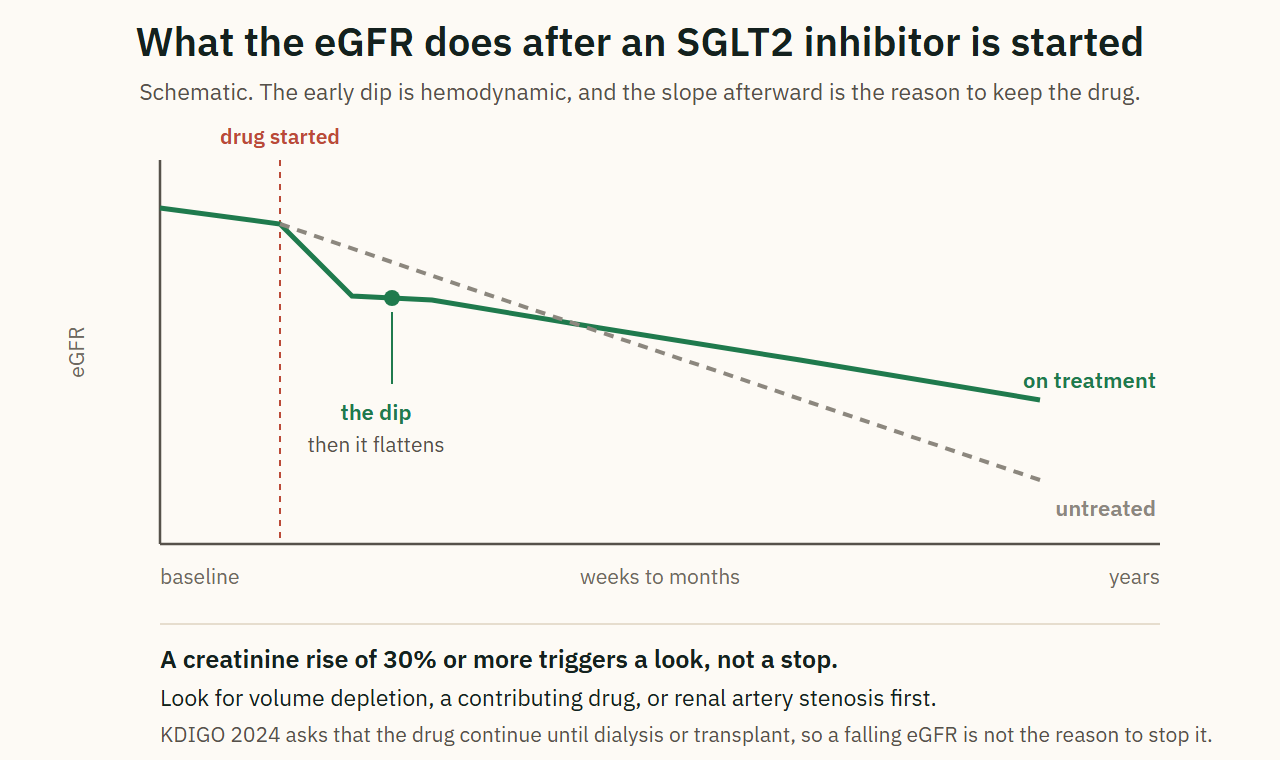
However, as we integrate the 2024 KDIGO clinical practice guidelines into our workflows, we must confront the SGLT2 inhibitor paradox: the very drop in eGFR that causes clinical alarm is frequently the clearest evidence of the drug's therapeutic success. This "early dip" is not a sign of kidney failure, but rather a sign of kidney protection in action.
As clinical leaders, our goal is to move beyond reactionary prescribing. We must distill the latest nephrology evidence into actionable insights that prevent the premature discontinuation of life-saving, kidney-protective therapy.
What is not settled here
The perioperative hold interval is contested. Published recommendations range from 24 hours to five days and the evidence behind all of them is thin. This piece does not pick one, and a local protocol should be built from the label and your anesthesia group rather than from a summary.
The dip is not quantified here. Reported magnitudes differ by agent and by population, and no single figure was verified to a primary trial.
Euglycemic ketoacidosis is the reason the sick-day rule exists. Keep it on the differential for any patient on this class who presents unwell with a normal glucose. No incidence figure is asserted here.
Takeaway 1: The "Dip" is a Feature, Not a Bug
When an SGLT2 inhibitor is initiated, an initial reduction in eGFR within the first few weeks is expected. This is a hemodynamic phenomenon, not a structural injury. The drug restores tubuloglomerular feedback, causing the afferent arteriole to constrict and reducing intraglomerular pressure.
While this drop in filtration pressure manifests as a lower eGFR on a lab report, it is the exact mechanism that shields the nephron from long-term barotrauma. Think of it as a "step down for a gentler slope." We are intentionally trading a small, acute reduction in eGFR today for a significantly slower rate of kidney function decline over the next decade.
Takeaway 2: The 30 Percent Rule (Investigate, Don't Liquidate)
To normalize this transition, we should lean on our existing experience with Renin-Angiotensin System (RAS) inhibitors. Just as we expect a creatinine bump when starting an ACE inhibitor or an ARB, we apply the same "30 percent rule" to SGLT2 inhibitors. A serum creatinine rise of 30% or more from baseline is a trigger for investigation, not an automatic mandate to stop the drug.
Before discontinuing the medication, clinicians should utilize the following investigation checklist to identify reversible factors:
| What | Why it matters |
|---|---|
| Volume depletion | This is the most common and treatable cause of an exaggerated creatinine rise. |
| Contributing medications | Audit the profile for NSAIDs, recent contrast exposure, or recent increases in diuretic dosing. |
| Renal artery stenosis | Consider this if the clinical history or the magnitude of the rise suggests a vascular etiology. |
Dose reduction or discontinuation should only be considered if this search for a reversible cause comes up empty.
Takeaway 3: Start at 20, Stay Until Dialysis
The KDIGO 2024 guidelines have expanded the therapeutic window for SGLT2 inhibitors. They are now recommended for adults with an eGFR of 20 mL/min/1.73 m² or above who have type 2 diabetes and chronic kidney disease (CKD), or those with CKD and proteinuria, regardless of diabetes status.
-
The Initiation Threshold: 20 mL/min/1.73 m².
-
The Continuation Rule: Once started, the drug should be maintained until the patient progresses to dialysis or kidney transplant.
This requires a fundamental shift in our clinical logic. We must pivot from "lab value management" to "nephron preservation." A falling eGFR is often the exact reason a patient needs the drug most; withdrawing the therapy as the kidney function worsens denies the patient the very tool designed to slow that progression.
Takeaway 4: Mastering the "SADMANS" Sick-Day Protocol
The only clear reason to temporarily hold an SGLT2 inhibitor is during acute dehydrating illness. This hold is necessary to mitigate the risk of euglycemic ketoacidosis (euDKA), a metabolic complication that can occur even when blood glucose levels appear normal.
To manage this, we utilize the SADMANS mnemonic:
Letter Agent Group S Sulfonylureas A ACE inhibitors D Diuretics (or direct renin inhibitors) M Metformin A ARBs N NSAIDs S SGLT2 inhibitors
The Restart Rule: The agents should be paused during vomiting, diarrhea, or fever. However, the most common failure point is the "permanent hold." To prevent this, the restart instruction must be specific. Rather than a vague "when feeling better," the instruction should ideally name a specific person and a date for the patient to resume therapy (e.g., "Restart these three medications on Thursday morning if you are eating and drinking normally").
Takeaway 5: Institutional "Failure Points" for Pharmacy Leadership
Aligning a hospital with modern guidelines requires more than just updated knowledge; it requires system-level changes led by Pharmacy.
| What | Why it matters |
|---|---|
| Renal-Dosing Alerts | Many automated alerts still trigger "stop" recommendations based on outdated eGFR cutoffs (such as 30 or 45). These must be audited. If your alerts predate 2024, they are likely providing incorrect advice that contradicts the "continue to dialysis" guideline. |
| Pharmacist-Led Protocols | Post-initiation creatinine follow-up is an ideal candidate for a protocol-driven pharmacist service. This ensures that the 30% rule is applied consistently and that the "expected dip" is not mistaken for AKI. |
| The "Invisible" Discontinuation | On a discharge summary, "Held for AKI" and "Stopped" often look identical to the primary care provider. If a drug is held on admission for an acute illness, pharmacists must ensure the reason is documented and a restart plan is clearly communicated to prevent the therapy from being lost during the transition of care. |
Conclusion: The One Thing to Check
The 2024 KDIGO guidelines demand a shift in perspective: a falling eGFR is the indication for SGLT2 inhibitors, not the contraindication. We must stop viewing a rising creatinine as an automatic failure and start viewing it as the physiological signature of a drug at work.
As a call to action, I challenge you to audit one thing today: Are your hospital's electronic alerts or admission habits currently discontinuing SGLT2 inhibitors based on an eGFR number alone? If they are, your system is inadvertently removing the very treatment intended to save your patients' kidneys.
Related
- KDIGO 2024 CKD guideline, full text
- The AJHP pharmacist primer on KDIGO 2024
- How to read the statistics in a clinical trial
- The four pillars are meant to be started together, where the same class appears as a heart failure drug
- Running the Clinical Program, on building the follow-up that stops a hold from becoming a discontinuation
Want the practice knowledge behind this?
Your First Year as a Hospital Pharmacist covers the clinical judgment a residency front-loads. Part of the Pharmacy Handoff library.
See the book