The 3-Month Countdown: Why Heart Failure Therapy Just Got a Radical Remake
Introduction: The High Cost of Waiting
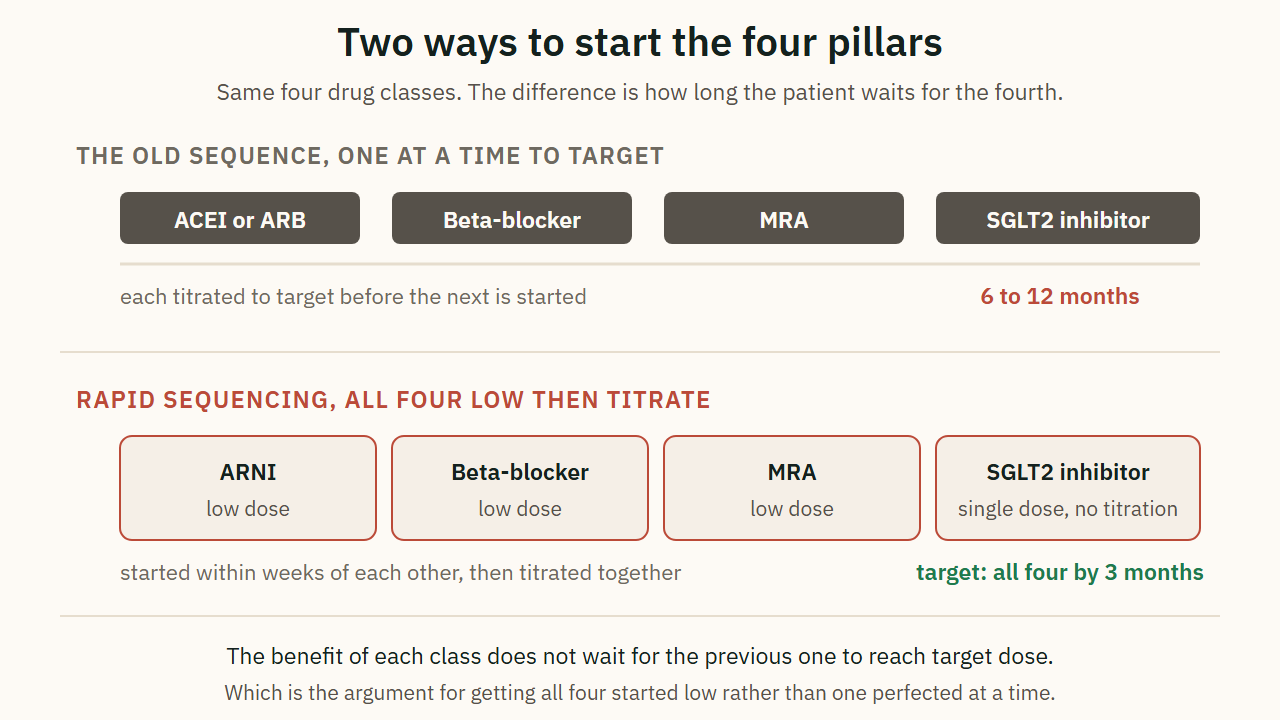
For decades, the clinical management of heart failure with reduced ejection fraction (HFrEF) followed a predictable, slow-motion rhythm. We were taught to start one medication, titrate it meticulously toward a target dose over several weeks, and only then introduce the next agent. This "serial titration" method was a marathon of caution, often taking six to twelve months to reach full foundational therapy. In practice, however, many patients never reached the finish line; they remained indefinitely "trapped" on sub-therapeutic doses of a single agent.
The updated 2026 ACC expert consensus decision pathway has turned this model on its head. The bottleneck in heart failure care has shifted: it is no longer a clinical debate over which drugs to use, but an operational imperative of how fast we can start them. We are moving away from sequential steps toward a sprint to get all foundational therapies on board simultaneously. The goal is to blanket the patient with every available mechanism of protection as quickly as possible.
What is not settled here
Doses and thresholds are deliberately not reproduced. They differ by drug within each class, the pathway has them, and a partial list here would be used as a reference.
HFpEF is a different question with a different evidence base, and the four pillars as described are the HFrEF pathway.
The class assignments and exact wording come from reporting on the pathway rather than from reading every recommendation. Local protocol should be built from the JACC document.
Takeaway 1: Low Dose Beats No Dose (The Logic of Rapid Sequencing)
The core shift in the new consensus is the move toward rapid sequencing. Instead of waiting months to perfect the dose of a single drug, the new imperative is to start all four classes of HFrEF therapy at low doses within just a few weeks.
This approach is rooted in a fundamental shift in pharmacological logic. Each drug class reduces events through independent pathways; one medication does not need to be at its maximum dose for another to begin saving lives. It is important to note that the updated pathway treats the specific order of initiation as flexible. This flexibility reflects a key piece of clinical reasoning: the evidence for having "all four" pillars on board is significantly stronger than the evidence for any one specific starting sequence.
For clinicians trained in the "start low, go slow" model, this is deeply counter-intuitive. However, the logic is sound: a patient on low doses of four protective agents is physiologically better off than a patient on a target dose of just one. We are prioritizing the breadth of protection over the depth of a single dose.
Takeaway 2: The New Hierarchy of the "Four Pillars"
The foundational therapy for HFrEF is now defined by four specific pillars. While the order in which they are started is flexible, their presence is not.
| What | Why it matters |
|---|---|
| ARNI (Angiotensin Receptor-Neprilysin Inhibitor) | Sacubitril/valsartan is now the preferred baseline over traditional ACE inhibitors or ARBs. While ACE inhibitors and ARBs remain acceptable where cost or side effects are significant barriers, the ARNI is the new standard of care. |
| Beta-blockers | These remain a cornerstone of therapy, included early in the rapid sequencing mix. |
| MRA (Mineralocorticoid Receptor Antagonist) | A critical pillar that must be introduced within the initial three-month window. |
| SGLT2 Inhibitor | This class has been elevated from an "add-on" to a primary pillar. Because it requires no titration, it is often the easiest medication to initiate immediately. |
Clinical Alert: Clinicians must expect an "early eGFR dip" when starting an SGLT2 inhibitor. This is a known hemodynamic response to the medication and should not be reflexively misread as an acute kidney injury (AKI) requiring the discontinuation of therapy.
Takeaway 3: The Four Hidden Breaking Points in Clinical Practice
Even the most robust clinical plan usually fails at the delivery stage. Rapid sequencing breaks down not because the science is flawed, but because the operational steps are missing. There are four primary failure points where the "plan" becomes a mere "aspiration":
Titration Ownership
This is the most common point of failure. When a patient is discharged on four low-dose agents, there is often no named individual or clinic responsible for the subsequent titration. Furthermore, there is often a documentation gap: a clinician must clearly distinguish between a patient who is "not started yet" on a pillar versus one who is "contraindicated." Only the latter should be left off the list; the former requires a specific follow-up plan that usually disappears in the transition of care.
Laboratory Scheduling
Starting an MRA and an ARNI in close proximity creates specific requirements for monitoring potassium levels and renal function. If these labs are not booked at the time of the prescription, and if no one is assigned to review the results, the safety of the rapid sequencing model is compromised, and clinicians will naturally retreat to the slower, "safer" traditional model.
The Pharmacy Counter Cost Barrier
For many, the cost of an ARNI or SGLT2 inhibitor is a prohibitive hurdle. A prescription that is never filled looks identical, from the clinic's perspective, to one that was started and failed. The discharge conversation regarding insurance coverage and cost is a clinical necessity, not an administrative task. If the patient cannot afford the "pillar," that pillar essentially does not exist.
Hypotension Mismanagement
Four agents that can each lower blood pressure create a real clinical constraint. However, hypotension should be treated as a sequencing problem to be solved rather than a reason to abandon therapy. Instead of stopping the agents, the modern approach is to re-evaluate the timing of administration (e.g., staggering doses throughout the day) or adjusting the doses of concurrent agents rather than stopping a "four-pillar" approach entirely.
Takeaway 4: Why "Pharmacy Work" is the New Rate-Limiting Step
In the rapid sequencing model, the pharmacist is no longer just a dispenser; they are the engine of the clinical protocol. The success of a heart failure program is now determined by how well the transition from hospital to home is managed.
To make rapid sequencing work, pharmacists must take specific clinical actions:
| What | Why it matters |
|---|---|
| Confirm presence | Ensure all four classes are present at discharge or that a clinical contraindication is documented. |
| Establish coverage | Resolve insurance hurdles for brand-name pillars (ARNI/SGLT2i) before the patient leaves the building. |
| Lead titration | Utilize collaborative practice agreements to lead protocol-based titration and structured lab monitoring. |
Editor's Note: We must change the metric of success. A heart failure program should not be audited on whether the four classes were initially prescribed. The only metric that matters in the rapid sequencing era is time to target dose. If we only measure the initial prescription, we ignore the reality that many patients stay on sub-therapeutic doses for the rest of their lives.
Conclusion: Beyond the Prescription
The radical remake of heart failure therapy is not about the discovery of new agents, but about the aggressive optimization of the ones we already have. The shift to a three-month window for all four pillars acknowledges that the most dangerous time for a heart failure patient is the time spent waiting for "perfect" serial titration.
Everything difficult about modern heart failure management is now downstream of the prescription. It is a matter of logistics, monitoring, and follow-up ownership.
As you evaluate your own clinical process, ask one question: Does your discharge process actually name who will titrate the meds and when the labs are booked? If not, the plan is just an aspiration.
Related
- How pharmacists get prescribing authority in a hospital
- What the 2025 ACS guideline changes about the drugs
- The 2026 lipid guideline brought LDL targets back
- Rapid sequencing of the four pillars
- Running the Clinical Program, on building the follow-up service this depends on
Want the practice knowledge behind this?
Your First Year as a Hospital Pharmacist covers the clinical judgment a residency front-loads. Part of the Pharmacy Handoff library.
See the book