The Return of the Target: Why the 2026 Lipid Guidelines Change Everything for Patients and Providers
For nearly a decade, the clinical community has navigated a landscape intentionally devoid of hard numeric targets. Since 2018, we have operated under a "percent reduction" framework, where success was defined by the intensity of the statin rather than the objective result on the lab report. This shift was scientifically defensible at the time, but it created a decade of ambiguity that stalled the progress of pharmacist-led services and automated clinical decision support.
As of March 2026, the era of ambiguity is over. The "numbers" have officially returned. The 2026 multisociety dyslipidemia guideline has restored a treat-to-target framework, fundamentally altering the definition of successful therapy and the "plumbing" of our clinical workflows.
This isn't just a minor update; it is a total restoration of clinical endpoints. We are moving away from the subjective "maximally tolerated therapy" and toward a clear, objective standard based on a patient's specific atherogenic burden. For healthcare leaders and clinicians, the message is clear: if your current clinical pathways are still encoded with 2018 logic, your lipid strategy is now obsolete.
The Numbers Are Back: 55, 70, and 100
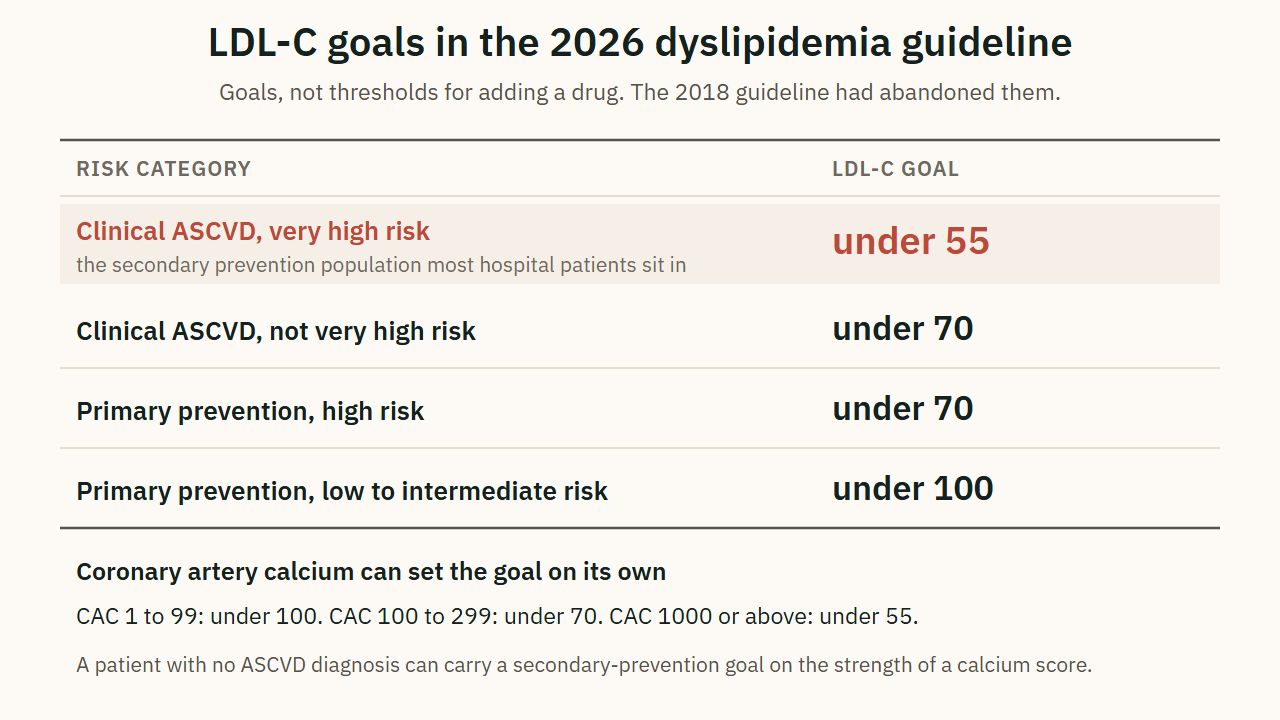
The 2026 guideline reintroduces tiered LDL-C goals, prioritizing aggressive lowering for those at the highest risk for cardiovascular events. The new numeric targets are:
| Under | Why it matters |
|---|---|
| Under 55 mg/dL | For patients with very high-risk clinical ASCVD. |
| Under 70 mg/dL | For clinical ASCVD that is not very high risk, and for high-risk primary prevention. |
| Under 100 mg/dL | For patients at low, borderline, and intermediate risk. |
Crucially, the guideline also recognizes high-volume specialty populations that were previously overlooked. Lipid-lowering therapy is now recommended for adults 40 and older with Stage 3+ Chronic Kidney Disease (CKD), HIV, or Type 1 or Type 2 Diabetes. Furthermore, for patients where LDL-C may not tell the full story, specifically those with diabetes, high triglycerides, or known CVD, the guideline introduces Apolipoprotein B (ApoB) as a preferred alternative metric to guide treatment.
The return to these numeric goals is the catalyst for operational excellence.
Under the previous framework, a patient on a high-intensity statin with an LDL-C of 118 mg/dL was technically "managed" according to the rules. Under the 2026 targets, that same patient has a glaringly unfinished treatment plan. A goal is what makes a pharmacist-run service possible; you cannot build a scalable protocol around the phrase "maximally tolerated," but you can certainly build one around a number.
Lp(a) Testing: Managing the Burden of the Uninterpretable Result
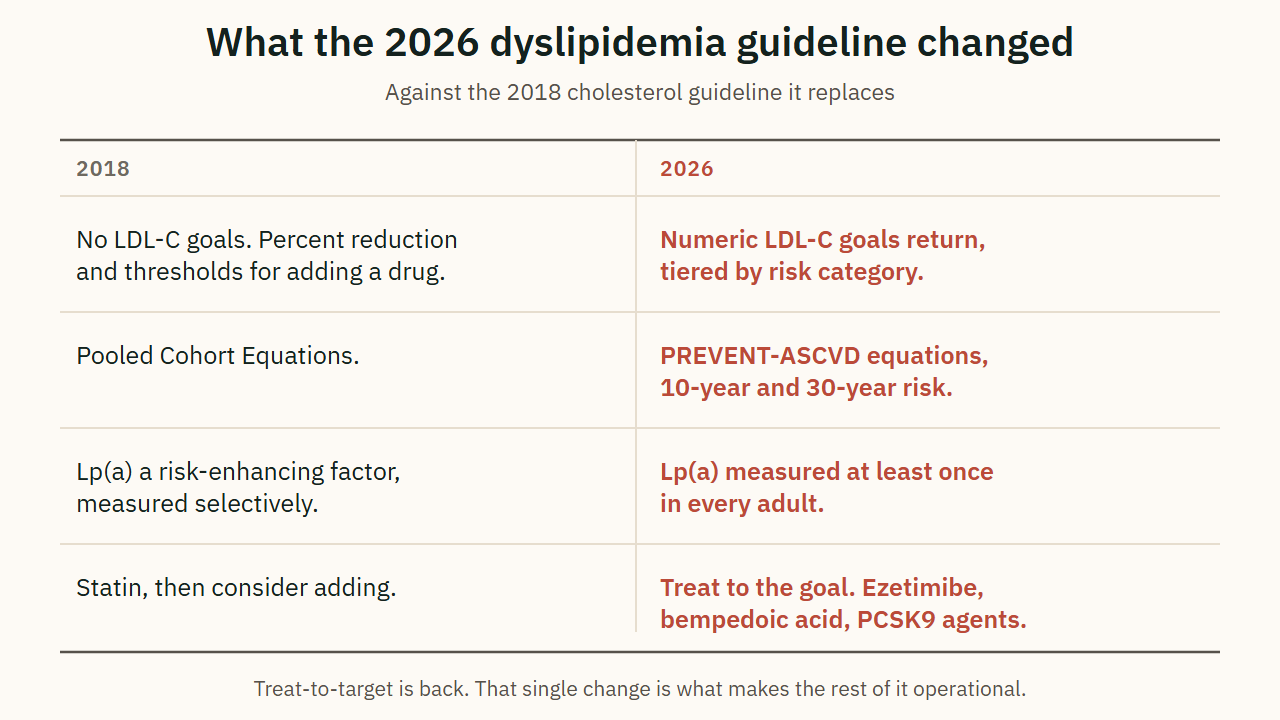
In a historic shift, the guideline moves Lipoprotein(a) from a selective, risk-enhancing test to a universal screening tool. Every adult now requires an Lp(a) measurement at least once in their lifetime.
From a Medical Science Liaison perspective, this represents a significant "volume challenge." Universal screening across an entire adult population will generate a massive surge of data. The operational friction lies in the fact that we currently lack a specifically approved therapy to lower Lp(a) for this indication. A result with no direct action attached still generates clinical work, patient anxiety, and administrative burden. Systems must decide now who reviews these results and how to communicate residual inflammatory risk to patients when the "lowerer" doesn't exist yet.
CAC 1000+: The New Proxy for Secondary Prevention
The 2026 guidelines significantly elevate the role of Coronary Artery Calcium (CAC) scoring, allowing it to dictate LDL-C targets independently of traditional risk factors. This is a profound shift in clinical logic:
-
CAC 1-99: Target LDL-C under 100 mg/dL.
-
CAC 100-299: Target LDL-C under 70 mg/dL.
-
CAC 1000 or above: Target LDL-C under 55 mg/dL.
By assigning a goal of under 55 mg/dL to a CAC score of 1000+, the guideline effectively equates a high calcium burden with established cardiovascular disease. This forces a transition from primary to secondary prevention logic, requiring the most intensive lipid-lowering strategies available for these patients.
PREVENT-ASCVD: Tracking Risk Across Decades
The Pooled Cohort Equations have been retired in favor of the PREVENT-ASCVD equations. This transition is part of a systemic shift in cardiology, matching the 2025 Hypertension guideline's move to the same model.
PREVENT-ASCVD covers adults aged 30 to 79 and, crucially, includes both 10-year and 30-year risk assessments. This long-term horizon justifies the "Lower for Longer" philosophy. Primary prevention is now recommended to start much earlier; therapy is considered "reasonable" at a 10-year risk as low as 3% to under 5%, and is fully recommended at 5% to 10% after a clinician-patient discussion. We are no longer waiting for risk to become imminent; we are treating to prevent the cumulative exposure of a lifetime of cholesterol.
The 55 vs. 70 Collision: Updating the EHR "Adequacy Trap"
Clinicians must navigate a specific friction point between the 2025 ACS guideline and the 2026 Dyslipidemia guideline. The 2025 document suggests adding a nonstatin when LDL-C is at or above 70 mg/dL post-ACS. However, the 2026 guideline, the newer and more specific authority on lipids, sets the goal for these "very high-risk" patients at under 55 mg/dL.
This creates an "adequacy trap." A post-ACS patient with an LDL-C of 62 mg/dL satisfies the older ACS threshold but fails the new 2026 goal. To avoid this, you must update your EHR order sets and discharge pathways to the 55 mg/dL target. The 2026 guideline is the higher-resolution document and should be the gold standard for lipid-specific decisions.
Operational Reality: Navigating the Nonstatin Surge
Moving to a target-based system means more patients will require therapy escalation beyond statin monotherapy. The guideline names ezetimibe, bempedoic acid, PCSK9 monoclonal antibodies, and inclisiran as the tools to close the gap.
However, the Senior Pharmacist knows that the binding constraint here is often administrative rather than clinical. While ezetimibe and bempedoic acid are operationally manageable, PCSK9-directed therapies and inclisiran remain high-intensity prior authorization (PA) pathways. As the volume of patients missing the 55 mg/dL target increases, so too will the PA burden. Success in this new era requires a robust "plumbing" system, automated alerts that compare results to targets and pharmacist-led teams equipped to handle the administrative hurdles of nonstatin access.
Conclusion: Is Your Logic Still 2018?
The 2026 guidelines embrace "lower for longer" as the definitive strategy for reducing cardiovascular events. By returning to numeric targets, the medical community can finally move away from the subjectivity of the last eight years and toward standardized, protocol-driven care.
The return of goals enables pharmacist-led services, precise decision support, and clear endpoints. The question for your practice is no longer about the intensity of the statin, but about the number on the page.
The final question for your leadership: Are your clinical pathways and electronic health record alerts still evaluating statin intensity, or are they encoded with the logic required to hit the 2026 targets? If you haven't changed your "if/then" rules to match the 55/70/100 tiers, you are practicing in the past.
Related
- The 2026 dyslipidemia guideline in Circulation
- ACC summary of the guideline
- National Lipid Association summary
- What the 2025 ACS guideline changes about the drugs
- What actually changed in the 2025 hypertension guideline, which moved to PREVENT for the same reason
- Running the Clinical Program, on building a service around a numeric target
Want the practice knowledge behind this?
Your First Year as a Hospital Pharmacist covers the clinical judgment a residency front-loads. Part of the Pharmacy Handoff library.
See the book