The Simple Logistics Fix Slashing Hospital Readmissions by Half

The day of hospital discharge is often a paradox of relief and profound vulnerability. For many patients, the transition from a highly monitored clinical environment to the self-management of a home setting is where the "revolving door" effect begins. Too often, patients find themselves back in the Emergency Department (ED) within days, victims of a fragmented transition process.
One logistical intervention, known as "meds-to-beds", where prescriptions are delivered directly to the patient's bedside before they leave the building, is frequently dismissed as a mere concierge service. New data from Emory University Hospital suggests the shift is worth more than that. By analyzing a cohort of 768 patients between January 1 and July 30, 2022, researchers have provided a case for why bedside delivery deserves a serious look from health systems.
Readmission: 13.3% versus 27.1%
The study's primary finding is a pointed challenge to the traditional "community fill" model. By providing medications at the point of discharge, the medical center set out to bridge the "medication gap", the period where a patient is expected to stop at a retail pharmacy while fatigued, in pain, or lacking transportation.
To sharpen the comparison, the study's control group specifically excluded any patients who happened to use the institution's own pharmacy, creating a cleaner look at community-based fulfillment. The results were these:
| Meds-to-beds | Filled elsewhere | |
|---|---|---|
| Patients | 384 | 384 |
| Readmitted within 30 days | 13.3% | 27.1% |
| Within 7 days | lower, P < 0.001 | reference |
| Within 60 days | lower, P = 0.001 | reference |
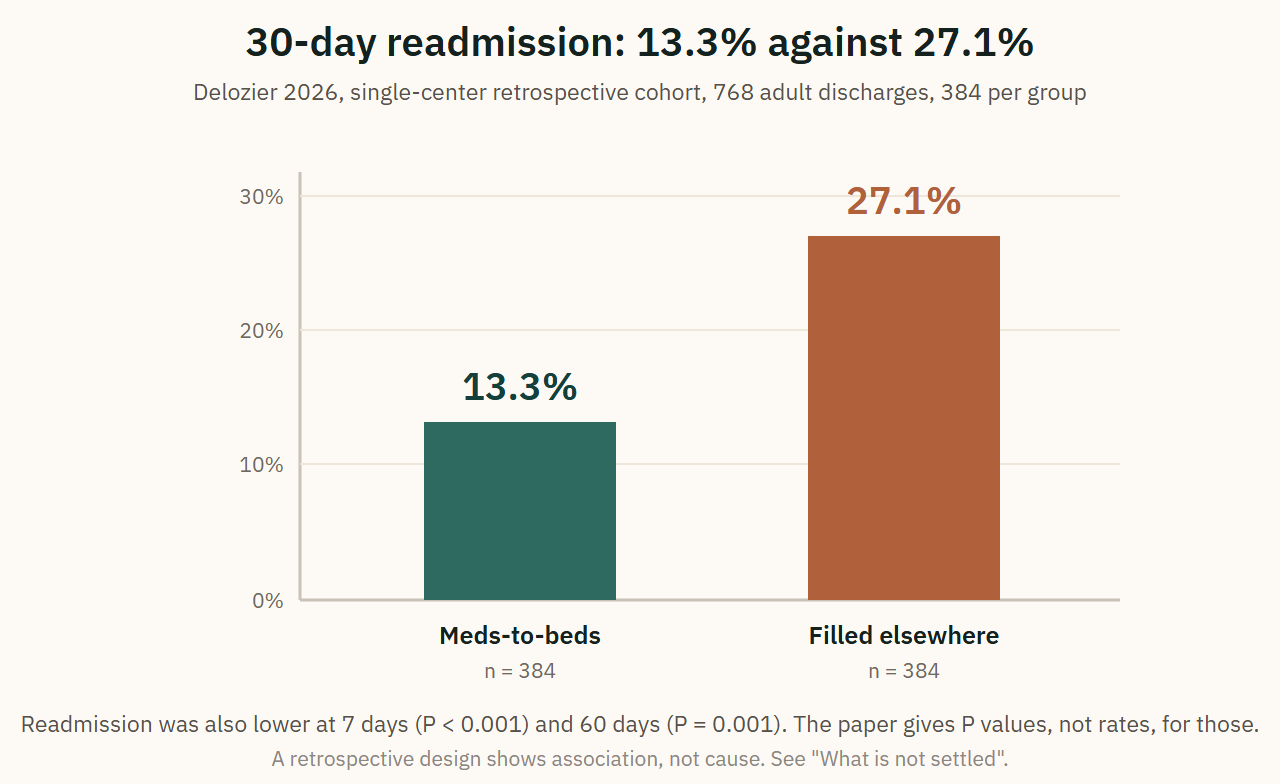
That difference is large. What it establishes is an association between the program and lower readmission, not proof that the program caused it. The distinction matters more than it might seem, and the section at the end of this piece is where it gets its due.
The gap held to 60 days
Bedside delivery does more than solve a day-one logistics problem. The study found the differences were not fleeting. Lower readmission rates remained statistically significant across multiple intervals: the 7-day mark (P < 0.001) and the 60-day mark (P = 0.001).
One reading is that meds-to-beds acts as a catalyst for medication reconciliation and longer-term adherence habits, and that removing the initial friction of obtaining medication helps patients integrate a regimen rather than merely start one. That is a hypothesis the design can suggest but cannot test. As the study authors concluded:
"The meds-to-beds program was associated with fewer readmissions to the ED or hospital within 7 days, 30 days, and 60 days and generated revenue for the institution's outpatient pharmacy."
Note the verb they chose.
It paid for itself
In a landscape where "improving outcomes" is often synonymous with "increasing costs", the meds-to-beds model presents a rarer arrangement. The study reports the service was not a cost center. Over the seven-month study period, the program produced a total marginal profit of $30,253.
For anyone building the business case, this is a capture-rate argument. By fulfilling prescriptions in-house, the health system stops the leakage of pharmacy spend to external retail chains. The institution captures the margin on the medications, and the readmission signal sits alongside that rather than having to justify the program on its own.
A mixed literature, added to
Historically, the data supporting bedside pharmacy delivery has been described as mixed, and the authors say so themselves in the paper's opening. This study adds to it. Conducted at a high-acuity academic medical center, the research modeled the primary outcome using logistic regression.
The primary outcome reached P < 0.001 across two evenly matched groups of 384 patients. That is enough to justify a serious look at these programs. Whether it is enough to move them from pilot status to a permanent, hospital-wide standard is a judgment each institution has to make on its own numbers, and on the questions below.
What is not settled
This is a single-center retrospective cohort. The authors label it as such. A retrospective design can show that two groups differed; it cannot show that the program is what made them differ. Every "proves" available here is really an "is associated with", which is the verb the authors used.
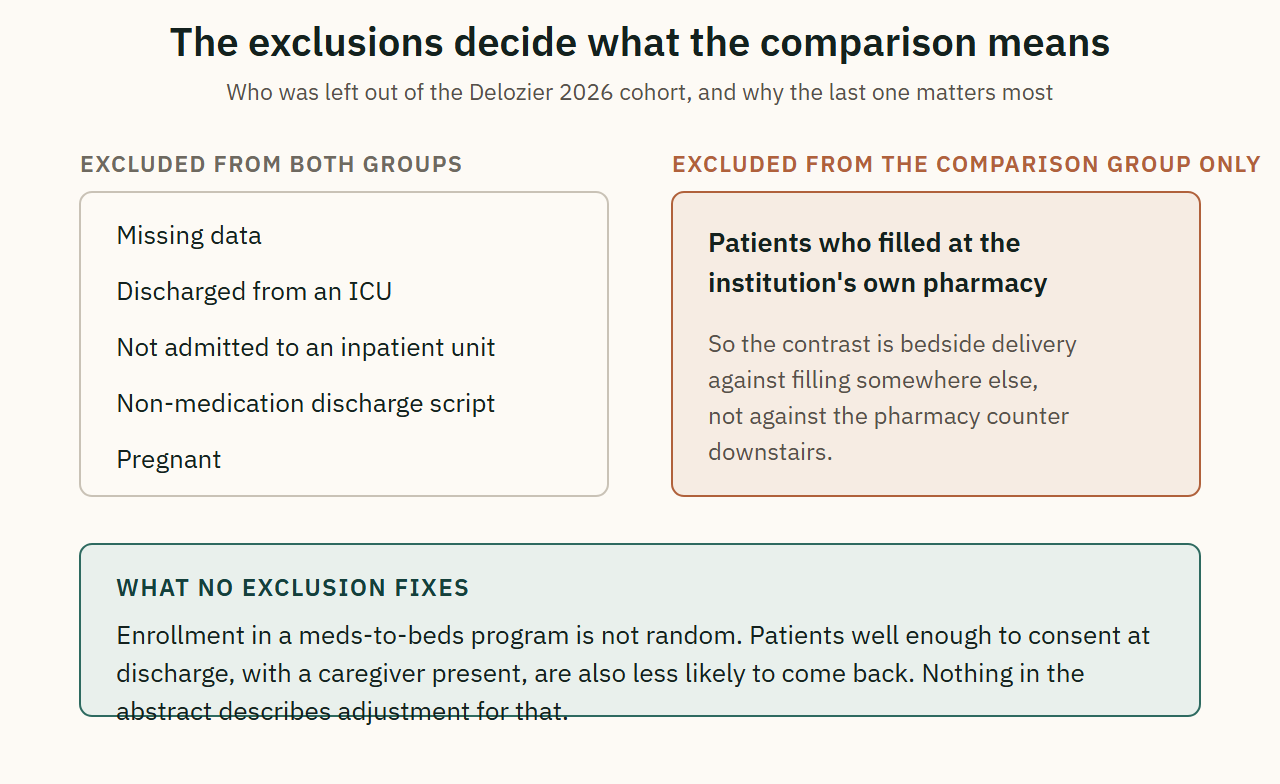
Who gets into a meds-to-beds program is the whole question. Enrollment plausibly selects for patients who are well enough to consent at discharge, who have a caregiver present, and who are already engaged in their own care. Those same patients are less likely to be readmitted whatever the pharmacy does. Nothing in the abstract describes adjustment for that, and it is the first thing to ask before the 50% figure is quoted to a CFO.
The exclusions shaped the contrast. ICU discharges, patients with missing data, non-medication discharge prescriptions, and pregnant patients were all excluded. So were comparison-group patients who filled at the institution's own pharmacy. That last exclusion is defensible, and it means the comparison is bedside delivery versus going elsewhere, not bedside delivery versus the institution's pharmacy counter.
The profit figure is one institution's seven months. $30,253 reflects Emory's payer mix, contract pricing, and staffing model. It is a demonstration that the arrangement can pay, not a number to put in your own forecast.
Only the abstract has been read here. The full text may address the confounding question directly. Anyone building a case on this should read the paper.