The $35,000 Gap: Why Some Night-Shift Pharmacists Earn $175k (and Others Don't)

Imagine two pharmacists. Both work the exact same grueling but coveted "seven-on, seven-off" schedule, alternating a week of ten-hour night shifts with a week of total freedom. They have similar levels of responsibility, yet at the end of the year, one sees $140,000 in gross pay while the other sees $175,000.
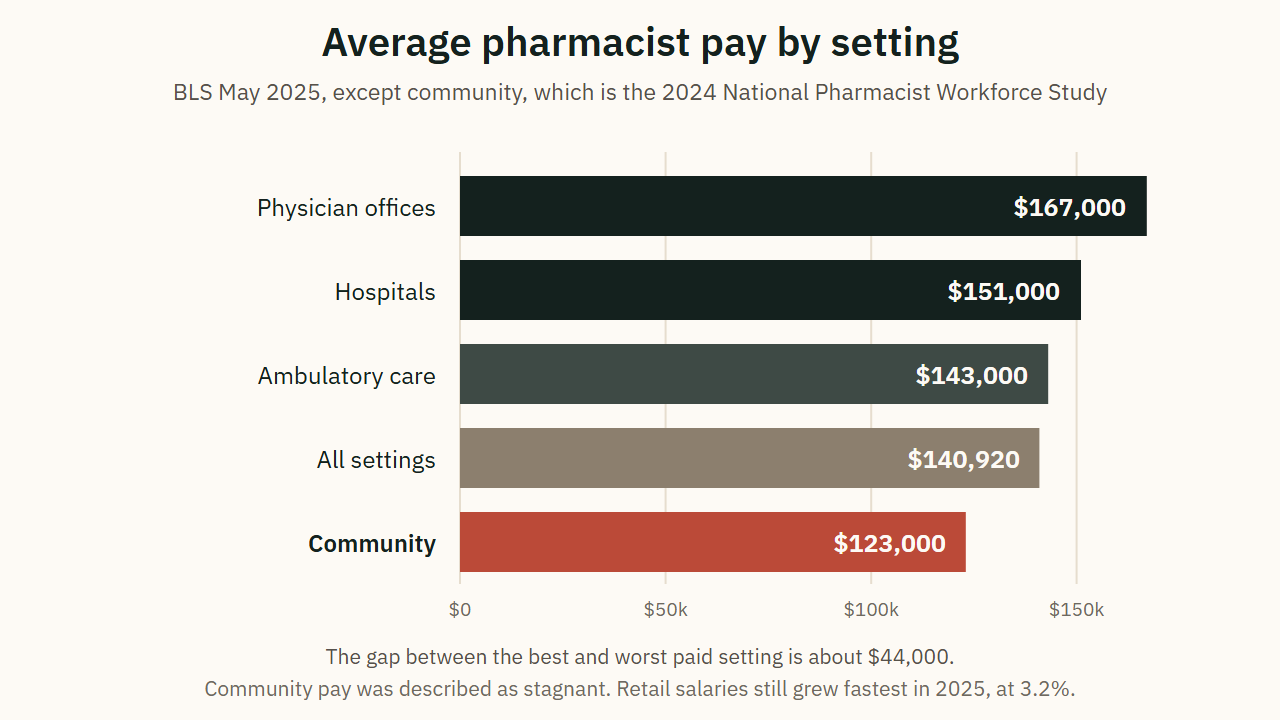
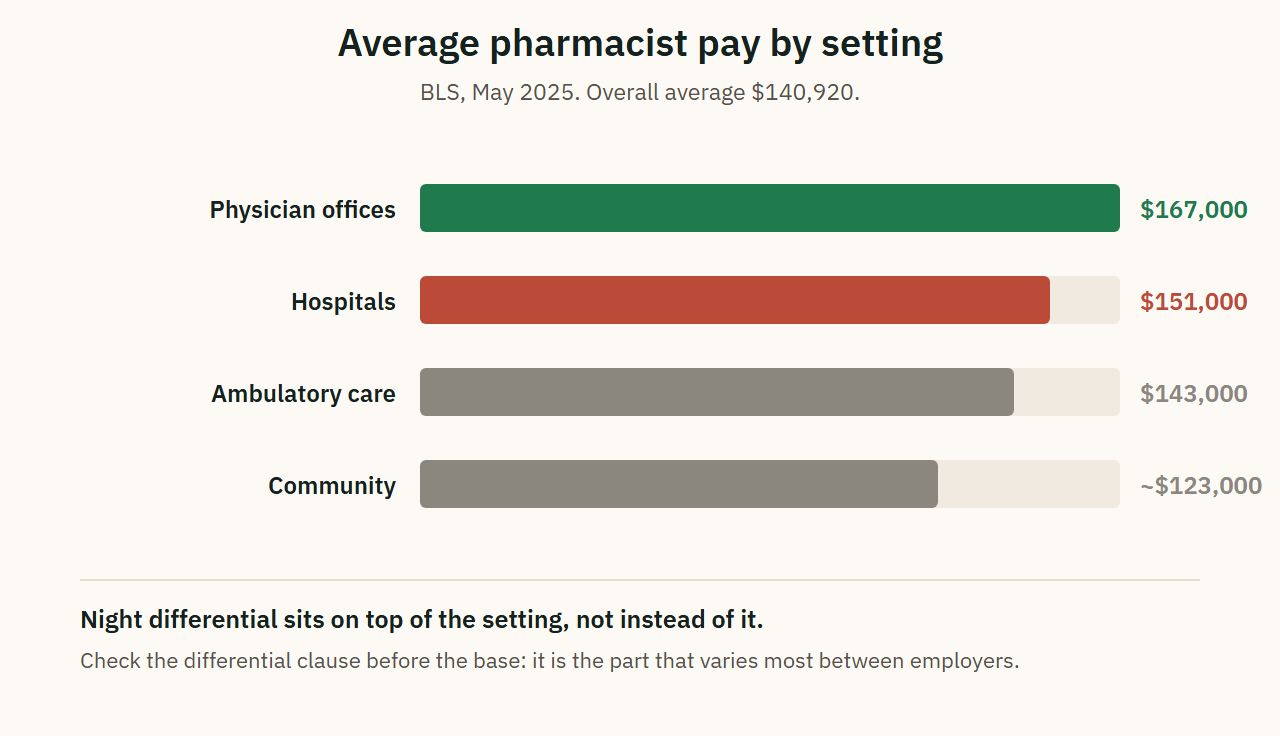
This $35,000 spread, which comfortably exceeds the national pharmacist average of $140,920 and even the hospital average of $151,000, is not the result of "negotiation magic" or superior clinical credentials. Instead, data from hospital pharmacy practitioners reveals that the difference is almost entirely mechanical. In the world of hospital overnights, your bank account is determined by the specific language of your offer letter. Pay in this sector is not mysterious; it is a math problem.
The "70-for-80" Golden Ticket
The single most influential lever in any overnight hospital offer is the "70-for-80" arrangement. Because overnight shifts are notoriously difficult to recruit for, many hospitals offer a significant incentive: you work 70 hours in a two-week pay period (seven 10-hour shifts) but are paid for a full 80 hours.
The math is simple but transformative. By receiving 10 hours of "gifted" pay for every 70 hours worked, you are effectively receiving a 14.2% immediate raise on your base rate before a single differential is added. This is the heaviest hitter on the balance sheet.
However, as a strategist, you must watch for the "differential trap." Some employers attempt to replace the 70-for-80 rule with a flat hourly differential, such as $6.50 per hour. On the surface, this sounds reasonable, but the math rarely favors the employee. A $6.50 differential over 70 hours equals $455 per pay period. In contrast, 10 hours of a typical hospital pharmacist's base pay (at roughly $70+ per hour) is worth $700 or more.
Comparing Pay Structures:
-
Standard Pay Period: You work 70 hours and are paid for exactly 70 hours.
-
70-for-80 Pay Period: You work 70 hours, but the employer adds 10 hours of pay to the check to reach a full 80-hour basis (a 14.2% premium).
The Trap of Non-Stacking Differentials
Beyond the base hours, hospital pharmacists rely on differentials, extra hourly pay for working nights, weekends, or holidays. However, the way these premiums are calculated varies wildly between institutions.
In a "stacking" model, a pharmacist working a Saturday night on a holiday would receive their base pay plus the night differential, plus the weekend differential, plus the holiday premium. In contrast, many employers use a "single-differential" model. In this scenario, the employer may only pay the highest applicable premium (e.g., night or weekend), but not both. Over the course of 26 pay periods, the failure to stack these premiums can cost a practitioner thousands of dollars in anticipated income.
The Fragility of Policy vs. Law
It is vital to recognize that these lucrative pay structures are usually corporate policies rather than protected legal rights. This makes them inherently fragile. One case study from a hospital pharmacy department illustrates the leverage involved: when a hospital decided to remove its 70-for-80 clause, four of its six overnight pharmacists resigned immediately.
These pharmacists understood their value. Because overnight shifts are the hardest to recruit for, the staff holds significant leverage. However, the reverse is also true: since these arrangements are policies, they can be withdrawn or replaced with smaller hourly differentials that do not truly equate to the original premium. If you are running a department, that 70-for-80 clause is doing more retention work than anything else in the offer.
The Hidden Clinical Depth of the "Ghost Shift"
There is a common misconception that the night shift, the "ghost shift", is a low-intensity environment where pharmacists simply wait for morning. The reality is often the opposite. With no management present and fewer staff members in the building, night-shift pharmacists manage a massive clinical breadth and enjoy a level of autonomy rare in day-shift roles.
For practitioners who are strongly introverted, the lack of administrative oversight and management presence makes the night shift a premier environment. It is a space where the work speaks for itself. Reports from the field show that night pharmacists are frequently responsible for:
-
Neonatal Intensive Care Unit (NICU) coverage.
-
Neuro ICU and Cardiac units.
-
Emergency Department (ED) staffing and code response house-wide.
-
Internal medicine services.
The "Life Stage" Expiration Date
Despite the potential for $175,000 salaries and the allure of eight weeks of paid time off (PTO) annually, the seven-on, seven-off lifestyle often has an expiration date. This combination of high pay and massive blocks of freedom creates a "golden handcuffs" effect, particularly for those in a life stage that prioritizes travel.
However, the schedule is becoming increasingly rare outside of the overnight shift. While it is excellent for a particular life stage, the friction increases as "dependents acquire fixed schedules." The eight weeks of PTO become harder to use effectively when children start school or join sports teams with non-negotiable schedules. When a pharmacist leaves the night shift, it is rarely because they have grown tired of the clinical work; it is almost always because the schedule can no longer survive the requirements of their current life stage.
Conclusion: The Four-Question Checklist
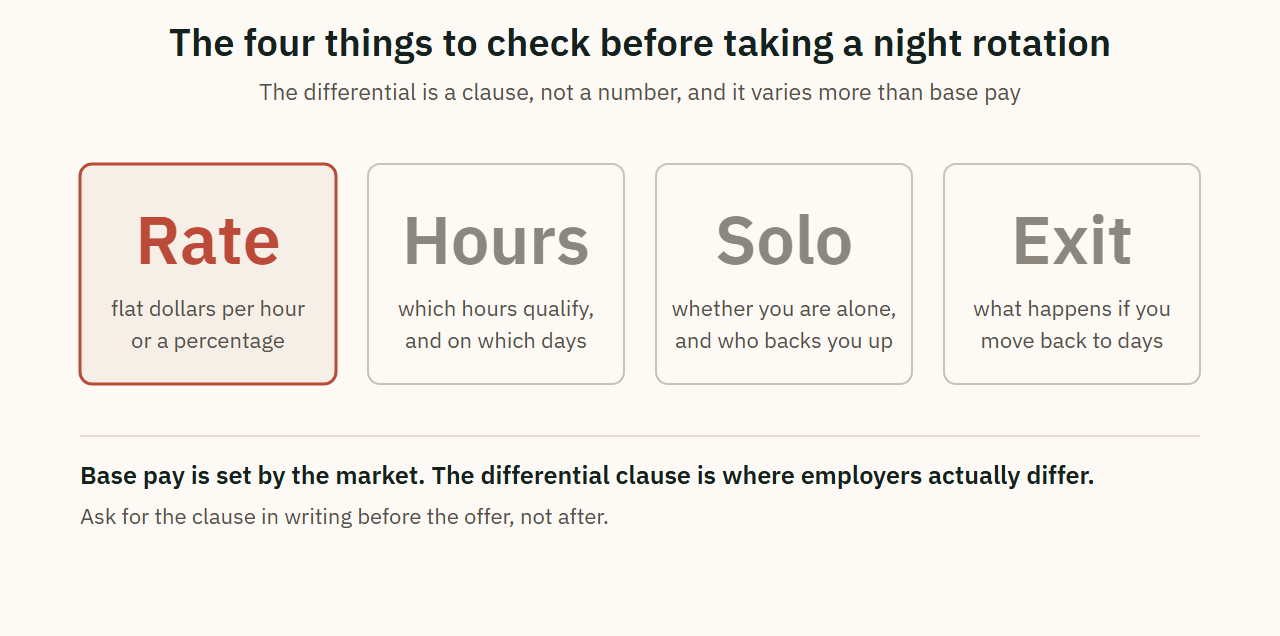
If you are evaluating a hospital overnight offer, remember that the top-line salary figure is only part of the story. To see if you are looking at a $140,000 role or a $175,000 role, you must ask the hiring manager these four specific questions:
-
Is this a seventy-for-eighty arrangement, or are paid hours equal to worked hours? If a differential is offered instead, calculate if it truly offsets the 14.2% loss of the gifted 10 hours.
-
Do night, weekend, and holiday differentials stack? Confirm whether you can receive multiple premiums simultaneously.
-
Where does overtime begin, and is this position classified as exempt under the FLSA? Under the Fair Labor Standards Act, your status as a "learned professional" is the legal pivot point for whether you are eligible for overtime or if you must exceed 80 hours before extra pay kicks in.
-
Who else is in the building overnight, and what is the escalation path? This is a question of clinical risk and safety. Knowing if you are solo or have a second pharmacist determines how the clinical weight of the entire house falls on your shoulders.
The high-intensity clinical autonomy and the significant pay premiums are compelling, but they come at a cost. Before accepting the offer, ask yourself: is the financial gain and professional independence worth the eventual friction with family life?
Related
- The original thread on Student Doctor Network
- BLS Occupational Outlook Handbook, Pharmacists
- Your First Year as a Hospital Pharmacist covers solo overnights and when to call
- Running the Pharmacy, on building a schedule that holds overnight coverage