What ten years of night shift costs, and what it buys

Why the trade is hard to see
For the hospital pharmacist, the appeal of the night shift is immediate and seductive. There is the professional autonomy of working without the administrative hum of the day, the ease of a commute against the flow of traffic, and, most tangibly, "the differential." That extra percentage on your salary feels like a clear win every time your pay stub arrives.
However, this arrangement is defined by a profound asymmetry. The benefits, the extra cash and the quiet wards, are credited to your account every two weeks. The costs, conversely, accrue invisibly. They are scattered across your health profile and your long-term career trajectory, only becoming visible in aggregate after years have passed. Ten years of nights has a price that is never printed on a payslip. To manage your career as a strategist, you must look past the fortnightly illusion and begin pricing the whole trade.
What the IARC classification says
In June 2019, the International Agency for Research on Cancer (IARC) updated its assessment of night shift work, and the nuances of that classification matter to anyone working them. The IARC classified night shift work as Group 2A: probably carcinogenic to humans.
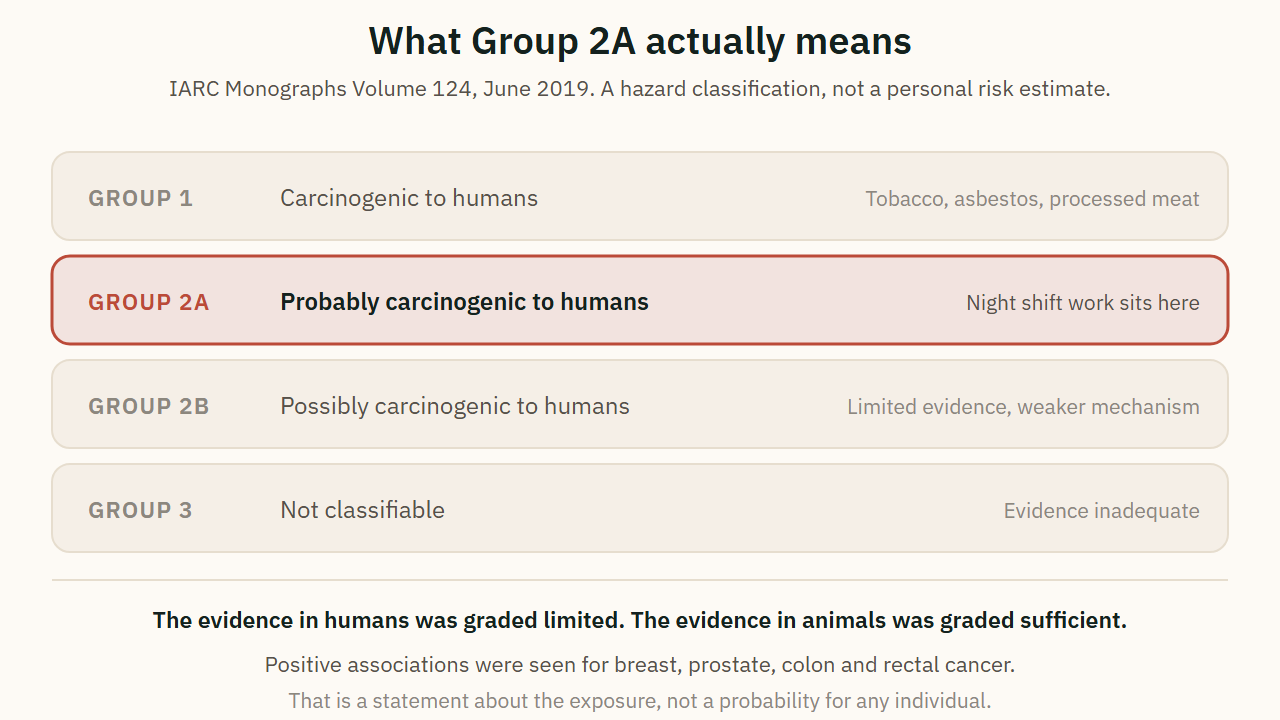
To understand this, one must understand the IARC scale. The agency performs hazard identification, not a personal risk estimate. They categorize the strength of evidence that an exposure can cause cancer, rather than the potency or the likelihood that an individual will be harmed at a specific "dose" of night shifts.
While Group 1 is reserved for agents with "sufficient" evidence in humans (like tobacco), and Group 3 for those where evidence is "inadequate," Group 2A sits in the middle: the agency judges the evidence sufficient to act upon, even if it is not yet conclusive in humans.
"The classification was based on limited evidence in humans, with positive associations observed for cancers of the breast, prostate, colon and rectum; sufficient evidence in experimental animals for alteration of the light-dark schedule; and strong mechanistic evidence through immunosuppression, chronic inflammation and cell proliferation."
The term "limited evidence in humans" is a precise technical designation. It means a positive association has been observed, but other explanations cannot be ruled out with confidence. Knowing this classification is not about frightening yourself out of a job; it is about moving from a position of accidental exposure to one of informed advocacy.
Why night work is career-invisible
The career mechanism of the night shift mirrors the structural disadvantage of remote work. In the modern hospital, decisions are made, committees deliberate, and Directors "walk the department" almost exclusively during daylight hours. This creates a proximity bias that is difficult to overcome through merit alone.
Promotion and professional advancement rest on evidence that a decision-maker has seen and remembered. For the night pharmacist, the primary evidence of their capability arrives on a desk at 8:00 AM in the form of a hand-off note, a clinical summary read by a supervisor over a morning coffee. Even the most clinically gifted pharmacist remains "invisible" because they are absent from the rooms where talent is observed in real-time.
It is not that leadership thinks less of the night staff; it is that they rarely think of them at all when new opportunities arise. You cannot be remembered in a room you never enter.
Pricing the whole trade
When evaluating your schedule, you must weigh the "differential" against two compounding costs that rarely appear in your personal budget:
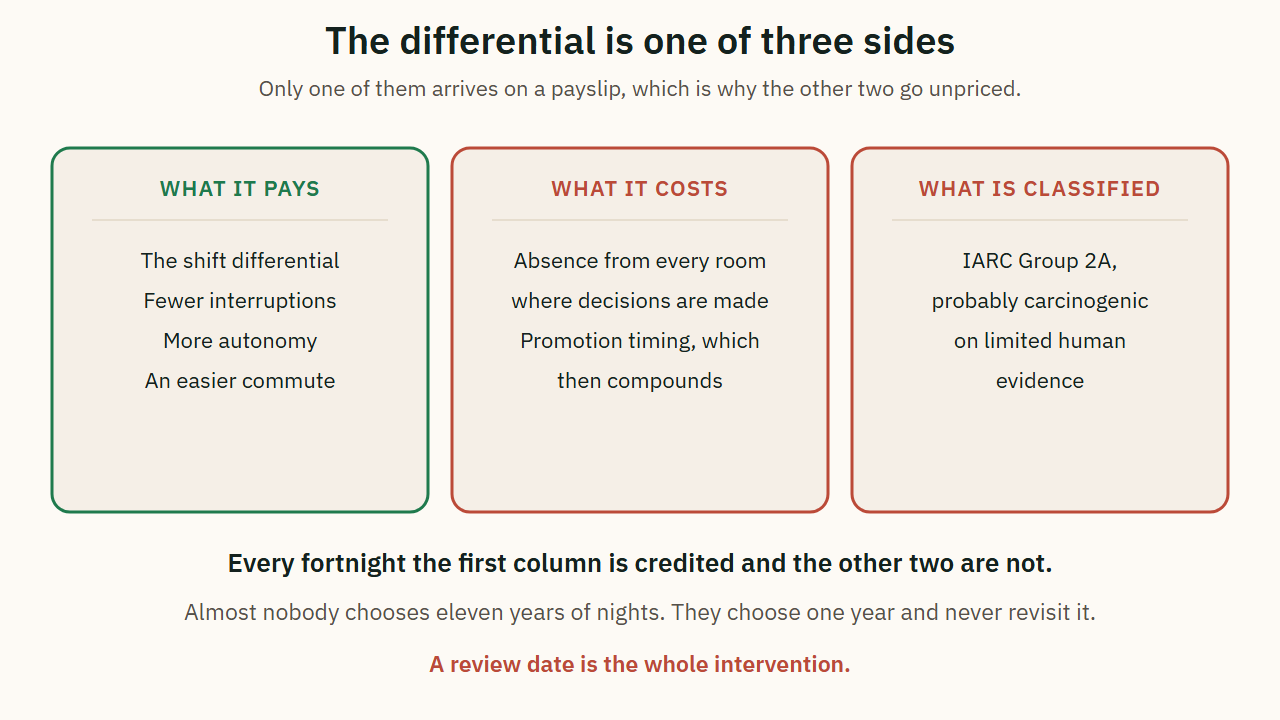
- The Compounding Career Lag: A delay in promotion is not a one-time loss of a title. It is a compounding financial hit. A two-year delay in moving to a senior grade represents lost earnings that, when projected over a 30-year career and factored into pension and investment growth, can dwarf the annual night-shift differential.
- The Health Exposure: The IARC-classified hazard is a long-term "cost" you are paying in exchange for today's autonomy and salary.
The goal here is not to tell you to quit. For many, the night shift is a necessary and deliberate choice for childcare or lifestyle. The goal is to ensure you are pricing the arrangement correctly. If the differential covers the bills but doesn't account for the career stagnation and the health trade-off, you are selling your time at a discount.
Two asks that keep you visible
If you choose to stay on nights, you must adopt a strategy to remain visible. There are two concrete asks you should make of your manager. They are high-impact for you, yet low-cost for the department, making them difficult for a Director to refuse.
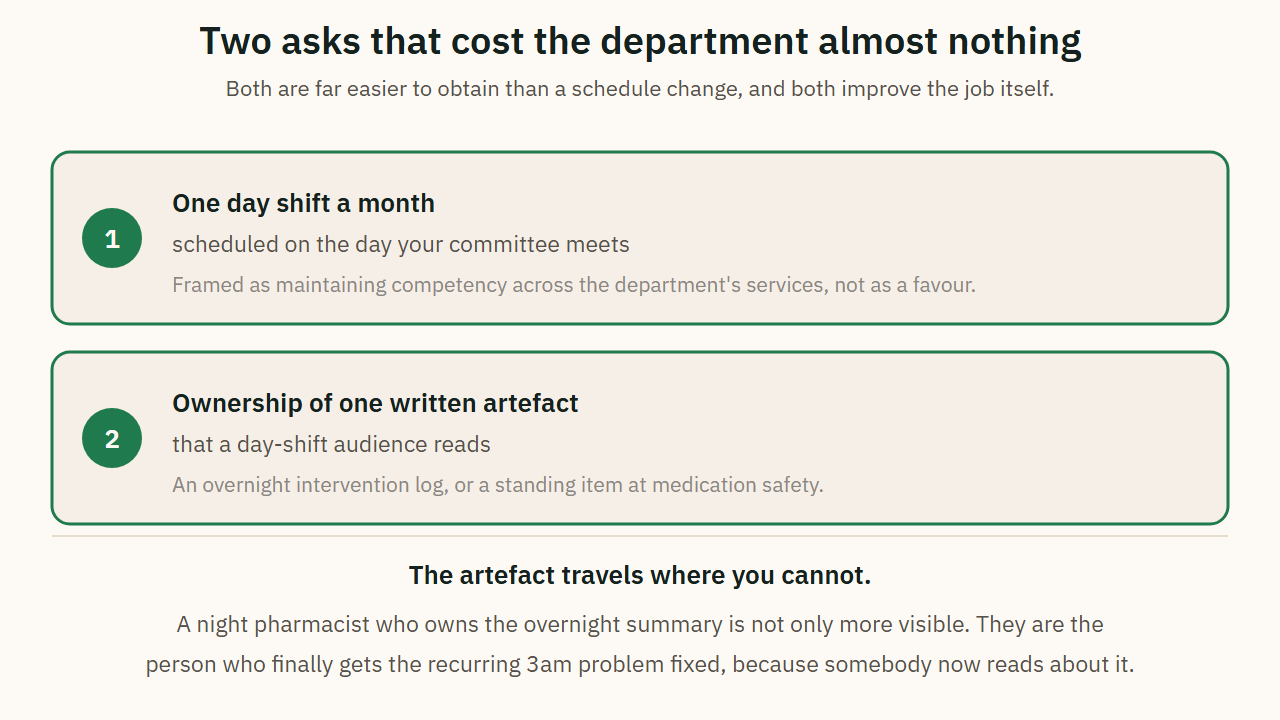
The Script: "I want to stay on nights, and I want to stay in the running. Can I take one day shift a month on a Tuesday so I can sit in on P&T, and can I own the overnight intervention summary that goes to the safety committee?"
- The Monthly Day Shift: By requesting one day shift per month, framed as "maintaining competency across the department's services", you force your presence back into the daylight. Scheduling this to coincide with Pharmacy & Therapeutics or other key committee meetings ensures you are seen by leadership as a stakeholder, not just a name on a rota.
- Ownership of the Written Artefact: You need a document that travels where you cannot. Whether it is an overnight intervention log or a medication safety summary, owning a recurring report gives you a voice in the daytime. When a daytime committee reads your report and finally fixes a recurring 3:00 AM safety issue, you have transitioned from a "shift filler" to a "system improver."
The failure is drift, not the decision
The most dangerous aspect of night work is drift, rather than the schedule itself. Almost no one consciously chooses to work eleven years of nights. Instead, they choose to work one year, and then through simple inertia and the regular arrival of the differential, they never revisit the decision.
To interrupt this drift, you must set a review date. Put a reminder in your calendar for twelve months from today. On that date, write down exactly what would have to be true (in your health, your finances, or your family goals) for you to move back to a day schedule.
A Note to Managers: If you are the one writing the rota, the strategy is different: rotate nights rather than assigning them permanently. By rotating shifts, you spread both the health exposure and the career visibility costs across the team instead of concentrating them on a single individual. This protects your most valuable asset, your human capital.
Choosing the duration on purpose
Intentionality is the hallmark of a senior professional. Whether you are the pharmacist on the floor or the strategist in the office, the objective is to ensure that the night shift remains a deliberate choice rather than a stale habit.
If you are currently on permanent nights, ask yourself: Is this schedule a tactical decision based on your needs today, or are you in the middle of an eleven-year accident? By naming your duration and implementing a visibility strategy, you ensure that when you finally look back at the "whole trade," it is one you would choose again.
The action plan
If you are on permanent nights, then put a review date in your own calendar for twelve months out, and write down now what would have to be true for you to move. The failure mode is drift, and a date is what interrupts drift.
Second plan:
If your next schedule request is due, then ask for one day shift a month on the day your committee meets.
The checklist
| Do this | Why it matters |
|---|---|
| Read the IARC classification wording, not a headline about it | Group 2A with limited human evidence is a specific claim |
| Price the differential against promotion timing and the exposure | The payslip shows one of the three |
| Ask for one day shift a month, on a decision day | Presence where evidence is observed |
| Own something that produces a written artefact | The artefact travels where you cannot |
| Set a review date and name the conditions to move | Interrupts the drift that produces eleven-year accidents |
| If you write the rota, rotate nights rather than assigning them permanently | Spreads both costs instead of concentrating them |
| Revisit after any change in health, family or goals | The right answer changes with circumstances |
References
- IARC Monographs Volume 124: Night Shift Work. International Agency for Research on Cancer, June 2019. Group 2A, probably carcinogenic to humans.
- IARC Monographs Volume 124 questions and answers document, IARC, 2019.
- Night shift work and its carcinogenicity. Lancet Oncology 2019.
salary-negotiation-hospital-pharmacyfor compounding.
Want the practice knowledge behind this?
Your First Year as a Hospital Pharmacist covers the clinical judgment a residency front-loads. Part of the Pharmacy Handoff library.
See the book