The Technician Vacancy Multiplier: Why Pharmacy Departments are Misallocating PharmD Labor

The "Glorified Tech" Paradox
There is a pervasive frustration echoing through hospital hallways and pharmacy forums: highly educated Doctors of Pharmacy (PharmDs) find themselves anchored to the dispensing counter, performing tasks traditionally reserved for technicians. This has led some industry veterans to argue that the degree itself is fundamentally "overbuilt." One 37-year veteran recently proposed a radical strategic shift: replacing the mandatory PharmD with a 2-3 year vocational track at community colleges. This would produce staff willing to work for $35 to $50 an hour without the crushing debt load of a doctoral program.
However, from the perspective of a healthcare workforce analyst, the problem isn't the degree's design, it is a massive labor-cost arbitrage failure. We are not witnessing an over-education of the workforce, but a systemic staffing collapse where departments are forced to pay a "pharmacist premium" for distributive work. The "glorified technician" isn't a job description; it's an operational emergency.
Takeaway 1: The Vacancy Gap is a Chasm, Not a Crack
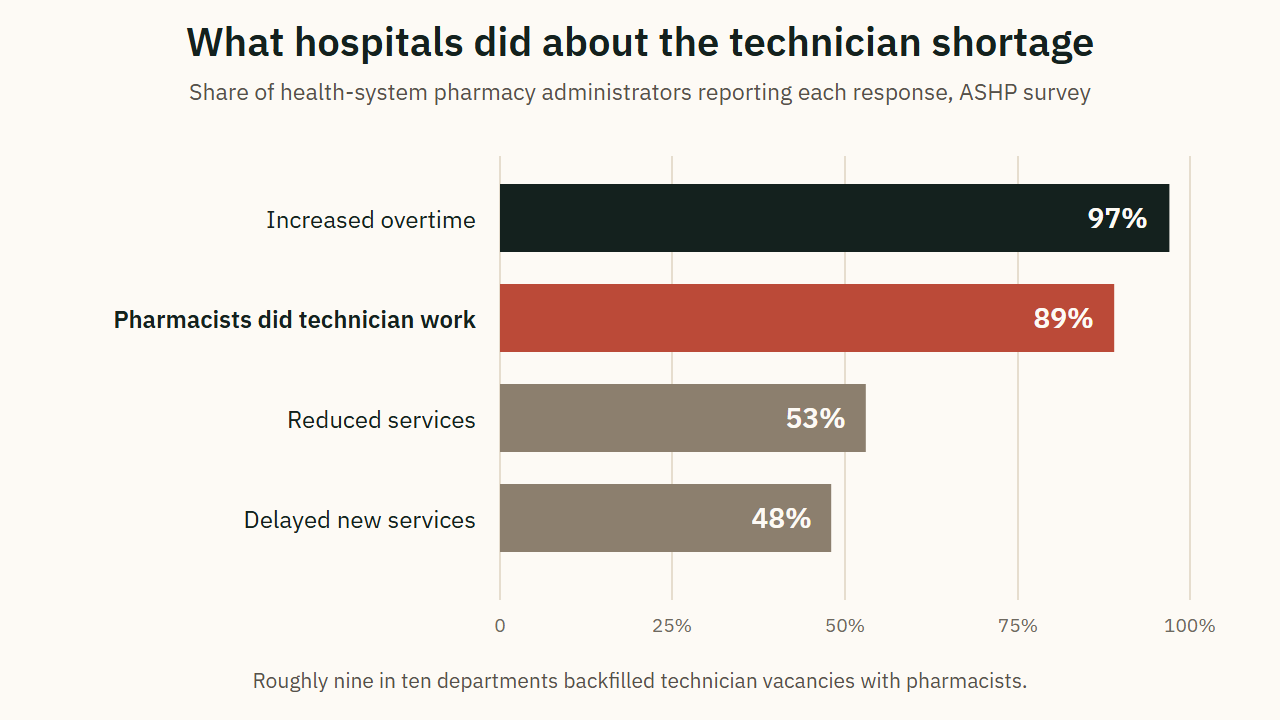
The observation that pharmacists are doing technician work is more than anecdotal; it is a documented operational reality. According to ASHP data, 89% of hospital pharmacy departments reported using pharmacists to fill technician shifts or perform technician activities.
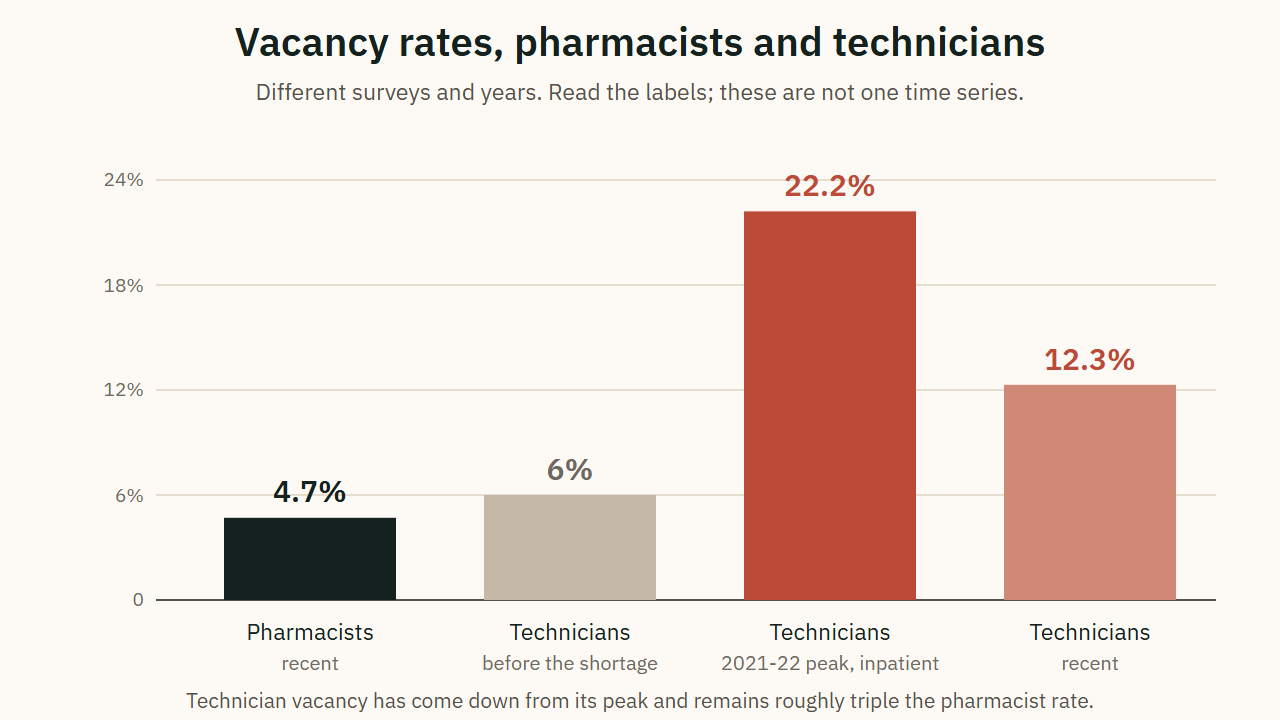
This "backfilling" phenomenon is driven by a staggering disparity in vacancy rates. To understand the gravity of the situation, one must look at the ratios:
-
Pharmacist Vacancy: 4.7% (with 11% turnover).
-
Technician Vacancy: Peaked at 22.2% during the 2021-2022 shortage and remains at approximately 12.3%.
Even as the market stabilizes, the technician vacancy rate remains roughly triple that of pharmacists. When the technician bench is empty, the work of medication distribution does not stop; it simply migrates to whoever is licensed and standing in the building. Because the technician vacancy is consistently a multiple of the pharmacist rate, pharmacists are forced into "backfilling" roles by sheer mathematical necessity.
Takeaway 2: The Invisible ROI Misalignment of Canceled Care
Using a PharmD (averaging $60+/hr) to perform tasks valued at $20/hr is an operational disaster, but the true cost is the opportunity cost of clinical revenue and patient outcomes. When the "distributive machine" consumes the pharmacist's time, clinical programs, the very services that justify the PharmD's ROI, are the first to be sacrificed.
The data reveals a significant contraction in healthcare access:
-
53% of departments reduced clinical services due to staffing shortages.
-
48% of departments delayed the expansion of new clinical initiatives.
Furthermore, approximately 60% of departments report insufficient staffing for advanced clinical roles. This isn't just a matter of professional frustration; it's a systemic failure where the clinical mandate of the profession is postponed to maintain the baseline of medication dispensing.
Takeaway 3: The $35,000 Revolving Door
The financial logic of underfunding technician roles is increasingly difficult to defend when one calculates the cost of attrition. Technician turnover is a major fiscal drain, with estimates placing the cost of losing a single employee between $25,000 and $35,000.
Despite the clear financial incentive to stabilize this workforce, three-quarters of technicians identify higher pay as the primary lever for retention. For a strategist, the choice is clear: fund the technician bench or continue paying the hidden tax of pharmacist backfilling and turnover costs.
Strategic Levers for Operational Change:
| Lever | What it Addresses | What it Needs |
|---|---|---|
| Technician Pay | The vacancy at the source | A data-driven budget case to finance competitive wages |
| Tech-Check-Tech | PharmD hours spent on product verification | State allowance and facility-specific validation |
| Advanced Certificates | Scope of practice and retention | Program funding and protected training time |
| Automation | High distributive volume | Significant capital expenditure |
Takeaway 4: The Rise of the Advanced Technician (CPhT-Adv)
The solution to freeing up pharmacist time lies in the professionalization of the technician workforce. The Pharmacy Technician Certification Board (PTCB) has introduced the CPhT-Adv credential, supported by five assessment-based certificate programs.
A critical tool in this transition is Technician Product Verification (TPV), or "tech-check-tech." By allowing a trained technician to verify the work of another, a department can eliminate the pharmacist premium on routine distributive tasks. A department's failure to implement these advanced credentials is often a self-inflicted wound; it indicates a refusal to invest in the very structures that would allow pharmacists to practice at the top of their license.
Takeaway 5: Strategic Career Due Diligence
For pharmacists evaluating new roles, the job description is often a secondary concern to the department's operational health. To determine if a "clinical" role is actually a "backfilling" role in disguise, candidates must perform due diligence on the technician infrastructure.
Ask these two questions during the interview process:
"What is your current technician vacancy rate and what was your turnover rate last year?"
- "Is tech-check-tech (TPV) fully implemented here? If not, what is the specific roadmap for implementation?"
A manager's inability to answer these questions is a significant red flag. It indicates a lack of operational tracking and a management style that prioritizes crisis response over data-driven staffing. If the department does not track its technician health, you can assume you will be the one filling the gaps.
A Nuanced Reality: Perception vs. Observation
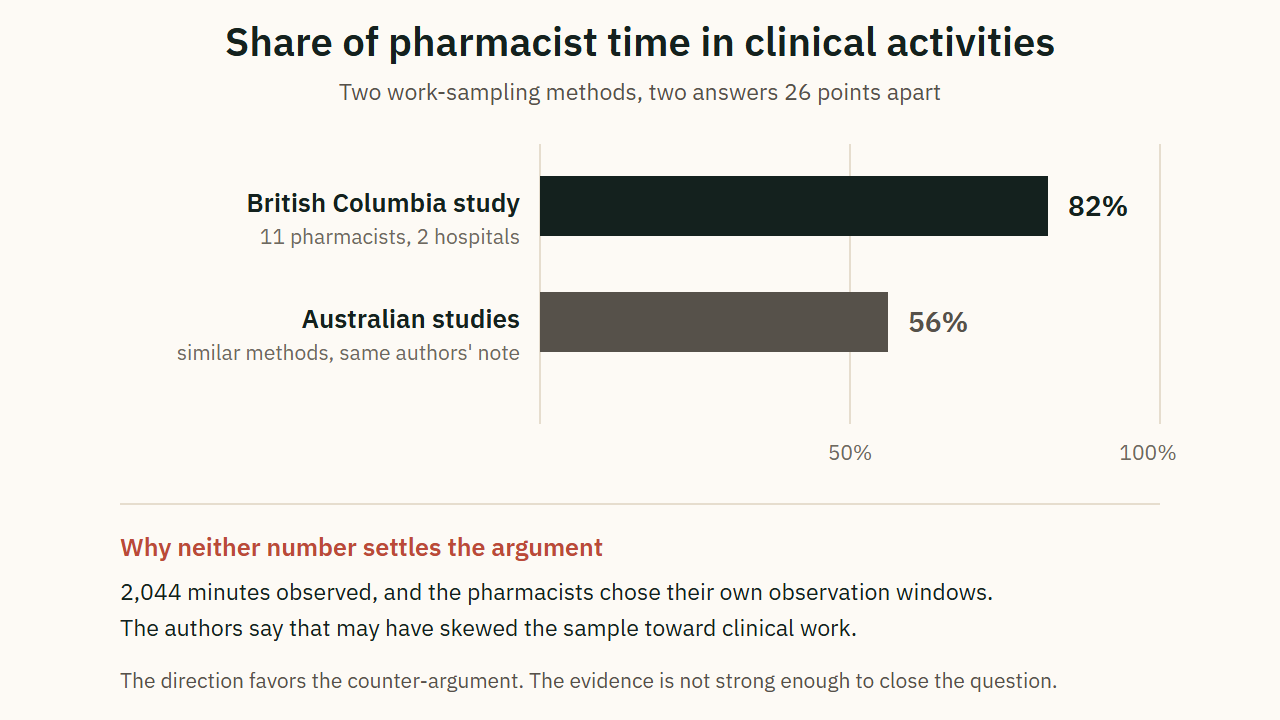
While the "glorified tech" narrative is dominant, workforce analysts must also account for perception bias. One work-sampling study of hospital pharmacists found that 82% of their time was actually spent on clinical activities, with dispensing accounting for only 0.5%. While this study was small and potentially skewed by self-observation, it serves as a reminder that the frustration of doing technician work can sometimes outweigh its actual duration in our memories. Regardless, if 89% of managers admit to the practice, the structural problem remains undeniable.
Conclusion: Reclaiming the Clinical Mandate
The argument that the PharmD degree is "over-education" ignores the underlying operational reality. The profession is not suffering from too much education; it is suffering from an under-supported foundation.
If pharmacists are to be the most accessible and clinical healthcare providers, that accessibility cannot be tethered to an IV hood or a dispensing counter. The survival of the pharmacy profession's clinical mandate depends on a radical shift in how technician roles are valued, funded, and advanced. Until the technician vacancy crisis is resolved, the pharmacist's doctoral training will continue to be an expensive substitute for a fractured distributive system.
Related
- The original thread on Student Doctor Network
- ASHP on the technician shortage
- What to measure when workload complaints rise but hours do not
- Running the Pharmacy, on staffing, throughput and the schedule
- The Business of the Pharmacy, on making the budget case for a position