From retail to hospital: what actually gets you through the first 90 days

Introduction: The "New Grad" Trap
You have spent years in the high-volume trenches of community pharmacy, yet within forty-eight hours of starting your first hospital role, you find yourself paralyzed. You will experience a regression to "novice speed", a physiological response to a high-stakes, unfamiliar environment. You will find yourself checking a simple order for a sodium chloride bolus three or four times, second-guessing the very clinical foundations you've relied on for years.
The "New Grad Trap" is set when a manager, accustomed to the rhythm of an established department, observes your hesitancy and raises "concerns about speed" in your second week. Do not internalize this as a personal failure. This pressure is a systemic failure of hospital onboarding. You are transitioning from volume-based speed to clinical-accuracy speed, and your first 90 days require a strategically defensive roadmap to survive the shift.
Your Manager's Timeline is Likely Impossible (And Here's the Proof)
When a manager assesses your independence after only 14 days, they are ignoring the gold standard of pharmacy training. Accredited PGY1 residencies, which recruit the "best and brightest" graduates who are already fresh from clinical rotations, typically allocate six weeks of orientation within a 52-week year. Even after those six weeks of intensive, structured learning, a resident is rarely expected to practice with total independence.
If the top tier of new graduates isn't ready in six weeks, you should not be expected to be a master of the house in two.
The perceived "failure" of many transitioning pharmacists is actually a failure of the "shadowing" model. Most hospital training is passive observation, sitting beside another pharmacist, watching, then being watched. This is not training; it is learning by osmosis. As the Sim et al. scoping review indicates, structured, practice-integrated onboarding is the exception, not the rule. Reject the two-week assessment window; it is mathematically and educationally unsound.
It's Not a Clinical Knowledge Gap; It's a Navigation Gap
The most important "Aha!" moment of your first month is this: you don't lack clinical knowledge; you lack navigation skills. In retail, your speed was built on a workflow and a physical environment you had memorized. In the hospital, that memory is obsolete. You know what a drug does, but you don't know where the hospital hides the policy for it.
The technical shifts are the real hurdles:
| What | Why it matters |
|---|---|
| The Electronic Health Record (EHR) | Finding where specific lab data or physician notes are buried. |
| Formulary Restrictions | Navigating what is stocked versus what is preferred by specific specialties. |
| Order Sets | Understanding how the hospital groups treatments, which can bypass individual clinical decisions. |
| Escalation Protocols | Knowing exactly who to call at 3 AM when an order is nonsensical. |
Action Item: Build Your Navigation Map This is a low-effort, high-reward task that can be completed in a single afternoon. Create one document that includes:
-
Digital paths to all hospital-specific protocols and the ISMP high-alert medication list.
-
A cheat sheet for common order sets.
-
A "Phone Tree" for after-hours escalation, including nursing unit leads and on-call providers.
The "Impostor Phenomenon" is the Majority Experience
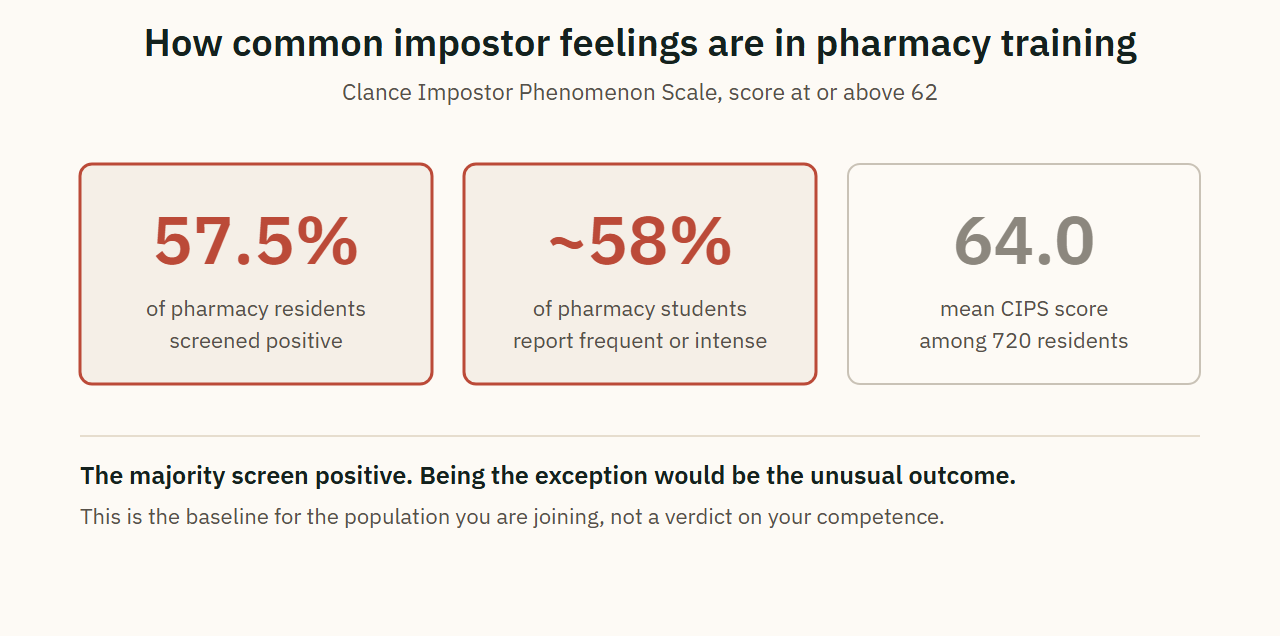
That feeling that you are "faking it" is not a unique pathology; it is a statistically predictable response to transition. Data shows that 57.5% of pharmacy residents and 58% of pharmacy students screen positive for impostor feelings on the Clance scale.
In a hospital, a verification decision can reach a patient in minutes rather than the hours of "wait time" common in retail. Your second-guessing is not a sign of incompetence, it is a careful person's response to unfamiliar consequences. You aren't questioning whether sodium chloride is saline; you are questioning your mastery of the hospital's EHR and the immediate clinical impact of that order. Accept the feeling as a byproduct of your diligence.
The "Batch" Strategy: How to Look Organized While Learning
You must control the variables you can: your organization and your professional branding.
The Batching Method Constant interruptions kill a trainer's productivity and make you look frantic. Instead of asking questions in real-time, keep a running list. Present this list once or twice a day. You will ask the same number of questions, but you will appear organized and respectful of the department's workflow.
Script for the Manager: "Break Glass in Case of Emergency" If you are pushed on your pace before you are ready, use this script to align expectations and reset the timeline: "I want to ensure we have the same timeline for my progress. My understanding is that most practitioners take approximately three months to reach full independence, and PGY1 residencies budget at least six weeks of orientation for graduates.
I am currently in week two. Can you define the specific benchmarks you want to see by week four, and how we can bridge the gap from my current orientation to those goals?"
"Slow Accuracy" Demand a standard of Slow Accuracy. State this out loud to your supervisors: "I am currently prioritizing absolute accuracy over speed to ensure I am following every protocol and navigation step to the letter. Speed will follow once the systems are memorized." This rebrands your hesitancy as a professional commitment to patient safety.
Conclusion: Building the Map
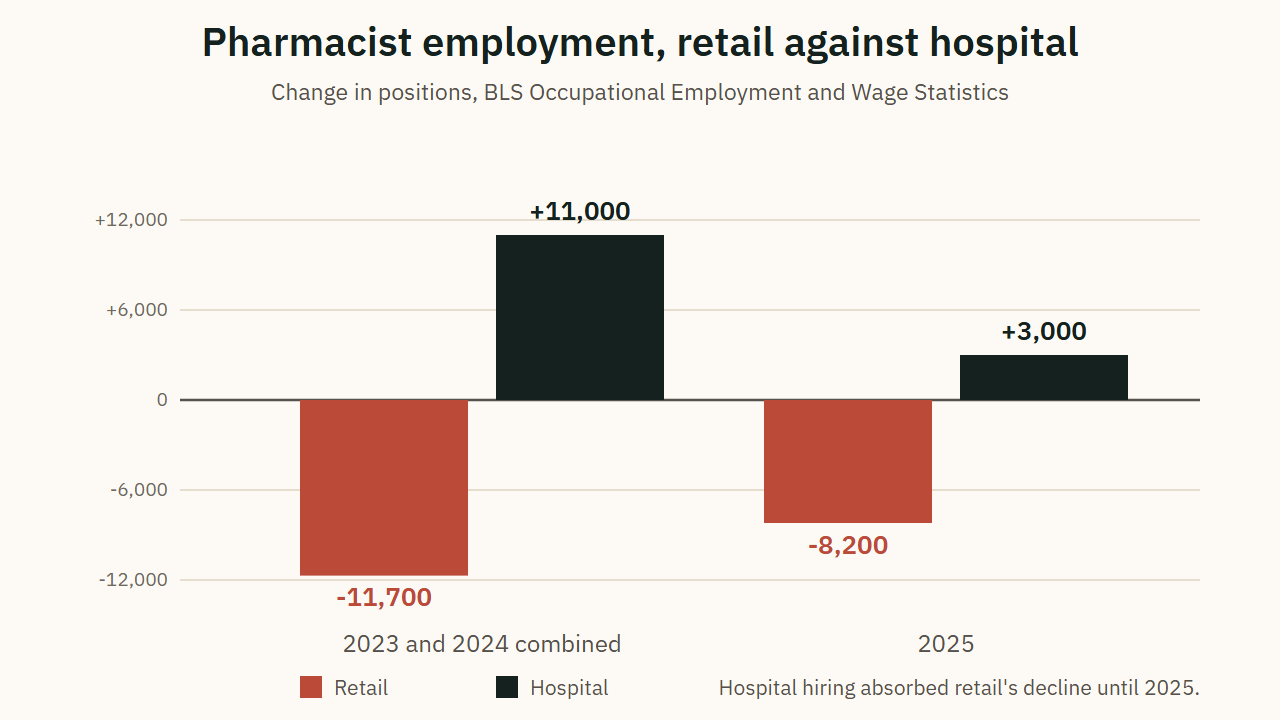
The pharmacy labor market is undergoing a tectonic shift. In 2025 alone, retail pharmacy lost 8,200 positions while hospitals added 3,000. Nearly half of all pharmacists now practice outside the community setting. You are moving with the industry, and the friction you feel is simply the cost of the transition.
The clinical knowledge you spent years building is still there; it is simply buried under new software and unfamiliar hierarchies. Your job in the first 90 days is not to be the fastest pharmacist on the floor, it is to be the one who knows where the map is kept.
Everything that feels like missing clinical knowledge in month one is usually missing navigation.
Related
- The original thread on Student Doctor Network
- Impostor phenomenon in pharmacy residents
- ISMP list of high-alert medications, free and the first thing to read
- What actually gets a hospital pharmacist promoted, for the step after this one
- Your First Year as a Hospital Pharmacist is written for exactly this transition: the work-up sequence, what you are actually checking, and the high-alert short list