Why Everything You Know About Drug Shortage Numbers is Probably Wrong (and What to Track Instead)
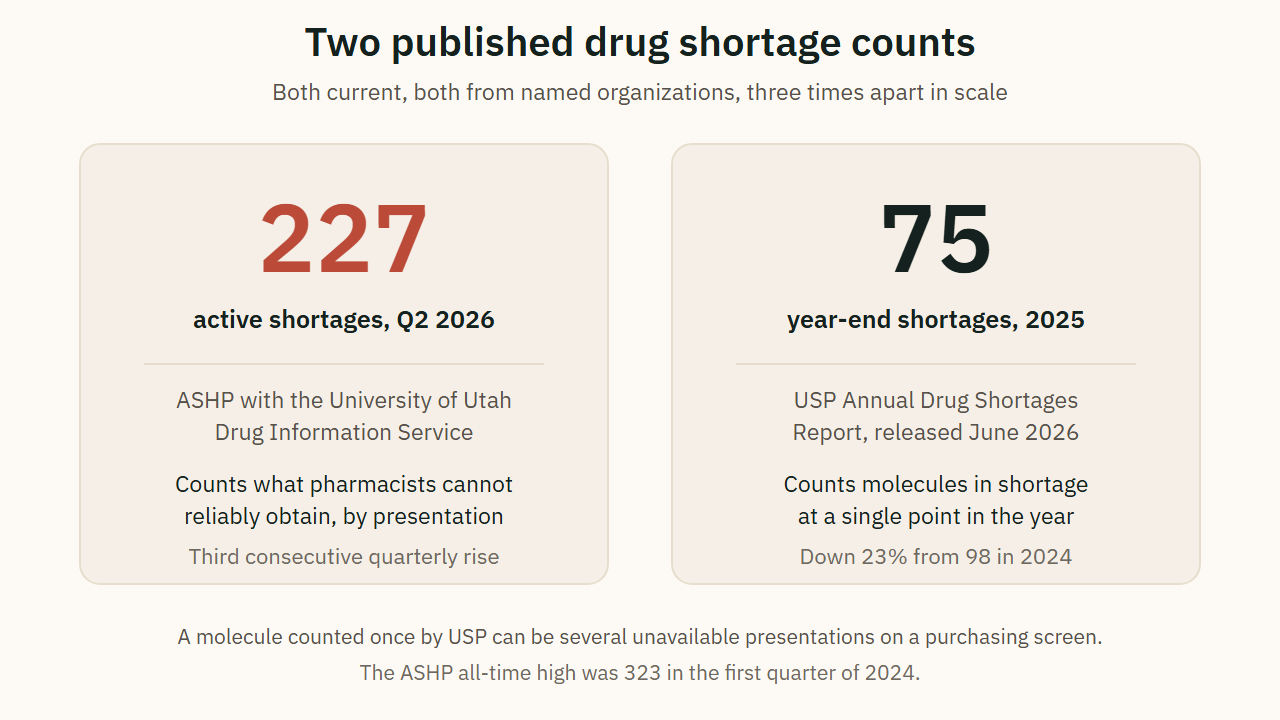
National drug shortage headlines are currently delivering a split message that borders on the schizophrenic. One major report suggests that shortages have risen for three consecutive quarters, signaling a deepening crisis. Simultaneously, another reputable industry source indicates that shortages actually fell by 23% last year. For hospital C-suites and pharmacy directors, this statistical dissonance is more than a curiosity, it is a strategic barrier. If the national data is contradictory, how can a department accurately forecast its budget, justify staffing increases, or mitigate clinical risk?
To navigate the current landscape, healthcare leaders must look past the top-line numbers. The reality is that the volume of shortages is no longer the most critical metric. The nature, duration, and systemic drivers of these gaps have shifted, requiring a new framework for operational measurement that prioritizes local reality over national "weather."
The "Two Truths" of Shortage Data
The discrepancy between the two most cited shortage trackers, the United States Pharmacopeia (USP) and the American Society of Health-System Pharmacists (ASHP) in partnership with the University of Utah, is a matter of methodology, not accuracy.
-
USP Count (75): USP counts molecules at a specific point in time. Their year-end snapshot measures how many unique drugs are in shortage across the country.
-
ASHP/Utah Count (227): This tracker measures presentations, the specific strengths, concentrations, and dosage forms, continuously.
For the pharmacy department, the ASHP count is the only one that actually maps onto a purchasing screen. A drug that is short in three out of five available concentrations represents three distinct operational disruptions, even if it counts as only one "molecule" in a national report. This difference in the "denominator" fundamentally changes the narrative of the crisis. While a falling molecule count might suggest a macro-level improvement in the pharmaceutical market, the rising presentation count confirms that the daily work of finding substitutable products remains highly volatile.
Duration is the New Disaster
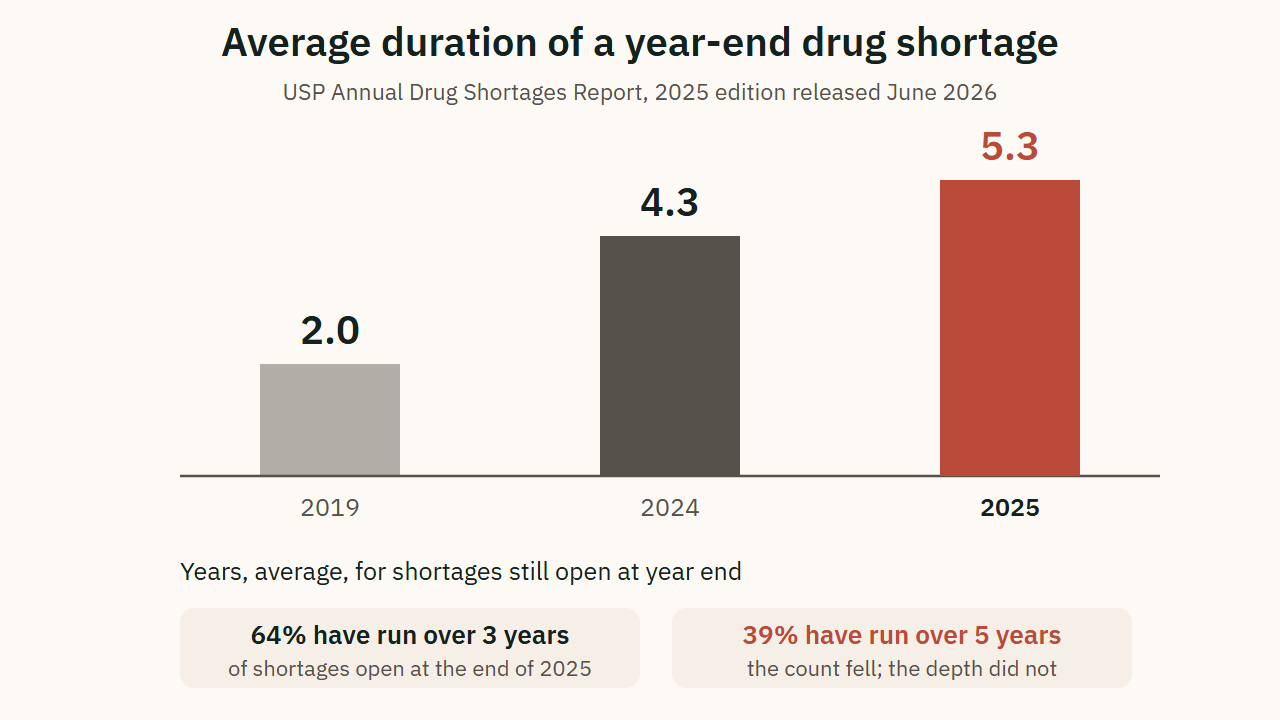
While the industry focuses on the volume of shortages, the more dangerous trend is how long they are lasting. The "weather" of short-term supply gaps is being replaced by a permanent climate of unavailability, driven by deep-seated geopolitical vulnerabilities.
The average drug shortage now lasts 5.3 years, more than double the average duration of 2 years recorded in 2019.
This pool of long-running, structurally caused shortages is significantly more hazardous than a high volume of short-term ones. The cause of this "forever shortage" is often found at the very base of the supply chain: 33 of the 75 shortages identified by the USP depend on a key starting material sourced from a single country.
These geopolitical bottlenecks ensure that once a supply line breaks, it remains broken for years. A five-year shortage is not a purchasing hurdle; it is a permanent change to the standard of care that requires fundamental shifts in clinical protocols.
The High Cost of Cheap Drugs: A Quality Paradox
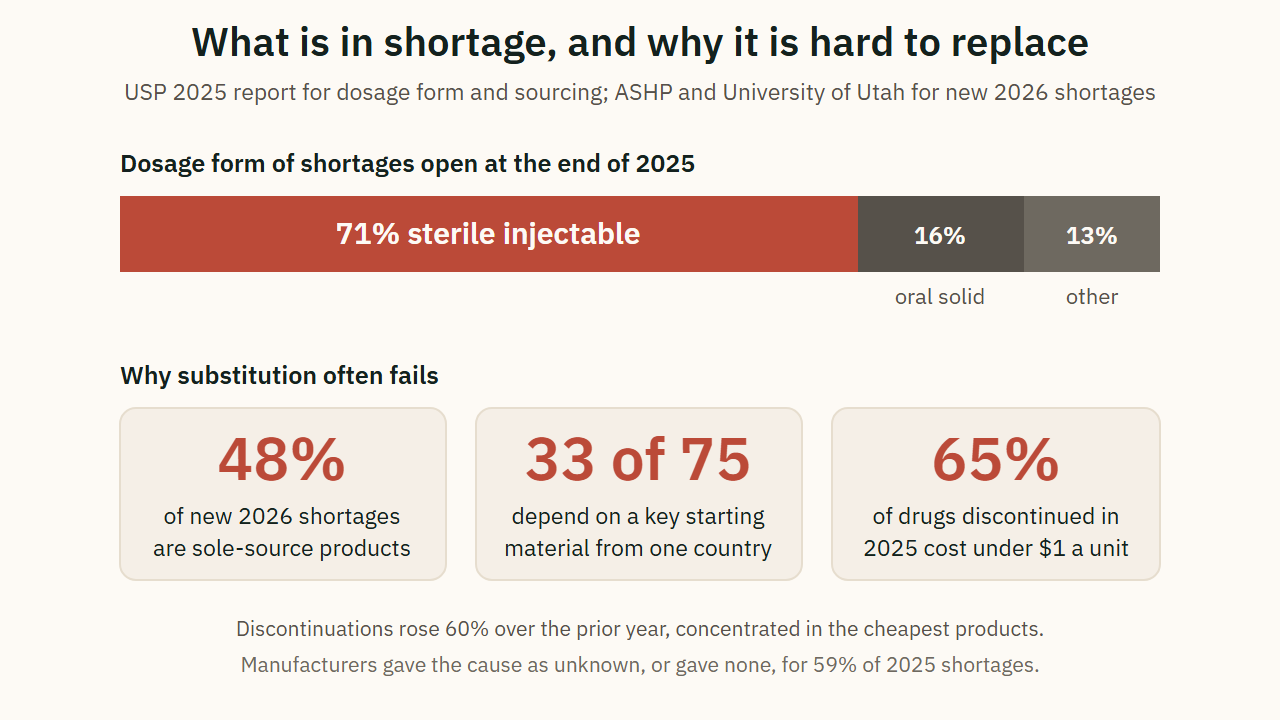
The composition of modern shortages reveals a fragile economic ecosystem. Data shows that 71% of active shortages involve sterile injectables, the backbone of acute care, and the drivers are often counter-intuitive.
While one might expect shortages in high-demand, high-margin medications, we are actually facing a crisis of the "low-cost." 65% of discontinued products in 2025 were priced under $1 per unit. These razor-thin margins create a "quality paradox": the price point is so low that manufacturers have no financial incentive to invest in the redundant capacity or high-end quality systems necessary to prevent facility failures. When a drug costs less than its packaging, the supply chain loses all resilience.
The Sole-Source Bottleneck: A Curative Crisis
The impact of this economic fragility is best illustrated by Ifosfamide. Following manufacturing quality problems at a key supplier, the direct result of the lack of investment mentioned above, this agent entered a severe shortage. Because of sole-sourcing, where 48% of new 2026 shortages involve a single manufacturer, a single plant failure can jeopardize three separate curative-intent cancer protocols: testicular cancer, sarcoma, and the RICE salvage regimen for relapsed diffuse large B-cell lymphoma.
Compounding this is a pervasive lack of transparency: for 59% of shortages reported in 2025, manufacturers provided "unknown" reasons or no reason at all. Without knowing the root cause, pharmacy leaders cannot predict a return to market, forcing them to manage every gap as a permanent loss.
Resource Diversion: The Invisible "Labor Tax"
The national conversation often misses the "labor tax" paid by pharmacy teams. The time hospitals spend managing drug shortages more than doubled between 2019 and 2024. As an analyst, I view this not just as a workload issue, but as a massive Resource Diversion.
Every hour a pharmacist spends on a therapeutic review, order set change, or ADC reconfiguration is an hour "cannibalized" from high-value clinical programs. This labor tax drains resources from antimicrobial stewardship, discharge counseling, and opioid safety initiatives. When you factor in that 16% of active shortages involve controlled substances (requiring intensive regulatory documentation) and 10% involve contrast agents (impacting entire imaging departments), the complexity of this labor becomes an immense administrative and compliance burden that headlines ignore.
Stop Watching the Weather, Start Measuring the Work
To move from a reactive to a strategic stance, pharmacy leaders should stop tracking national totals and start measuring two local metrics that predict actual workload:
-
The Age of Open Shortages: Categorize your shortages by duration. A list dominated by items under six months is a purchasing problem that can be managed with procurement tactics. A list where most items have been open for over three years is a formulary problem requiring clinical leadership to redesign protocols.
-
Hours Spent Managing Shortages: Quantify the time spent by pharmacists and technicians on shortage-related tasks. This is essential for building a staffing case and demonstrating the opportunity cost to hospital leadership.
The resolution of the 0.9% sodium chloride (saline) shortage provides the ultimate lesson. This shortage ran for seven years (2018-2025). It was finally resolved through massive manufacturing investment and regulatory flexibility, a structural resolution. No amount of "transactional" purchasing tactics or "buying ahead" could have solved a seven-year gap.
A Final Thought for Pharmacy Leaders
The conflict between national shortage counts is a distraction. The real story is the transition from temporary supply gaps to long-term structural changes in the pharmaceutical market. As you evaluate your department's performance, ask yourself: Are we solving for a temporary supply gap, or are we properly staffed and structured to manage a permanent change in the medical supply chain? Turning your attention from national totals to local duration and labor metrics is the first step in answering that question.
Related
- ASHP drug shortage statistics and current shortages
- GAO on how HHS coordinates its shortage work
- FDA drug shortages
- Which drugs should you actually stock up on?, on the concentration test that finds the next one
- Running the Pharmacy, on managing a shortage after it starts
- The Business of the Pharmacy, on what shortage substitution does to the drug budget
Want the practice knowledge behind this?
Your First Year as a Hospital Pharmacist covers the clinical judgment a residency front-loads. Part of the Pharmacy Handoff library.
See the book