Is Your Pharmacist Salary Actually Falling Behind? The Missing Metric in the "Fair Pay" Debate
On professional forums like the Student Doctor Network (SDN), a single, persistent frustration dominates the discourse: pharmacist pay feels stagnant. Practitioners often describe a "hollowing out" of the profession's economic status, even as responsibilities and clinical complexity increase.
The data for 2025 initially seems to contradict this sentiment. According to the latest Bureau of Labor Statistics (BLS) data and Drug Channels analysis, the average pharmacist salary rose to $140,920, a 2.7% increase over the previous year. With the Consumer Price Index (CPI) growing at 2.4%, pharmacists technically received a "real" raise.
Yet, the "upper middle class" lifestyle that once defined the profession feels like it is slipping away. To understand why the pay "feeling" does not match the pay "number," we have to look past nominal growth and examine relative economic compression.
The "Relative" Reality: Your 30% Premium is Shrinking
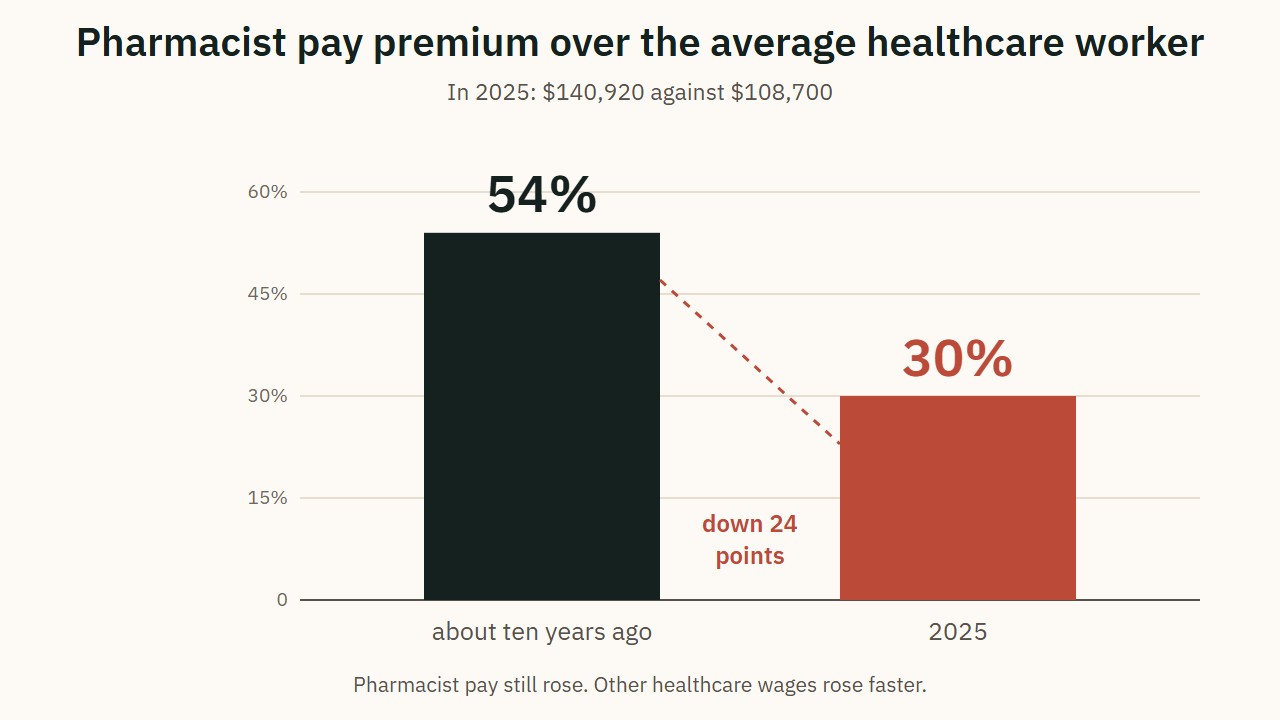
The primary driver of professional dissatisfaction isn't that pharmacist pay is falling in a vacuum; it is that the profession's "labor arbitrage" advantage is evaporating. A decade ago, pharmacists commanded a massive 54% premium over the average healthcare worker. By 2025, that premium plummeted to approximately 30%.
The community consensus, frequently echoed in professional forums, is that:
This isn't just a grievance; it is a measurable structural shift. While pharmacists have seen nominal gains, the rest of the healthcare field is moving significantly faster. You can receive a raise every year and still lose your relative economic standing if the "floor" of the industry is rising at a higher velocity. For many, the frustration stems from this realization: your specialized position within the healthcare hierarchy is being compressed from below.
The Retail Paradox: A "Risk Premium" in a Shrinking Sector
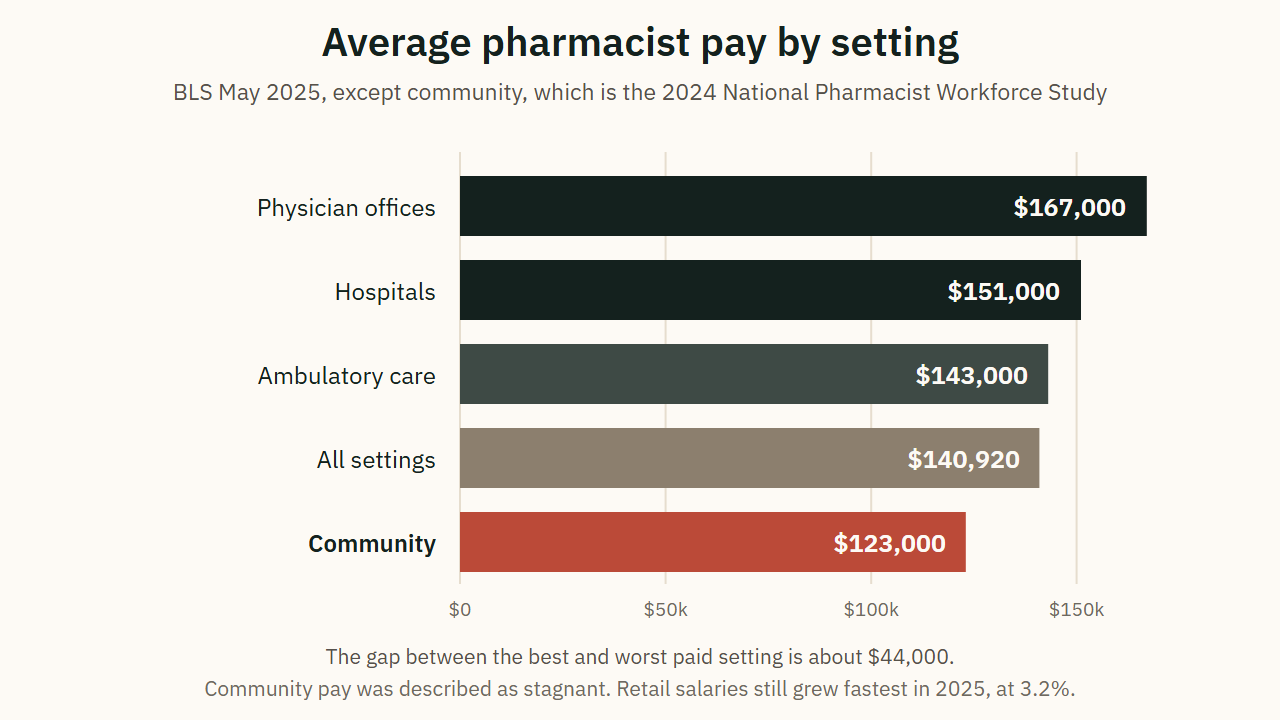
The 2025 data reveals a counter-intuitive trend in retail pharmacy. Often the target of "stagnation" complaints, retail salaries actually grew the fastest in 2025 at 3.2%, significantly outperforming hospitals (+2.2%) and physician offices (+0.2%).
However, this growth is a classic "Risk Premium." Retailers aren't necessarily paying for increased clinical value; they are paying a premium to compensate for a deteriorating environment. Consider the context:
-
Contraction: Retail employment fell by 4.8% (8,200 positions) in 2025, reaching its lowest level since 2010.
-
Workload Stress: According to the 2024 National Pharmacist Workforce Study, 91% of chain pharmacists rate their workload as "high or excessively high." Compare this to just 55% for independent community pharmacists.
Recruiters are raising pay because the setting has become so difficult to staff. They are paying you to endure the workload, not just to verify prescriptions.
The Irony of the "Fair Pay" Ratio
In the search for a "fair" wage, many pharmacists benchmark themselves against physicians. A popular proposal on SDN suggests a "fair" pharmacist salary should be two-thirds (66%) of a Primary Care Physician's (PCP) earnings.
There is a profound irony here: A user testing this formula against a local PCP average of 220,000 found that the "fair" target would be roughly 145,000. The realization? The profession is already there. The national average of $140,920 is within striking distance of that benchmark, and many settings exceed it. This proves that the physician ratio is the wrong metric; achieving it hasn't solved the feeling of being undervalued.
The $44,000 Gap You're Probably Ignoring
The focus on physician ratios distracts from a much more actionable data point: the massive spread between pharmacy settings. The gap between the highest and lowest paying environments is now roughly $44,000.
| Setting | Average Pay | Also True of It |
|---|---|---|
| Physician Offices | $167,000 | Under 3% of employment, but growing |
| Hospitals | $151,000 | Employs 102,000 pharmacists (nearly 1/3 of the field) |
| Ambulatory Care | $143,000 | 82% job satisfaction; 93% daytime shifts |
| All Settings | $140,920 | The national mean; up 2.7% in 2025 |
| Community | ~$123,000 | Often described as stagnant; highest workload stress |
As a strategist, the math is clear: The "move" is more valuable than the "negotiation." If you are in a community setting earning 123,000, a successful 3% raise negotiation nets you an extra 3,690. However, moving one row up the table to Ambulatory Care represents a $20,000 jump, nearly six times the value of that raise, with a massive boost to quality of life.
The "Sweet Spot": Why Ambulatory Care Wins
With nearly half of all pharmacists now working outside of the retail sector, the professional landscape has shifted. While physician offices offer the highest raw salary, they represent a tiny fraction of the market.
Ambulatory Care has emerged as the definitive "sweet spot." It offers:
| What | Why it matters |
|---|---|
| The Financial Jump | A $20,000 premium over community pharmacy. |
| Quality of Life | 93% of shifts occur between 6 a.m. and 6 p.m. |
| Professional Fulfillment | An 82% job satisfaction rate, the highest in the 2024 Workforce Study. |
Conclusion: A Personal Audit
It is time to change your benchmark. Stop benchmarking against physicians, it is a comparison that hasn't moved in years and won't help your next career move.
Instead, benchmark against the setting next door. If you are staying in a high-stress, lower-paying setting while fighting for a 2% nominal raise, you are negotiating the wrong number. You are essentially subsidizing your employer's retention challenges with your own "opportunity cost."
Your Personal Audit: Look at the table above. Calculate your own "gap to the next row up." If that gap is larger than the raise you were planning to ask for, you aren't underpaid by your boss, you are in the wrong setting. Are you ready to stop negotiating for pennies and start moving for thousands?
Related
- The original thread on Student Doctor Network
- BLS Occupational Outlook Handbook, Pharmacists
- Which pharmacist salary number to use when you ask for a raise
- The Business of the Pharmacy, on how pharmacy labor budgets are actually built
- Running the Pharmacy, on staffing and the schedule