The 89% Bet: Why Your ICU Needs a New Default Fluid (And One Critical Exception)
Introduction: The Crystalloid Confusion
For the modern clinician, the "Great Fluid Debate" has become a source of profound frustration. We have been presented with a sea of data that, at first glance, appears fundamentally contradictory. Since 2015, five major randomized controlled trials have sought to settle the score between 0.9% saline and balanced crystalloids. When four of those trials returned null results for their primary outcomes, many hospitals stalled, waiting for a "definitive" signal that may never come.
However, the perceived confusion is a result of viewing these studies as bedside mandates rather than informatics opportunities. This is not a clinical deadlock. It is a clear-cut case for optimized choice architecture. While the individual patient requires clinical nuance, the decision for hospital order sets and floor stock is remarkably straightforward. It is time to recognize that our "default" fluid choice is essentially a population-level bet, one that the current evidence now clearly favors with nearly 90% certainty.
The Trials Didn't Actually Disagree
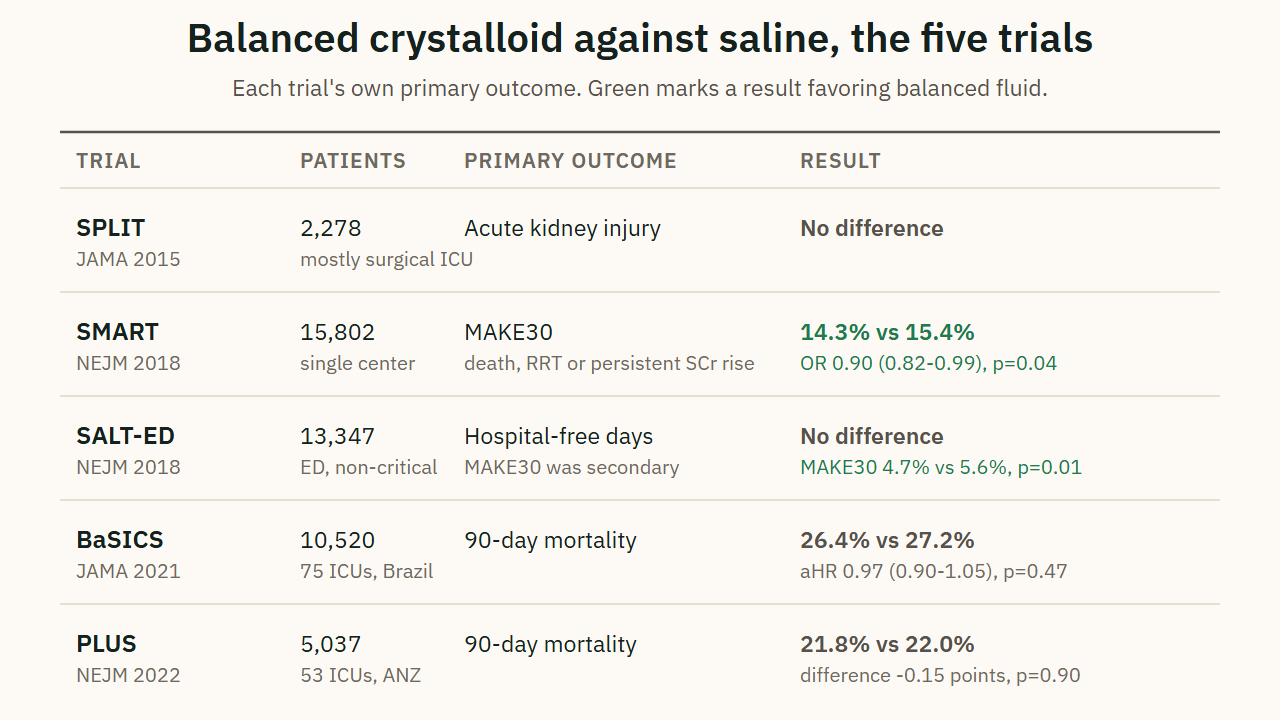
A common error in interpreting the fluid literature is reading the SMART, SALT-ED, SPLIT, BaSICS, and PLUS trials as contradictions. "Reading them as a contradiction is the common error." In reality, these studies were designed to measure different things across different populations.
-
SMART & SALT-ED (Kidney Focus): These trials focused on "Major Adverse Kidney Events" (MAKE30). SMART (15,802 patients) found a 1.1 percentage point absolute reduction in MAKE30 for balanced crystalloids (14.3% vs. 15.4%). SALT-ED (13,347 patients) found a similar signal in non-critically ill patients, with MAKE30 occurring in 4.7% of the balanced group versus 5.6% in the saline group.
-
BaSICS, PLUS, & SPLIT (Mortality and Surgery Focus): BaSICS (10,520 patients) and PLUS (5,037 patients) were powered for 90-day mortality and found no significant difference. SPLIT (2,278 patients) focused on a surgical population and was similarly null.
The synthesis is simple: A trial powered for mortality requires a massive effect size to reach statistical significance. A trial of 5,000 patients is mathematically incapable of detecting the subtle 1% difference in kidney outcomes found in the larger SMART and SALT-ED cohorts. When viewed together, the trials are entirely compatible, suggesting a small but consistent benefit concentrated in renal preservation.
The Power of the Pooled Estimate
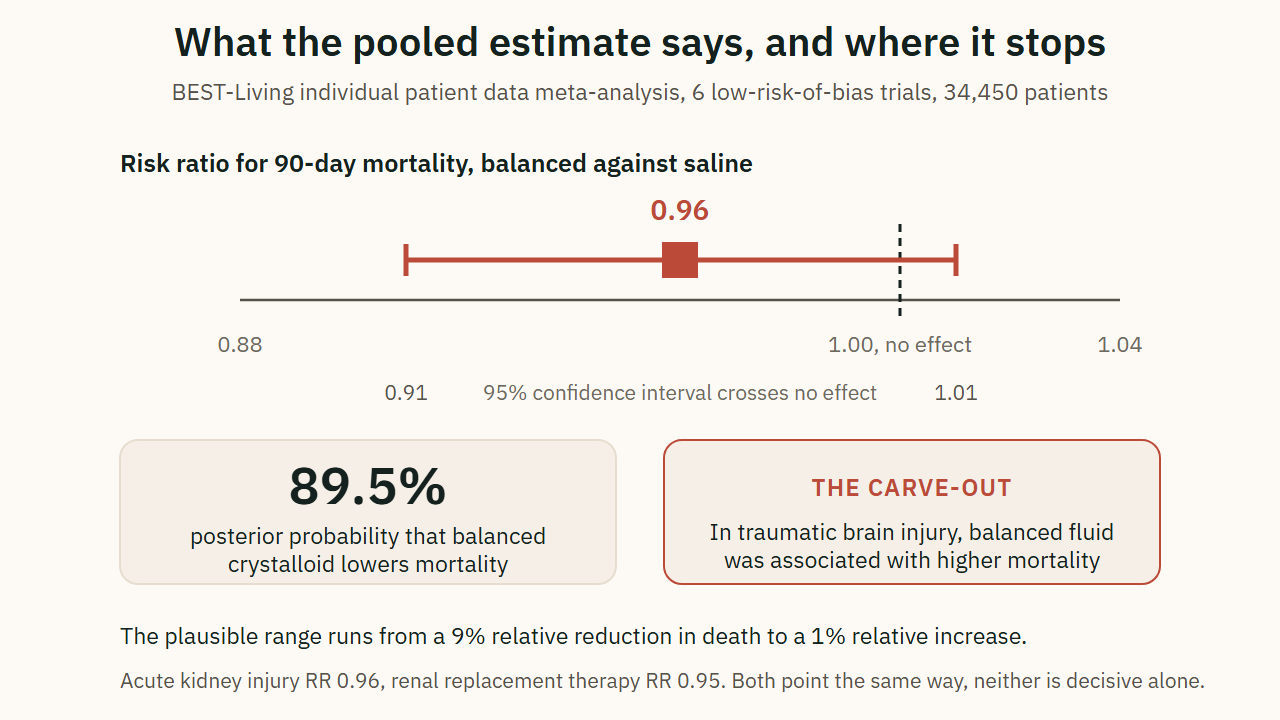
To move past the "p-value obsession," we must look at the BEST-Living individual patient data meta-analysis. This study aggregated data from 34,450 patients across six low-risk-of-bias trials, providing the most robust statistical landscape available.
The pooled risk ratio for 90-day mortality is 0.96 (95% CI 0.91 to 1.01). In frequentist terms, this "crosses the line of no effect." However, a Bayesian analysis reveals the true utility for a Pharmacy and Therapeutics (P&T) committee: there is an 89.5% posterior probability that balanced crystalloids reduce mortality.
From an EBM perspective, waiting for a p < 0.05 in a mortality trial for a zero-cost intervention is a failure of logic. We have an 89.5% chance of a life-saving benefit (up to 9%) against a mere 1% risk of a tiny marginal harm. When the alternative costs the same, an 89.5% probability is not just a good bet, it is the only rational choice for a departmental default.
A Default is a Nudge, Not a Mandate
In the language of informatics, changing a default is an exercise in Choice Architecture. We are not implementing Hard Stops or mandatory overrides that erode clinical credibility. Instead, we are using Soft Stops and "nudges" to guide the system toward the statistically superior path.
Saline's harm is often dose-dependent, manifesting as hyperchloremic acidosis. While a few liters of saline in a healthy patient are negligible, the harm accumulates in our high-volume resuscitation cases. By setting balanced crystalloids as the default, we route these high-risk patients toward better outcomes automatically. The bedside clinician remains free to select saline when they deem it appropriate, but the "momentum" of the order set now works in favor of the patient's kidneys.
The Traumatic Brain Injury (TBI) Carve-Out
While balanced crystalloids should be the default for the general population, the evidence identifies one critical exception where our choice architecture must be precise: Traumatic Brain Injury.
In the pooled subgroup analysis, balanced crystalloids were associated with higher mortality in TBI patients, with an odds ratio of 1.42 (an absolute mortality increase of roughly 3.2 percentage points). The mechanism is physiological: Lactated Ringer's is relatively hypotonic (Sodium 130 mEq/L) compared to plasma and 0.9% saline (Sodium 154 mEq/L). In the context of cerebral edema, where sodium management is a primary therapeutic lever, this relative hypotonicity can be catastrophic.
Informatics teams should implement this via filtered order sets. When an admission is tied to ICD-10 codes for intracranial injury or when a clinician selects a "Neuro-Critical Care" PowerPlan, the choice architecture should automatically revert the default fluid to 0.9% saline.
Know Your Fluids (The Composition Factor)
Understanding the chemical composition is essential for distinguishing between Resuscitation-Choice logic and Vehicle-Choice logic.
| Product | Sodium (mEq/L) | Chloride (mEq/L) | Potassium (mEq/L) | Buffer | Tonicity vs Plasma |
|---|---|---|---|---|---|
| 0.9% Sodium Chloride | 154 | 154 | 0 | None | Isotonic |
| Lactated Ringer's | 130 | 109 | 4 | Lactate 28 | Slightly Hypotonic |
| Plasma-Lyte A | 140 | 98 | 5 | Acetate 27, Gluconate 23 | Isotonic |
Note: Always verify compositions against the specific manufacturer's labeling for your hospital's stock.
The "Carrier" Exception: Beyond TBI, a second minor carve-out involves drug compatibility. Certain medications, most notably those incompatible with calcium, cannot be administered in Lactated Ringer's. This is Vehicle-Choice logic; the requirements of the drug carrier govern the choice for that specific infusion, which should remain distinct from the larger Resuscitation-Choice strategy for volume expansion.
Conclusion: Check Your Order Sets
Most ICU defaults are inherited, not chosen. They are often artifacts of 20th-century habit rather than reflections of 21st-century evidence.
The data from 34,450 patients suggests that while the margin of benefit for balanced crystalloids is small, it is consistent and mathematically favorable. By setting balanced fluid as the default and building automated carve-outs for traumatic brain injury via smart order-set logic, hospitals can optimize outcomes for the majority of patients without restricting clinical freedom.
Review your sepsis and resuscitation PowerPlans today. Does your default reflect the latest pooled evidence, or is it still running on the momentum of 19th-century chemistry?
Related
- SMART in NEJM
- SALT-ED in NEJM
- BaSICS in JAMA
- PLUS in NEJM
- The BEST-Living meta-analysis
- What actually changed in the 2025 hypertension guideline, on the other side of the same order-set problem
- Running the Clinical Program, on taking a default to P&T and making it stick
Want the practice knowledge behind this?
Your First Year as a Hospital Pharmacist covers the clinical judgment a residency front-loads. Part of the Pharmacy Handoff library.
See the book