Why Your Gout Treatment Stopped Too Early: The 300 mg Myth
Imagine a patient who has been "compliant" with their gout medication for over eighteen months. They show up to your clinic, visibly frustrated and limping, describing yet another agonizing flare in their great toe. When you check the chart, they are on allopurinol 300 mg daily. The reflexive clinical reaction is to assume the drug has failed, or perhaps the patient's disease is simply too refractory for standard therapy.
The provider might even tell the patient, "We've maxed you out on the standard dose; it might be time to try something else." This is the "invisible" treatment failure that haunts ambulatory care. It is not a failure of the molecule, but a failure of the strategy. The patient is not being maintained; they are being undertreated because the clinical team has stopped at an arbitrary threshold.
This disconnect exists because the 2020 American College of Rheumatology (ACR) Guideline for the Management of Gout, the undisputed gold standard, is being systematically ignored. While the guideline provides a rigorous framework for success, its most critical "strong" recommendations are frequently bypassed in favor of outdated habits, leaving patients trapped in a cycle of avoidable pain.
300 mg is the Floor, Not the Ceiling
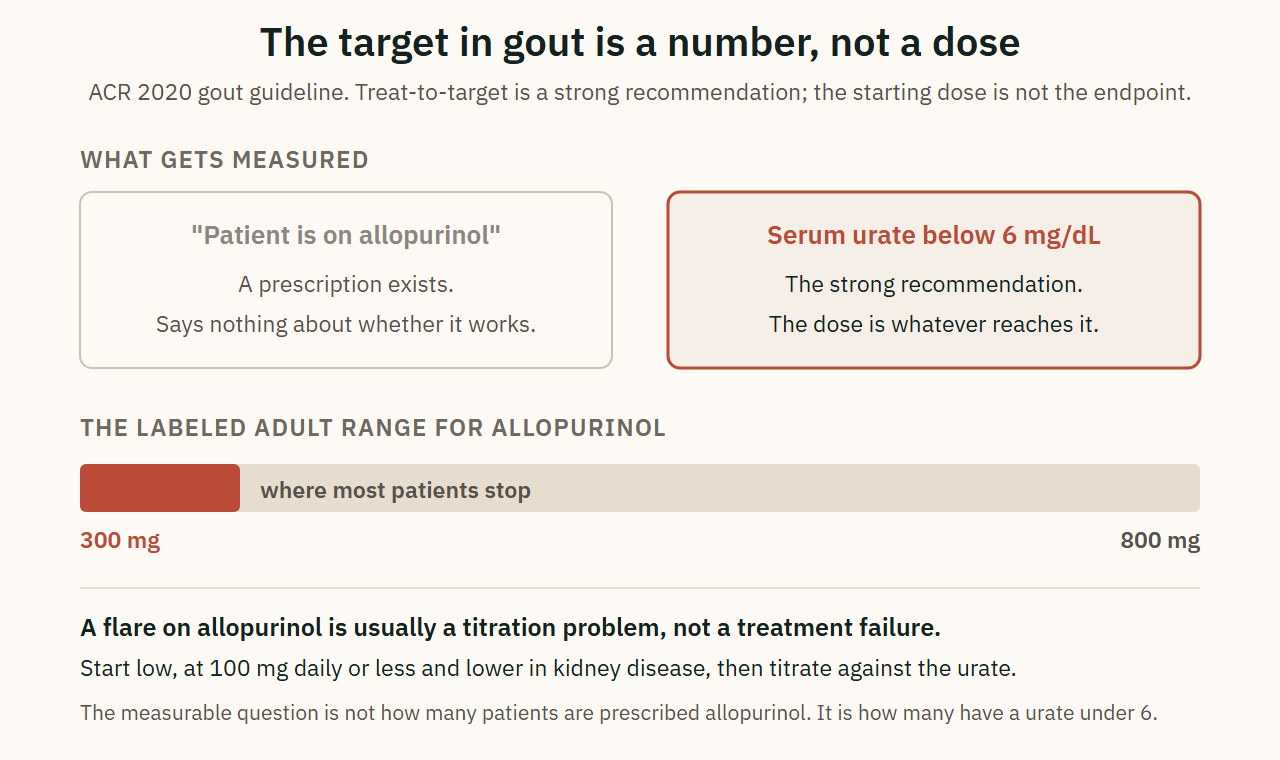
The most pervasive barrier to successful gout management is the "300 mg habit." In the majority of clinical settings, 300 mg of allopurinol is treated as a physiological ceiling. In reality, 300 mg is merely the bottom of the FDA-labeled adult dose range, which extends up to 800 mg daily. When titration stops at 300 mg despite a patient remaining above the therapeutic target, the "titration gap" begins.
A flare that occurs while a patient is taking allopurinol is rarely a sign of drug resistance. Instead, it is a signal that the Urate-Lowering Therapy (ULT) has not yet achieved its physiological objective. The failure is almost always linked to a lack of follow-up labs; if a clinician does not recheck the serum urate, they cannot know that the 300 mg dose has left the patient in a state of sub-therapeutic risk.
Chronic Kidney Disease is Not a Stop Sign
Clinicians often hesitate to optimize allopurinol in patients with chronic kidney disease (CKD), fearing the risk of allopurinol hypersensitivity syndrome or decreased renal clearance. This often leads to the premature abandonment of the most cost-effective therapy in favor of expensive second-line agents like febuxostat.
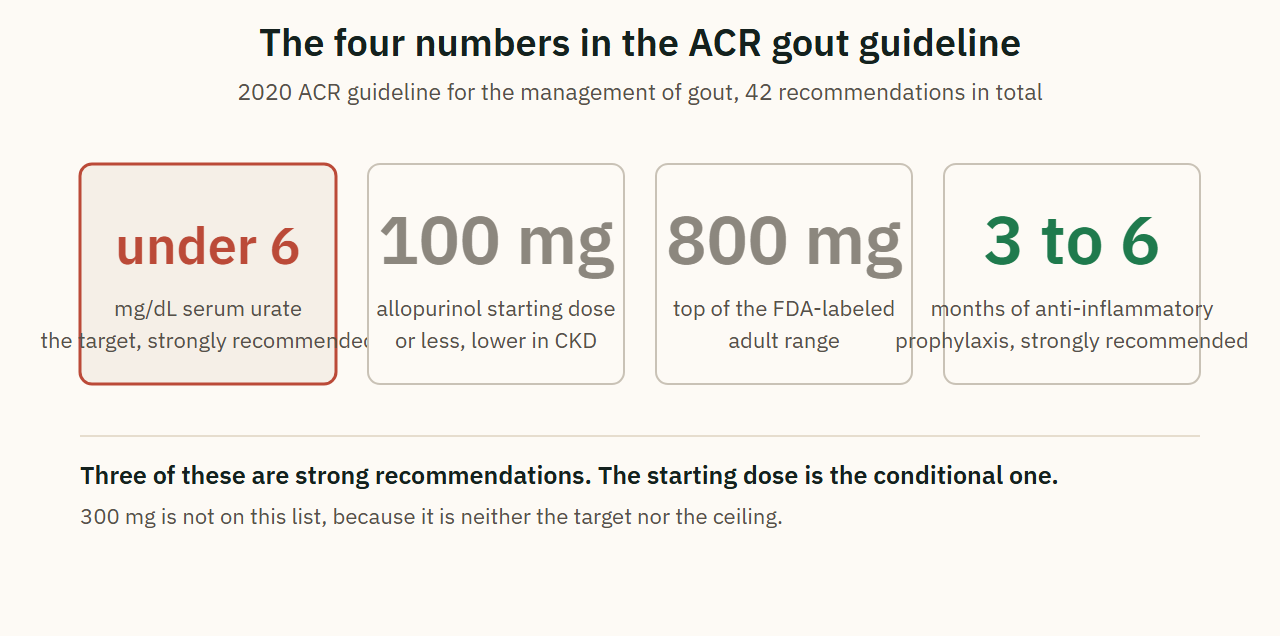
The 2020 ACR guideline clarifies this with high-level evidence. There is a strong recommendation that allopurinol remains the first-line ULT even for patients with CKD. It is vital to distinguish between the choice of drug and the method of delivery: while the choice of allopurinol is a strong recommendation, the "start-low-and-titrate" approach is a conditional recommendation.
This means CKD only changes the starting dose (100 mg or less) and the pace of the titration; it does not change the fact that allopurinol is the preferred agent. Moving a patient to a second-line drug solely because of a rising creatinine is often a misunderstanding of a dosing instruction as a contraindication.
The Four-Week Prophylaxis Trap
One of the most misunderstood aspects of gout physiology is "urate mobilization." As ULT begins to lower serum levels, urate crystals in the joints begin to dissolve and move, which can paradoxically provoke new, acute flares. To bridge this gap, the guideline strongly recommends anti-inflammatory prophylaxis, such as colchicine, NSAIDs, or corticosteroids.
In the real world, prophylaxis is often limited to a four-week course. This is a clinical trap. Mobilization flares frequently peak just as a short-course prescription runs out. When a patient flares at week five or six, they conclude that the allopurinol is actually causing their gout and stop the medication entirely. The guideline's strong recommendation is for a duration of at least three to six months.
Stop Waiting for the Flare to End
There is a long-standing "conventional instinct" to wait for an acute flare to fully resolve before initiating ULT. The logic is that starting the medication might worsen the current flare. However, the ACR guideline explicitly recommends starting ULT during the acute flare.
The reasoning is strategic rather than purely physiological. Waiting for a flare to resolve creates a significant risk of a "plan that never gets executed." Once the pain subsides and the patient leaves the clinical setting, the urgency to start chronic, preventive therapy evaporates. By initiating ULT immediately, the clinician ensures the patient is stabilized on a long-term path to remission before the opportunity for intervention is lost.
The Missing Lab Test: A Pharmacist's Perspective
From a clinical pharmacy and strategic audit perspective, the dose of allopurinol is secondary to the serum urate value. Any patient "on allopurinol" without a recorded serum urate check in the last twelve months is essentially unassessed. You cannot manage what you do not measure, and the "300 mg habit" persists precisely because the labs are not being audited.
To move from reactive to proactive management, clinicians and pharmacists should adopt a "Pharmacist's Audit" approach, checking for these four critical elements:
| What | Why it matters |
|---|---|
| Serum Urate < 6 mg/dL | Is there a recent lab confirming the patient has reached the "strong recommendation" target? |
| Correct First-Line Use in CKD | Is allopurinol being utilized as the primary agent despite renal impairment, rather than an unnecessary move to second-line agents? |
| Prophylaxis Duration | Is the anti-inflammatory "bridge" scheduled for a full three to six months to prevent treatment abandonment? |
| Continuity of Therapy | Is ULT being maintained during inpatient flare episodes? The habit of "holding" ULT during an admission is a common error that contradicts current guidelines. |
| Pharmacogenomic Screening | For patients of Southeast Asian or African descent, has HLA-B*5801 testing been performed? This conditional recommendation provides an actionable check to mitigate the risk of severe adverse reactions. |
The One Question to Ask
Closing the "titration gap" requires a shift in focus. We must stop viewing 300 mg as a destination and start viewing it as a milestone. By adhering to the three most-skipped strong recommendations, targeting a urate below 6 mg/dL, maintaining allopurinol as first-line in CKD, and providing 3-6 months of prophylaxis, we can prevent the "invisible" failures that leave patients in chronic pain.
As you review your next patient chart, look past the medication list and focus on the results. Ask yourself the one question that determines the success of the strategy: "If your patient is 'on allopurinol' but their serum urate isn't in the chart, are they actually being treated?"
What is not settled
No titration schedule appears here, deliberately. It depends on renal function and on the follow-up urate, and the guideline and the label both have it.
The febuxostat cardiovascular question is real and is not addressed here. It is a live controversy and it deserves its own treatment.
The guideline is from 2020 and remains the current edition as of this writing. That is not a weakness of the content; it means the gap described here has had six years to close and has not.
Related
- ACR gout management guideline
- ACR summary of the treat-to-target strategy
- Allopurinol prescribing information
- How to read the statistics in a clinical trial
- What a clinical pharmacist actually does
- Running the Clinical Program, on building the audit that finds these patients
Want the practice knowledge behind this?
Your First Year as a Hospital Pharmacist covers the clinical judgment a residency front-loads. Part of the Pharmacy Handoff library.
See the book