The 3-Day Revolution: How the 2025 Pneumonia Guidelines Just Upended Your Order Sets
Medical guidelines move at the speed of data, but hospital IT infrastructure often moves at the speed of continental drift. For most of us, the "five-day floor" has been the hard-coded gospel for community-acquired pneumonia (CAP) since 2019.
The 2025 ATS/IDSA update just threw that gospel out the window.
This isn't just a minor tweak to a few citations; it's a fundamental reversal of long-held clinical instincts. For the ID pharmacist and the frontline clinician, the 2025 update presents a fascinating stewardship paradox: it demands shorter courses for most, while simultaneously calling for more aggressive interventions, including steroids and continued antibiotics, for the sickest.
The "Five-Day Floor" Has Collapsed
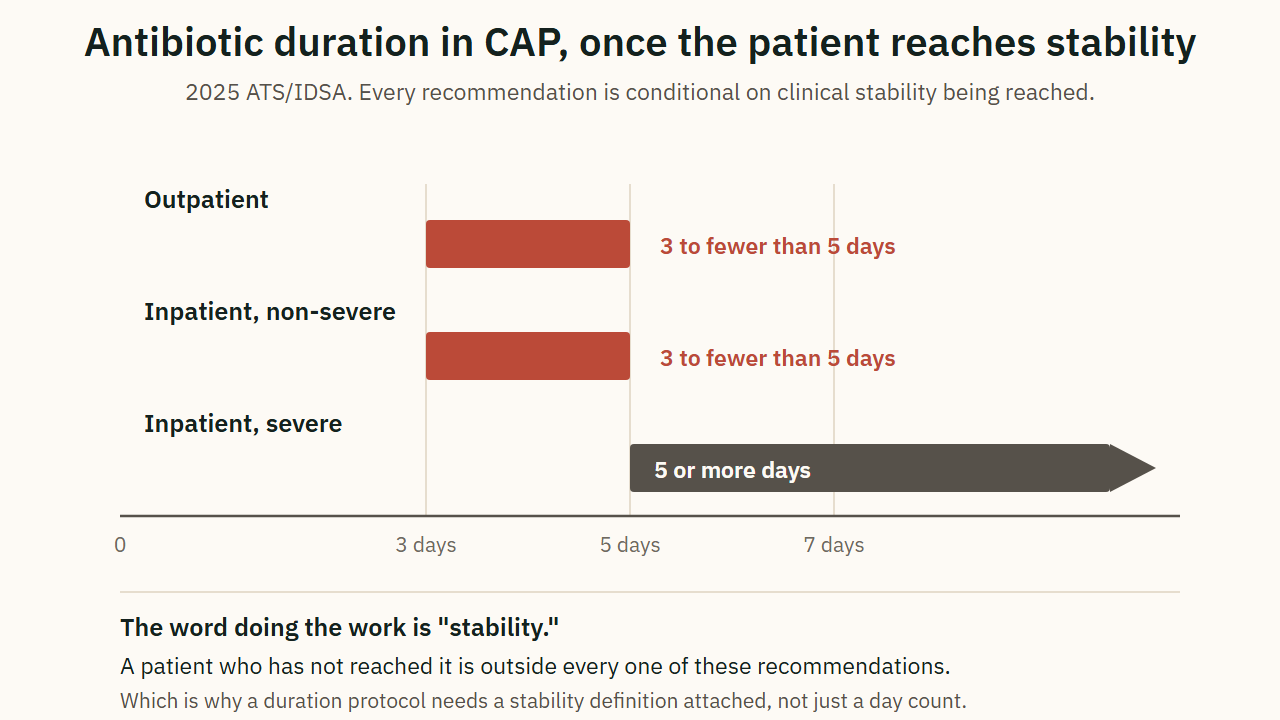
The most jarring shift in the 2025 update is the demolition of the universal five-day minimum. For outpatients and non-severe inpatients, the guideline now suggests a treatment duration of fewer than five days (with a minimum of three).
However, the "shorter is always better" instinct stops at the ICU door. For severe inpatients, the recommendation actually shifts the other way, suggesting five or more days of therapy.
The Stability Warning: As a clinical pharmacist, here is the nuance that matters: A duration rule with a hard day count and no stability definition attached is a clinical error. Every duration recommendation in the new guideline is conditional. If your EMR order set defaults to a 3-day or 5-day stop date without a "Stability Check" prompt, it will inevitably be applied to the wrong patients.
Patient Category Duration Once Stable Outpatient Fewer than 5 days (minimum 3) Inpatient, non-severe Fewer than 5 days (minimum 3) Inpatient, severe 5 or more days
The Great Corticosteroid Reversal
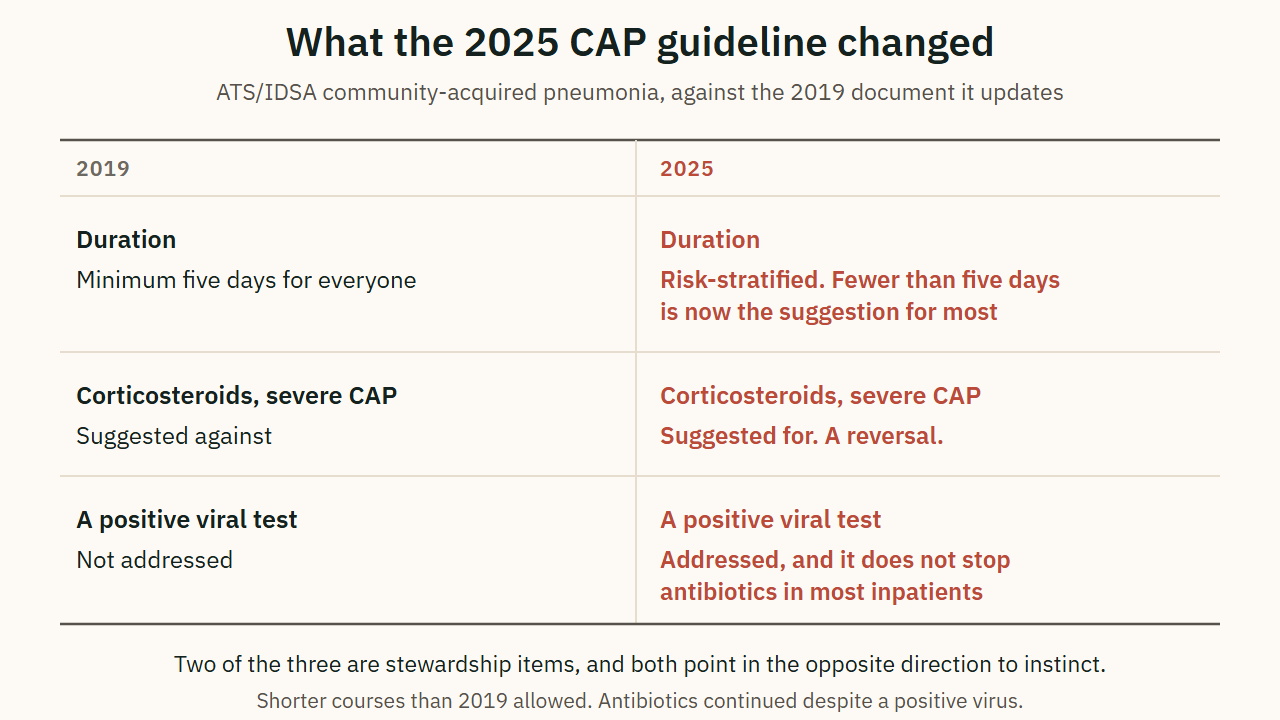
In a rare and notable "U-turn," the 2025 guidelines have reversed the stance on systemic corticosteroids. While the 2019 version suggested against them for severe CAP, the 2025 update now suggests for them.
This reversal turns the clinical classification of "severe" versus "non-severe" into a high-stakes decision. In previous years, misclassifying a patient was a minor documentation issue. Now, it carries heavy treatment consequences. If a clinician incorrectly labels a non-severe patient as "severe," they are now incorrectly initiating steroids and unnecessarily extending antibiotic duration past the 5-day mark. For non-severe cases, the recommendation against steroids remains unchanged.
A Positive Viral Test is Not a "Get Out of Antibiotics Free" Card
The 2025 update throws cold water on the "viral de-escalation" reflex we've spent a decade training our residents to follow. We used to think a positive Flu or RSV test was a license to stop the Rocephin. The new guidelines suggest the opposite for almost everyone.
Because the risk of bacterial coinfection is so high in sick patients, the guideline is remarkably conservative:
Patient Setting Positive Viral Test Action Outpatient, no comorbidities Suggests against antibiotics Outpatient, with comorbidities Suggests continuing antibiotics Inpatient, non-severe Suggests continuing antibiotics Inpatient, severe Suggests continuing antibiotics
For 75% of these patient categories, the intuitive stewardship move (de-escalation) is now considered the wrong move.
The Diagnostic Shift: Enter the Ultrasound
The guidelines now recognize lung ultrasound as an acceptable diagnostic alternative to chest radiographs, provided the bedside expertise exists. From a workflow perspective, this reflects a shift toward bedside diagnostics that can drastically reduce the "wait time" for imaging. For the clinician, this means a faster diagnosis and a potentially accelerated "time to first dose" and stability assessment.
Stop Trying to Make HCAP Happen
While the 2025 update brings new changes, it also doubles down on 2019 recommendations that the medical community is still stubbornly ignoring. These remain unusually clean audit targets for stewardship teams:
-
HCAP is dead: "Healthcare-associated pneumonia" was eliminated years ago because it fails to predict antibiotic resistance. If your order set still has an HCAP button, it's driving unnecessary broad-spectrum use.
-
Aspiration coverage: Routine anaerobic coverage for aspiration pneumonia is not recommended unless there is a specific complication like a lung abscess or empyema.
Conclusion: The Stewardship Reality Check
The 2025 guidelines run counter to the instincts many of us have built. Shorter courses for most, steroids for the severe, and a more cautious approach to viral de-escalation require a deliberate pivot in how we practice.
Stewardship Pro-Tip: When updating your protocols, pay close attention to the strength of evidence. In the ATS/IDSA world, "suggest" and "recommend" carry different weights. Ensure your local policy reflects these nuances before it ships.
Your Action Plan:
| What | Why it matters |
|---|---|
| Audit the Order Set | Remove HCAP language, update duration defaults to reflect stratification, and add a steroid orderable specifically for the "severe" pathway. |
| Redefine Stability | Ensure your EMR doesn't just count days, but prompts for clinical stability before suggesting a stop date. |
| Update Reference Materials | Pocket cards and intranet pages based on 2019 data are now clinically inaccurate regarding duration and steroids. |
Is your "standard" 5-day default now the very thing keeping patients on antibiotics longer than necessary? It's time to find out.
Related
- ATS/IDSA pneumonia guideline timeline, 2019 to 2025
- CDC pneumonia management and prevention guidelines
- How to read the statistics in a clinical trial
- Two drug shortage counts, 227 and 75, on the antimicrobials in short supply
- Running the Clinical Program, on turning a guideline change into a stewardship intervention
Want the practice knowledge behind this?
Your First Year as a Hospital Pharmacist covers the clinical judgment a residency front-loads. Part of the Pharmacy Handoff library.
See the book