The Lighthouse Trap: Why Fewer Pharmacy Graduates Might Not Save Your Career

For a decade, the pharmacy profession has been haunted by the specter of oversaturation. Now, the pendulum is swinging back with startling velocity as applications and graduation rates crater. On the surface, this appears to be the correction the industry has begged for. In a market governed by supply and demand, a shrinking talent pool should theoretically create a "seller's market," driving up wages and restoring leverage to the individual pharmacist.
But do not mistake a shrinking workforce for a growing opportunity. Whether this contraction is a sign of a dying trade or a strategic opening for those who remain depends entirely on your specific "row" in the profession. The data suggests that while some sectors are becoming materially easier to navigate, others are being structurally dismantled regardless of how many pharmacists are in the pipeline.
The Pipeline is Crashing Faster Than You Think
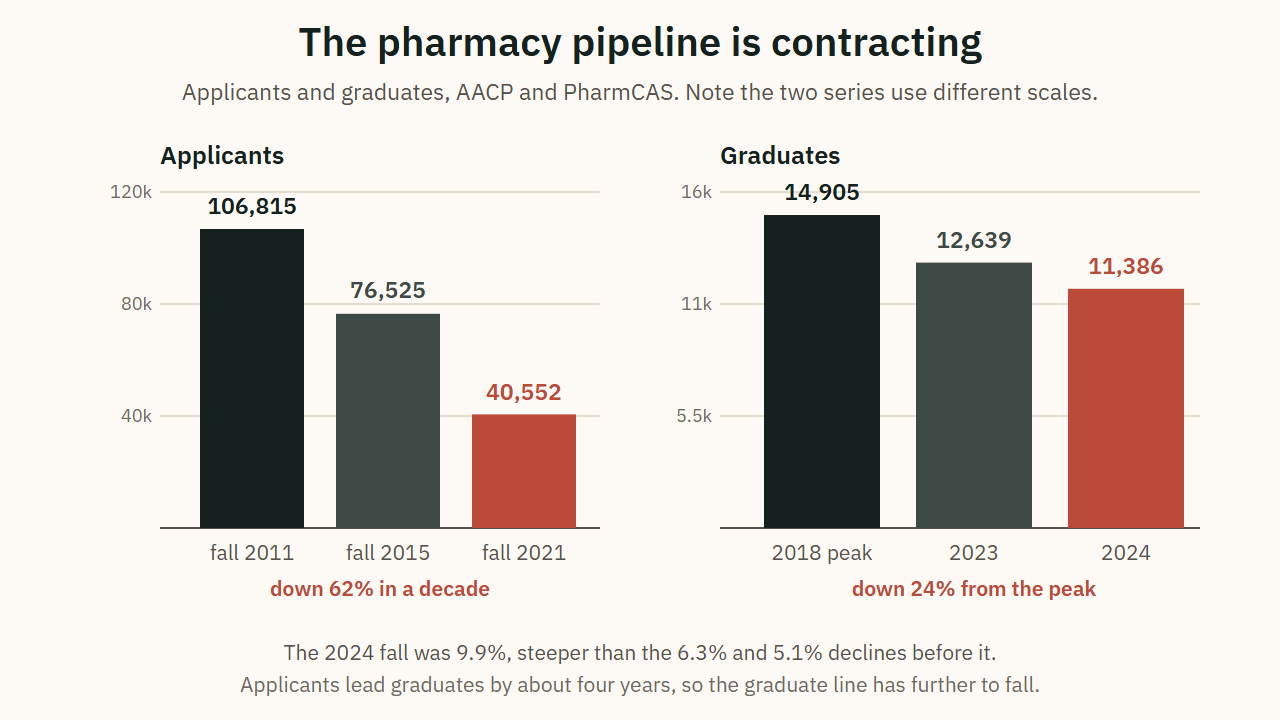
The contraction of the pharmacy workforce is not a minor correction; it is a structural collapse of the traditional pipeline. Between 2011 and 2021, verified applicants to pharmacy schools fell by a staggering 62%, plummeting from 106,815 to just 40,552.
While graduation numbers have also declined, down 24% from their 2018 peak, the most critical concept for any analyst to grasp is the "four-year lead time." Because applicants lead graduates by roughly four years, the graduate figure has much further to fall. The 2024 graduation decline of 9.9% was significantly steeper than the 5.1% drop seen just years prior, signaling an accelerating trend.
While we saw a 6% uptick in applications in the most recent cycle, this is merely a "temporary pulse" that does not break the four-year drought. The decline in new supply is already "locked in" through the end of the decade.
The severity of this shift is underscored by the fragility of the institutions themselves:
| What | Why it matters |
|---|---|
| Capacity Failure | By 2019, 62% of pharmacy schools were unable to fill their entering classes. |
| Surging Attrition | School attrition rates reached 19.7% recently, a high for this century. |
| Institutional Closure | The University of Charleston School of Pharmacy stopped admitting students in late 2024 and will shutter entirely after the spring 2026 class. |
The Residency Market has Flipped (The Strategic Window)
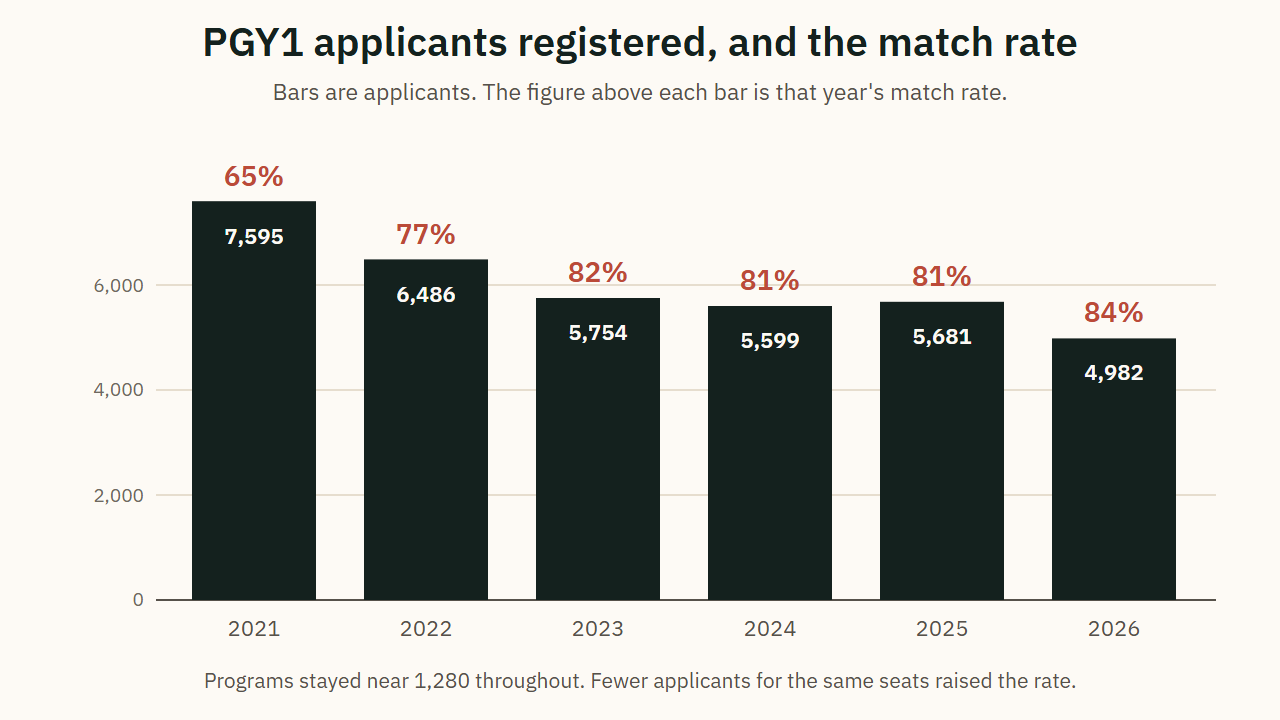
The primary area where supply contraction has provided a massive advantage is the residency market. For years, the PGY1 match was a brutal bottleneck that left thousands of qualified graduates without a path to clinical specialization. That dynamic has been fundamentally disrupted.
The barrier to clinical specialization has been lowered, creating a strategic window for those previously intimidated by a 65% match rate. Between 2021 and 2026, PGY1 match registrations fell from 7,595 to 4,982. During this same period, the PGY1 match rate rose from 65% to a record 84%. Perhaps more telling is the surge in unfilled core PGY1 positions, which jumped from a mere 13 to 268.
This is a materially better market for those entering training today. For the early-career strategist, the supply contraction has turned a high-stakes competition into a buyer's market, offering a clear path to clinical roles that were once considered out of reach.
The Lighthouse Keeper's Warning
Despite the optimism in the residency sector, a shrinking pipeline is not a universal shield. This paradox is best explained by an analogy found in recent industry discourse:
In the retail pharmacy sector, this "automatic light bulb" is being installed piece-by-piece via Technician Product Verification (TPV) and advanced automation. In this context, a "pharmacist shortage" is often a calculated choice by corporations rather than a lack of available talent. Store closures and position eliminations are driven by reimbursement models, declining foot traffic, and corporate balance sheets, factors that are completely indifferent to the number of people passing the NAPLEX.
A smaller graduating class might help you compete for a remaining job, but it does nothing to prevent that job from being deleted by a CFO.
Supply and Demand are Separate Forces
One of the most dangerous errors a professional can make is conflating "supply contraction" (fewer grads) with "demand contraction" (fewer jobs). Both are happening simultaneously, but they are driven by different engines.
In 2025, retail pharmacy employment shed 8,200 positions, falling to its lowest level since 2010. Even as the pipeline dries up, the sector continues to shrink. While a thinner applicant pool helps you stand out, it cannot create a position where a corporate balance sheet has already decided a store is no longer viable.
However, pharmacists possess a "Protective Moat" that the lighthouse keeper lacked: the Licensure Barrier. A state license is a unique legal hurdle that prevents total automation. Displacing a pharmacist requires not just a better machine, but legislative shifts. While TPV is beginning to move some tasks under supervision rather than eliminating the role entirely, the license remains your most potent legal shield, though it is a shield currently being tested by corporate lobbying and tech-driven workflow shifts.
Your Outcome Depends on Your "Row"
The current workforce contraction is neither inherently good nor bad; its impact depends entirely on your position within the industry.
| Your Current Role | Impact of Contraction | The Reason Why |
|---|---|---|
| Residency Applicant | Clearly Helping | Barrier to entry lowered; match rates rose from 65% to 84% with 268 unfilled spots. |
| Prospective Student | High Risk / Neutral | Admission is significantly easier (62% of schools unfilled), but long-term retail job security is deteriorating. |
| Retail Pharmacist | Not Helping | Roles are being eliminated by reimbursement and corporate factors, not filled by competitors. |
| Hospital Pharmacist | Slightly Helping | Sector added 3,000 jobs in 2025; thinner applicant pool increases your career leverage. |
| Mid-career Professional | Largely Irrelevant | Stable, existing roles are rarely moved by pipeline shifts or entry-level retail closures. |
Conclusion: A Profession Replaced, Not Collapsed
The pharmacy profession is not in a state of terminal collapse, nor is it in an era of expansion. BLS projections suggest a 5% growth rate through 2034, with roughly 14,200 annual openings. This depicts a profession being "replaced at retirement" rather than one that is expanding or disappearing.
The contraction of the graduate pipeline provides a definitive advantage for those seeking specialized clinical roles or hospital positions, where demand remains resilient. However, for those in the retail trenches, the shrinking supply of new graduates is a distraction from the real threat: a changing economic model that values automation over professional oversight.
Before you celebrate the shrinking pipeline, ask yourself: Are you relying on a state license to protect a job that a corporate balance sheet has already marked for deletion?
Related
- The original thread on Student Doctor Network
- AACP student applications, enrollments and degrees conferred
- ASHP Match statistics
- Applications turned back up 6% in the most recent cycle
- Where pharmacist jobs are being added in 2026
- Your First Year as a Hospital Pharmacist, for the transition most of this ends at