Finerenone's New Frontier: Why the July 2025 FDA Update is a Game-Changer (and a Warning) for Heart Failure
Introduction: The Heart Failure Gap
For years, treating heart failure with a left ventricular ejection fraction (LVEF) of 40% or above has felt like navigating a therapeutic no-man's-land. While the "four pillars" of therapy for reduced ejection fraction (HFrEF) are backed by ironclad evidence, the higher EF population has been a graveyard for clinical trials. Most notably, the TOPCAT trial saw spironolactone fail to meet its primary endpoint, leaving clinicians with few options beyond diuretics and hope.
On July 14, 2025, that clinical landscape shifted. The FDA approved a new indication for finerenone, a nonsteroidal mineralocorticoid receptor antagonist (MRA), to reduce the risk of cardiovascular death, heart failure hospitalizations, and urgent heart failure visits in adults with an LVEF of 40% or above. But as we integrate this into our formularies, we need to look past the "16 percent" headline to the practical clinical reality of what this drug does, and the safety hurdles it creates.
The "16 Percent" Mystery: Not All Benefits are Created Equal
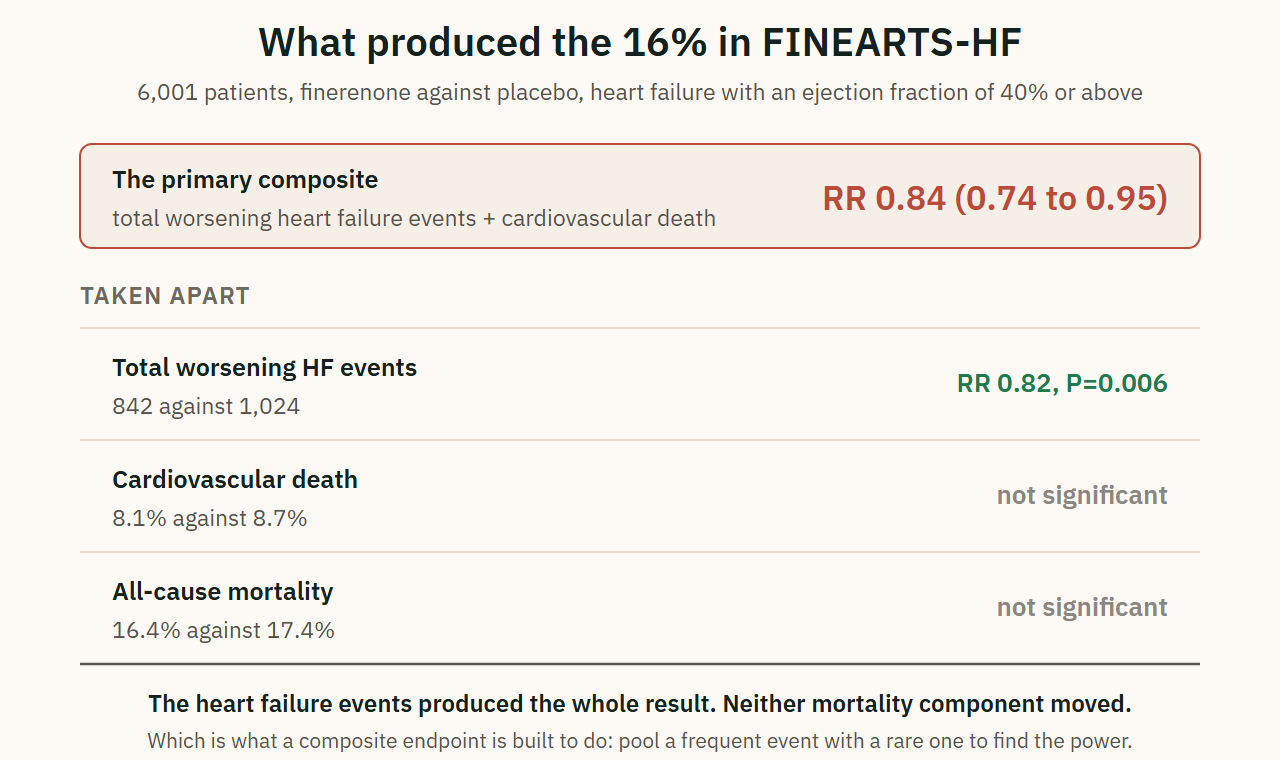
The approval of finerenone rests on the FINEARTS-HF trial, which reported a 16% relative reduction in its primary composite endpoint (rate ratio 0.84). To a clinical pharmacist, a composite is always a puzzle that needs taking apart. In heart failure, composites are designed to pool frequent events (hospitalizations) with rare ones (death) to ensure a trial has enough power to detect a signal.
The breakdown reveals that the "16 percent" is driven almost entirely by the prevention of worsening events, not survival.
| Component | Finerenone | Placebo | Result |
|---|---|---|---|
| Total Worsening HF Events | 842 | 1,024 | RR 0.82 (0.71 to 0.94), P=0.006 |
| Cardiovascular Death | 8.1% | 8.7% | Not statistically significant |
| All-Cause Mortality | 16.4% | 17.4% | Not statistically significant |
While mortality figures moved in a positive direction, they did not reach statistical significance. For a chronic oral agent in this population, the Number Needed to Treat (NNT) is 31 over approximately three years to prevent one heart failure hospitalization or cardiovascular death.
The honest sentence for this drug is "fewer heart failure events," rather than "lives saved."
This is not a criticism, but a framing tool for formulary reviews. Preventing a hospitalization is a massive win for the patient's quality of life and the healthcare system's budget, but the drug should be positioned as a tool for clinical stability.
Breaking the "TOPCAT" Curse
Finerenone's success is historically significant because it breaks a decade-long drought. Since the TOPCAT trial failed to prove spironolactone's benefit in this population, the MRA class was essentially locked out of the "higher EF" space.
It is important to note that this is a new indication, not a replacement. In HFrEF (LVEF < 40%), spironolactone and eplerenone remain the established MRA pillars. Finerenone has simply succeeded where others didn't, finally providing an evidence-based MRA option for patients with an LVEF at or above 40%.
The Two Hard Gates: Knowing When to Start (and Stop)
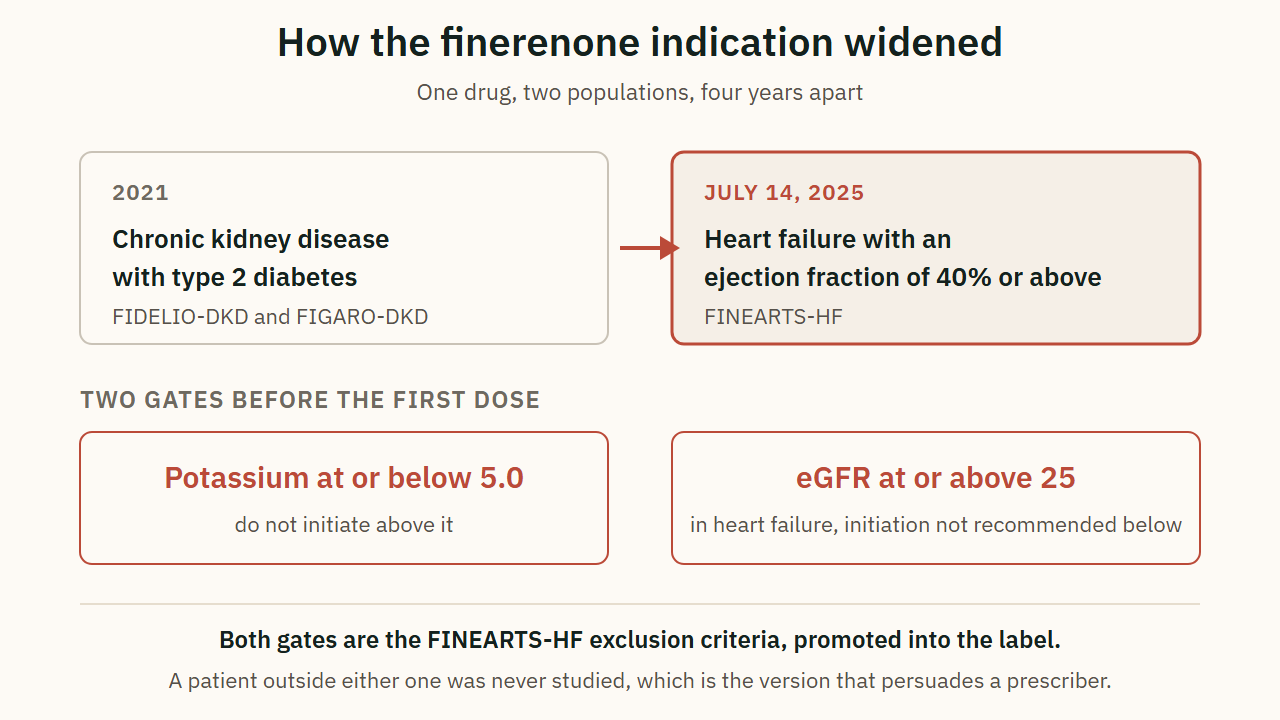
The FDA label mandates two specific initiation criteria that act as "gates" for treatment. Before the first dose, clinicians must confirm:
-
Serum potassium is ≤ 5.0 mEq/L.
-
Estimated glomerular filtration rate (eGFR) is ≥ 25 mL/min/1.73 m² (in heart failure).
These aren't just arbitrary regulatory hurdles; they were the exact exclusion criteria used in the FINEARTS-HF trial. Patients outside these parameters were never studied, meaning these gates are essential to replicate the safety and efficacy seen in the data.
The Electrolyte Seesaw (And a New Warning)
Finerenone's safety profile is often summarized as a hyperkalemia risk, but the FINEARTS-HF data shows a more complex electrolyte "seesaw":
-
Hyperkalemia: Potassium > 5.5 mmol/L roughly doubled (14.3% vs. 6.9%).
-
Hypokalemia: Low potassium was nearly halved (4.4% vs. 9.7%).
The reduction in hypokalemia is a significant benefit for patients on high-dose loop diuretics, who are often prone to arrhythmias. However, the 2025 update also brings a vital warning regarding blood pressure. The trial showed a significant increase in hypotension, with systolic pressure falling under 100 mm Hg in 18.5% of finerenone patients compared to 12.4% on placebo. Clinicians must be vigilant when adding finerenone to patients already stabilized on multiple antihypertensives.
The "Double-MRA" Trap: A New Patient Safety Risk
The most dangerous pitfall of this new indication is the "duplication problem." A patient may be prescribed finerenone for their heart failure while already taking spironolactone for volume overload or a separate diagnosis.
Because finerenone is nonsteroidal and was originally indicated for kidney disease in 2021, many pharmaceutical databases and electronic health records (EHRs) do not categorize it alongside traditional MRAs. This means a dangerous co-prescription might not trigger a duplicate-therapy alert.
Call to Action for Pharmacy and Informatics Teams: Review your EHR and pharmacy alert libraries immediately. Ensure that finerenone is recognized as a mineralocorticoid receptor antagonist to prevent co-prescription with spironolactone or eplerenone. Checking whether your duplicate-therapy alert treats finerenone as an MRA takes exactly one test order, do it today.
Additionally, update your patient counseling protocols. Remind patients that this is a potassium-raising drug and that many common salt substitutes are actually potassium chloride, a "boots-on-the-ground" insight that prevents avoidable hyperkalemia.
What it does not replace
It is not the MRA pillar in reduced ejection fraction. The indication and the trial both cover an ejection fraction of 40 percent or above. The four pillars for HFrEF still name a mineralocorticoid receptor antagonist, and the evidence there is spironolactone and eplerenone.
No head-to-head trial exists against spironolactone or eplerenone in any population. The argument for finerenone in an ejection fraction at or above 40 is that it has a positive trial there and the older agents do not, rather than that it beat them.
Ejection fraction is measured with error. A cutoff of 40 percent applied to a number that moves between studies and between readers will produce patients on either side of the line whose disease is identical. That is a real limitation of an EF-defined indication and it will show up in prior authorization.
Conclusion: Beyond the Ejection Fraction
Finerenone has successfully transitioned from a specialty kidney drug to a foundational pillar of heart failure management. While it brings a respectable NNT of 31, its success in the real world depends on strict adherence to the initiation "gates" and a proactive approach to informatics.
One final hurdle remains: the subjectivity of the 40% cutoff. Ejection fraction is not a static number; it is an estimate subject to reader error and imaging modality variations. This fluctuation will undoubtedly complicate prior authorizations and long-term clinical management.
A Question for Your Institution: How will your clinical protocol handle the "subjectivity" of the 40% EF cutoff, will you require a specific imaging modality to verify the gate, or will a single historical measurement satisfy the criteria for initiation?
Related
- FDA approves finerenone for heart failure with LVEF 40% or above
- FINEARTS-HF, New England Journal of Medicine
- The KERENDIA label
- How to read the statistics in a clinical trial, including what a composite endpoint hides
- The four pillars are meant to be started together
- Running the Clinical Program, on writing formulary criteria that survive a prescriber challenge
Want the practice knowledge behind this?
Your First Year as a Hospital Pharmacist covers the clinical judgment a residency front-loads. Part of the Pharmacy Handoff library.
See the book