The Pharmacy Shortage Myth: Why Both Sides of the Argument Are Right (and Wrong)

Introduction: The Great Pharmacy Paradox
In the upper echelons of pharmacy academia, a klaxon is sounding: school leaders warn of an impending national shortage, citing a thinning pipeline and an emptying applicant pool. Simultaneously, on forums like Student Doctor Network, frontline practitioners dismiss these warnings as "nonsense" or bad-faith propaganda designed to maintain tuition revenue.
Both groups are analyzing the same profession, yet they have reached diametrically opposed conclusions. The central issue is that "shortage" is too blunt a term to describe a profession undergoing a massive internal migration. The paradox is the result of a collision between lagging indicators, the academic models, and real-time displacement, the practitioner experience. To resolve this, we must move beyond the headlines and analyze the labor market through the lenses of vacancy data, labor absorption capacity, and role-specific scarcity.
The General Shortage is a "Ghost" (4.7% vs. 12.3%)
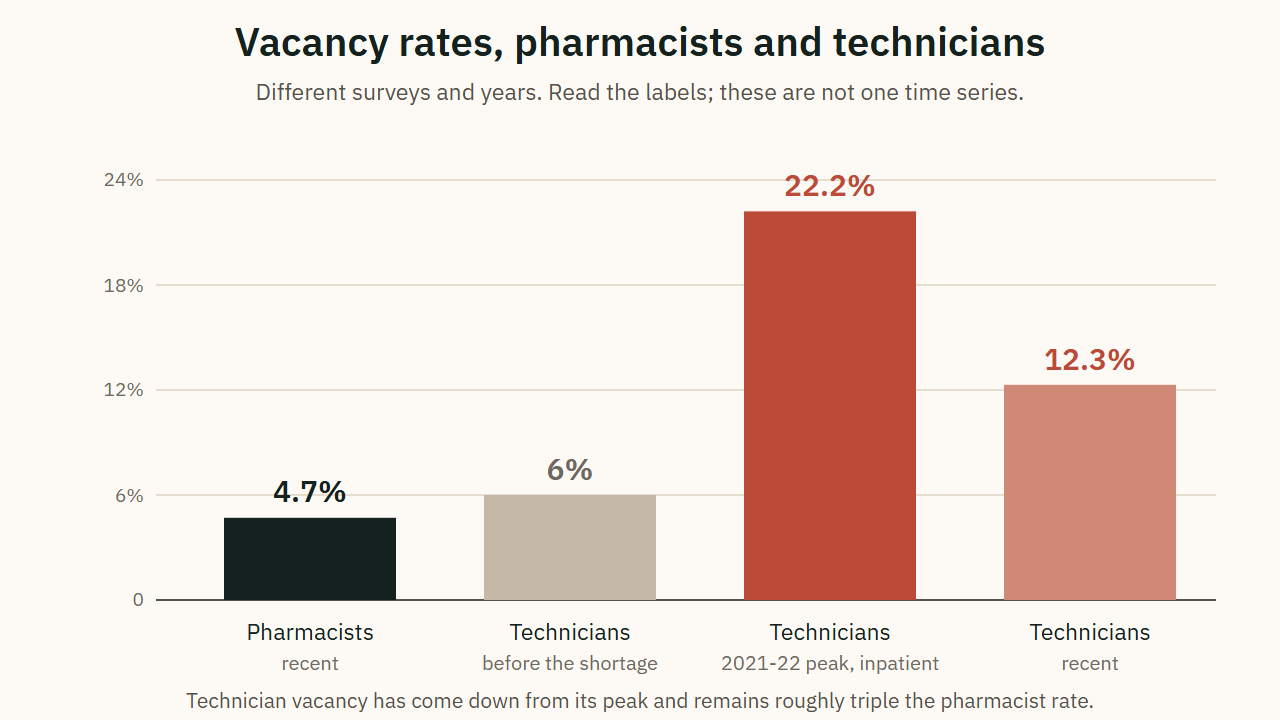
At a macro level, the data suggests that a general pharmacist shortage is non-existent. While "shortage" makes for a compelling narrative, subjective labor market tightness is better measured by objective vacancy and turnover rates. In current health-system reporting, the vacancy rate for licensed pharmacists remains remarkably stable, especially when contrasted with the support staff they manage.
| Role | Vacancy Rate | Turnover Rate |
|---|---|---|
| Pharmacists | 4.7% | 11.0% |
| Technicians | 12.3% | 26.9% |
If the profession were facing a true systemic crisis of "bodies," the vacancy rate for licensed pharmacists would be significantly higher. Instead, a 4.7% vacancy rate suggests a balanced market where most departments are successfully filling general staff positions.
This stability is reflected in supply-side models. The Bureau of Labor Statistics (BLS) projects a steady 5% employment growth through 2034, which indicates a sustainable pace of demand rather than a labor squeeze. Furthermore, the 2018 HRSA model once projected a massive oversupply of 19,000 to 51,000 pharmacists by 2030. While that model predates the recent graduate decline and should be viewed as an outdated ceiling, it explains why practitioners are skeptical: for nearly a decade, the primary market risk has been oversupply, not scarcity.
Retail is Hemorrhaging Jobs While Hospitals Slow Down
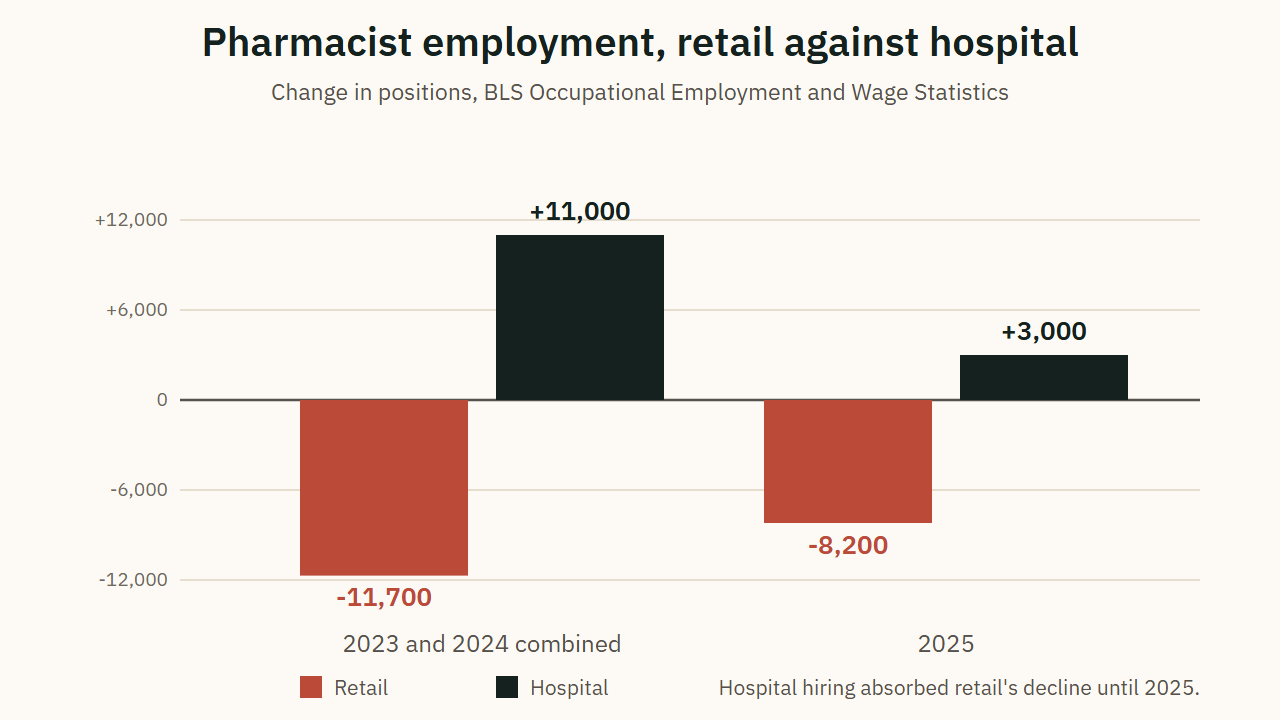
The perception of a "shortage" or "surplus" depends entirely on where a practitioner sits within the market. We are currently witnessing a massive "Retail Exodus" that is fundamentally reshaping the profession's topography. In 2025 alone, the retail sector, which still holds the largest share of the market with 162,000 positions, shed 8,200 jobs. This represents a 14.2% drop from the sector's 2017 peak and brings retail employment to its lowest level since tracking began in 2010.
Historically, the hospital sector acted as a primary engine for labor absorption, adding 11,000 jobs across 2023 and 2024 to reach a total of 102,000 positions. However, that absorption capacity is hitting a ceiling. In 2025, the hospital sector added only 3,000 positions. This creates a critical "Absorption Gap": in a single year, the market produced a surplus of 5,200 displaced retail pharmacists who could not be absorbed by the hospital sector.
This structural contraction masks the "shortage" feeling. While nearly half of pharmacists now work outside of retail, and those in physician offices are seeing the highest pay in the profession, the migration is not seamless. A retail pharmacist watching their store close sees a surplus of labor, while a hospital department head maintaining a 4.7% vacancy rate sees a market in equilibrium.
The "Leadership Gap" is the Real Crisis
The true workforce crisis is not one of quantity (the number of licensed bodies), but of credentialing and specialized experience. The unfilled demand is concentrated in two high-stakes areas: advanced clinical practice and executive leadership.
While general staffing remains stable, 60% of pharmacy departments report insufficient staffing for advanced clinical roles. It is important to note that this is a qualitative assessment of department needs, not a formal vacancy rate, indicating a gap in the type of pharmacists available rather than a lack of applicants.
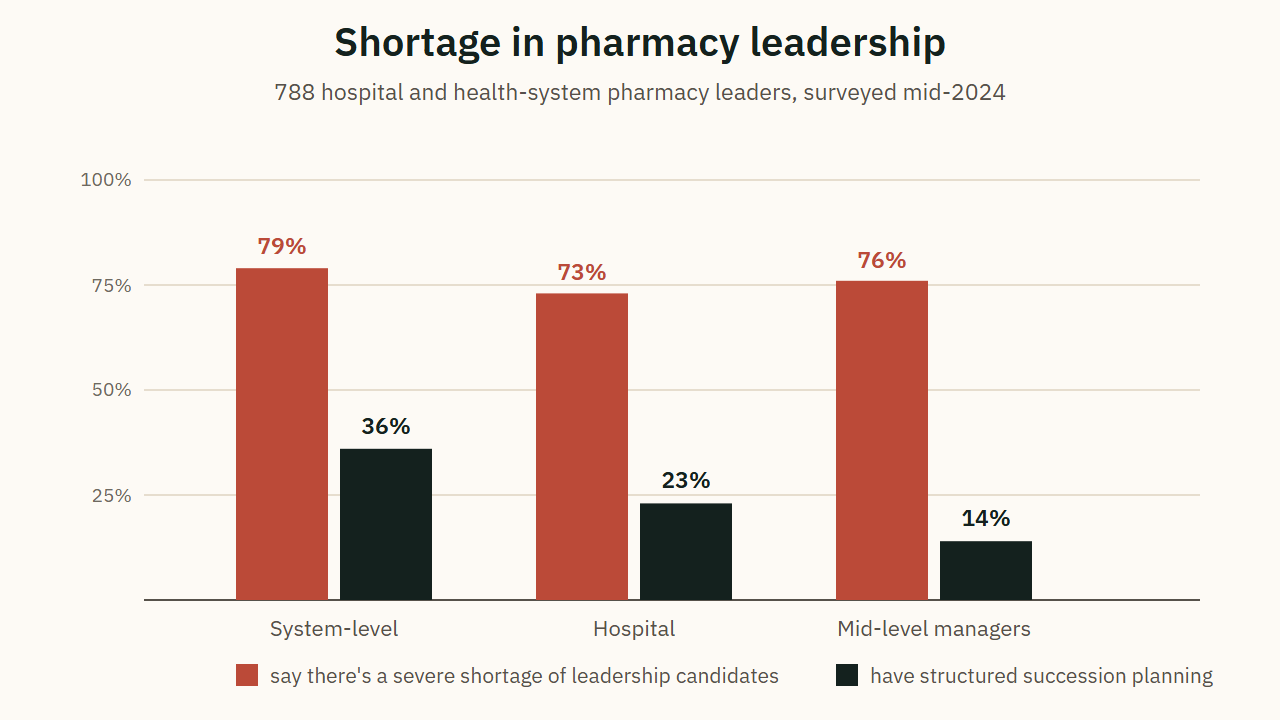
The crisis is even more acute at the top of the organizational chart. Between 73% and 79% of pharmacy leaders report a "severe shortage" of candidates for leadership positions. This is exacerbated by a staggering lack of institutional "bench strength": only 14% to 36% of departments have structured succession planning, and roughly 50% have no identified successor for their current leadership. As one analyst noted:
The shortage is a qualitative one. These roles require specialized experience and a willingness to operate under value-based payment models, competencies that the traditional labor pool was not originally structured to provide.
The Shrinking Pipeline vs. The Market Ceiling
The "Supply Side" argument championed by academics is fueled by an alarming decline in the professional pipeline. Pharmacy graduates peaked at 14,905 in 2018 and have since plummeted to 11,386 in 2024. More concerning for the long term is the "Applicant Cliff": pharmacy school applications have dropped by more than 60% over the last decade. This has led to the structural contraction of the educational sector itself, evidenced by the University of Charleston School of Pharmacy's decision to close its doors in 2026.
This is the core of the disagreement:
-
Academics see a pipeline that has lost more than half of its applicants and worry that the profession will eventually lack the sheer number of bodies required to meet basic public health needs.
-
Practitioners see a retail market in retreat and a hospital sector reaching its hiring limit, leading them to conclude that the market is still saturated with available labor.
Both viewpoints are valid but operate on different timelines. Academics are looking at the students entering the back of the line, while practitioners are looking at the jobs disappearing at the front of it.
Conclusion: How to Spot the Truth in the Next Headline
The term "shortage" is a failing metric for the modern pharmacy workforce. It obscures the nuances of a profession in transition. To find the truth behind future workforce claims, use this three-point actionable checklist:
| Ask | Why it matters |
|---|---|
| Ask which setting is being discussed | Is the claim about the contracting Retail sector (162k jobs) or the growing Physician Office and Hospital sectors? Growth and high compensation are migrating away from the community pharmacy. |
| Ask which role level is being cited | General staff positions are largely balanced. If the "shortage" refers to advanced clinical roles or leadership, it is a deficit of specialized training and succession planning, not a lack of licensed pharmacists. |
| Ask for the vacancy rate | Disregard national projections from the 2018 era. Trust current, department-level vacancy data. If the vacancy rate is holding near 4.7%, the market is not in a shortage; it is in a state of displacement. |
The pharmacy profession is not shrinking; it is evolving into a discipline that requires a fundamentally different type of practitioner. The strategic question for the next decade is not whether we have enough pharmacists, but whether we have the leaders and clinicians capable of navigating the shift toward value-based care.
Related
- The original thread on Student Doctor Network
- BLS Occupational Outlook Handbook, Pharmacists
- Where pharmacist jobs are being added in 2026
- The 2024 AJHP leadership survey
- Running the Pharmacy, on staffing and how vacancy actually gets managed