The "Coin Flip" Diagnostic: Why Your MRSA Nasal Swab is Smarter (and Dumber) Than You Think
The Empiric Trap
It is a routine clinical scene: a patient presents with a cough, fever, and a fresh infiltrate on a chest X-ray. Out of caution, empiric vancomycin is initiated to cover the possibility of Methicillin-resistant Staphylococcus aureus (MRSA) pneumonia. While the care team waits days for respiratory cultures to return, they often overlook a tool already at their disposal, one that is powerful enough to confidently stop a heavy-duty antibiotic, yet too weak to justify starting one.
The MRSA nasal swab is a clinical paradox. Mastering this asymmetric diagnostic tool requires moving past the "positive or negative" binary and understanding the statistical reality of how it performs at the bedside. To use it correctly, you must realize that this test is designed to be smarter than your intuition when it says "no," but dumber than a coin flip when it says "yes."
The Power of the Negative: A 96.5% Certainty
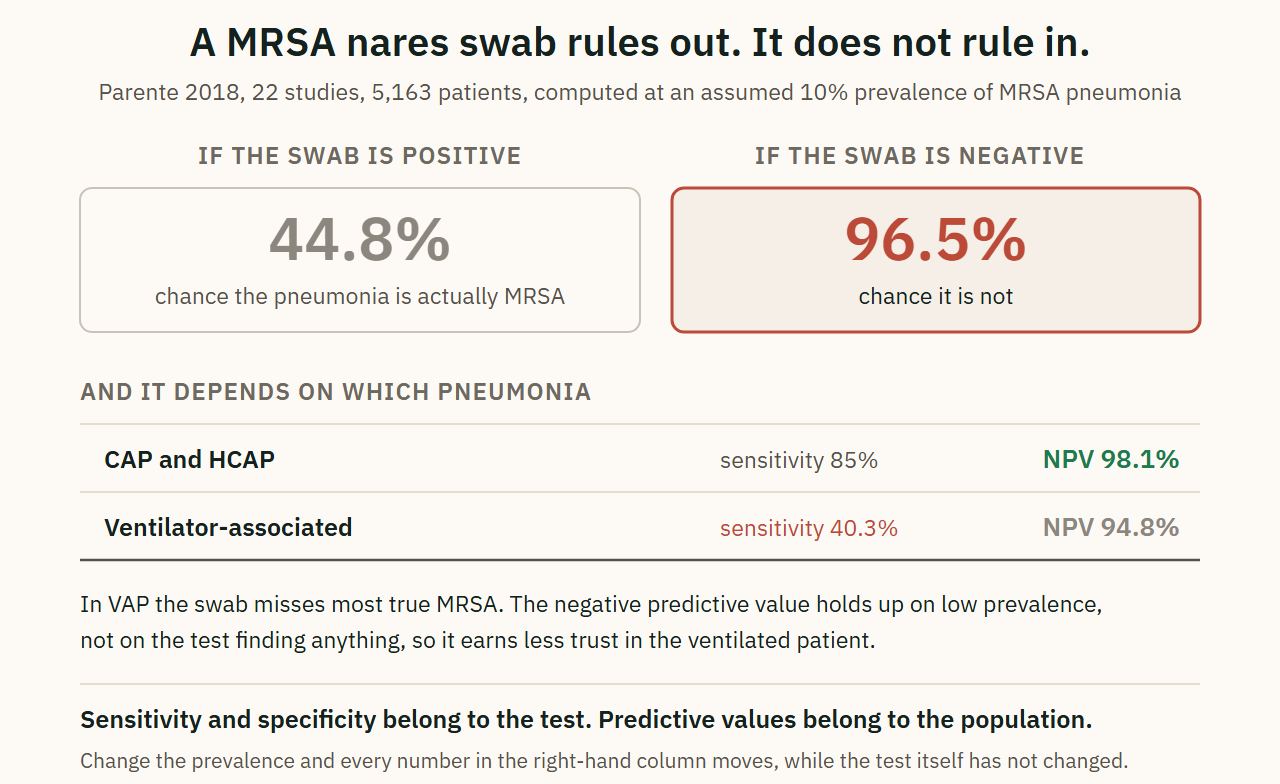
The true clinical value of the MRSA nasal swab lies in its ability to rule out infection. According to a diagnostic meta-analysis of 22 studies involving over 5,000 patients by Parente DM, et al., the test possesses a remarkably high Negative Predictive Value (NPV).
Across all types of pneumonia, the pooled NPV is 96.5%. When focusing specifically on community-acquired pneumonia (CAP) and healthcare-associated pneumonia (HCAP), that NPV rises even further to 98.1%. This means that if the swab is negative, you can be nearly certain the pneumonia is not caused by MRSA.
This "rule-out" capability is the cornerstone of effective antimicrobial stewardship. It provides the objective clinical confidence necessary to de-escalate therapy early, bypassing the wait for slow-growing cultures and reducing unnecessary drug exposure.
The Positive Result is a Coin Flip
While a negative result is definitive, a positive result is frustratingly vague. The same meta-analysis found that the overall Positive Predictive Value (PPV) is only 44.8%.
In clinical practice, a positive result is right about the presence of MRSA pneumonia less than half the time. This discrepancy exists because of the fundamental difference between colonization and infection. Many patients carry MRSA in their nares without it being the causative pathogen of their respiratory distress. Treating every positive swab as a confirmed diagnosis is a clinical error that leads to the unnecessary and prolonged use of vancomycin.
A positive swab in a patient whose clinical picture does not otherwise strongly suggest MRSA should be viewed with significant skepticism.
The 10% Rule: Why Geography Matters
It is vital for the clinician to remember that predictive values are not inherent properties of the test itself; they are products of the population being tested. Specifically, NPV and prevalence are inversely related. The 96.5% NPV reported in the literature is grounded in an assumed 10% prevalence of MRSA pneumonia.
Because the disease is relatively rare (10% prevalence), the high NPV is "buffered", it is easier to be right about a negative result when the pathogen is unlikely to be there in the first place. If the prevalence of MRSA pneumonia in your specific unit or hospital is higher than 10%, the "miss rate" of the test increases and the NPV drops.
Conversely, in low-prevalence areas, the test becomes an even more reliable rule-out tool. You must consult your microbiology lab to determine your local prevalence; without this context, the test's results are statistically orphaned.
The Ventilator Exception and Other Blind Spots
The reliability of the MRSA nasal swab is not universal. There are specific "blind spots" where the test's performance falters, necessitating clinical caution:
| What | Why it matters |
|---|---|
| Ventilator-Associated Pneumonia (VAP) | The sensitivity of the test drops to a mere 40.3% in ventilated patients. This means the swab misses the majority of true MRSA cases in this population. While the NPV remains statistically high at 94.8%, this is a reflection of low disease prevalence rather than the test's ability to actually detect the pathogen. |
| Non-Respiratory Infections | These predictive values apply strictly to pneumonia. They do not apply to bacteremia, skin and soft tissue infections, or any other infection sites. |
| Known MRSA History | If a patient has a documented history of MRSA, the pre-test probability shifts significantly. This moves the patient outside the standard 10% prevalence assumption, making the typical NPV less reliable. |
The "70% Ceiling": Why Protocols Fail
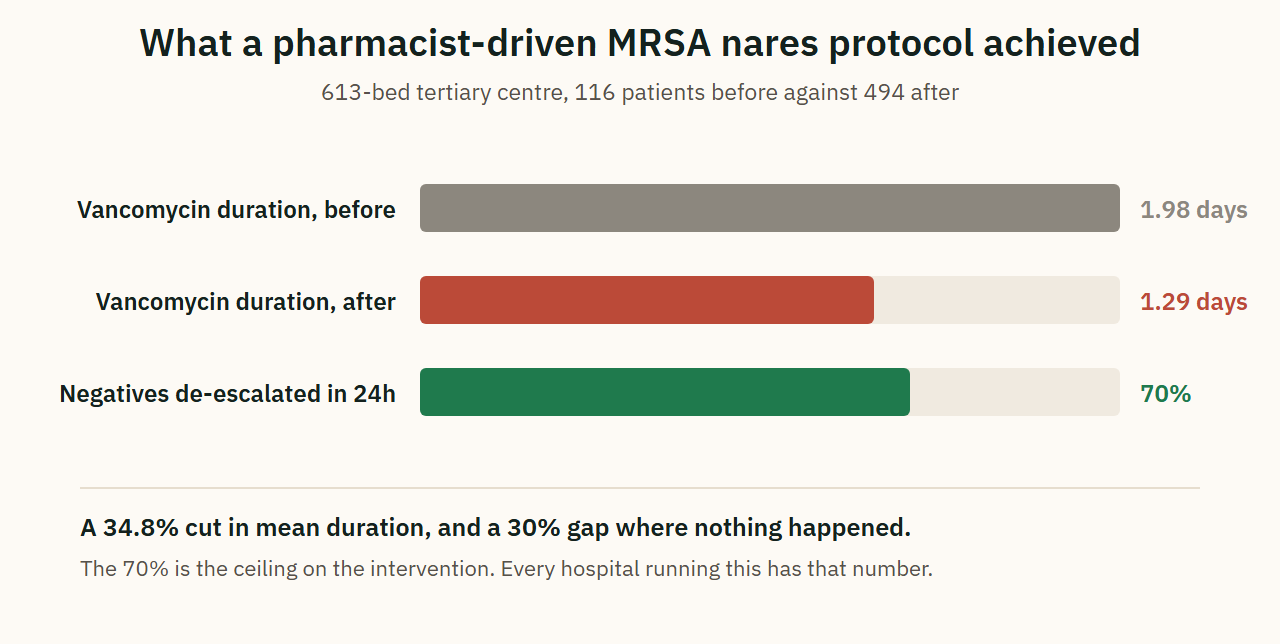
A diagnostic test only has clinical value if it leads to a decision. A retrospective quality improvement study by Meng L, et al., examined a pharmacist-driven protocol at a 613-bed center to evaluate how these results were utilized in practice.
The study demonstrated clear stewardship benefits: the implementation of the protocol led to a 34.8% reduction in the mean duration of vancomycin (falling from 1.98 days to 1.29 days), resulting in a cost avoidance of $40.33 per patient. However, the study also revealed a significant "operational gap." Even with a negative result, 30% of patients remained on vancomycin past 24 hours.
This "70% ceiling" highlights the inertia in de-escalation that plagues many hospital systems. The success of the Meng study relied on the pharmacist's ability to both order the test and act on the result. Without a proactive decision-maker empowered to bridge the gap between the lab result and the discontinuation order, the test becomes a wasted resource that costs money without changing management.
Where it does not apply
Ventilator-associated pneumonia. Sensitivity drops to 40.3%, which means the swab misses most true MRSA VAP. The negative predictive value still reads 94.8%, but it is holding up on specificity and low prevalence rather than on the test detecting anything. Use it with more caution in the ventilated patient, and the meta-analysis itself separates this group for that reason.
Any site other than the lung. These numbers are for pneumonia. Bacteremia and skin and soft tissue infection have their own literature and their own values, and this article does not extend these to them.
The patient with a known MRSA history. A negative swab in a patient with documented prior MRSA infection is a different clinical situation, and the pre-test probability that determines the whole calculation is not 10%.
Conclusion: The One Question to Ask Your Team
The MRSA nasal swab is an asymmetric tool that earns its place in the clinician's toolkit by stopping therapy, not by starting it. It is a highly effective "rule-out" mechanism that allows for the safe de-escalation of empiric treatment, provided clinicians account for its limitations in VAP and the impact of local prevalence.
To evaluate the effectiveness of your own institution's stewardship, there is one critical question to ask your team: "What percentage of negative MRSA results in our hospital actually lead to vancomycin being stopped within 24 hours?" The answer to that question will tell you more about the health of your stewardship program than the results of the swabs themselves.
Related
- Parente et al., the diagnostic meta-analysis
- Meng et al., the pharmacist-driven protocol
- The SNAP randomized trial protocol
- How to read the statistics in a clinical trial
- The 2025 pneumonia guideline made courses shorter
- Running the Clinical Program, on turning a diagnostic into a pharmacist-driven protocol
Want the practice knowledge behind this?
Your First Year as a Hospital Pharmacist covers the clinical judgment a residency front-loads. Part of the Pharmacy Handoff library.
See the book