The Great Prophylaxis Pivot: Why We Were Wrong About ICU Stress Ulcers
For more than a decade, clinical teaching has framed stress ulcer prophylaxis (SUP) as the poster child for reflex overprescribing. The prevailing wisdom suggested that for most patients, the risk of gastrointestinal bleeding was overblown and the potential harms of proton pump inhibitors (PPIs) were too significant to justify their routine use. We trained clinicians to de-prescribe SUP at every opportunity, treating its initiation as an avoidable error.
However, the REVISE trial has acted as a catalyst for a major shift in this thinking. This was not a small, single-center observation; it was a massive undertaking involving 4,821 patients across 68 hospitals in 8 countries. The sheer scale of this data demands a "re-learning" experience for hospital leadership. The data suggests that our decade-long push for universal de-prescribing was too broad, missing a critical distinction for the most vulnerable patients in the intensive care unit.
The Evidence Just Did a U-Turn (For Some)
The narrative of "reflex overprescribing" has been directly challenged for a specific, high-risk population: invasively ventilated patients. For years, clinicians were taught that the benefits of SUP were negligible, but the direction of the evidence has reversed for this group.
As noted in the evidence, "The direction of the evidence reversed for one population... In ventilated patients it is now supported by a 4,821-patient randomized trial." This shift is inherently uncomfortable for practitioners who have built their quality improvement protocols around de-prescribing. However, as evidence-based practitioners, we must acknowledge that for the invasively ventilated, the pendulum has swung back toward prophylaxis.
The Magic Number is 40
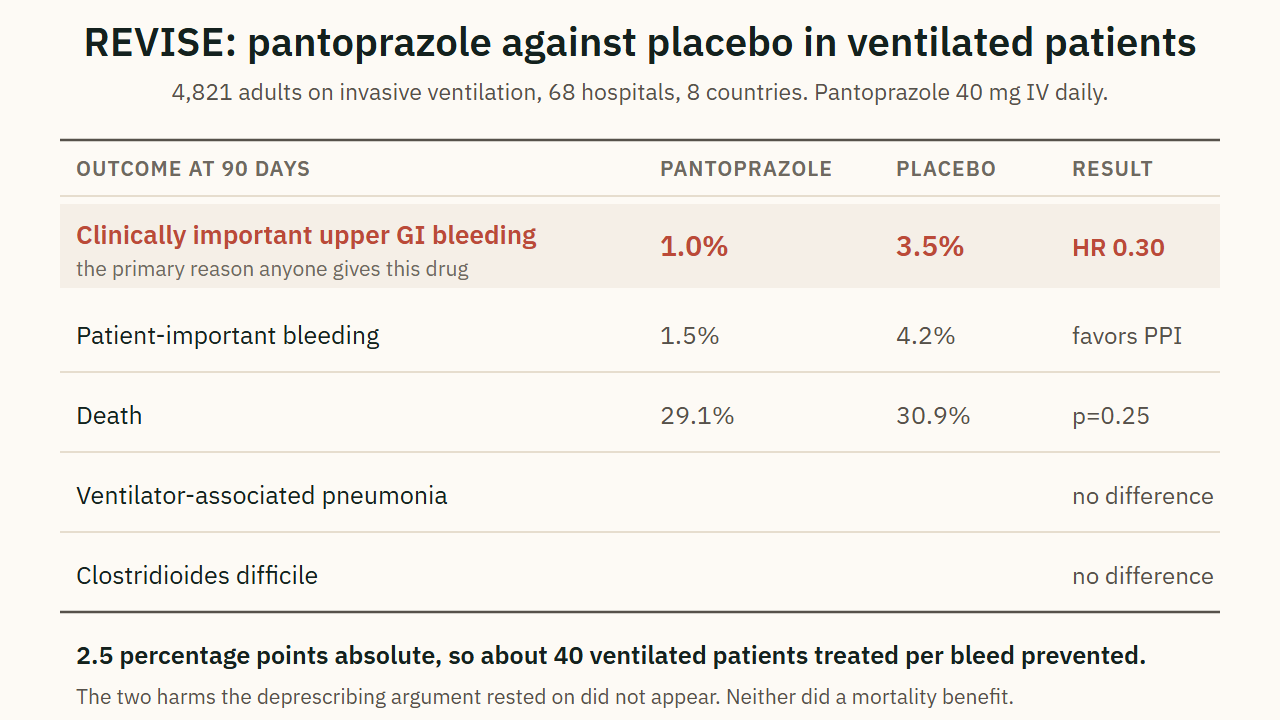
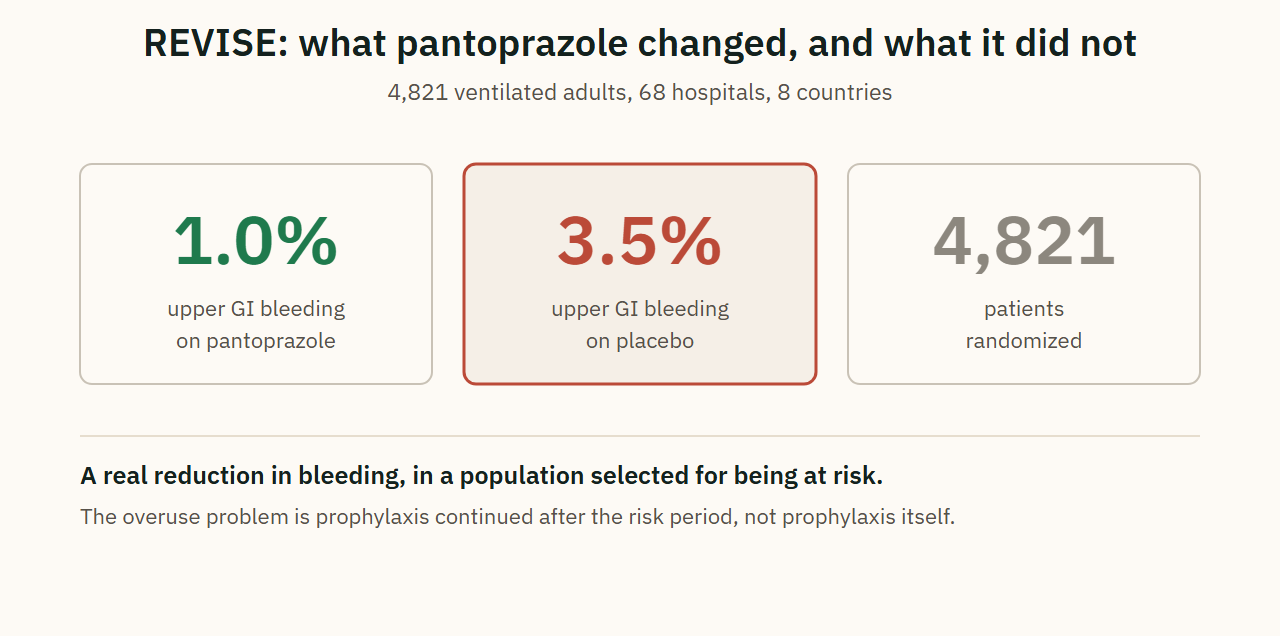
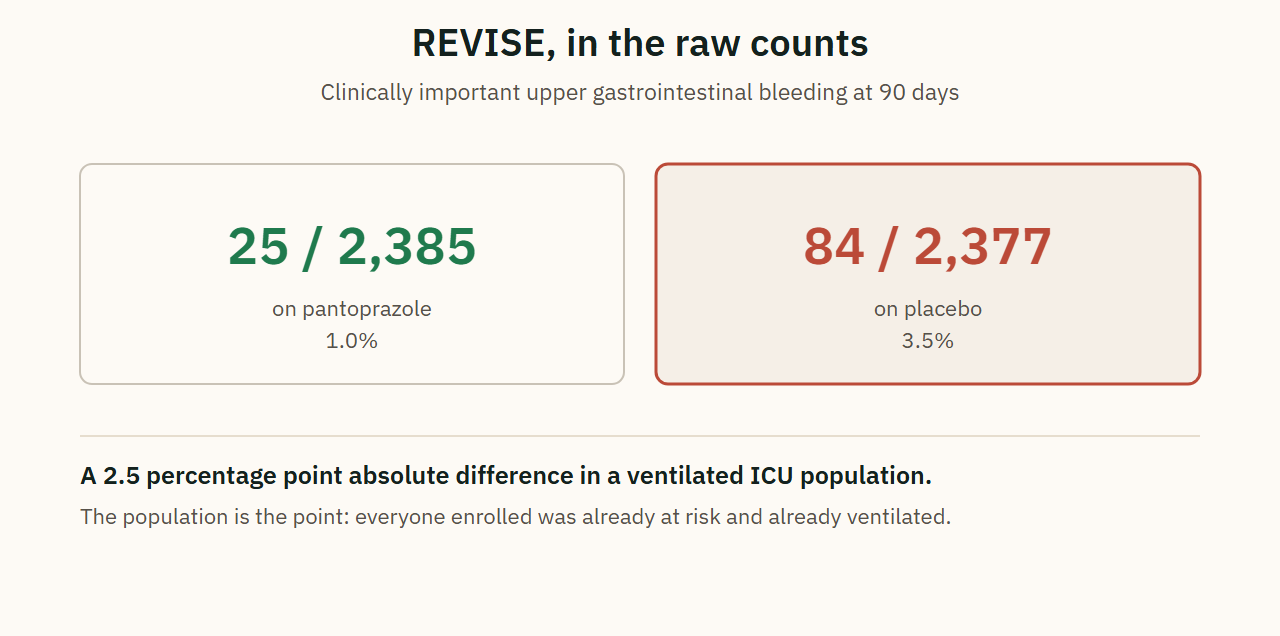
The clinical impact found in the REVISE trial, comparing pantoprazole 40 mg IV daily to a placebo, is substantial. When we look at clinically important upper GI bleeding, the rate dropped from 3.5% in the placebo group to 1.0% with pantoprazole. This is an absolute reduction of 2.5 percentage points. Furthermore, "patient-important bleeding" showed a similar trend: 1.5% in the pantoprazole group versus 4.2% in the placebo group.
From a statistical standpoint, clinicians may see the Hazard Ratio (HR) of 0.30 and think the effect is enormous. While that sounds impressive, a Senior Strategist focuses on the absolute difference to determine clinical value. The "Number Needed to Treat" (NNT) here is 40. For a cheap, generic medication administered to a high-risk population, preventing one major bleeding event for every 40 patients treated is a highly favorable trade-off that justifies routine use in this specific cohort.
The Feared "Harms" Were No-Shows
A major pillar of the de-prescribing movement has been the fear of secondary infections, specifically Ventilator-Associated Pneumonia (VAP) and Clostridioides difficile. These "feared harms" often drive hospital policy more effectively than the primary benefits of a drug.
However, the REVISE trial found no significant difference in these outcomes between the groups within the 90-day timeframe. In this specific population and acute window, the data did not support the fear that PPIs increase the risk of pneumonia or C. diff. While these risks remain a valid concern for long-term PPI use, they did not materialize as significant safety signals in the context of acute ICU prophylaxis for ventilated patients.
Survival is Not the Metric
While the reduction in bleeding is statistically and clinically significant, we must be clear with hospital leadership: mortality was not affected. Death at 90 days occurred in 29.1% of the pantoprazole group compared to 30.9% in the placebo group (p=0.25).
It is important to note that the trial was large enough that a substantial mortality benefit would have been visible if it existed. Therefore, we should not justify SUP as a life-saving intervention. Instead, we must view it as a complication-prevention tool. Preventing a major GI bleed is a valid clinical and operational goal; it prevents a secondary crisis, simplifies the care of the critically ill, and reduces the need for emergency interventions or transfusions.
Stop Treating the Hospital as a Single Unit
The most critical actionable insight is the need to stop applying a single, hospital-wide prophylaxis policy. Protocols that treat the ICU and the general medical floor as a single unit are now fundamentally flawed. We must split our approach into two distinct categories:
-
Rule A (Ventilated Patients): Prophylaxis is now evidence-based. In this group, the primary concern has shifted from over-use to under-use. An invasively ventilated patient without a prophylaxis order should now be flagged in quality audits.
-
Rule B (All Other Patients): Nothing has changed. The REVISE findings do not apply to non-ventilated patients. This is where the medical floor volume is, and where the greatest risks of "indication creep" and unnecessary costs reside. De-prescribing efforts for the general floor should continue unabated.
As the evidence warns, "A department that carries the bundled version will now under-treat the ICU and keep over-treating the floor, which is the worst available combination."
The "Stop Rule" is the Real Safety Guard
The primary risk of SUP remains the failure to stop it when the high-risk window closes. The "transition point", specifically extubation, is where most medication errors occur.
The REVISE trial evaluated the drug specifically during the period of invasive ventilation. Indication creep occurs when a medication started for a legitimate ICU reason becomes a permanent fixture on a patient's home medication list.
Hospital protocols must include a "stop trigger" tied directly to extubation. Furthermore, our discharge reconciliation protocols remain a vital safety net: a PPI started for a critical-care indication should not leave the facility on a discharge list unless there is a separate, documented indication. A drug started in the ICU must be either justified or removed before the patient leaves the building.
The New Audit
The "overuse problem" in healthcare has not disappeared; it has simply moved. Our strategic focus must now pivot to a dual-track audit. We must be vigilant about under-treating ventilated patients in the ICU, while simultaneously remaining aggressive about stopping the inappropriate continuation of these drugs on the general floor and at discharge.
The goal of a modern clinical protocol is to ensure the drug does not outstay its welcome. We are looking for under-treatment in the ICU and over-treatment on the floor, the "worst available combination", and correcting both. As you review your current hospital guidelines, ask one vital question: "Does your current protocol have a start rule without a stop rule?"
Related
- REVISE on ClinicalTrials.gov
- How to read the statistics in a clinical trial, on hazard ratios against absolute differences
- Which crystalloid should your ICU default to?, the other ICU default due for review
- Running the Clinical Program, on protocols that start a drug and do not stop it
- Keeping the Pharmacy Compliant, on discharge medication reconciliation
Want the practice knowledge behind this?
Your First Year as a Hospital Pharmacist covers the clinical judgment a residency front-loads. Part of the Pharmacy Handoff library.
See the book